Monopolistic competition
 Studied by 0 people
 Call with Kai
 Learn
Learn Practice Test
 Spaced Repetition
 Match
Match Flashcards
 Knowt Play
1/85

Earn XP
Description and Tags
Chapter 18
Name | Mastery | Learn | Test | Matching | Spaced | Call with Kai |
|---|
No study sessions yet.
86 Terms
what is monopolistic competition
A market structure with many firms, differentiated products, and free entry/exit. firms have some pricing power because products are not identical, but competition limits that power
market power
each firm faces a downward sloping demand curve and can set its own price because its product is unique in some way
difference of monopolistic competition from perfect competition
firms are not price-takers, products are not identical, each firm has some control over price
difference of monopolistic comp from monopoly
a firm has rivals and faces competition, substitutes exist, so it cannot price like a monopolist
difference from oligopoly
there are many firms, not a few interdependent ones. too many participants for collusion or strategic interdependence
Where it commonly appears
restaurants, hotels, gas stations
why is product differentiation matter in monopolistic competition
with many firms, tacit collusion is impossible. differentiation is the only source of market power. without it, firms would be price-takers
imperfect substitutes
products differ enough that consumers prefer some varieties over others, but not enough to ignore price completely. demand curves slopes downward
three forms of product differentation
style/type, location, and quality
What is the long-run impact of free entry on firms selling differentiated products?
Entry shifts each firm’s demand curve leftward until economic profits fall to zero.
How does product differentiation function differently in oligopoly versus monopolistic competition?
Oligopolies may differentiate when collusion is absent, but monopolistic competition relies on differentiation because many firms make coordination impossible.
market niche
a subset of consumers whose preferences a firm serves better than rivals, differentiation creates and protects this niche
how do consumer tastes create pricing power firms
differences in preferences make consumers willing to pay slightly more for their preffered variety, giving firms some market power
What is the overall mechanism linking differentiation and long-run outcomes in monopolistic competition?
Differentiation grants short-run market power, but free entry eliminates economic profit over time while maintaining product variety for consumers.
whats the shit
FIRMS USE DIFFERENTIATION TO REDUCE PRICE COMPETITION, NOT TO ESCAPE COMPETITION ENTIRELY.
what is the main difference between perfectly competitive and mono competitive
standardized product vs differentiated product
main difference between monopoly and monopolistically competitive industry
single vs many firms
if demand curve is downward sloping
raising price does not make quantity fall to zero, you have the ability to choose a price above marginal cost
if your demand curve is horizontal
you are a price taker, so no pricing power
monopolistic competition what does it contain on the graph of short run
price y axis, quantity x axis, demand curve downward sloping, marginal revenue under demand, marginal cost buurunhii upward, ATC going down but higher than the mr curve at all cost, and then goes up (downward and then upward so has a minimum value), produces at mr = mc, price is shown by the demand curve at that point, economic profit is shown by the distance between demand and atc at that point, and that distance and its area is the total economic profit,
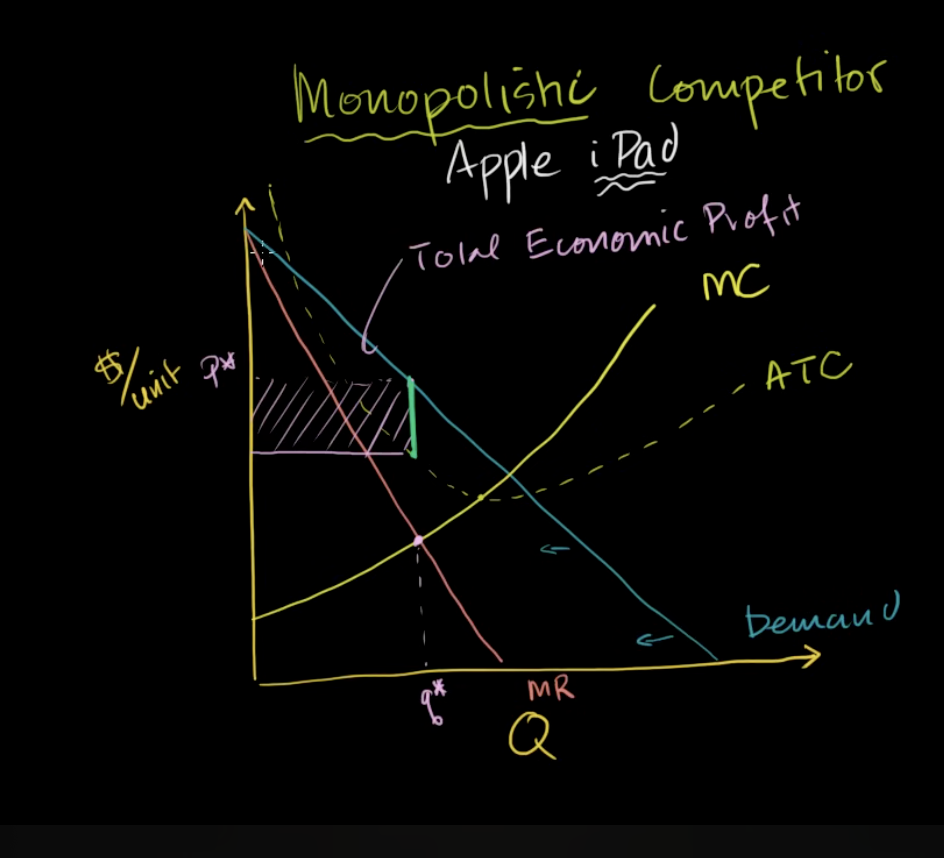
what happens to the graph in the long run after a competitor enters
the demand will shift down, marginal revenue goes down, so the price decreases because quantity demanded decreases, and the economic profit decreases, or 0 economic profit
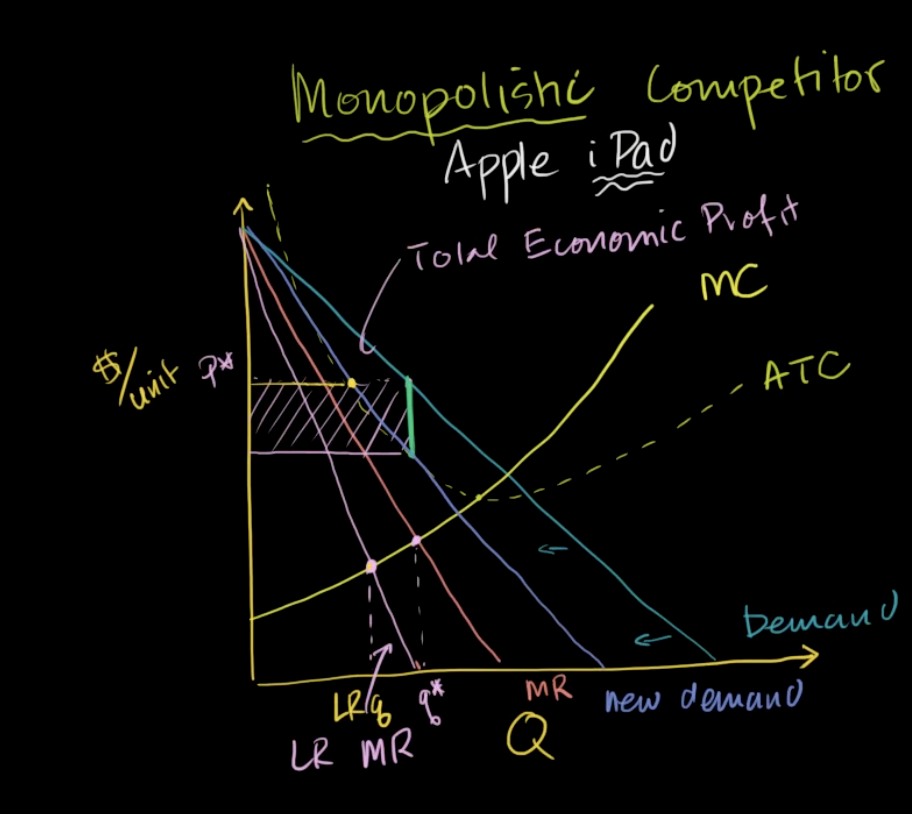
effects of entry in the long run
shifts the demand mr curve left
effects of exit in the long run
mr and demand curve rightwards
zero economic profit means
firm makes normal profit, not extra profit
on the graph, characteristics of a graph with no economic profit
price (demand curve) is equal to the atc curve (tangent), and always produces at mr=mc
Currently a monopolistically competitive industry, composed of firms with U-shaped average total cost curves, is in long-run equilibrium. Describe how the industry adjusts, in both the short and long run, in each of the following situations.
A technological change that increases fixed cost for every firm in the industry
A technological change that decreases marginal cost for every firm in the industry
An increase in fixed cost raises average total cost and shifts the average total cost curve upward. In the short run, firms incur losses. In the long run, some will exit the industry, resulting in a rightward shift of the demand curves for those firms that remain in the industry, since each one now serves a larger share of the market. Long-run equilibrium is reestablished when the demand curve for each remaining firm has shifted rightward to the point where it is tangent to the firm's new, higher average total cost curve. At this point, each firm's price just equals its average total cost, and each firm makes zero profit.
A decrease in marginal cost lowers average total cost and shifts the average total cost curve and the marginal cost curve downward. Because existing firms now make profits, in the long run new entrants are attracted into the industry. In the long run, this results in a leftward shift of each existing firm's demand curve since each firm now has a smaller share of the market. Long-run equilibrium is reestablished when each firm's demand curve has shifted leftward to the point, where it is tangent to the new, lower average total cost curve. At this point, each firm's price just equals average total cost, and each firm makes zero profit.
Why, in the long run, is it impossible for firms in a monopolistically competitive industry to create a monopoly by joining together to form a single firm?
If all the existing firms in the industry joined together to create a monopoly, they would achieve monopoly profits. But this would induce new firms to create new, differentiated products and then enter the industry and capture some of the monopoly profits. So in the long run it would be impossible to maintain a monopoly. The problem arises from the fact that because new firms can create new products, there is no barrier to entry that can maintain a monopoly.
what happens to a firm’s demand curve when other firms exit in monopolistic competition?
Demand shifts right; the firm can sell more at any given price
what determines long-run equilibrium in monopolistic competition?
entry and exit shift each firm’s demand until P=ATC at the MR=MC quantity
graphically, what does zero - economic profit equilibrium look like
the demand curve is tangent to atc at the output where mr=mc
why must demand be tangent to ATC in the long run?
if demand is above ATC → profit entry
if demand is below ATC → loss exit
Only tangency eliminates incentives to enter or exit
Main long-run difference perfect competition vs monopolistic competition
Perfect competition = p = mc = minimum atc
monopolistic competition - p = atc, but P>MC and output < minimum atc
what is excess capacity under monopolistic competition
firms operate left of minimum atc, meaning they produce less than the cost-minimizing quantity
Why does monopolistic competition produce P > MC?
Downward-sloping demand gives firms market power; they won’t cut price to sell more even though MC < price.
Why do monopolistic competitors advertise?
Because P > MC, an additional sale increases revenue more than cost; firms want more customers at the posted price.
Is monopolistic competition inefficient?
Not clearly — higher prices come with consumer gains from product variety.
What is the efficiency trade-off in monopolistic competition?
More firms → higher ATC (excess capacity).
More firms → greater product diversity that consumers value.
What mutually beneficial trades go unexploited?
People willing to pay at least MC are priced out because P > MC.
two functions of advertising
Informational - consumers arent perfectly rational
Persuasive / signaling - advertising acts as a quality signal
Social value of advertising
It should convey information about quality rather than manipulating consumers
why does advertising mainly occur in industries with market power?
Only firms with P > MC benefit from convincing consumers to buy more at the posted price
How can celebrity endorsements function economically?
As signals of financial strength and brand scale, not as information about product quality
When is advertising socially wasteful?
If it manipulates irrational preferences without conveying meaningful information.
how do brand names create market power
by giving consumers confidence and familiarity even when generic alternatives are identical
why might consumers prefer chain brands over independent firms?
chains have reputations to protect, creating predictable quality for travelers and one-time buyers
why is the perfume industry so profitable despite low production costs?
Branding, packaging, and advertising—not the fragrance—create market power and barriers to entry.
what does the perfume example illustrate about product differentiation
differentiation can be almost entirely constructed through branding rather than physical product differences
What does the perfume example illustrate about product differentiation?
Differentiation can be almost entirely constructed through branding rather than physical product differences.
 Note
Note  Flashcards (58)