Chapter 16: Exothermic and Endothermic Reactions
16.1-Exothermic and Endothermic Reactions
Energy is moved around in chemical reactions
- Chemicals store a certain amount of energy, and different chemicals store different amounts
- If the products of a reactions store more energy than the original reactants, then they must have taken in the difference in energy between the products and reactants from the surroundings during the reaction
- But if they store less, then the excess energy was transferred to the surroundings during the reaction
In an exothermic reactions, heat is given out
- An exothermic reaction is one which transfers energy to the surroundings, usually by heating
- The best example of an exothermic reaction is burning fuels, also called combustion
- This gives out a lot of energy, it’s very exothermic
- Neutralisation reactions are also exothermic
- Examples of exothermic reactions are self-heating cans and hand warmers
In an endothermic reaction, heat is taken in
- An endothermic reaction is one which takes in energy from the surroundings, this is shown by a fall in temperature
- They also have everyday uses such as:
- In some spots injury packs
- An example of an endothermic reaction is the reaction of citric acid with sodium hydrogen carbonate.
16.2-More Exothermic and Endothermic Reactions
Energy
- Chemicals store energy in their bonds. If the products of a reaction store more energy than the reactants, then energy must have been taken in from the surroundings.
- The overall amount of energy, however, doesn't change (if this is a closed system) - we know this is true, because energy cannot be created or destroyed
- When reactions happen in solution, if there are temperature changes that can be observed they can be measured using a thermometer.
- Reactions that take in more heat energy from their surroundings (than they give out) are called endothermic reactions. Examples include:
- citric acid and sodium hydrogen carbonate
- thermal decomposition
- Some sports injury packs are based on endothermic reactions.
- Reactions that release more heat energy to their surroundings (than they take in) are called exothermic reactions. Examples include:
- combustion
- many oxidation reactions
- neutralisation
- Chemical reactions can be thought of as happening in two stages:
- Energy is needed to break the bonds in the reactants to form their separate atoms. This energy is called the activation energy, and is an endothermic process.
- The newly separated atoms form new bonds to make the products, and release energy to their surroundings. This is an exothermic process.
- The overall net movement of energy determines if the reaction is endothermic or exothermic. The reaction is:
- exothermic if more heat energy is released in forming bonds in the products than is required in breaking bonds in the reactants
- endothermic if less heat energy is released in forming bonds in the products than is required in breaking bonds in the reactants
Reaction Profiles
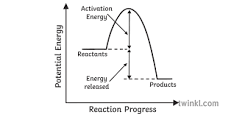
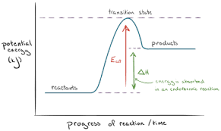
- These are diagrams that show the relative energies of the reactants and products in a reaction - to show how energy changes over the course of a reaction.
- All reaction profiles start with an initial rise in energy, this is the activation energy and is the energy required for the reaction to begin.
- Whether the reaction then releases more (or less) energy than it initially required will determine if it is an exothermic or endothermic reaction.
Exothermic Reactions
- A reaction that releases energy can be shown on a reaction profile to initially have an increase (due to breaking bonds of reactants), but then has a bigger drop in energy overall (due to this energy being released from making new bonds).
Endothermic Reactions
- A reaction that takes in energy can be shown on a reaction profile to initially have an increase (due to breaking bonds of reactants), but then has a smaller drop in energy (due to bonds being made).
Practice Questions:
- A reaction that releases energy from the system in the form of heat is called an
- Exothermic reaction
- In which kind of reaction energy in the form of heat?
- Endothermic reactions
- Photosynthesis is popular example of which kind of reaction?
- Endothermic reaction
- What is the change in enthalpy in exothermic reaction?
- Negative