Microbio 2.0 Lec 4 (EXAM 2) - INCOMPLETE
 Call Kai
 Learn
Learn Practice Test
 Spaced Repetition
 Match
Match Flashcards
 Knowt Play
1/10

There's no tags or description
Looks like no tags are added yet.
Name | Mastery | Learn | Test | Matching | Spaced | Call with Kai |
|---|
No analytics yet
Send a link to your students to track their progress
11 Terms
Cell Nutrition
Nutrients → supply of elements req. by cells for growth
Macronutrients → LARGE amnt needed
Micronutrients → SMALL amnt needed
Heterotrophs → req. organic carbon
Autotrophs → syn. organics from CO2
Chemical Make Up of a Cell
Carbon , Oxygen, Nitrogen, Hydrogen, Phosphorus, Sulfur → req. BY ALL LIFE (~96% of dry weight of bacterial cell)
K, Na, Ca, Mg, Cl, Fl (~3.7% dry weight)
Nitrogen used for protein and nucleic acid (nitrogen fixation)
nearly all microbes can use ammonia (NH3) and many use nitrate (NO3-)
Phosphorus used for nucleic acid
Sulfur used for sulfur containing amino acids
EX: vitamins (biotin, thiamine, lipoic acid)
K is for enzymes
Mg used to stabilize ribosomes, membranes, and nucleic acid
Ca used for cell wall
Na important for marine organisms
Fe used for cellular resipiration, related oxidation-redux reactions*****
BACTERIAL cells have a much higher binding affinity for iron than human cells
Growth Media and Lab Culture
Classes of Culture Media
Defined media → exact comp. is known
Complex media → digests of microbial, animals, or plant products
Selective Medium → contains compounds that inhibit growth of some microbes but not others
Differential Medium → contains indicator that detects particular metabolic reactions
EX: MSA (mannitol Salt Agar) → selective for staph bacteria and differentiates between staph species
mannitol fermentation
Lab Culture
can be liquid or sold
solid media is prepped via addition of agar to liquid media
Colony morphology → used to identify microorganisms and determine if culture is pure, contaminated, or mixed
Aseptic Technique → transfer w/o contamination
Pure cultures contain a single microbe usually req. streak plate technique w. inoculating loop
Microscopic Counts of Microbial Cell #
Total Cell Count
microscopic cell count → observing and enumerating cell present
Potential Problems:
experimental error (might’ve not been fully homogenized)
human error (miscount or double counted)
is the cell dead or alive (req. special staining)
Phylogenetic stains can determine proportions of bacteria and archaea in a sample
Viable Counting of Microbial Cell #
Viable (alive/lving) count → measurement reproducing population
2 Ways to perform viable plate count:
Spread-plate method
pour-plate method
is reported in cfu
Diluting a Sample
10 fold, serial/successive dilutions needed for dense cultures
Plate counts are: quick and easy, used in food, dairy, medical, and aquatic microbiology, and highly sensitve
Great plate count anomaly → naturally selected samples reveal more organisms than recoverable samples on plates bc you can’t tell if cells are dead or alive
Turbidimetric Measures of Microbial Cell #
Cell suspensions are turbid (cloudy) bc cells scatter light
turbidity measurements are rapid, widely used for estimates
is measured w/ spectrophotometer → units in optical density (OD) @ specific wavelength
Microbial Growth Cycle
Growth → increase in # of cells
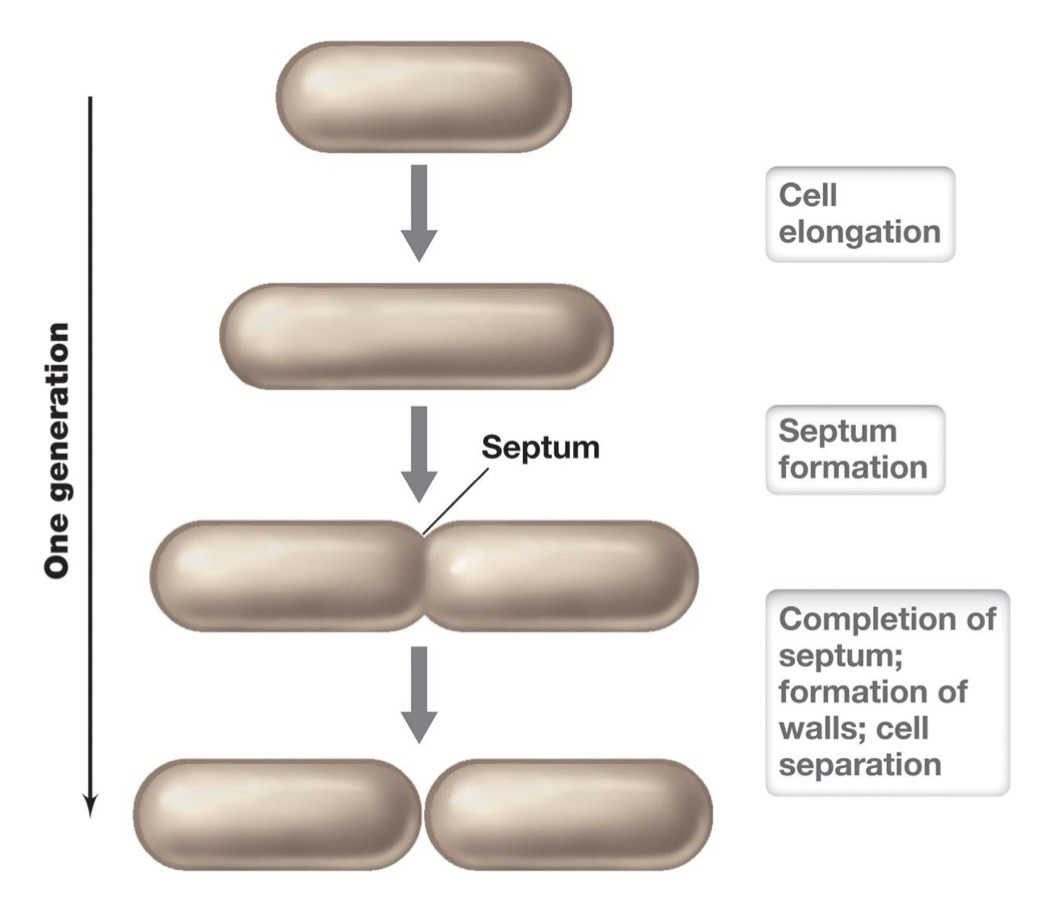
Binary Fission → cell division following enlargement of a cell to twice original size
Septum → partition between dividing cells, pinches off between 2 daughter cells
Generation (doubling) time → time req for cells to double in #
EX: E. Coli → 20 min
Microbial Growth Cycle
Batch culture → closed-system microbial culture of fixed volume
Typical growth curve:
lag phase → time needed for biosynthesis of new enzymes
exponential/growth phase (shortest time) → doubling population @ regular intervals, GROWTH will continue until conditions can no longer sustain growth
stationary phase
decline/death phase (longest time)
growth + stationary phase growth limited by nutrient depletion OR waste accumulation
Continuous Culture + Biofilm Growth
Continuous Culture → open system
Chemostat → most common type of continuous culture device where know volume added while spent medium is removed at same rate
this keeps microbes fresh + constantly growing while removing waste\
Dilution rate (D) : F / V
experimental uses of chemostat → used to study physiology, microbial ecology + evolution, enrichment + isolation of bacteria from nature
Steady state → cell density + substrate conc do not change over time
Biofilm Growth
Planktonic growth → floating (suspension of free living cells)
Sessile Growth → attached to surface
can develop into biofilms
important in medical + industrial app
diff prop than planktonic cells
Biofilms → cells enmeshed in POLYSACCHARIDE MATRIX attached to surface
Stage of Biofilm development:
Planktonic cells attach (flagella, fimbriae, pili)
colonization
development
dispersal
EX: psudomona aeruginosa (very well known for forming biofilms + rez to antibiotics)
Microbial Mats → multilayered sheets w/ diff organisms in each layer
EX: hotsprings
responsible for cavities, gum disease, plug + corrode pipes, form in fuel tanks + ship hulls, joint infections + medical devices
Alternatives to Binary Fission
Hyphae → long, thin filaments of actinomycetes G(+) filamentous bacteria
Mycelia → weaved hyphae
Arthrospores → survival structures formed from mycelia
Temp Classes of Microorganisms
Cardinal Temps
minimum, optimum, and maximum temp @ which an organism grows
@ optimum all/most cellular components are functioning @ max rate
Psychrophiles (cold) ; optimal growth ~15C, max 20C, minimum 0C
Mesophiles (optimal temp)
thermophiles (hot temp)
hyperthermophile (very hot temps)
Microbial Life in Cold
Extremophiles → organisms that grow under very hot or cold conditions
Psychrotolerant → can grow @ 0C but have optima of 20 - 40C
isolated from soils + waters in temperate climates and food @ 4C
prod of enzymes that function optimally in the cold
more alpha-helices than beta-helices → greater flexibility for catalysis @ cold temp
more polar + fewer hydrophobic amino acids
cytoplasmic membrane functions @ low temps
cold shock proteins
cryoprotectants (EX: antifreeze proteins, certain solutes) prevents form of ice crystals

