Biology
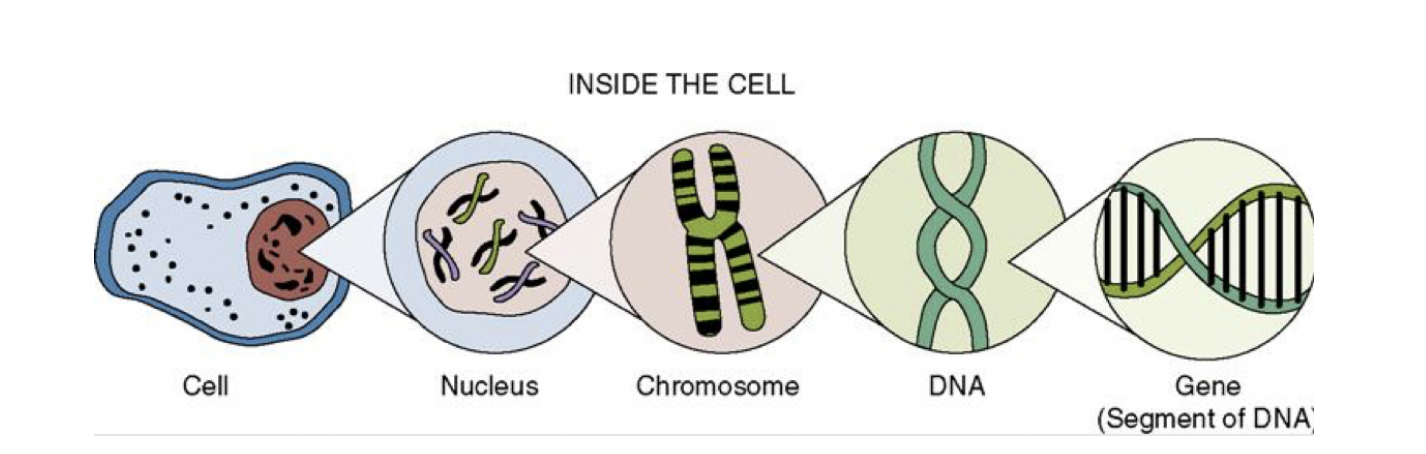
● DNA=DNA (deoxyribonucleic acid):long double helix molecule that contains genes
● GENES=a segment of DNA ^^within the chromosome^^ that carries genetic information-Each gene contains information about a certain trait.
● CHROMOSOMES=A structure found inside the nucleus of a cell. A chromosome is made up of proteins and DNA organized into genes. Each cell normally contains 23 pairs of chromosomes.
● CHROMATIDS=one of the two identical halves of a chromosome that has been replicated in preparation for cell division.
● NUCLEOTIDES =A nucleotide is one of the structural components or building blocks of DNA and RNA.-
● HAPLOID =the presence of a single set of chromosomes in an organism's cells.
● DIPLOID=the presence of two complete sets of chromosomes in an organism's cells, with each parent contributing a chromosome to each pair.
● REPLICATION=a biological process of duplicating or producing an exact copy
● TRANSLATION=the process by which a cell makes proteins using the genetic information carried in messenger RNA (mRNA).
● TRANSCRIPTION=copying a gene's DNA sequence to make an RNA molecule.
● MEIOSIS=a type of cell division in sexually reproducing organisms that reduces the number of chromosomes in gametes
● MITOSIS=the process by which a cell replicates its chromosomes and then segregates them, producing two identical nuclei in preparation for cell division
● m-RNA=mRNA molecules carry the genetic information needed to make proteins. They carry the information from the DNA in the nucleus of the cell to the cytoplasm where the proteins are made. Also called messenger RNA.
Parents pass on their genes to their offspring
- Sperm nucleus carries father's genes
- Egg nucleus carries mother's genes
Human body cells:
- 46 chromosomes in 23 pairs
- 2 chromosomes of each kind = DIPLOID cells Sex cells:
- pair 23: XY = male, XX = female
- 23 chromosomes, no pairs = HAPLOID Cells
Nucleotide structure
2 nucleotide strands build up the DNA double helix
● A phosphate
● A sugar
● A base→Bases will pair up and connect through hydrogen bonds
Base pairing
If you look at the diagram you can see that the bases join together. Each pair of bases is held together by hydrogen bonds.
There are four different bases in DNA:
- Thymine (T)
- Adenine (A)
- Cytosine (C)
- Guanine (G)
\n The bases always pair up in the same way:
- Adenine (A) pairs with thymine (T)
- Cytosine (C) pairs with guanine (G)
● Replication: making new DNA
- Hydrogen bonds break
- Double helix --> single helix
- New nucleotides align (C to G, A to T)
- 2 Double strands are formed
● Transcription: makes mRNA from DNA(Making proteins)
messenger-RNA (mRNA) makes a copy of the bases
● Translation: makes proteins from mRNA
-mRNA copy leaves the nucleus through pores
-copy travels to ribosomes
ribosomes read the copy
- transfer-RNA (tRNA) carries the right amino-acids
- amino acids --> PROTEIN CHAIN
-Genetic code refers to the instructions contained in a gene that tell a cell how to make a specific protein
Mitosis
When?
-Growth: wound healing, baby growth, asexual reproduction,..
Result?
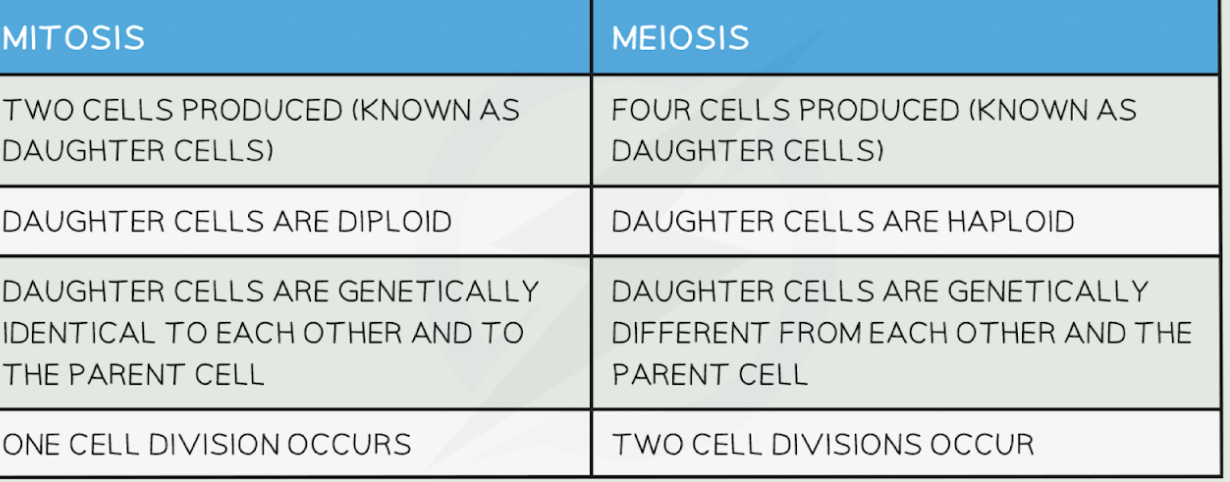
-2 identical daughter cells
-Diploid number
Meiosis
When?
-forming sex cells (gametes)
Result?
-chromosome number is halved from diploid to haploid
-genetically different cells
● HETEROZYGOUS=different alleles
● HOMOZYGOUS=same alleles
● DOMINANT=Dominant refers to the relationship between two versions of a gene they show their effect even if the individual only has one copy of the allele
● RECESSIVE=a gene that can be masked by a dominant gene.
● ALLELES:different forms of the same gene
● GENOTYPE=It refers to the genetic makeup of an organism, it describes an organism's complete set of genes.
● PHENOTYPE=The observable characteristics in an individual resulting from the expression of genes the clinical presentation of an individual with a particular genotype.(refers to the alleles you have)
● PUNNET SQUARES=A table in which all of the possible outcomes for a genetic cross between two individuals with known genotypes are given.(refers to your appearance)
Alleles
2 alleles code for a characteristic, on neigh boring chromosomes
Alleles = different forms of the same gene
Dominant and recessive alleles
A recessive allele only affects the phenotype when there is no dominant allele present.
Big letter = Dominant allele (e.g.: B) Small letter = Recessive allele (e.g.: b)
--> combinations in genotype: BB, bb = homozygous Bb = heterozygous Genotype: combination of alleles Phenotype: appearance
Steps with Punnet Squares
- Identify your alleles.
- Identify genotype parent 1. Show possible gametes.
- Identify genotype parent 2. Show possible gametes.
- Fill in your punnet squares.
- Write down ratios of the possible genotypes.
- Write down ratios of the possible phenotypes.
● MUTATIONS=a change in a gene/chromosome that can cause a change in a characteristic
● MUTANT=Any change in the DNA sequence of a cell.
● ALBINO=Mutated gene doen't produce melanin
● CYSTIC FIBROSIS=Recessive disease caused by a gene mutation, risk 1/2000.Thick, sticky mucus blocks air passages + digestive tubes. Respiratory and digestive problems.Antibiotics, chest physio, gene therapy
●HUNTINGTON’S DISEASE =Dominant disease, risk 1/20,000 Degeneration of brain cells -> movement, memory disorders-Heterozygous Hh + homozygous dominant HH = sufferers Late disease onset (>30-40y)
● SICKLE CELL ANAEMIA=Recessive genetic disease Sickle shaped RBC with abnormal haemoglobin -> O2 transport problems-West Africa -homozygous recessive = affected heterozygous = carrier (resistant to malaria!)
● COLOUR BLINDNESS=Recessive allele on x-chromosome
● TUMORS=An abnormal mass of tissue that forms when cells grow and divide more than they should or do not die when they should. Tumors may be benign (not cancer) or malignant (cancer).
●Genetical engineering=Removing a gene from an organism and putting it in another-Eg: making insulin in diabetes patients-Gene therapy is a technique that modifies a person's genes to treat or cure disease.
●Selective breeding:
Artificial selection -> improves characteristics in plants and animals, usually for human benefit -> humans determine passed on alleles to next generation
-The danger of selective breeding is too much inbreeding.This involves selective reproduction between closely related organisms.This may result in harmful recessive alleles being passed on to the descendants and a reduction in variation.
● CANCER:
10% of all cancers are genetic
- mutation in genes that control the way cells grow and multiply
- Leading to uncontrolled cell growth -> tumor
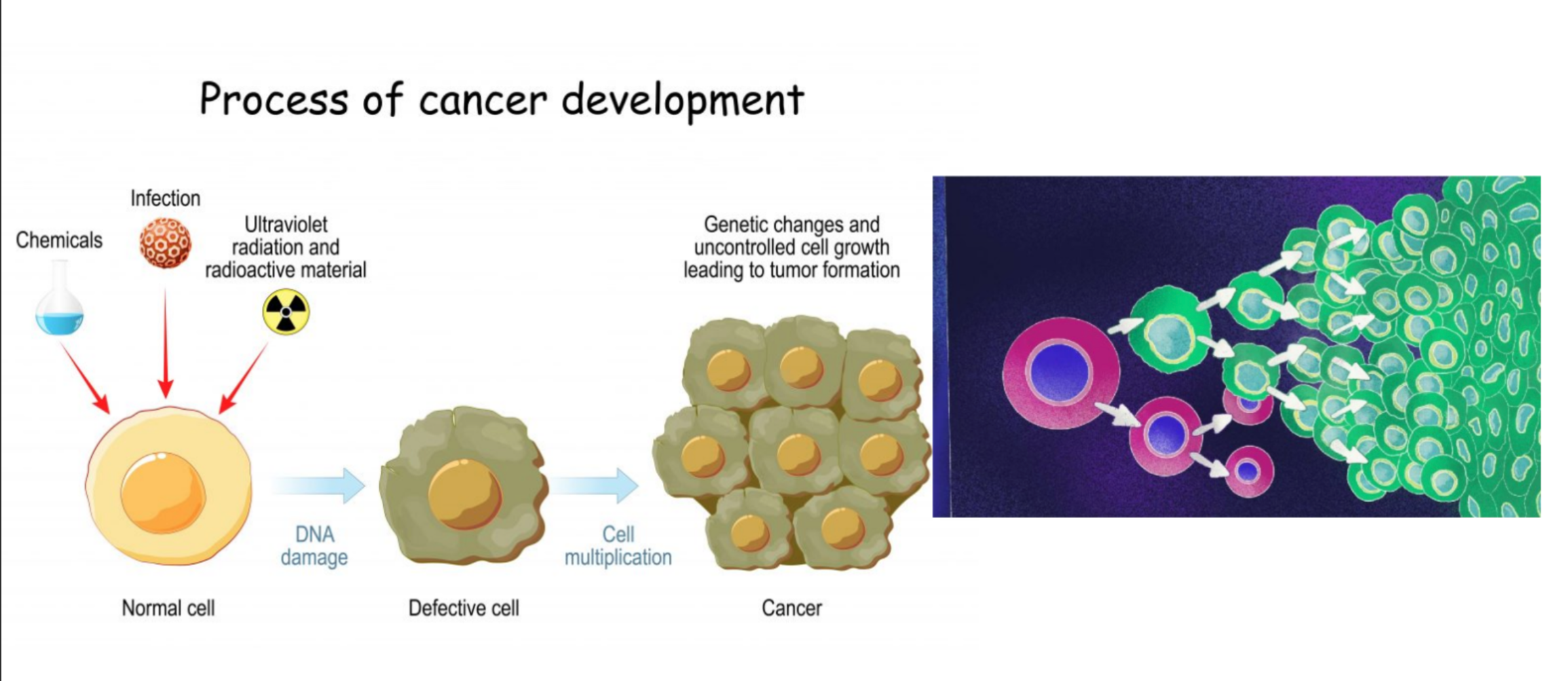
● MALIGNANT=A term used to describe cancer.Malignant cells grow in an uncontrolled way and can invade nearby tissues and spread to other parts of the body
● BENIGN=a condition, tumor, or growth that is not cancerous. This means that it does not spread to other parts of the body. It does not invade nearby tissue.
● METASTASIZE=The spread of cancer cells from the place where they first formed to another part of the body. In metastasis, cancer cells break away from the original (primary) tumor, travel through the blood or lymph system, and form a new tumor in other organs or tissues of the body.