Microeconomics - Chapter 11
 Studied by 0 people
 Call Kai
 Learn
Learn Practice Test
 Spaced Repetition
 Match
Match Flashcards
 Knowt Play
1/33

Earn XP
Description and Tags
Behind the Supply Curve: Inputs and Costs
Name | Mastery | Learn | Test | Matching | Spaced | Call with Kai |
|---|
No analytics yet
Send a link to your students to track their progress
34 Terms
def of a firm
an organization that produces goods or services for sale
what is production
the process of turning input to outputs
what is the production function
the relationship b/w the quantity of inputs a firm uses and the quantity of output it produces.
what is a fixed input
an input whose quantity is fixed for a period of time and cannot be varied
what is a variable input
an input whose quantity the firm can vary at any time
what is the long run
the period in which all input can be varied
what is the short run
the period in which at least one input is fixed
what is the total product curve
the curve shows how the quantity of output depends on the quantity of the variable input for a given quantity of the fixed input
what is the marginal product and what does MPL stand for
marginal product is the additional quantity of output that is produced by using one more unit of that input and MPL stands for marginal product of labor
what is MPL
it’s the change in output resulting from an additional unit in the amount of labor input (change in quantity/change in labor)
the MP is the slope of the
total product curve
what do I mean by a unit of labor
an additional hour of labor or an additional week (time)
what is a fixed cost
a cost that does not depend on the quantity of output produced. its the cost of the fixed input
what is a variable cost
a cost that depends on the quantity of output produced. Its the cost of variable input.
what is the total cost
the sum of the fixed cost and the variable cost of producing that quantity of output
equation of the total cost
TC= FC+VC
what is the total cost curve
the curve shows how total costs depends on the quantity of output
the total cost curve becomes..
steeper as more output is produced
why does the total cost curve become steeper
because of diminishing returns
what is the marginal cost
its the change in total cost generated by one additional unit of output
equation of marginal cost
MC=change in TC/change in quantity of output
why is the marginal cost curve upward sloping
more and more of the variable input must be used to produce each additional unit of output as the amount of output already produced rises. since each unit of the variable input must be paid for, the cost per additional unit of output also rises
what are the 3 different average costs
average total cost, fixed cost, and variable cost
equation for average total cost
ATC= TC/Q (output produced)
equation for average fixed cost
AFC=FC/Q (output produced)
equation for average variable cost
AVC= VC/Q (output produced)
what are the effects on average total costs when increasing output
spreading effect and diminishing returns effect
explain the spreading effect
the larger the output leads to lower average fixed cost
explain the diminishing returns effect
the larger the output, leads to a higher average variable cost
draw the marginal cost and average cost curves together
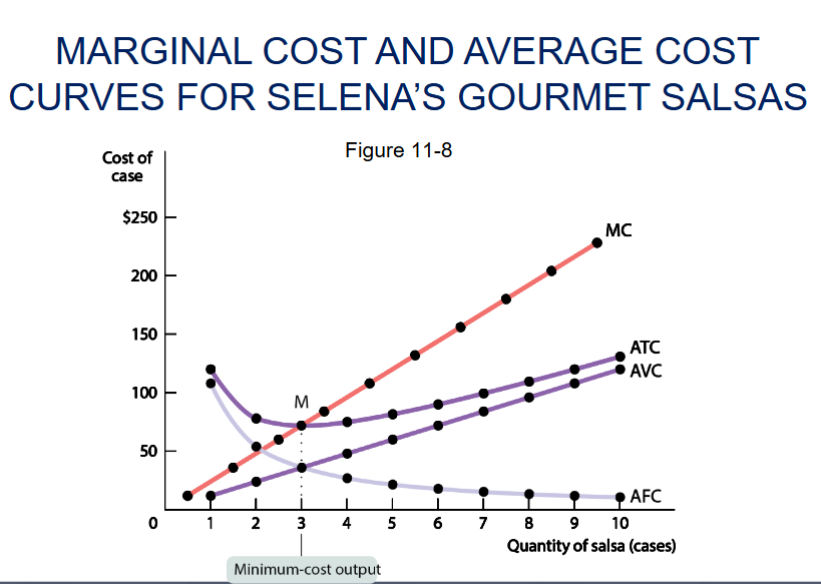
at high levels output the spreading effect is
what is increasing returns to scale (economies of scale)
when long-run average total cost declines as output increases
what is decreasing returns to scale (diseconomies of scale)
when long-run average total cost increases as output increases
what are constant returns to scale
when long-run average total cost is constant as output increases
 Note
Note  Flashcards (159)