3.4 Market Structures
 Call Kai
 Learn
Learn Practice Test
 Spaced Repetition
 Match
Match Flashcards
 Knowt Play
1/30

There's no tags or description
Looks like no tags are added yet.
Name | Mastery | Learn | Test | Matching | Spaced | Call with Kai |
|---|
No analytics yet
Send a link to your students to track their progress
31 Terms
allocative efficiency
when resources are used to produce goods which consumers want and value most highly
P=MC
productive efficiency
when firms produce at the lowest point on the AC curve
MC=AC
Dynamic efficiency
when resources are allocated efficiently over time.
Related to the rate on innovation
concerned with investment
firms must have SNP
x-efficiency
when a firm is producing at any given output on the AC curve
characteristics of perfect competition
many buyers and sellers
sellers are price takers
no barriers to entry or exit
perfect knowledge
homogeneous goods
perfect competition
productive and allocative efficiency (MC=AC=MR=P)
cannot benefit from economies of scale
LR normal profit
characteristics of monopolistic competition
many small buyers and sellers sellers
low barriers to entry and exit perfect
imperfect information
heterogeneous goods
SOME price setting power
monopolistic competition
assumed to be SR profit maximisers
can only make normal profit in the long run
produce at AC=AR and MC=MR
characteristics of oligopoly
high concentration
interdependence
high barriers to entry and exit
non-price competition
differentiated goods
n-firm concentration
(total sales of N firms/total size of market) x 100
advantages of collusion
maximise industry profits
reduce uncertainty
disadvantages of collusion
illegal
fear of others firms breaking agreements
market share has to be divided
overt collusion
when there is a formal agreement on either price or market divide (cartel)
an agreement must be reached
potential competition must be restricted
ways of preventing cheating must be enforced
tacit collusion
no formal agreement
price leadership
barometric firm price leadership
unwritten rules
price competition
price wars: repeated undercutting of competitors prices
predatory pricing: when large firms set price bellow AC so smaller firms cannot make profit (illegal)
limit pricing: when firms set price bellow profit maximising point to discourage new firms from entering market but must be making normal profit
non price competition
advertising
loyalty cards
beading
quality
customer service
product development
game theory table
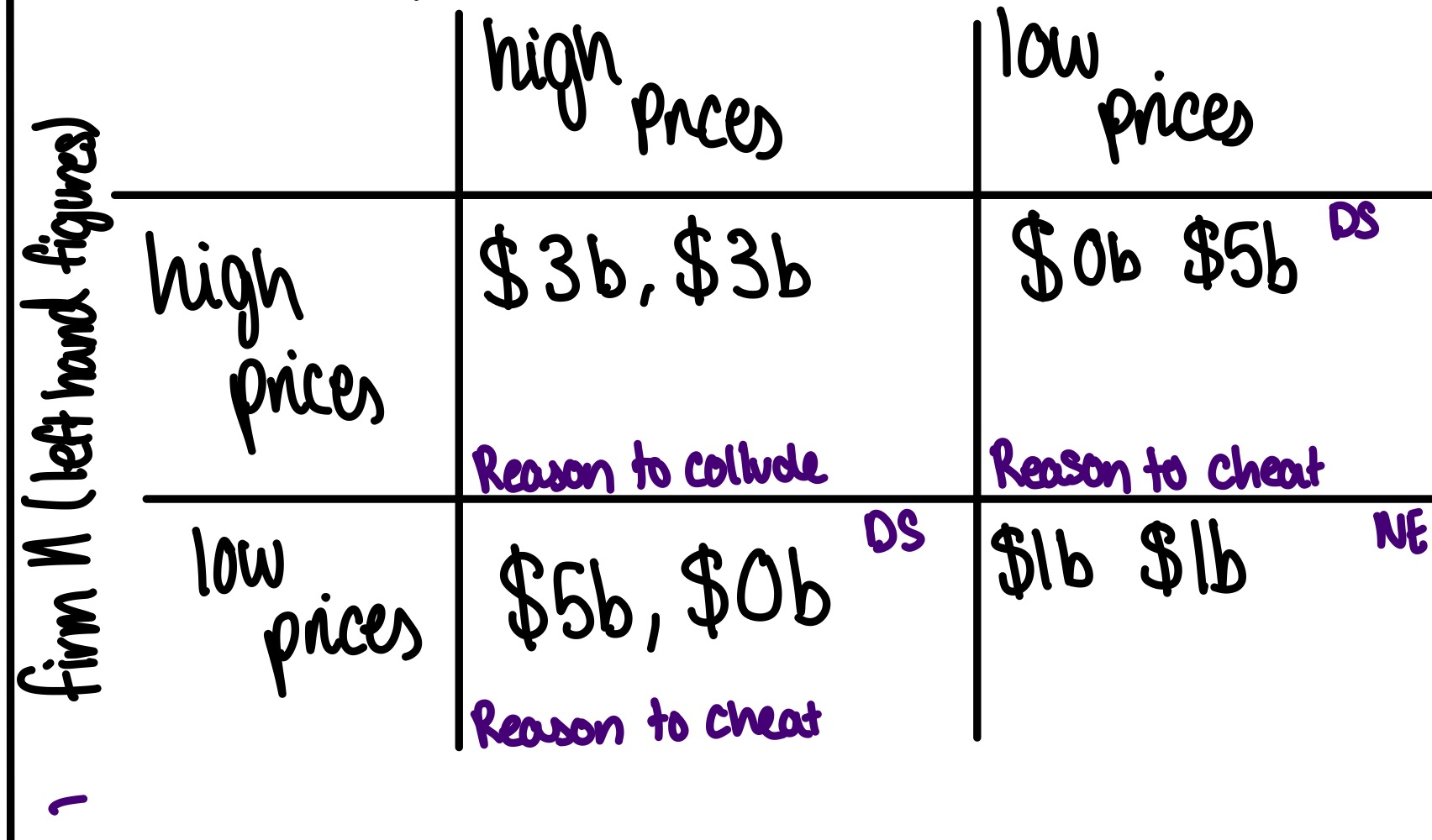
game theory
used to examine the best strategy a firm can adapt for each assumption about its rivals
nash equilibrium
where both firms use dominant strategy
dominant strategy
the best option regardless of what the other player chooses
characteristics of a monopoly
profit maximisation
one sole seller
high barriers to entry
price setters
price discrimination
third degree price discrimination
when the monopolist decides to charge different groups of consumers different prices for the same good or service
advantages of price discrimination
consumer:
may benefit from net welfare gain due to cross subsidisation
producers:
better use of spare capacity
higher SNP can stimulate investment
costs of price discrimination
consumers:
loss of consumer welfare
loss of allocative efficiency
higher prices
Producers:
firms may be regulated by competition and market authorities
firm may have to divide the market
may cause inefficiency as there is higher profit
lack of consumer choice
natural monopoly
when one firm naturally becomes the most efficient firms due to high fixed costs
characteristics of monopsony
single buyer in the market
assumed monopsonists are profit maximisers
price setters
costs of monopsony
firms providing loose profit
risk of labour exploitation
lower productivity if wages are too low
benefits of monopsony
NHS can negotiate lower prices for healthcare services
consumers may receive lower prices as cost of production is low
characteristics of contestable markets
actual and potential competition
entrants have free access to production techniques and technology
no barriers to entry or exit (no sunk cost)
low consumer loyalty
no of firms in market varies
implications of contestable market for the behaviour of firms
firms are more likely to be allocatively and productively efficient
threat of hit and run firms
firms can earn SNP in short run but only NP in long run
types of barriers to entry and exit
economies of scale
legal barriers
customer loyalty & branding
predatory pricing/limit pricing
anti-competitive practices
vertical integration
cost of making workers redundant

