The impact of physical activity on cardiac conduction system
 Call Kai
 Learn
Learn Practice Test
 Spaced Repetition
 Match
Match Flashcards
 Knowt Play
1/55

There's no tags or description
Looks like no tags are added yet.
Name | Mastery | Learn | Test | Matching | Spaced | Call with Kai |
|---|
No analytics yet
Send a link to your students to track their progress
56 Terms
What happens to the body during exercise
more O2 required by working muscles, heart works harder +> more blood pumped around the body and faster
What is stroke volume
= volume of blood pumped out by heart ventricles in each contraction
average = 70ml
What happens to stroke volume (SV) during exercise
Increases with exercise up to 40-60% of max effort, then will plateau
Due to shorter diastolic phase (lack of filling time)
What is venous return
the volume of blood returning to the heart via veins
Up to 70% of vol. blood = contained in veins at rest
During ex. The amount of blood returning to heart increases
What is the relationship between venous return and stroke volume
If VR increases then SV increases
Describe starlings law
increased venous return (VR) -> creates a greater diastolic filling of the heart -> meaning that Cardiac muscle gets stretched -> the greater the force of contraction ->the more increased ejection fraction
What is HR
number of beats per minute
avg. = 72 bpm
What is cardiac output
the vol. of blood ejected by the heart ventricles per minute
how do you calculate cardiac output (Q)
Stroke volume (SV) x Heart rate (HR)
as HR and SV increases so does cardiac output
What happens to HR range in response to exercise
HR increases with exercise dependent on the intensity of the exercise
Increases in direct proportion to exercise intensity
Regular aerobic training = more cardiac muscle => stronger => cardiac hypertrophy
What is cardiac hypertrophy and what are the benefits of cardiac hypertrophy
thickening of muscular wall of the heart
Means more blood can be pumped around the body in a single beat =. Results in a decreasing resting heart rate = BRADYCAARDIA (rate below 60 bpm)
What happens to cardiac output in response to exercise
Cardiac output increases to maximum (threshold) and then plateaus
Maximum cardiac output changes during exercise = benefits : more blood with oxygen to working muscles, efficient waste removal
What happens to the distribution of blood during exercise
During exercise distribution of blood flow changes => more blood to muscles which are working
Less blood passes through organs such and intestines, blood flow stays the same for the heart and kidneys
What happens to stroke volume during exercise
SV increases as intensity of exercise increases
Plateaus as it reaches threshold for individual this is because the ventricles don't have as much time to fill up with blood => can't pump as much out
What is the leading cause of death in the UK
Coronary heart disease
Cardio vascular disease
What is atherosclerosis
Occurs when coronary arteries become blocked and start to narrow due to fatty deposits
caused by:
high blood pressure
lack of exercise
smoking
angina = pain and discomfort
Prevented by:
regular exercise = aids flexibility of the blood vessels
What is blood pressure
It is the force exerted by the blood against the blood vessel wall
What does a high blood pressure do
it puts extra strain on the arteries and heart
if untreated => higher risk of Heart attacks, heart failure, kidney disease, strokes and dementia
What does regular aerobic exercise do
lowers BP
Lowers both Systolic and Diastolic pressure by up to 5-10 mmHg => reduces risk of a heart attack by up to 20%
What are the 2 types of cholesterol
LDL (low density lipoproteins)
HDL (high density lipoproteins)
What is the function of LDL (low density lipoproteins)
transport cholesterol in the blood to the tissues and = bad as linked to an increase risk of CHD (coronary heart disease)
What is the function of HDL (high density lipoproteins)
transport excess cholesterol inn blood back to liver => broken down = good cholesterol as lower risk of developing heart disease
How does exercise help with cholesterol levels
Regular exercise lowers LDL and increases HDL levels
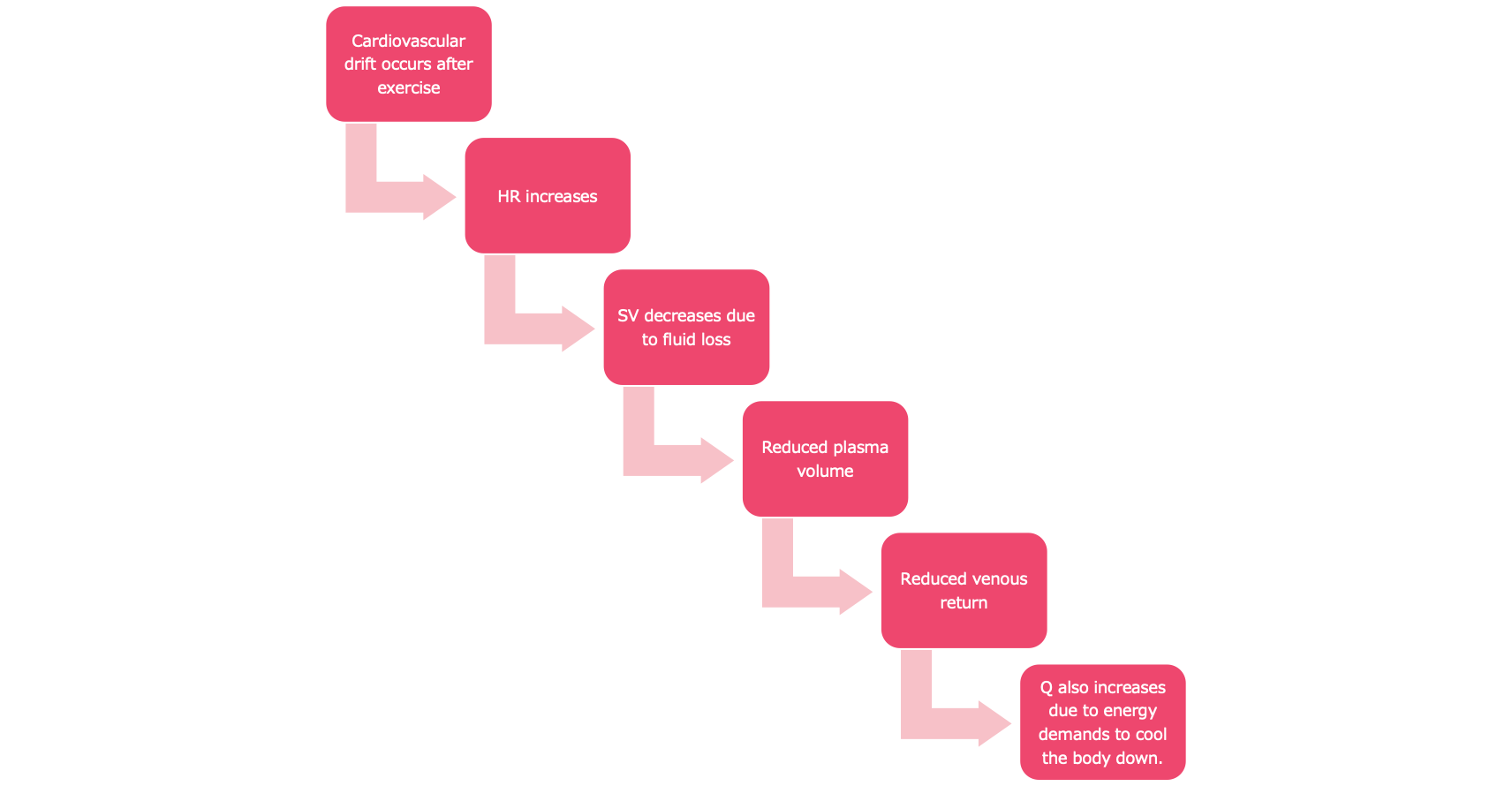
What is cardio-vascular drift
Steady inc. = cardiovascular drift
Characterised by progressive decrease in SV and aBP (arterial blood pressure), together with a progressive rise in HR
Occurs during prolonged exercise after 10 mins -> in warm environment despite intensity of the exercise remaining the same
Why does cardio-vascular drift occur during exercise
When we Sweat = portion of fluid = lost from plasma volume
This Decrease in volume. = reduce of venous return and SV
HR inc. To compensate and maintain higher Q to make energy to cool body down
RESPONSE => maintaining high fluid intake before and during exercise = minimise drift
Blood vessels carry
blood containing…
nutrients
O2
they work with the heart and lungs to ensure muscles have enough O2 during exercise
What are the 2 types of circulation
PULMONARY
Deoxygenated blood from heart to lungs
Oxygenated blood back to heart
SYSTEMIC
Oxygenated blood to the body from the heart
Return of de-oxygenated blood from the body to heart
describe the pathway of blood vessels
Heart
Arteries
Arterioles
Capillaries
Venules
Veins
Heart
What are the characteristics of Veins
Thinner muscle/elastic tissue layer |
Blood at low pressure |
Valves |
Large lumen |
What are the characteristics of arteries
Thicker muscle/elastic tissue layer |
Blood at high pressure |
Smooth inner layer |
Small lumen |
what are the characteristics of capillaries
One cell thick |
Only allow one red blood cell at a time |
Slow blood flow to allow for nutrient exchange |
What is blood pressure
the force which is exerted by the blood against the blood vessel wall
What are the venous return mechanisms
the muscle skeletal pump
the respiratory pump
pocket valves
describe the role of the skeletal muscle pump
when Muscles contract/relax
=> change shape => pressing on veins = pumping effect
During exercise
the skeletal muscle pump works harder because muscle contractions are more frequent and powerful.
This squeezes veins and pushes more blood back to the heart, increasing venous return and helping maintain high cardiac output and oxygen delivery.
describe the role of the respiratory pump
when Muscles contract/relax during breathing
=> changes thoracic + abdominal cavities => compressing veins
describe the role of pocket valves
Prevent backflow of blood
=> closing once blood has passed through
how does gravity aid venous return
helps blood return to the heart from upper body
Suction pump action of heart draws blood back towards it
what it the role of venous return during exercise
Ensure skeletal muscles receive enough O2
During rest the valves and smooth muscle in veins are suff. To maintain VR
During ex. Need to support skeletal muscle and respiratory pumps
Performing an active cool down = maintain to prevent blood pooling
What are the effects that BP has on VR
When sBP (systolic blood pressure) increases VR increases
When sBP (systolic blood pressure) decreases the VR decreases
Venous pressure (Pv) - right atrial pressure (PRA) / venous vascular resistance (Rv)
Increases Pv or decrease in Pra or Rv leads to increase VR
Increase in PRA decreases VR
What is venous return determined by
VR is determined by a pressure gradient, which is the mean systemic pressure minus the right atrial pressure and resistance is the total peripheral vascular resistance
During exercise what happens to O2
3% dissolves into plasma in blood
97% combines with haemoglobin => making oxyhaemoglobin
Describe the transportation of O2
O2 combines with haemoglobin in RBC’s making => oxyhemoglobin
Fully saturated haemoglobin carries 4 oxygen molecules
=> occurs when the partial pressure of oxygen (concentration) in the blood is high i.e. alveolar capillaries
Oxygen released into the tissues due to the lower partial pressure of oxygen
Oxyhaemoglobin dissociation => O2 binds with haemoglobin = oxyhemoglobin => travels to tissues and unbinds = oxygen and haemoglobin
Stored in muscles by myoglobin => higher affinity for oxygen (binds more easily)
Store oxygen for the mitochondria (centre for aerobic respiration)
What does the oxyhaemoglobin dissociation curve help us to understand
Helps us to understand how O2 is transported and released by haemoglobin
Lungs: partial pressure of O2 = high --> haemoglobin fully saturated
Tissues: partial pressure of O2 is low --> haemoglobin lower saturation 23%
What is the Bohr shift
additional O2 releases from haemoglobin at lower PH (higher CO2 conc.)
In tissues there is a low partial pressure of O2 + a higher partial pressure of CO2 => Haemoglobin unloads at this point
Meaning that O2 is available to the tissues
During exercise => curve shifts to the right => muscles require more O2
Dissociation of O2 from haemoglobin in the blood capillaries to shift the right known as the Bohr shift
What 3 factors are responsible for the increase in Bohr shift
increased blood temperature
Partial pressure of CO2 increase
pH levels
What happens during increased blood temperature
when blood and muscle temp inc. during exercise O2 will dissociate from haemoglobin more readily
What happens when the partial pressure of CO2 increases
level of blood CO2 rises during exercise => O2 will dissociate faster from haemoglobin
What happens when pH increases
more CO2 will lower pH in blood
A drop in blood pH will cause O2 to dissociate from haemoglobin faster (Bohr shift)
Describe the redistribution of blood during exercise
During exercise, the skeletal muscles require more O2 => more blood needs to be redirected to them in order to meet the increase O2 demand
Redirection of blood flow to the working muscles mean that sports performers should ensure they don't eat less than an hour before competition
Full stomach = more blood being directed to stomach instead of working muscles => effects amount of O2 going to performers muscles
Blood flow to the brain must remain constant to ensure brain function in maintained as the brain needs O2 for energy
In addition more blood needs to go to the heart as the heart needs oxygen for energy to beat faster and more blood goes to the skin as energy in needed to cool the body down
What is the vascular shunt
Redirecting of blood flow to areas where it is most needed
What is vasodilation
widening of blood vessels to increase the flow of blood into capillaries
What is vasoconstriction
narrowing of blood vessels to reduce blood flow into capillaries
The vascular centre of the brain located in the medulla oblongata controls…..
Blood pressure and blood flow around the body
What happens to blood flow during exercise
During exercise chemical changes such as inc. CO2 and lactic acid = detected in chemoreceptors
Receptors stimulate the vasomotor centre which will redistribute blood flow through vasodilation and vasoconstriction
During exercise more O2 = needed at working muscles => vasodilation will occur in arterioles supplying the muscles => increases blood flow and brings in muscles needing O2
Vasoconstriction occurs in arterioles supplying non-essential organs such as intestines and liver
Why do we need blood redistribution
Inc the supply if O2 to the working muscles
Remove waste products from the muscles such as CO2 and lactic acid
Ensure more blood goes to the skin during exercise to regulate body temp. + get rid of heat through radiation, evaporation and sweating
Direct more blood to the heart as it is a muscle which requires extra O2 during exercise
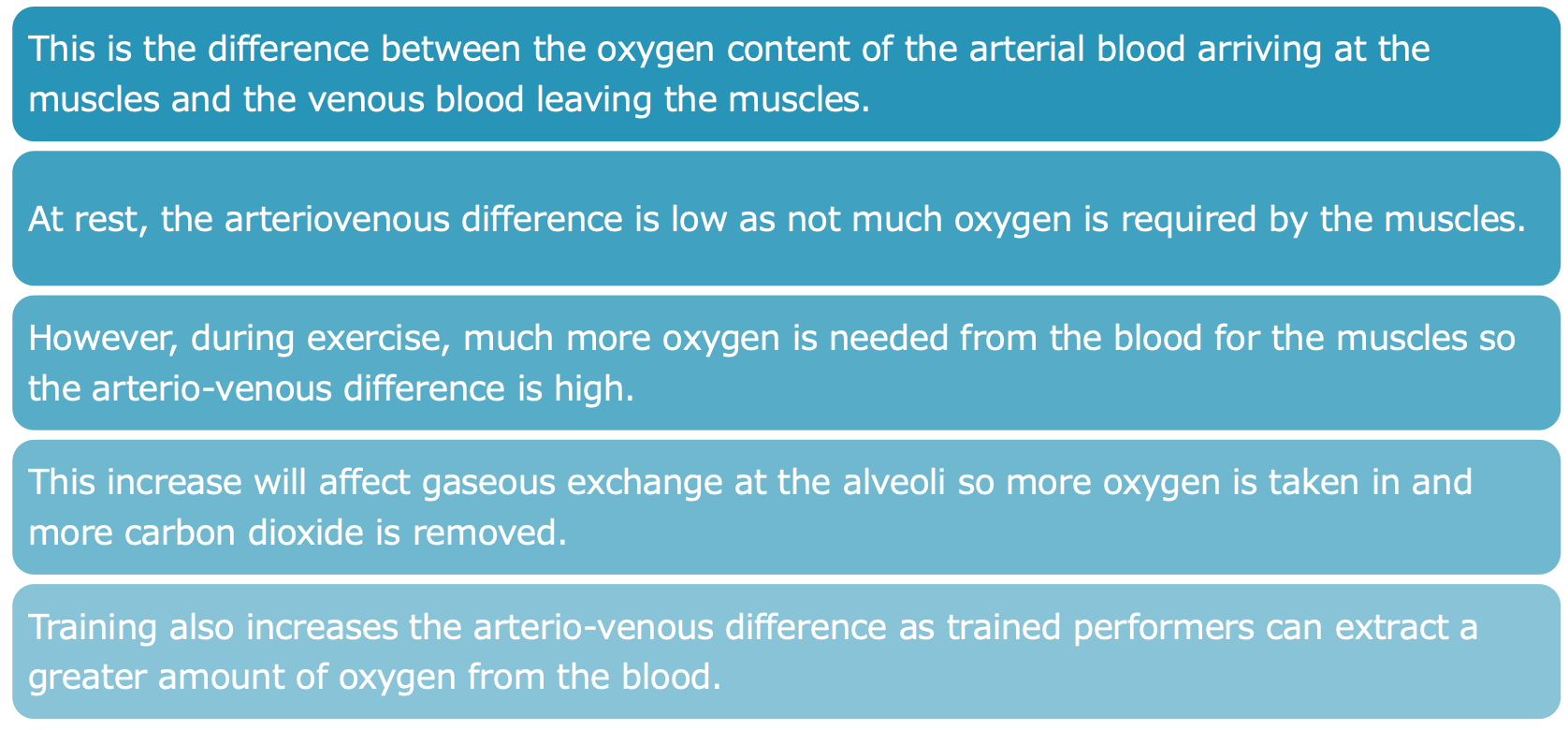
Atrio-venous (AV) difference = difference between O2 content of the arterial blood arriving at the muscles and the venous blood leaving the muscles
What is A-VO2 difference
= the difference between the o2 content of the arterial blood arriving at the muscles and the venous blood leaving the muscles