BIOL 1720 II: Bacteria and Archea
 View linked note
 Call Kai
 Learn
Learn Practice Test
 Spaced Repetition
 Match
Match Flashcards
 Knowt Play
1/19

Earn XP
Description and Tags
Flashcards to review key concepts from the lecture notes on bacteria and viruses.
Name | Mastery | Learn | Test | Matching | Spaced | Call with Kai |
|---|
No analytics yet
Send a link to your students to track their progress
20 Terms
What distinguishes gram positive and gram negative bacteria?
Gram positive bacteria have a thick peptidoglycan layer, while gram negative bacteria have a thinner peptidoglycan layer and an additional outer membrane.
What dye is commonly used in gram staining, and what do the colors indicate?
Saffranin is used as a pink dye, while crystal violet stains cells dark purple; purple indicates gram positive bacteria and pink indicates gram negative bacteria.
Why are gram negative bacteria considered more pathogenic than gram positive?
They have an outer membrane that prevents antibiotics from easily penetrating, making them harder to treat.
What is an endospore and its significance in bacteria?
An endospore is a protective structure that allows bacteria to survive in harsh conditions for extended periods, even centuries.
What is the primary function of pili in bacteria?
Pili, particularly sex pili, allow for the exchange of genetic material between bacteria.
What is the difference between phototaxis and chemotaxis?
Phototaxis is movement toward light, while chemotaxis is movement toward a chemical stimulus.
What is the nucleoid region in prokaryotes?
The nucleoid region is where the bacterial genome is organized and concentrated, but it is not membrane-bound.
What are plasmids?
Plasmids are small, circular sections of DNA that can exist independently within bacteria, often carrying additional genetic functions.
Describe the process of binary fission in bacteria.
Binary fission is the asexual reproduction method where the bacterial genome duplicates and the cell divides into two genetically identical cells.
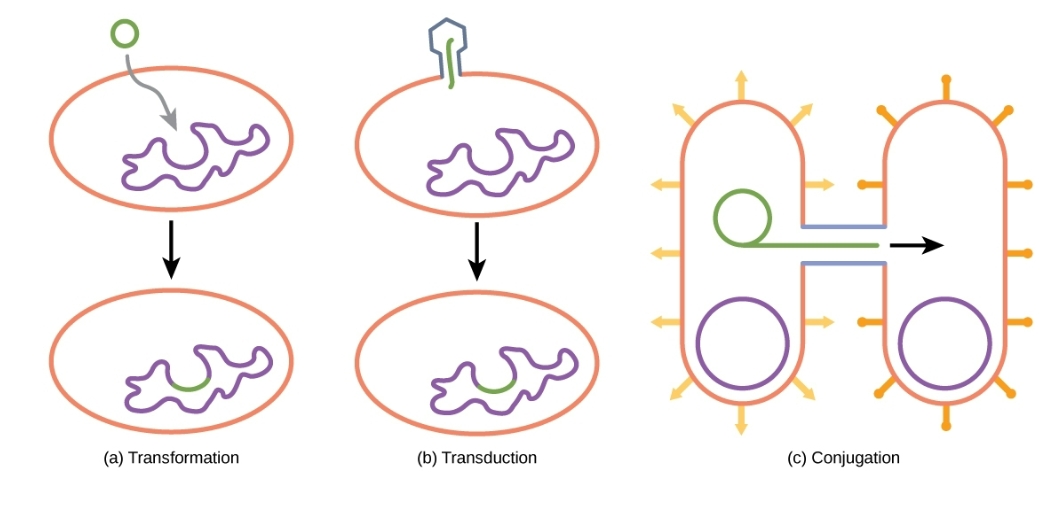
What are the three mechanisms that enhance genetic diversity in bacteria?
The three mechanisms are transformation (uptake of environmental DNA), transduction (virus-mediated DNA transfer), and conjugation (direct transfer of DNA between bacteria).
Define autotrophs and heterotrophs in microbial ecology.
Autotrophs produce their own energy using light or inorganic substances, whereas heterotrophs obtain energy by consuming organic compounds.
What is bioremediation?
Bioremediation is the process where microbes break down or detoxify harmful substances in polluted environments.
What are cilia and their function?
Cilia are small, hair-like structures on the surface of cells that help in movement and feeding.
What is the role of flagella in microorganisms?
Flagella are long, whip-like structures that enable rapid movement in bacteria and other microorganisms.
What are photoautotrophs?
Photoautotrophs are organisms that utilize light energy and carbon dioxide for photosynthesis, such as cyanobacteria.
Define chemoautotrophs and provide an example.
Chemoautotrophs are organisms that extract energy from inorganic chemicals to produce food, like sulfur bacteria.
What are photoheterotrophs?
Photoheterotrophs are organisms that use light for energy but require organic compounds for carbon, commonly found in some aquatic microbes.
Explain chemoheterotrophs.
Chemoheterotrophs depend on organic compounds for both energy and carbon, including many bacteria, fungi, and animals.
What distinguishes extremophiles?
Extremophiles are organisms that thrive under extreme environmental conditions, such as high temperatures or salinity.
What role do methanogens play in the environment?
Methanogens are archaea that produce methane and contribute to greenhouse gas dynamics, thriving in anaerobic environments.
