International Marketing, Trade Policies, and Business Strategy Concepts
 Studied by 0 people
 Call Kai
 Learn
Learn Practice Test
 Spaced Repetition
 Match
Match Flashcards
 Knowt Play
1/32

There's no tags or description
Looks like no tags are added yet.
Name | Mastery | Learn | Test | Matching | Spaced | Call with Kai |
|---|
No analytics yet
Send a link to your students to track their progress
33 Terms
World Trade
the flow of goods and services among different countries
non-convertible currency
Government restriction on certain money; Example: North Korean Won or USD in North Korea
Countertrade
if insufficient credit is available, firms trade products with each other
First stage of the international marketing process
Ask "Is there room to grow domestically?"
Second stage of international marketing process
Will your competitive advantage succedd against local firms with a home-court advantage?
Third stage of international marketing process
Will what made the company succesful domestically translate into a new, foreign market
Fourth stage of international marketing process
What Level of Commitment should we pursue?
Protectionism
restricts trade to make foreign goods more expensive or less available, Example: quotas, embargoes, tariffs
Coordination of Trade Policies
create pacts wtih each other for trade policy coordination EX: US-Mexico-Canada Agreement, European Union
Elements of the External environment
Economic, Competitive, Political, technological, socio-cultural
Economic Environment
Indicators of economic health, level of economic development, business cycle
Competitive Environment
Competition in the micro and macro-environment
Political / Legal Environment
National laws of commerce, international regulations, regional agreements, political stability, regulatory issues, human rights issues
Socio-Cultural Environment
demographics, values, social norms, xenocentrism, ethnocentrism
Least-Developed Country
Economic base is often agricultural, includes bottom of the pyramid (BOP) countries
Developing Countries
Products include PCs, skincare, mobile phones; Example BRIC (Brazil, Russia, India, China) countries
Developed Countries
luxury products, includes G7 Countries (US, France, Canada, Germany, Italy, Japan, EU & UK)
Oligopoly
a market structure where a few large firms dominate the market
Monopolistic Competition
a market structre with many firms selling similar but differentiated products
Perfect Competition
a market structure with many firms selling identical products with no barriers to entry
The triple-bottom-line orientation
companies focus on maximizing financial, social, and environmental benefits
Green Washing:
the practice of making misleading or false claims about the environmental benefits of a product service, or company to appear more environmentally responsible than they actually are
Collectivism
a cultural orientation where people prioritize group goals and collective welfare over individual interests, emphasizing interdependance and group harmony
Locavorism
a movement or practice that emphasizes consuming food and products that are locally produced, typically to reduce environemntal impact, support local economies, and ensure fresher products
Business planning
the ongoing process of decision-making that guides an organization in both the short and long term. It involves setting objectives and developing strategies to achieve them
Strategic planning
defining the mission, evaluating the environment, and setting objectives
Functional planning
focuses on specific areas like marketing wehre objectives and strategies are developed
Operational planning
involves day-to day management and the implementatoin of strategies
What makes a good mission statement
clearly defines the organization's purpose and what it aims to achieve, identifies target market and key stakeholders, provides direction for decision-making
Activity Metrics
measures specific marketing activities and efforts EX: number of sales calls, website visits, social media engagement, email open rates
Outcome metrics
measures the results and impact of marketing activities; example: sales revenue, market share, customer lifetime value
Return on Marketing Investment
measures the revenue generated by marketing activities relative to their cost ((Revenue from marketing - marketing cost) / cost)
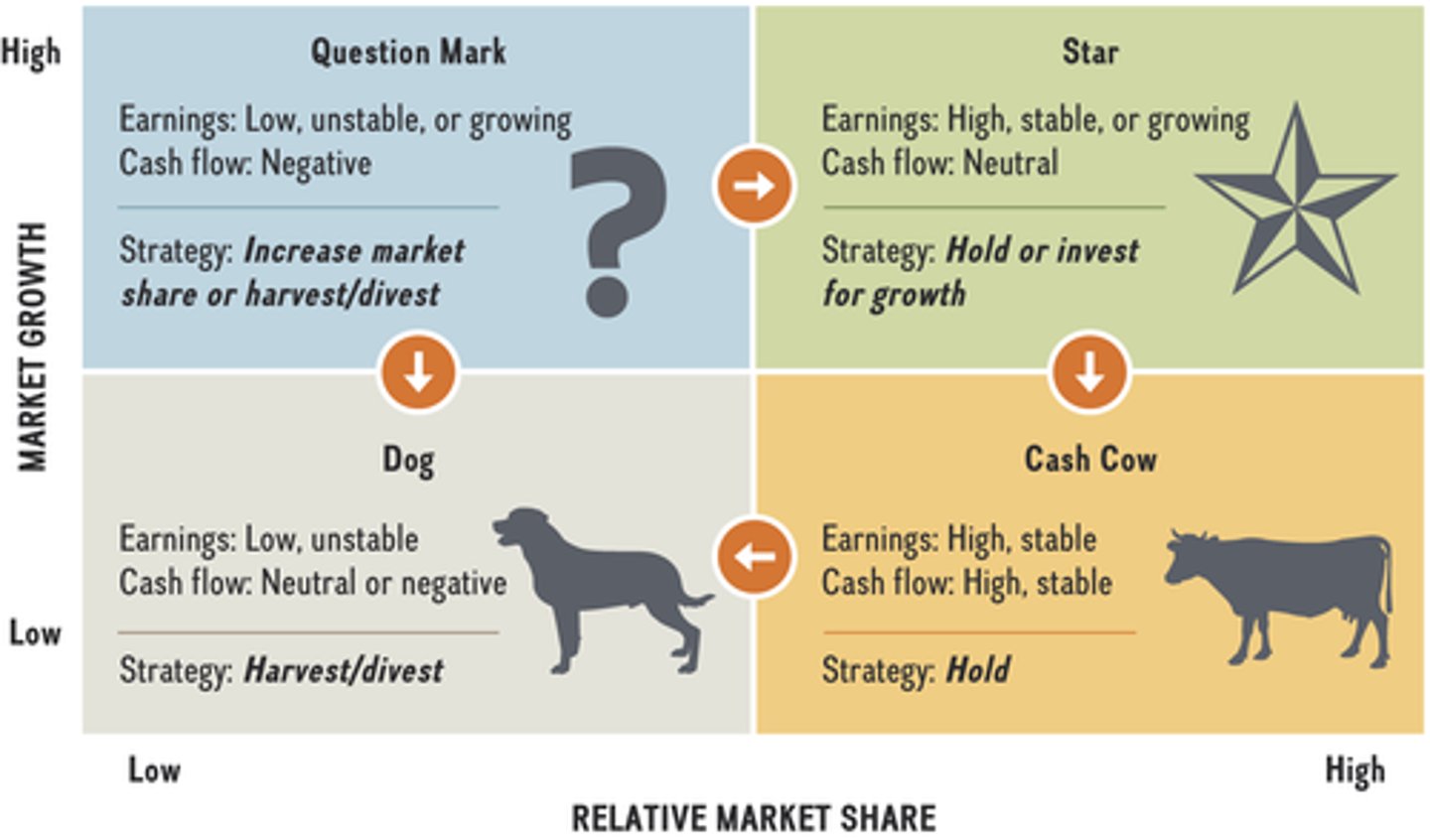
BCG growth-market share matrix
a portfolio analysis model developed that assesses the potential of successful products to generate cash that a firm can then use to invest in new products
 Note
Note  Flashcards (342)