APHG Unit 4 Topic Questions
 Studied by 0 people
 Call with Kai
 Learn
Learn Practice Test
 Spaced Repetition
 Match
Match Flashcards
 Knowt Play
1/25

There's no tags or description
Looks like no tags are added yet.
Name | Mastery | Learn | Test | Matching | Spaced | Call with Kai |
|---|
No study sessions yet.
26 Terms
Based on the map, which of the following can be identified as a true statement about Northern Ireland?
It is physically separate from the rest of the United Kingdom, a multinational state. Northern Ireland is physically separated from the island of Great Britain containing England, Scotland, and Wales, but it is connected by land to the Republic of Ireland. All form distinct nations that have been given some degree of autonomy and self-rule but are still united under the United Kingdom.
Semiautonomous regions
having a degree of, but not complete, self-government.
nation-state
countries with a single government and a singular ethnic culture. Nation-states tend to be small in size or are located in remote locations such as peninsulas or islands.
why could the region of Catalonia in Spain could be a viable country?
Catalonia is well developed economically compared to other regions in Spain. The Catalan region accounts for approximately one-fifth of Spain's economy and is an important industrial and banking center. These economic resources give viability to the idea of an independent Catalonia.
What is the most likely outcome of the possible establishment of an independent Kurdistan for the Kurdish people?
They might secede from or rebel against the states labeled on the map. The Kurds are a stateless nation and want to create a country out of the land shown on the map. The establishment of Kurdistan would require other states to relinquish some of their territory.
Which of the following best explains the political pattern?
The devolution of Yugoslavia occurred primarily along national lines, resulting in countries with a defined ethnic majority. The data show that the countries were divided mainly by ethnicity, such that one ethnic group was in the majority of the resulting populations.
Some territories within the Russian Federation are characterized by concentrated populations of ethnic groups and these areas function as autonomous republics. Which of the following best explains the political relationship between the autonomous republics and the central government of Russia?
The autonomous republics provide ethnic groups with some political control over their homelands while preserving Russia's territorial integrity. Each autonomous republic maintains a significant amount of independence but shares some power with Russia's central government. This political system preserves ethnic groups' connection to and control over historic ethnic homelands while maintaining the central government's territory.
Which of the following best explains the effect of French language and culture on the federal state of Canada's political power?
French language and culture act as a centrifugal force in Canada because independence movements in Quebec have attempted to secede the province from Canada. The distinctiveness of the Quebecois people (the ethnic French in Quebec) has acted as a centrifugal force because of political movements that advocate for Quebec's independence from Canada.
Which of the following explains why Korea and Vietnam were viewed as shatterbelts during the Cold War?
Korea and Vietnam experienced conflict due to a dispute between global powers. Korea and Vietnam were shatterbelts, as they were areas thrown into conflict due to internal tensions and were caught in the middle of a dispute between the United States and the Soviet Union during the Cold War.
The former international border between East Germany and West Germany is best described as
a relict boundary. A relict boundary is a political boundary that no longer exists. Germany was divided between Europe and Soviet Russia at the close of the Second World War, and in 1961 a physical barrier was constructed by the Soviets. The barrier was officially removed in 1989 and Germany was reunified in 1990.
Which of the following describes an example of a consequent boundary?
Canada created the province of Nunavut to provide greater autonomy for the First Nations. The province of Nunavut is a consequent boundary because it was drawn to accommodate the existing cultural landscape.
What is an example of a superimposed boundary?
The geometric boundary between Iraq and Saudi Arabia. The boundary between Iraq and Saudi Arabia is an example of a straight-line boundary superimposed between the two states by an outside power.
The Berlin Conference established the borders of North African countries including Egypt, Libya, and Sudan. The landscape of these countries influenced the types of boundaries imposed by the European colonial powers. Which of the following boundary types best explains the influence of landscape on the political borders of the North African region?
Geometric, with straight lines, disregarding physical features or tribal cultural differences of the areas. Geometric or straight-line boundaries were created for Egypt, Libya, and Sudan without regard to natural landmarks and cultural features for ease of boundary demarcation and mapping in arid or desert regions with shifting sands.
The Philippines and Malaysia lay claim to resources under and around the Spratly Islands. Which of the following best explains how the United Nations Convention on the Law of the Sea (UNCLOS) influences claims to the islands by both countries?
The claims to the Spratly Islands by both the Philippines and Malaysia overlap due to exclusive economic zones up to 200 nautical miles from their coasts. Under UNCLOS, states gain resources 200 nautical miles from the coast and so controlling these islands would expand each state's resources.
AMERICAN INDIAN RESERVATIONS, ALASKAN NATIVE CORPORATION LANDS, HAWAIIAN HOME LANDS. Which of the following best explains the governance of the shaded areas shown on the map?
These areas show where indigenous peoples have a limited amount of self-government at a national scale. The lands shown on the map are areas where indigenous groups have limited self-government as semiautonomous regions. Tribal organizations exist as political entities at the national scale within the United States.
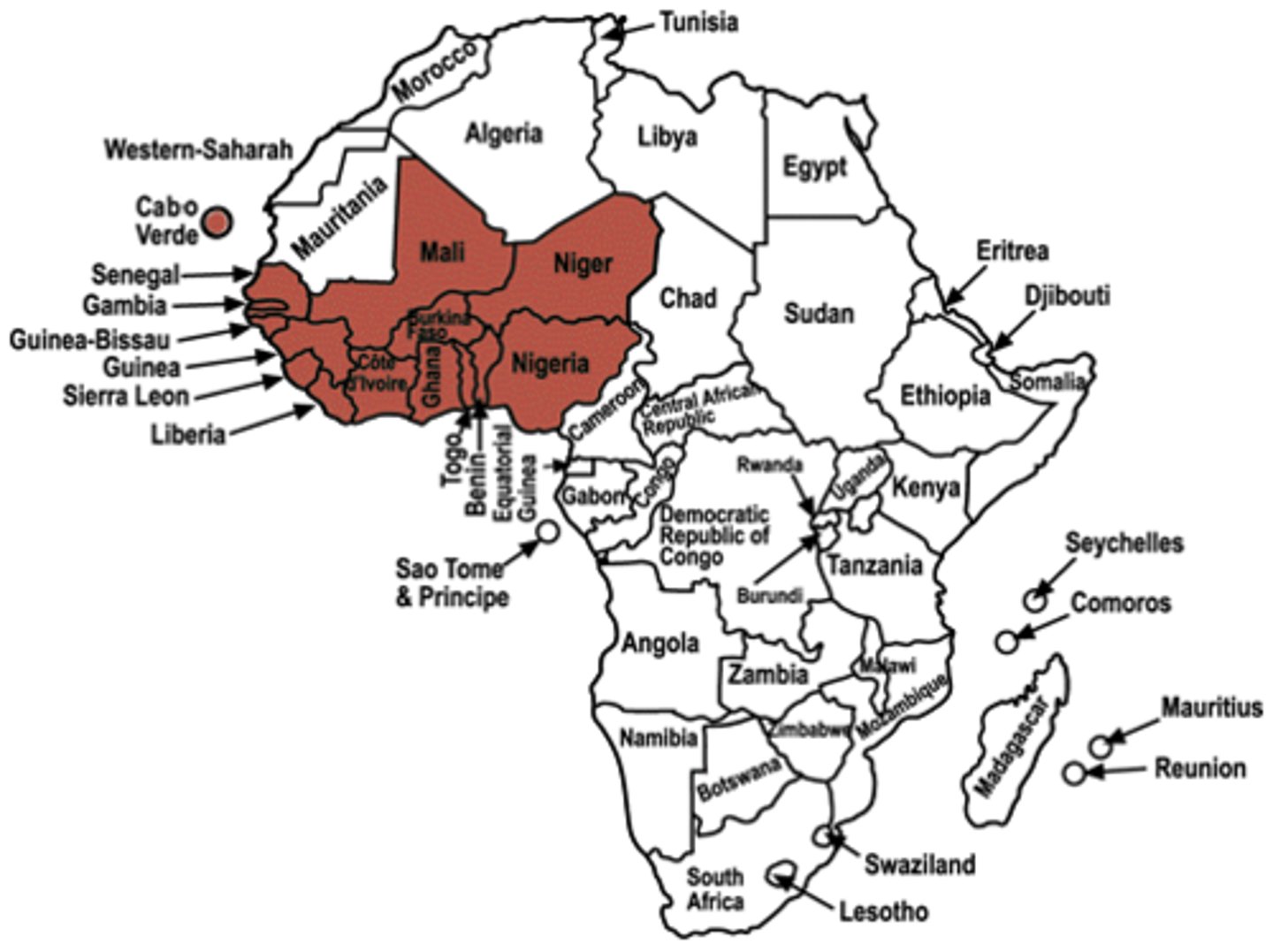
Which of the following is the correct organizational scale for the Economic Community of West African States (ECOWAS)?
Supranational. The Economic Community of West African States (ECOWAS) acts as a supranational trade organization. ECOWAS countries share a free-trade zone where no tariffs are charged on goods crossing borders between member states.
In the United States House of Representatives there are a fixed number of 435 seats divided among the states based upon each state's relative population size. Changes in the number of representatives, as shown on the map, affect politics at which of the following scales?
National. Changes in the number of representatives per state impact politics at the national scale. States with more representatives have more influence in the federal government.
The examples in the table show states that gained or lost United States House of Representatives districts based on 2010 census data. The states were required to revise district boundaries based on census data.
Local representation in the national legislature. The redistricting that occurs after each decennial census in the United States determines the number of House of Representatives districts per state in the national Congress.
Which of the following describes typical characteristics of federal states?
A large land area and multiple ethnic groups. In a federal state, governance is organized into units such as regions, states, or provinces. Federal states are generally characterized by a large land area and multiple ethnicities.
Which of the following describes a federal form of governance?
Multiple substates have local control and are unified to pursue common goals at the national level. Federal states have dispersed power centers that give more power to the local level, keeping more of the population engaged in the political process.
Which of the following describes a unitary form of governance?
A state has a strong central government with no power given to regions. Unitary governments are a form of governance in which there is a strong center of power exercising control over an entire state.
Which of the following is a possible impact of ethnic and religious diversity in Iraq?
Ethnicity and religion lead to devolutionary pressures in the country by politically dividing regions. The ethnic and religious diversity increases devolutionary pressures on the Iraqi state, as the groups shown are at odds politically, and each contends for control over land and resources.
Which of the following is an accurate comparison of devolutionary movements in Spain and Canada?
There is an economic aspect to the Catalan independence movement, while the Quebecois focus mainly on cultural differences. Both groups see themselves as being culturally distinct compared to the rest of Spain and Canada, but the movement for autonomy in the Catalan region also focuses on their economic strength, whereas the Quebecois mainly focus on ethnic and linguistic distinction.
Compare the centralized power of the Soviet Union with the contemporary Russian Federation, in terms of the control of territory. Which of the following statements does the information in the map best support?
Russia is an ethnically diverse region with many subnational units. The map suggests that Russia is made up of many subnational units. The granting of autonomous republics after the breakup of the Soviet Union acknowledged the cultural diversity of the region.
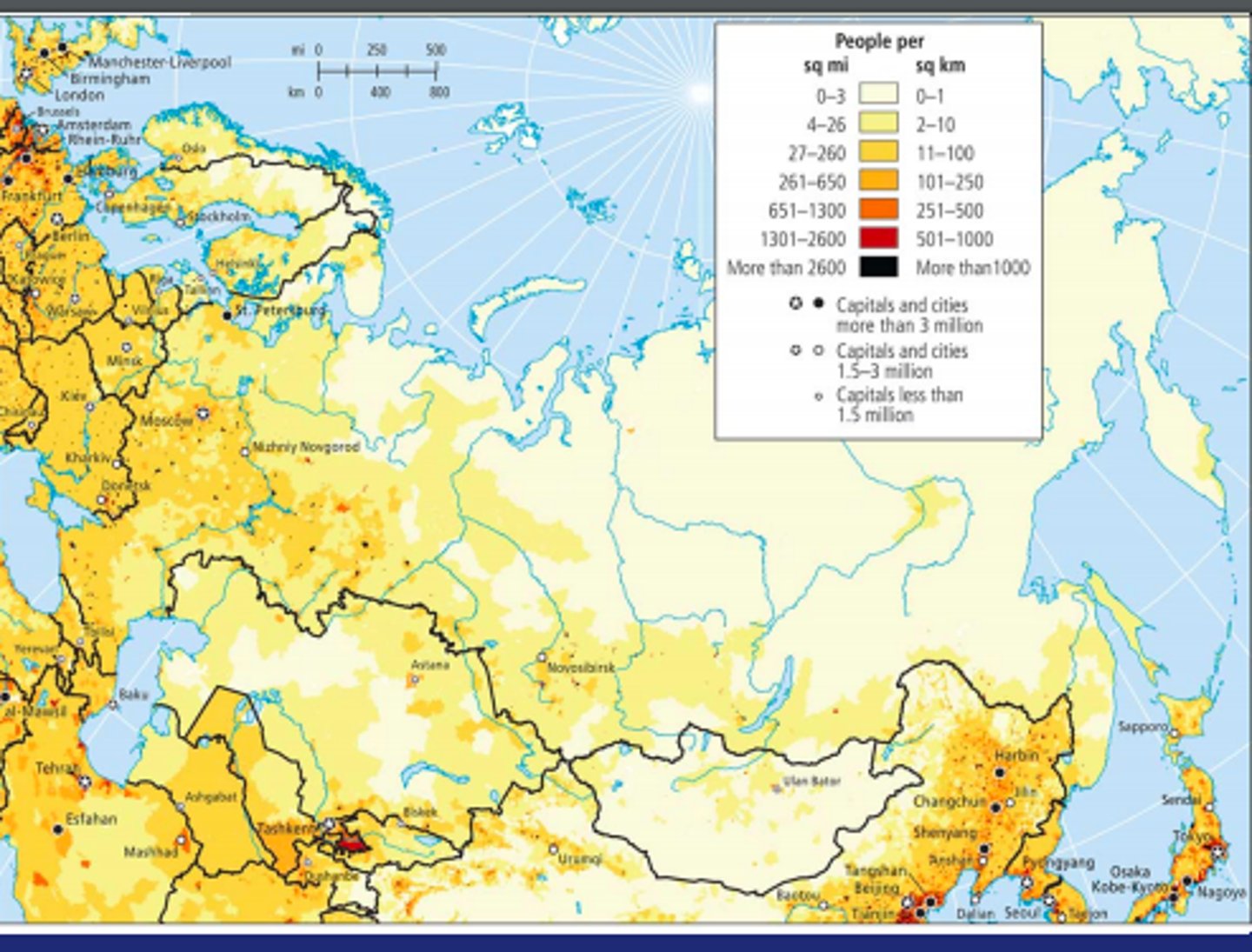
The map suggests that Russia is made up of many subnational units. The granting of autonomous republics after the breakup of the Soviet Union acknowledged the cultural diversity of the region.
Admittance into a supranational organization such as the European Union. Entrance into any supranational organization is a threat to sovereignty because political and economic decisions are made at the committee level instead of the state level, but it would bind together the countries within the supranational organization at a global scale.
Which of the following correctly compares the impact of centripetal forces at the local scale with the impact of centripetal forces at the national scale?
Centripetal forces at both the local scale and the national scale may lead to increased cultural cohesion. Centripetal forces, such as a common ethnicity, religion, or a charismatic leader, help to unify populations and may lead to increased cultural cohesion at both local and national scales.
 Note
Note  Flashcards (100)