OTH - 510 Final (specifically points covered on email)
 Studied by 0 people
 Call Kai
 Learn
Learn Practice Test
 Spaced Repetition
 Match
Match Flashcards
 Knowt Play
1/99

There's no tags or description
Looks like no tags are added yet.
Name | Mastery | Learn | Test | Matching | Spaced |
|---|
No study sessions yet.
100 Terms
transition planning helps students move from
school to post school activities
IDEA requires transition services begin by age
16
OT should identify _______ and ________ that align with vocational goals
interests and skills
consider ______ and _______ environment in potential work settings
physical and social environment
functional skills includes (3) skills required for employment
self care
independent living
transportation/travel
collaborate with ________, ______ _________, and ________ ________ _________ to develop transition plan
educators
case managers
vocational rehabilation counselors
teach _____- _________ skills such as self-advocacy and communication
self-advocacy skills
2 standardized assessments for transition planning
2 informal assessments
transition behaviors scale-3
life skills inventory
transition planning
collaborate with family, school, and community agencies to create transition plan
vocational skills
develop work related skills such as task sequencing, time management, and social interaction in a work place setting
self advocacy
teaching pt to communicate needs and preferences in work place setting
environmental adaptions
identify accomodations for job tasks (visual schedules, adaptive tools)
community integration
facilitate participation in community based vocational programs
Within these assessment areas, which individual skills would you want to evaluate as an OT to provide more information on strengths and weaknesses for future job placements?

the SFA is ______ referenced
criterion
the SFA assists in evaluating an elementary school student's
participation in school related activity settings
support needs
and performance in school-related functional activities
3 sections of the SFA
part I: participation
- one scale 6 ratings (participation extremely limited to full participation)
- theres 6 major school settings listed, you add their scores and get an overall raw score (reg. class room vs spec ed [where they are more often], playground, transportation, bathroom, transitions, mealtime)
part II: task supports
- looking at the extent to which their performance is supported by adults or adaptions beyond those of typically developing students (extensive to no assistance (1-4) theres two columns one ofr assistance and one for adaptions, find raw score for each, looking at physical and cog/behavioral tasks
part III: activity perforamnce
- theres 21 groups (physical or cog/behavioral tasks in which they get a score 1 to 4 on these 1 being not at all 2 is partial 3 is inconsistent so they can do it IND but they do not always vs 4 is a consistent performance - these are also seperated into cog/behavioral and physical tasks...
SFA scoring
find the total score for each part I-III, use appendices to find the criterion score and standard error score
here you will find the criterion cut-off score
criterion cut-off score
derived from performances of children in regular education classrooms ONLY
- 5% or lower are likely to score below the criterion cutoff score = can be used to establish need for servives when it is decided their score is below that of typically developing peers
functional profile (SFA)
can create a chart of the student's perforamnce using the criterion scores
scoring example and interpretation of SFA
say after adding the scores on Part I participation, my raw score is 15. then go to appendices find participation I in the class room they are often in most. raw score = 15 = criterion score of 45 = a standard error of 5. = Score below cutoff in class, participation is below and compared to other kids it can be considered limited (can be moderately, somewhat – this is compared to age and expectation of that age).
part II task supports: my raw scores are 17 for assistance and 25 for adaptions. 17 = criterion = 37 SE of 5 = Criterion score is below cut off score of 100, indicating additional need for assistance in physical tasks. His scores in setup and clean up and hygiene were a score of 1, indicating additional assistance required in these tasks. These were taken in consideration upon choosing sections in part III.
adaption raw score was 25, so find criterion in appendices = 55 w/ SE of 5. because the cut off score is 100, we know 55 is much lower than this indicating increased requirement for adaptions, " His score of 55 is much lower than the 100 cut off score from K-3rd grade. This indicates a requirement for adaption that exceeds that of what is expected of children of his same age."
then based on part I And II we selected physical tasks (part III) that were the most relevant so
example would be
maintaining and changing position, scores 1-4 (1 = does not do 2= partial 3= inconsistently 4= consistent) so my raw score was 36, go to appendices, part III, maintaining and changing positions criterion = 60 SE 4 = For maintaining and changing positions, his score is lower than the K-3rd cut off grade of 100. Most of his scores were ranging from 2-3, indicating a partial to inconsistent performance.
overall, find raw, find criterion and cutoff, then break it down and justify their need.
FCE
functional capacity evaluation
economic satisfaction
salary
retirement
health benefits
economic stability
psychological satisfaction
opportunity for advancement
desire to do well
yearning to find self-fullfilment thru meaningful work (important to note that you can get fulfillment from any job that is meaningful to you - not just healthcare)
occupational therapy uses
work related activities in assessment, treatment, and management of individuals whose ability to function in a work environment has been impaired by physical, emotional, or developmental illness or injury
OTs skilled in ______ ________ programs and _______ base
job specific programs
knowledge base
FCE is a form of ______ evaluation that conisists of a battery of tests focuing on
FCE is a form of work evaluation that conisists of a battery of tests focusing on selected work tolerance tests
evaluation of the FCE gathers data to determine (2)
consistency of effort
employability
FCE is a _____-term eval that focuses on
short-term eval that focuses on major tolerance abilites related to musculoskeletal strength, endurance, speed and flexibilty that is used to determine baseline physical abilites plus limitations and restrictions
2 types of FCEs
functional baseline
job specific
functional baseline FCE
an objective assessment of physical abillites to perform a variety of tasks related to the demands of work
job specific FCE
- job specific based on
- integral part of this?
- an evaluation of the individuals physical abilities to function within the parameters of an identified job.
- job specific FCE is based on critical physical demands of the essential functions of the job
- work simulation acitivies are often an integral part of job specific FCE
MMI
Maximum Medical Improvement
when you do an FCE (3)
- reached maximum medical improvement, but continues to have concerns with return to work or injury
- determination of disbility status
- when physical function needs measured prior to vocational search or return to work
one ethical dilemma of FCE
who is the referral source? could be physician, emploter, case manager, insurance rep., lawyer
whoever our client is is not going to change our results, but the person who we are testing very well may not be the one who made the referral. the documentation will meet the needs of the referral but our evaluation as well as the results should not change
common areas of measurement (9)
work and medical history (all the jobs they have had)
musculoskeletal evaluation
max strength
endurance
dexterity
materials handling (lifting)
positional tolerances (seat, stand, kneel, squat, crawl)
psychosocial status (motivation, anxiety, depression)
is there a match? (between their desired job and their abilites)
components of FCE (8)
history (written, chart review)
musculoskeletal eval
material handling (objective measures)
non material handling
endurances (why this is a 3 hr exam)
job specific assessments
reliability of client report/symptom magnification
max vs submax effort
critical to determine whether
the effort of the person you are evaluating accurately reflects their work capacity - do this through looking at consistency of effort. finding the coefficient of variation is a method (controversial and not well supported)
-- a high coefficient of variation indicates they may not be putting forth full effort - it is hard for someone to quantify sub max effort consistently
for the FCE, there is no
gold standard of certification - there are a lot of them
FCEs are
length (min 3 hours -can be 3, 6, or 8 hours and write ups are lengthy as well - most industries use a program to guide write ups
who controls the length of FCE?
the subject controls the length and the results of the FCE
home safety standards
4b - provide appropriate evaluation and plan of intervention for recipients of OT specific to their needs (beneficence)
4c - use, to the extent possible, evaluation, planning, intervention techniques, assessments, and therapeutic equipment that are evidence based, current and within recognized scope of OT practice (beneficience)

accessibility involves
making environments equally accessible to all people
decreasing/eliminating barriers to people with physical, cognitive, physical, or auditory losses

Purpose of OT home evaluations:
- collab with
- determine
- assess the need for
- determine
- assess for overall
collab with the clients on goals
determine supports and barriers to everyday living
assess the need for equipment
determine funding options
assess for overall safety with the performance of tasks in their natural environment
we are not
we are not judging living conditions unless unsafe or uninhabitable
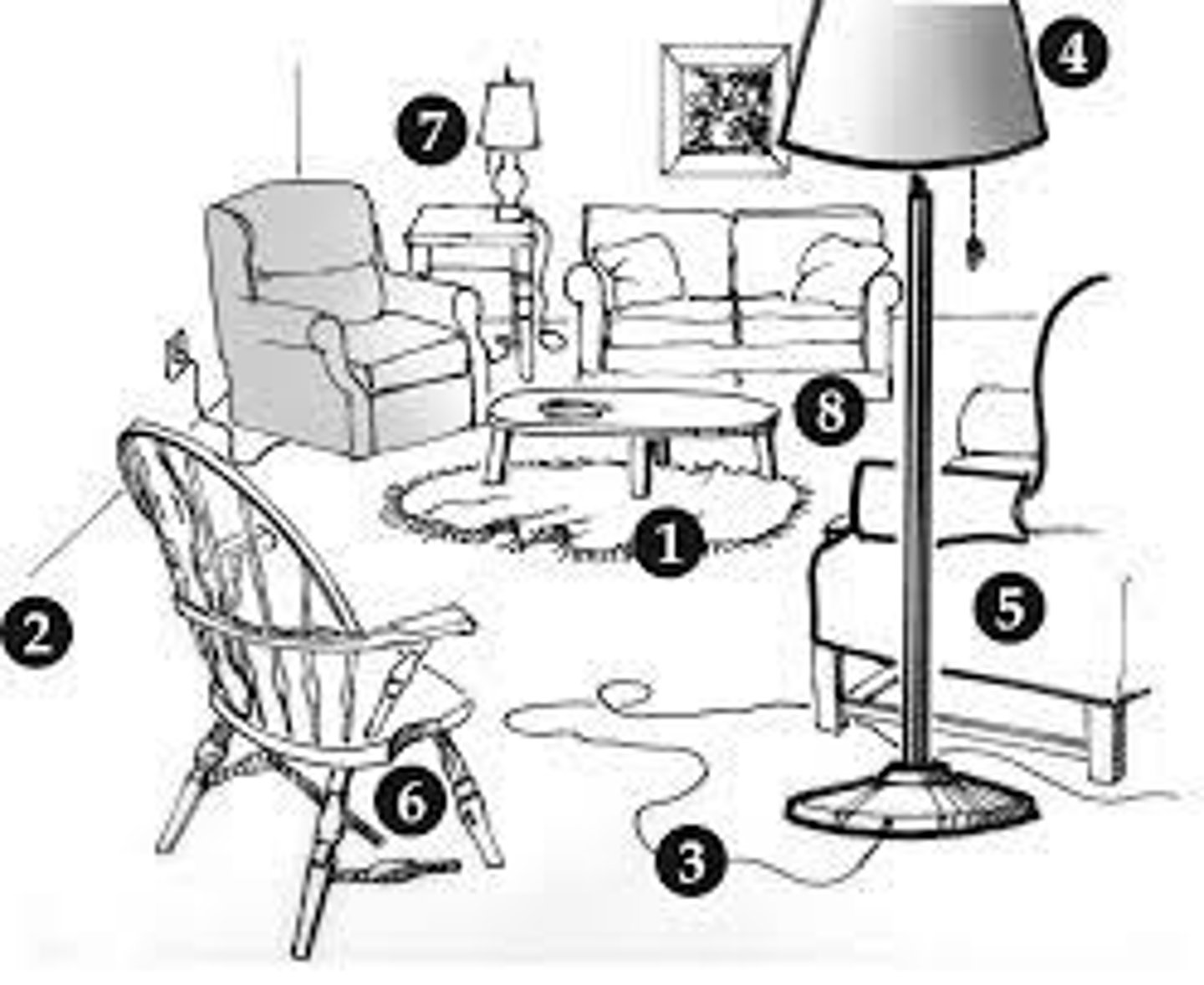
items to consider around the home
- access (door, garage, elevator)
- driveway
- steps (inside and outside)
- doorbell or security system
- fire alarm system/detectors
- door knobs/handles
- railings
- floor surface
- lighting
- clutter
- cords
- furniture
- doorways
- ramps
- bathroom layout

safety in house, think about
fire extinguishers
smoke detectors
evacuation plan phone numbers in plain sight
clutter
access to water shut off
ability to exit

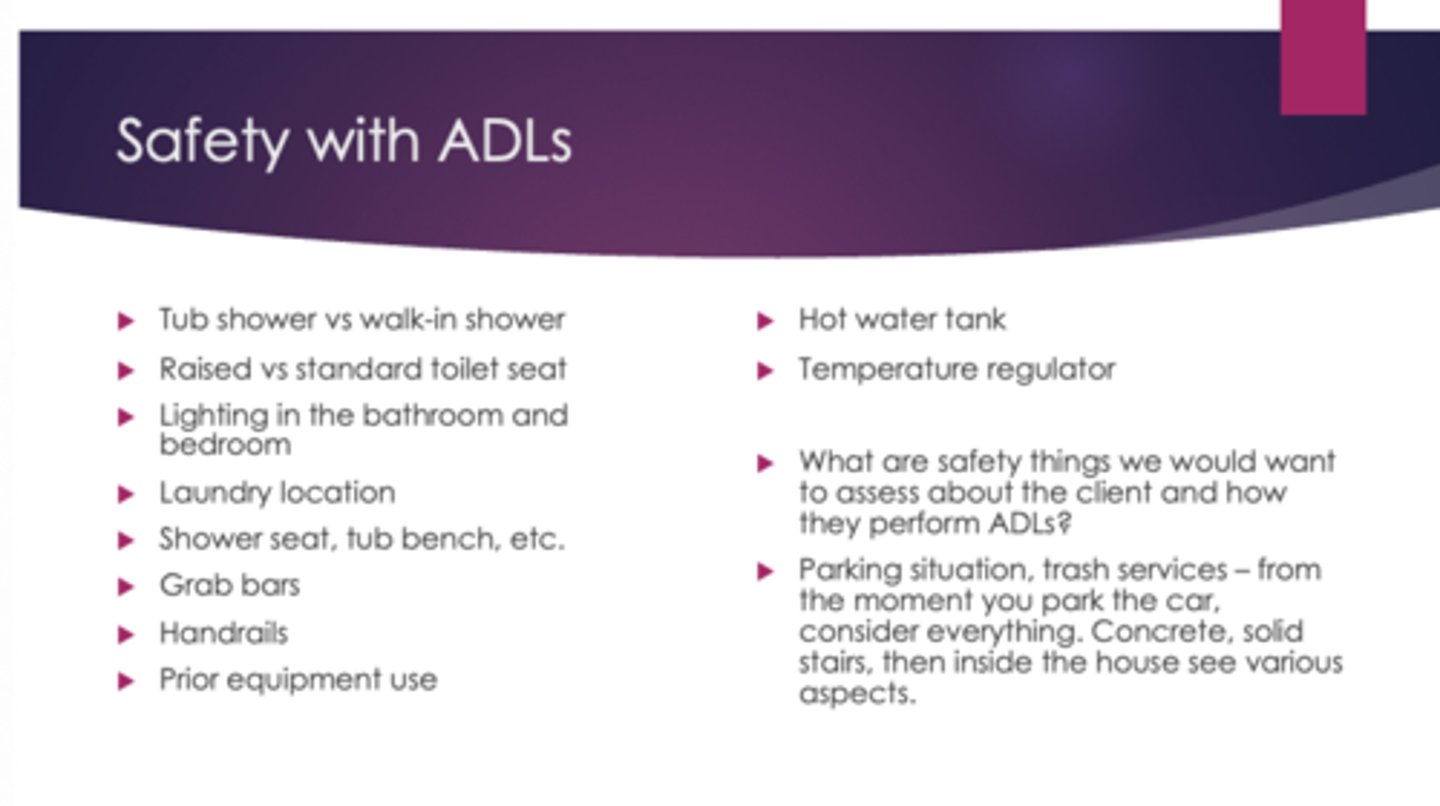
Safety with ADLs
- shower
- toilet seat
- laundry
- shower ...
- hand
- prior
- hot water
- temp
- tub shower or walk in shower
- raised or regular toilet seat?
- laundry location
- shower seat, TTB?
- hand rails
- prior equipment use
- hot water tank
-temperature regulator
HSSAT
home safety self assessment
HEAP
home environment assessment protocl
I-HOPE
In-Home Occupational Performance Evaluation
other assessments of home safety are
deficit dependent (vision, mobility, needs for devices.)
Ergonomics
the study of people's efficiency in their working environment - functional mobility and body mechanics
ethical considerations for practical, technical, and ethical issues with assessing functional mobility and body mechanics
1E - respect the practices, compentencies, roles, and responsibilities of your own profession and others to promote a collaborative envrionment reflective of IPE teams (fidelity)
2C - do not threaten, manipulate, coerce, or decieve clients to promote compliance to OT (autonomy)
functional mobility includes
bed mobility
transfers
ambulation
w/c mobility
monitor symptoms with
first mobility
OH
SBP drops >20mmHg w change in posture
allow patients to
accomodate to positions changes - consider garments in severe cases
bed mobility includes
rolling
scooting up
supine to sit
sit to suping
safety in bed mobility (4)
- prevent rolling off bed
- lines and tubes (prevent impeding or pulling lines/tubes reposition PRIOR to move
- lower bed such that feet are on the floor
- prevent sliding off of side of mattress
transfers steps
1. scoot to EOM
2. sit to stand
3. pivot or step over
4. stand to sit
Ensure they are wearing
If they are just sitting
use a
ensure wearing non slip footwear
if they are just sitting, use a towel on floor
use a gait belt
proper procedure for sit to stand
1. scoot to edge
2. lean forward (noes over toes) if appropriate
3. push up
when do you clear the floor?
once they're up
when returning to sit from stand (2)
clear BEFORE standing
once up - check status
when returning to sit from stand bring hands to reach back and feel target surgace on back of legs
helpful hints for transfer
position your self on their weak side (side!)
place foot in front of their feet, stabilize knee
when assisting in lift, forward = up importance
keep COG aligned w/ client's
safety for the therapist
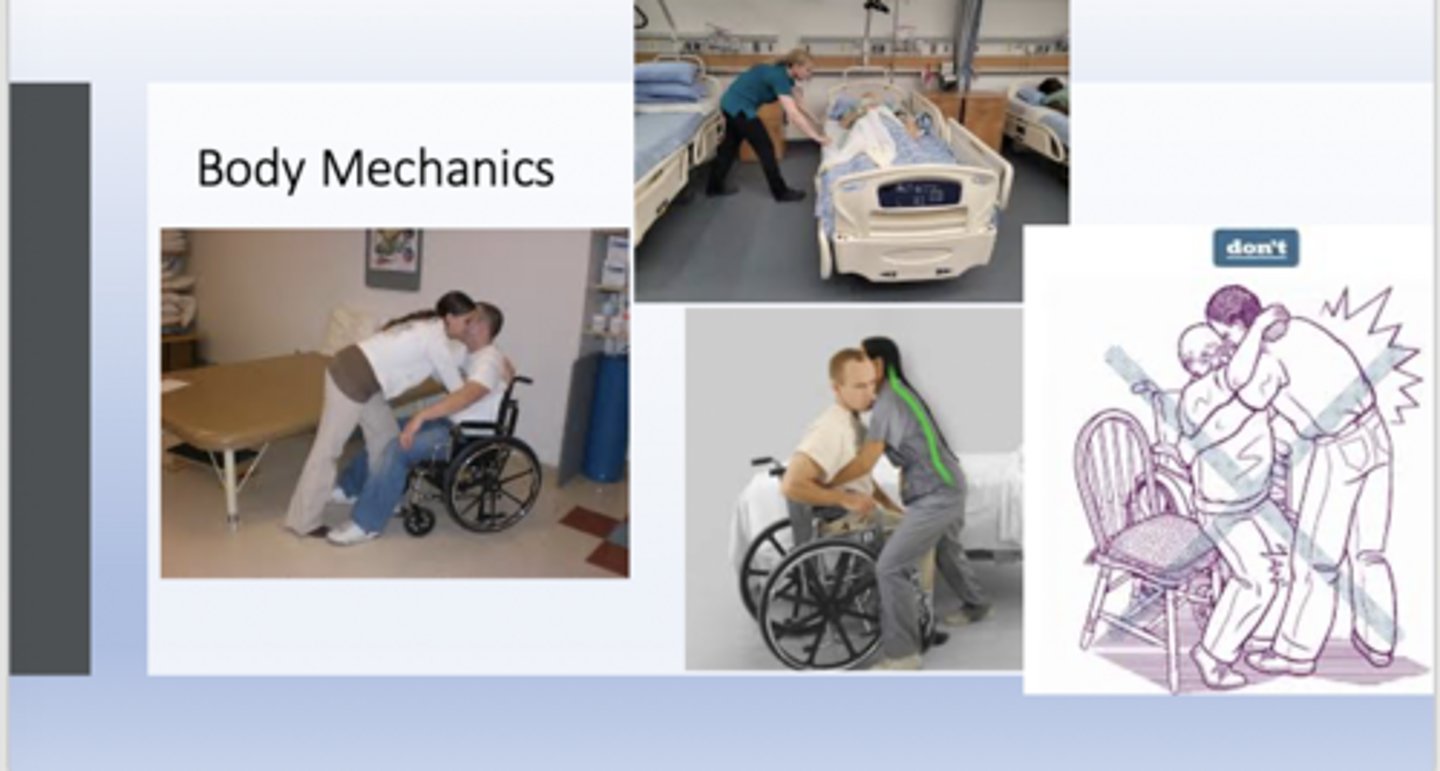
body mechanics!!!:
- get help
- bend your knees
- avoid twisting
- keep COG aligned
- keep close
- yell for help
- rest BW of client on you
- lower to the ground
- go down w them, if necessary
some gait faciliters require these - can be helpful if...
some facilities require gait belts
- can be helpful if used right
- must be tight
- careful of placement
- does not replace proper biomechanics!!!
LOA with bed mobility and transfer
Determined by how much of Pt's weight YOU assist with - using your professional judgement as MIN A for someone who is 200lbs may be more work than DEP 90 lbs persons
- consider the lift over the entire activity (up and down)
PAC
physical assistance category - how much do you feel you provided - so you use % in this form of measurement ...
Ambulation includes
step off
stride size
turning
stopping
use of assistive device
wheeled mobility (3)
ability to propel chair
control direction
distance
ambulation safety (6)
- ensure device is properly adjusted
- non slip footwear
- therapist is close
- bring chair behind
- clear pathway
- use gait belt
LOA for ambulation and wheeled mobility
think about assistance and distanace
- if the person requires no help but can only go 50' it is a high level of assist
must consider both!!!
body mechanics (6)
- tuck your tail bone
- solid BPS
- engage core to protect back
- deepen squat
- slight bend in elbow
- head between ct. head and the target location (i.e. w/c)
Who can look at functional mobility?
Both PT and OT. Typically, OT is gonna look at tub and toilet transfer.
Typically, PT can select the mobility device, but OT must be able to facilitate safe use of that device.
quality of life
-OTPF: the dynamic appraisal of ones life satisfaction (perception of progress toward goals), self-concept (beliefs and feelings about oneself), health and functioning (health status), and SES factors (vocation, income, education0
- WHO - an individuals perception of their position in life in the context of their culture and value systems and in relation to their goals and expectation, standards and out comes
QOL is an _______ of therapeutic intervention
quality of life is an outcome of therapuetic intervention
life satisfaction
an indicator of psychological well-being, which can be described as a cognitive assessment or response that people make about their own lives - overall assessment of their own existence based on comparison of achievements and aspirations
self-concept
our personal knowledge of who we are, encompassing our thoughts and feelings about ourselves (physically, socially, and personally) & our knowledge about how we behave, our capabilites, and out individual characteristics
health
a state of complete physical, mental, and social well-being and not merely the absence of disease or infirmity
QOL is a 1-4
broad concept:
- therapy can only intervene in some aspects
- many measures are disease specific
- comprehensive measures are broad and time intensive
- perception of QOL is insight dependent
WHOQOL-BREF
•WHOQOL (100 item assessment) WHOQOL-BREF is 26 item assessment.
•The WHOQOL-BREF should be self-administered if respondents have sufficient ability.
•Will derive four domain scores. Domain scores scaled in positive direction so higher score = higher QOL.
•Mean score of items in each domain are used to calculate the domain score.
•Can leave 1 blank only in each domain!
•Think about life in the past 2 weeks.
•Use the table on page 1 for scoring (says for office use only). Then put their score for each Q in the small box. For the ones that say 6-Q3, use the reverse score - so if they put 2, answer is 4.
•Add up the scores to find raw score.
•Then go to page 11 table 4 to find transformed scores.
** client ranks 5 items on a 7 point scale

The goal of the KELS
provide info used to match a person's strengths and their living environment - allowing them to live safely in the LRE
- combines tasks and interview questions
KELS may be used for
D/C planning
identify problem areas for interention
used in court for determination of commitment and gravely disabled cases
KELs can be used in these settings (8)
IPR
IP mental health
IP burns
HH
OP
hands
SNF
acute care

Administration and before formal intro of the KELs
- must read word for word!!!! (standardized)
- stay on subject
- do NOT give feedback throughout evaluation
- client sit across or to the left
need to get background indo like where is the residence, who do they live with, does they use electronic banking, do they use a cell phone, etc.

Possible scores of the KELS and what does score reflect
the scores reflect current status
Independent = level of competency needed to perform basic living skills in a manner that maintains the client's safety and health without the direct assistance of other people
Needs assistance = should not be viewd as negative or abnormal - doesn't mean theyre incapable of living alone - requires or has assistance with some daily living skills
Not applicable = used for an item that doesnt pertain to ct
See note - cant be clearly scored IND or needs assistance
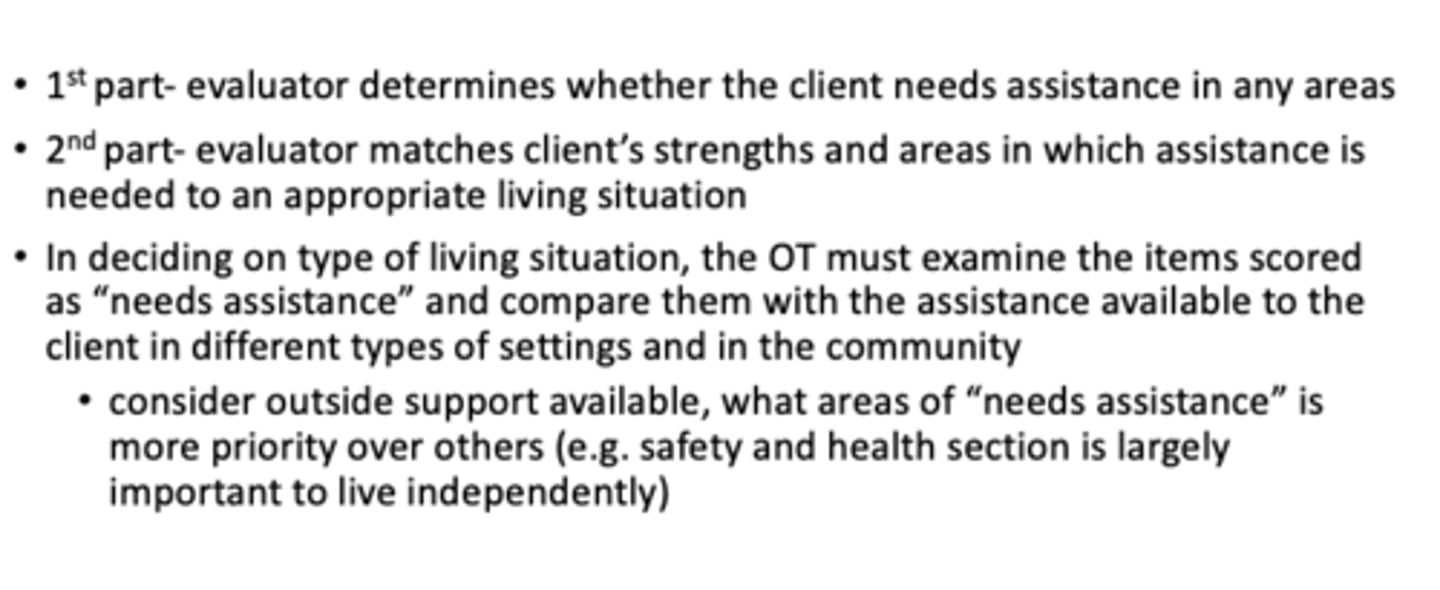
KELs explanation
- First give the reading and writing form, say first do this, then you'll do self care, money management, and safety health/etc.
- One each paper with the directions there are minimum standards and this is how you decide if theyre independent or need assistance, then you put it on the score sheet.
- making d/c plans and recommendations for the KELs
- Fill out the summary page based on the scoring form - then make justification as to why you choose this D/c plan - maybe they would benefit from leisure based occupational therapy if they only identified 1 leisure occupation - the book says 3 - so just look at what the booklet says and then make decisions based on the apparatus in which they "need assistance"

things to consider during playground evaluation
inclusivity
accessibility
ramps
surface
seating
play components
play is a primary occupation of children, OTs are experts in environment evaluation and modification, as well as activity analysis
ADA standards for playground
1. Must have an accessible route from parking to playground
2. Must be able to access ground and elevated components (independently or transfer system)
3. Water components must also have a transfer system (Not all w/c go in water, tho)
% regarding transfer systems?
only 25% of elevated equipment are to be accessed ONLY by transfer system
Accessible routes
accessible routes are to be a minimum width of 60''
However, can be decreased to 36" for a max distance of 60" as long as they are broken up by segments that are 60'' wide as well
Playgrounds less than
playgrounds less than 1000 sq ft can have accessible route minimum of 44" wide
routes connected to
routes connected to elevated play components must be 60" wide as well
- but these can be decreased to 32" wide for a distance of 24" as long as they are broken up by segments that are 48" at least
group level ramps slope
not to be steeper than 1:16
transfer stations
provided where transfer is intended from mobility device/w/c
- level
- 24" wide
- 14" deep
- 11-18" from ground

other play areas must have
adequate turning spaces
playtables
17 deep
24 high
30 wide
Reach ranges (high and low)
3-4: 36", 20"
5-8: 40", 18"
9-12: 44", 16"
Principles of Universal Design
 Note
Note  Flashcards (55)