2. Electrical Circuits
 Call Kai
 Learn
Learn Practice Test
 Spaced Repetition
 Match
Match Flashcards
 Knowt Play
1/7

There's no tags or description
Looks like no tags are added yet.
Name | Mastery | Learn | Test | Matching | Spaced | Call with Kai |
|---|
No analytics yet
Send a link to your students to track their progress
8 Terms
What is Kirchhoff’s second law?
The sum of e.m.f.s = the sum of p.d.s in a closed loop
Why does Kirchhoff’s second law exist?
Due to the conservation of energy
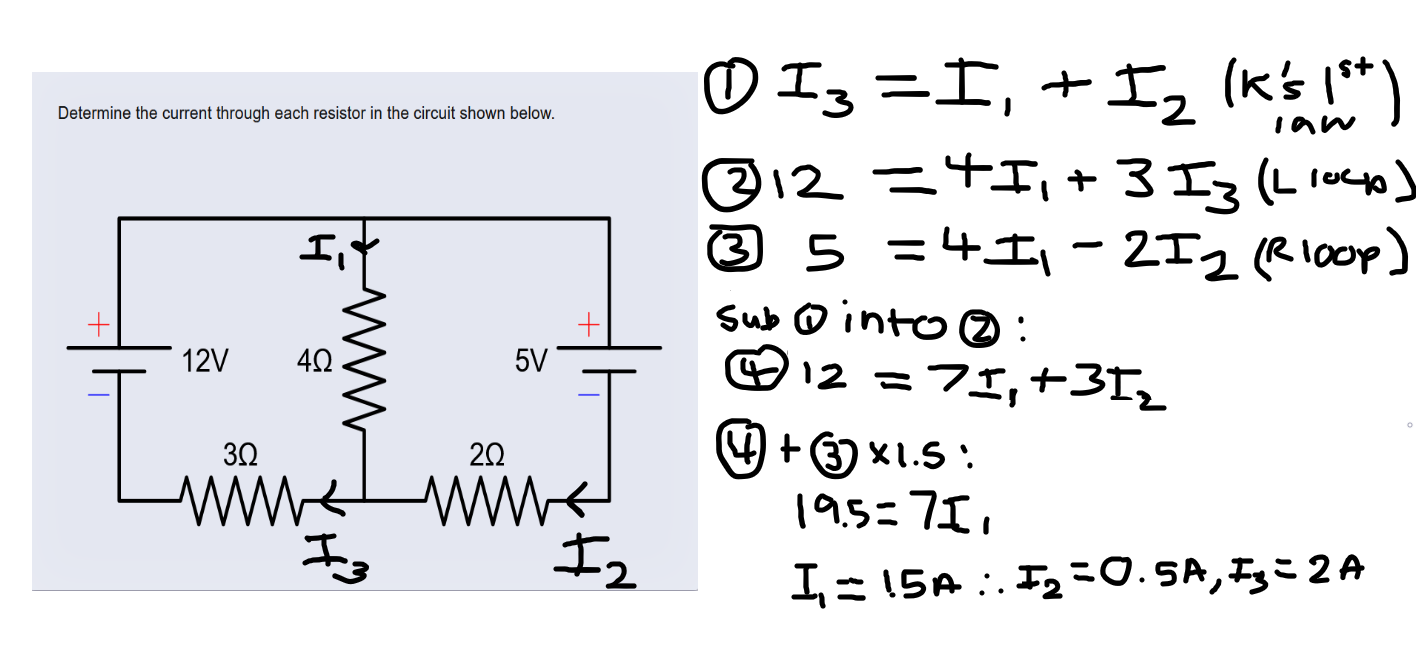
How to do a Kirchhoff’s laws calculation question?
Label different currents on circuit as I1, I2 etc
Use Kirchhoff’s first law to form your first equation
Use Kirchhoff’s second law to form your other equations - split the circuit into loops (to find sum of e.m.f. add source e.m.f.s + to find sum of p.d.s use V = IR)
Solve using simultaneous equations
If current is negative then direction is wrong
How to find the total resistance of a series circuit?
Add the individual resistances of the components together
How to find the total resistance of a parallel Circuit?
1/RT = 1/R1 + 1/R2 + 1/R3 etc (where R1 is the resistance of a branch in the circuit)
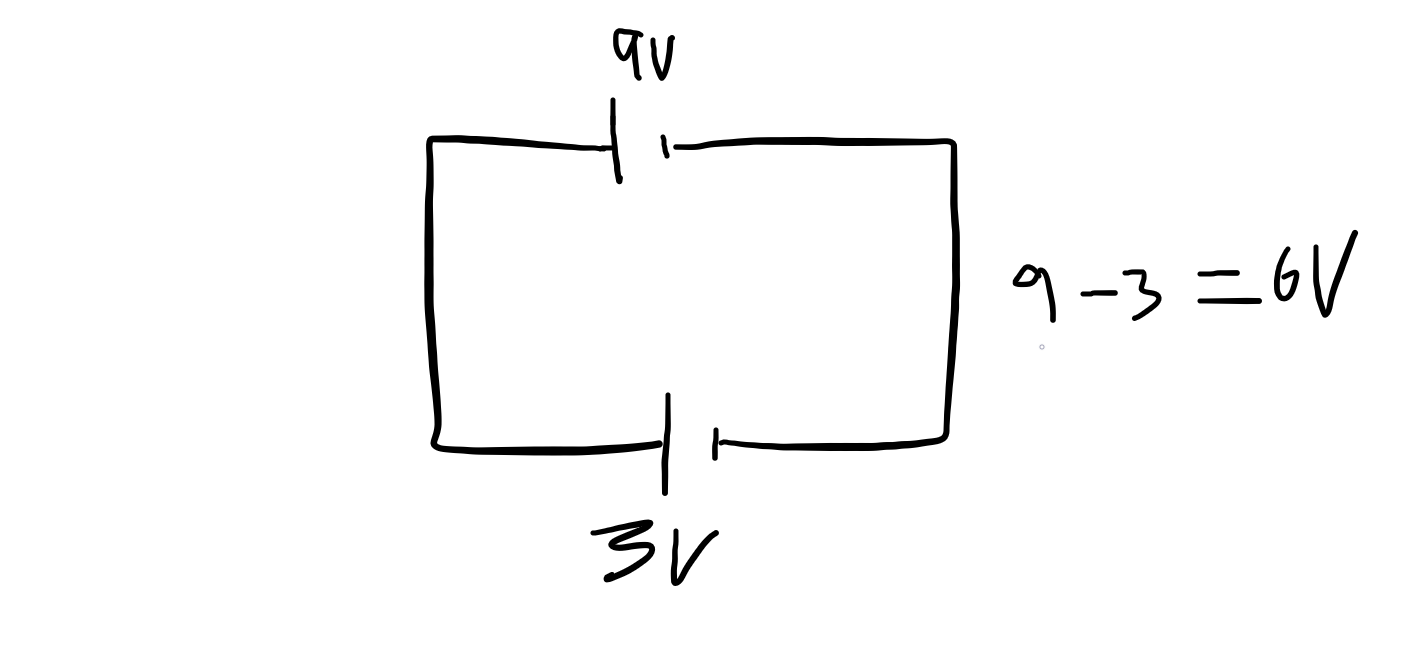
What is the e.m.f. of a circuit with more than 1 source?
e.m.f. of circuit = sum of e.m.f. of sources
If a source is the wrong way then subtract its e.m.f for the e.m.f. of the circuit
What is a potential divider + equations?
Potential divider - 2 resistors in series used to split p.d.
Vout = R1 / (R1 + R2) x Vin
V1 / V2 = R1 / R2
How to investigate the potential divider?
Setup a circuit with a battery, fixed resistor, LDR/thermistor + voltmeter across the LDR/thermistor
Vary light intensity (e.g by putting tracing paper over the LDR) or temperature (e.g by putting thermistor in boiling water + then adding cold water)
Record reading on voltmeter

