UNIT 2: Transport across membranes
 Call Kai
 Learn
Learn Practice Test
 Spaced Repetition
 Match
Match Flashcards
 Knowt Play
1/27

There's no tags or description
Looks like no tags are added yet.
Name | Mastery | Learn | Test | Matching | Spaced | Call with Kai |
|---|
No analytics yet
Send a link to your students to track their progress
28 Terms
What are the 3 main functions of plasma membranes ?
To control the transport of substances into and out of the cell or organelle. Membranes allow certain molecule to pass through, but not other - partially permeable
To act as a recpetor site to recognise chemicals which need to enter the cell or organelle
To seperate off the cell from the environement and the different reactions of the celll from each other by forming the organelles
What is the Cell-Surface membrane described as and why ?
Fluid mosaic model: This is due to the mixture and movement of the
Phospholipid
Membrane Proteins
Glycoprotein
Glycolipid
Cholesterol
How is the Membrane structured overall
All of these molecules arranged within the phospholipid bilayer create the partially permeable membrane, that is the cell-surface and organelle membrane
How are the Phospholipids arranged in the bilayer ?
The Hydrophobic tails all point towards each other
The Hydrophillic heads point out into the water
Draw a labelled diagram of a Phospholipid
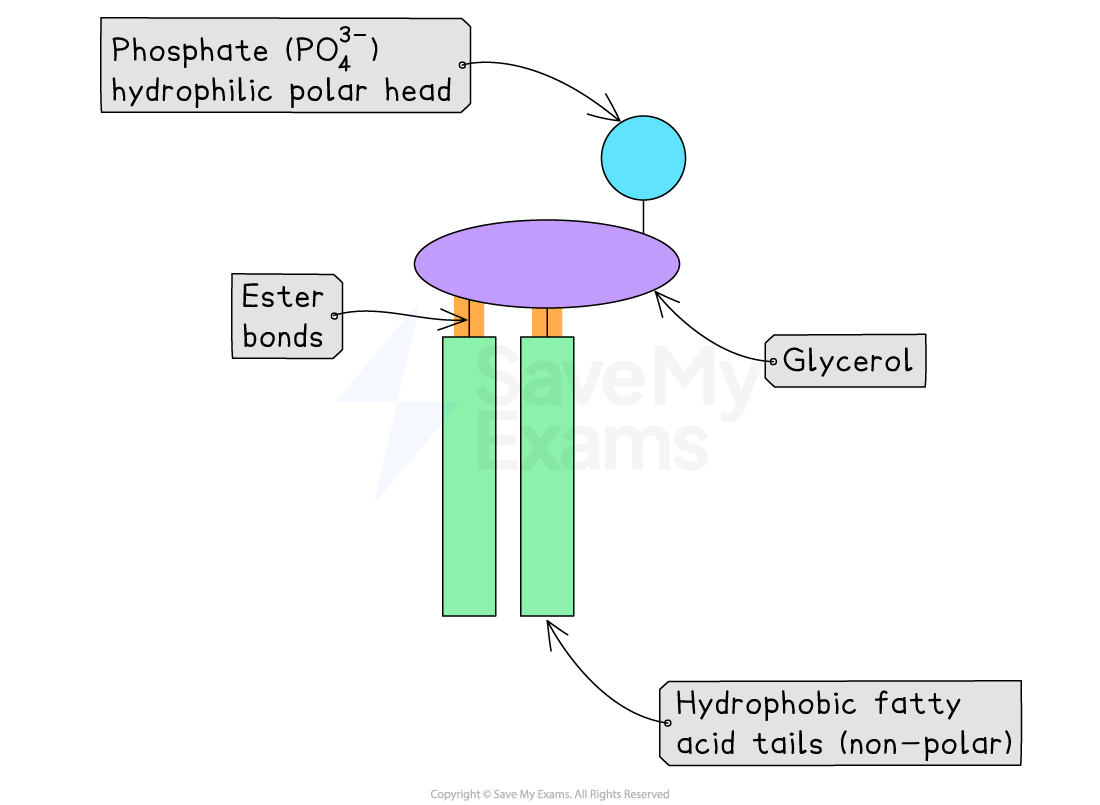
Function of Peripheral Proteins
Peripheral proteins do not extend completely across the membrane
They provide mechanical support, as well as carbohydrate chains that are connected to proteins or lipids to make Glycoproteins and glycolipids
Function of these is Cell recognition, as receptors
Function of Integral Proteins
These are protein carriers or channels proteins involved in the transport of a molecule across the membrane
Protein channels: Form tubes that fill with water to enable water-soluble ions to Diffuse
Carrier Protein: These bind with other larger molecules e.g glucose, amino acids and change shape to transport them to the inside of the cell or organelle
Function of Cholesterol
This restricts the Lateral movement of other molecules making up the membrane and increases strength and stability of membranes by making them less flexible
Helps prevent water loss and dissolved ions from the cell
State some Molecules that pass through the plasma membrane
Lipid soluble substances - hormones
Very small molecules e.g CO₂, O₂, H₂O
State molecules that cannot pass through the membrane
Water-soluble (polar) substances e.g Sodium ions
Large molecules - Glucose
What are the 4 Key types of Transport ?
Simple Diffusion
Facilitated Diffusion
Active Transport
Osmosis
Explain what Simple Diffusion is ?
The net movement of molecules from an area of high concentration to an area of low concentration until equilibrium is reached
This process does not require ATP and therefore it is a Passive process
Movement of molecules by simple diffusion is due to Kinetic energy they possess to enable them to constantly move in fluids
What most molecules be for simple diffusion to take place ?
For molecules to diffuse across the membrane they must be lipid-soluble and small
What are the main two adaptations to increase the rate of these 4 types of transport ?
Involves increasing the surface area
Increasing the number of protein channels and carrier molecules in the membrane
What are the factors that affect Diffusion and what is the Law called ?
Fick’s Law
Surface area x difference in concentration / Thickness of exchange surface
To increase Diffusion rate what must we do to each of the factors
Maximise the surface area
Maximise the concentration difference
Minimise the thickness of the exchnage surface
Explain the process of Facilitated Diffusion ?
This is a Passive process (does not require ATP)
This differs from simple diffusion as now membrane proteins are used to transport molecules
Ions are polar molecules, which cannot simply diffuse, can be transported across the membrane by facilitated diffusion using protein channels and carrier proteins
Explain the proccess of Osmosis
This is the net movement of water from an area of high water potential to an area of low water potential across a partially permeable membrane
Define the term water potential and what is it measures in ?
Water potential is the pressure created by water molecules
Measured in kPa
What is the Water potential of Pure water ?
Pure water has a water potential of Zero
When solutes are dissolved in water the water potential will become negative
What does it mean if the Water potential is Negative ?
The more negative the water potential, the more solute must be dissolved in it
Name the 3 Types of solution, explain what they are and affect on animal cells ?
Isotonic solution: when the water potential of the solution is the same as the water potential of the cell
When animal cells are placed in this solution, there is no net osmotic movement of water (no water potential gradient) and so the shape and size of the cell remains the same
Hypotonic solution (Dilute solution/ high water potential) : A dilute solution will have a high water potential than the cell
Water will enter the cell by osmosis. The cell swells and eventually bursts, when the pressure inside the cell becomes too great - osmotic lysis
Hypertonic Solution (concentrated solution/low water potential): This is when the water potential is more negative than the cell
Water will leave the cell by osmosis, causing the cell to shrink - crenate
What happens to Plant cells when placed in a Hypertonic solution ?
Lower water potential than the cell
Water leaves the plants cytoplasm and vacuole by osmosis
This cases the cytoplasm to shrink away from the cell wall leaving gaps between the cell membrane and the cell wall - filled with concentrated soltuion of salt
Plasmolysis
What happens to Plant cells when placed in Hypotonic solution?
A dilute solution- have a higher water potential than the cell
Water enters the cell by osmosis
The cyctoplasm and vacuole gains some water, but because of the high tensile strength of the cellulose cell wall the cell will not burst - it becomes turgid
Explain the process of Active Transport
The movement of molecules and ions from an area of low concentration to an area of high concentration against the concentration gradient, using ATP and carrier proteins
The Carrier proteins act as pumps to move substances across the membrane
Process is very selective, as only certian molecules can bind to the carrier proteins to be pumped
What role does ATP play in changing the shape of carrier proteins during active transport?
Certain molecules can bind to the receptor site on carrier proteins. ATP will bind to the protein on the inside of the membrane and is hydrolysed into ADP and Pi. This causes the protein to change shape and open towards the inside of the membrane.
This causes the molecule to be released on the other side of the membrane. The Pi molecule is then released from the protein, and this results in the protein reverting to its original shape. This is how ATP and carrier proteins are used in active transport.
Why may Co-transport be used ?
To absorb glucose from the lumen of the intestines into the
epithelial cells, there must be a higher concentration of
glucose in the lumen compared to the epithelial cell (for
facilitated diffusion). However, there is usually more glucose in
the epithelial cells and this is why active transport is needed.
Explain the process of Co-transport of Glucose and Amino acids
Sodium Ions (Na⁺) are actively transported out of the epithelial cell into the blood in the capillary
Only recognises Sodium ions and glucose as there are binding sites with a specific tertiary structure - complementary shape
This reduces the Sodium ion concentration of the epithelial cell
Sodium ions can then diffuse from the lumen down their concentration gradient into the epithelial cell
The protein, the sodium ions diffuse through is a co-transporter protein, so either glucose or amino acids also attach and are transported into the epithelial cell against their concentration gradient
Glucose then moves by facilitated diffusion from the epithelial cell to the blood

