ap physics c electrostatics & potential - january 2026
 Studied by 1 person
 Call Kai
 Learn
Learn Practice Test
 Spaced Repetition
 Match
Match Flashcards
 Knowt Play
1/62

There's no tags or description
Looks like no tags are added yet.
Name | Mastery | Learn | Test | Matching | Spaced | Call with Kai |
|---|
No analytics yet
Send a link to your students to track their progress
63 Terms
e
1.6 × 10⁻¹⁹
k
9 × 10⁹
εo
8.85 × 10⁻¹²
electric flux
φ = EAcosθ = Qenc/εo
charge densities
ρ = Q/Volume
σ = Q/Area
λ = Q/Length
V due to multiple charges
k ∑ q/r
U due to multiple charges
k ∑ q1q2/r12
U of a system
W needed to bring in charges from ∞
k ∑ q1q2/r12 but for all charges with each other
V for point near finite line
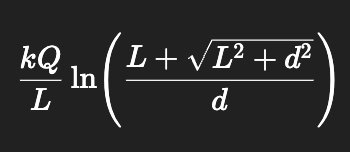
if point P is the perpendicular bisector of the line, treat each half as a separate finite line and then add the results
where L is the length of the finite line and d is the distance of the point to the line
V for point near a disc of charge
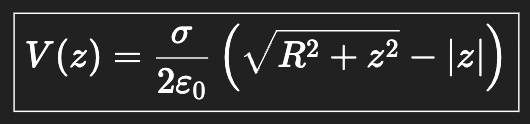
process for solving for V of a distribution of charge
V = ∫kdq/r
figure out dq using the charge density
figure out r using the location of the test charge
using bounds, solve the integral
calculating E from V
E = -∇ V
V of a charged conductor
constant inside & equal to the V on its surface
E is 0 inside, so no work is required to move a charge inside
ΔV is 0 going from the surface of a conductor to a point inside a conductor, as well as between any points two inside a conductor
the graph of V over r depends on the geometry of the conductor
for a sphere or point charge, the graph will be V∝1/r after R
two charged conductors connected with a metal wire
final V of both conductors become equal to one another
use kq/r = kQ/r & conservation q+Q=q+Q
ΔV near infinite line of charge
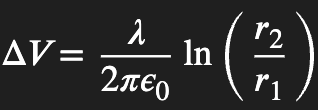
really easy to solve for just knowing E
ΔV near insulating plane
σ/2ε (rb-ra)
ΔV near insulating cylinder

V inside insulating sphere

V outside sphere
same as point charge
area & volume of a sphere
A = 4πR²
V = (4/3)πR3
area & volume of a cylinder
A = 2πRL (main) + 2πR²
V = πR²L
ρ & λ of a cylinder
Q = ρ(πR²L)
λ=Q/L=ρπR²
E inside of a conductor
= 0
Disjointed E
With an off-center charge (+Q) inside of a hollow conductor, the (-Q) on the inner surface will be off-center.
However, +Q on the outside surface will be evenly distributed.
There is no communication between the inside & outside surfaces of a hollow conductor.
E due to an infinite line of charge
E = λ/2πεor
E due to an infinite insulating flat sheet
E = σ/2εo
E due to an infinite conducting flat sheet
E = σ/εo
twice as big because the charges are more concentrated
E due to two parallel infinite insulating sheets
Enet = σ1/2εo (ř1) + σ2/2εo (ř2) → basically just adding up the Es
in the middle: E1-E2
on the right or left: E1+E2
E due to two parallel infinite conducting sheets
inside charges are equal & opposite
outside charges are equal
E between plates = |(q1-q2)/2| / Aεo
E outside plates = |(q1+q2)/2| / Aεo
E inside an insulating sphere
E = ρr/3εo = kQr/R3
E outside a sphere
same as point charge
E inside an insulating cylinder
E = ρr/2εo
E outside of a cylinder
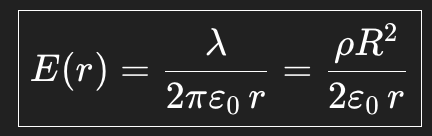
ΔU =
= -W
=-∫F⋅dr
= kqQ/r
= qtΔV
E =
E = F/q
= kQ/r2
= ∫k*dq/r2
F =
(newton’s second law)
F = qE = ma
or Coulomb’s law
ΔV
ΔV
= ΔU/q
= -∫E⋅dr = V(B)-V(A) with the bounds of the integral being A on the bottom and B on top
= ∫k*dq/r
= kQ/r (for point charge or outside a spherically symmetric charge)
work done by E
W
= ∫F•dr
= q∫E•dr
= -qΔV
=-ΔU
U depending on charge
like charges → U>0
opposite charges → U<0
so if you move positive charge against electric field or move a negative charge with the electric field ΔU>0
FE compared to FG
FE is much stronger than FG
Electric dipole
Two equal but opposite charges (Qnet = 0)
Electric field goes from…
higher potential (more positive) to lower potential (more negative)
Higher potential means a more ____ charge
positive
Units for UE & V
UE can be Joules, Volt-Coulombs, Newton-Meters
V can be Volts, Newton-Meters/Coulomb
Why can’t same-sign charges produce a zero potential point (finite)?
Both have the same sign, so they cannot cancel
For opposite charges, where is V=0 located relative to the charges?
Closer to the smaller magnitude charge
How to find field from potential graphically?
Slope of V(x) is -E(x)
E=-dV/dx
E inside a metallic shell?
0
Approximating using a point with a distance from the object that is very small compared to the length of the object
Treat the object as infinitely long
Electrostatic induction
bringing a charged object next to a conductor attracts electrons from the object
What is the place where the force in the +x direction for a + charge is maximized on a V vs. X graph?
Where the slope of V has a negative value with the greatest magnitude
Where is the force zero on a V vs. X graph?
Where the slope of the potential curve is zero
What regions are positive charges attracted to?
Regions of lower potential!
How do you draw E using equipotential lines
Know that the electric field is always perpendicular to equipotential lines & the electric field points from higher to lower potential
Stuff about enclosed charge and flux
If the enclosed charge is zero, the net flux must be zero (but the field at every point along the surface doesn’t have to be zero because it could be positive at some locations and negative along others).
If the electric flux is zero, the net charge must be zero. (Could still have charge!)
Charge outside the Gaussian surface does not affect the net electric flux but it does affect the field along it.
W =
-delta U
½ mv² =
-delta U
work done by an electric field
q delta V
Three spheres with different charge density distributions but the same charge
Field & potential is identical outside the spheres
The closer the charge is to the center of the sphere, the greater the potential is at the center of the sphere.
For a particle to escape to infinity
The particle must have at least zero total energy
KE = qV = 1/2mv²
(Q)(Q/4piepsilon0a) = 1/2mv²
The charge is all the same distance from the point
Just do kq/r
What are equipotential lines?
Lines perpendicular to the electric field lines, where the electric potential is the same anywhere on the line.
No work is done when moving between points on an equipotential line.
E between 2 parallel charged plates
Ed = VAB
 Note
Note  Flashcards (342)