EXAM 2 Objectives
 Studied by 1 person
 Call Kai
 Learn
Learn Practice Test
 Spaced Repetition
 Match
Match Flashcards
 Knowt Play
1/114

There's no tags or description
Looks like no tags are added yet.
Name | Mastery | Learn | Test | Matching | Spaced | Call with Kai |
|---|
No analytics yet
Send a link to your students to track their progress
115 Terms
explain the importance of nodes on a phylogenetic tree in determining evolutionary relationships
they represent the common ancestors of those descendants
includes all the groups we are interested in figuring out relationships
ingroup
a group of organisms that don’t belong to those being studied
outgroup
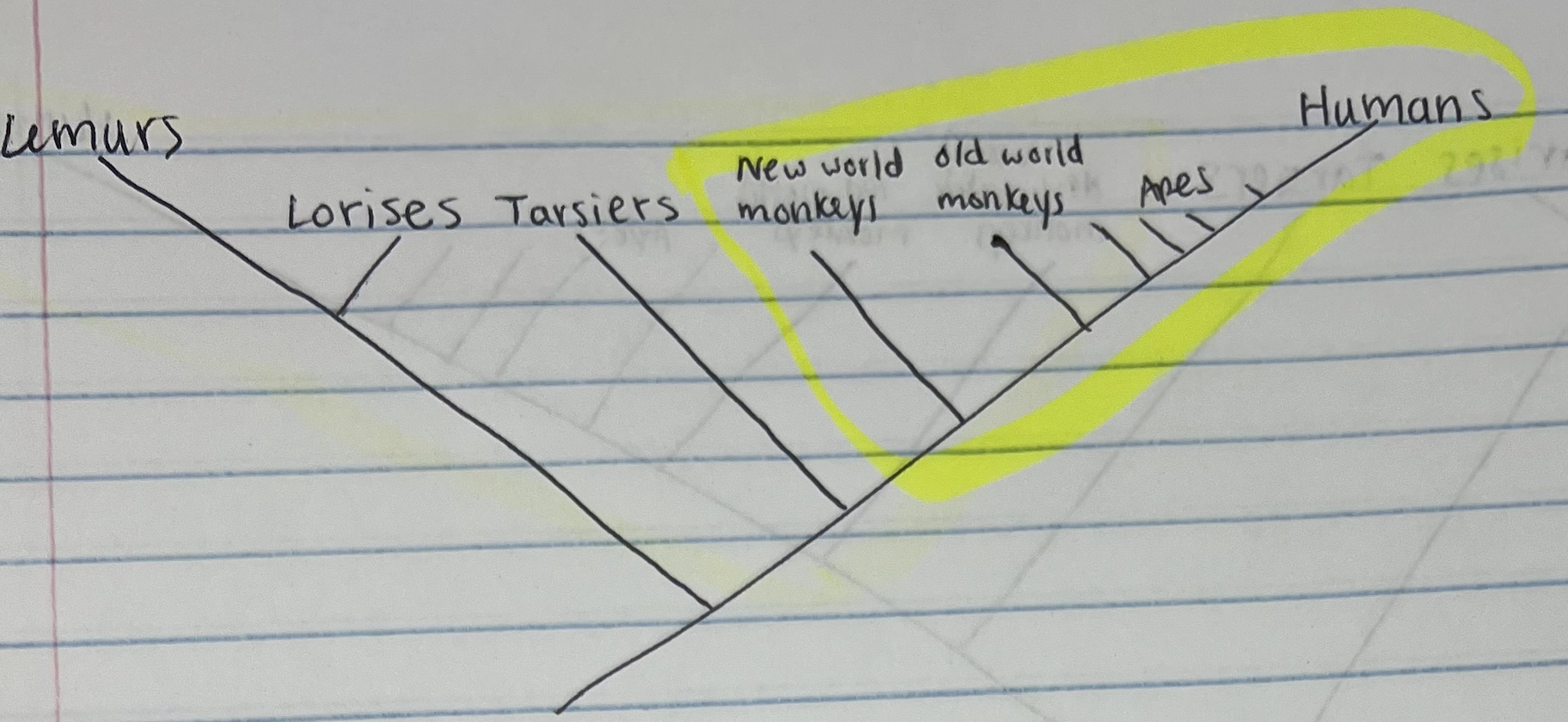
contains an ancestor and all of its descendants
monophyletic group
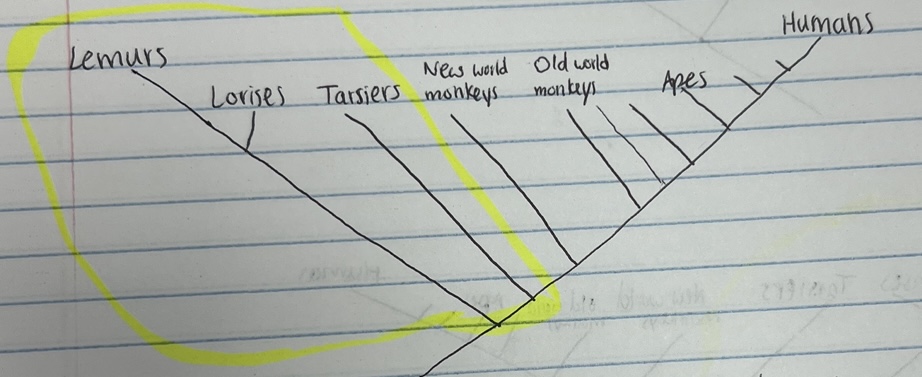
contains a common ancestor and only some of the descendants of that ancestor
paraphyletic group
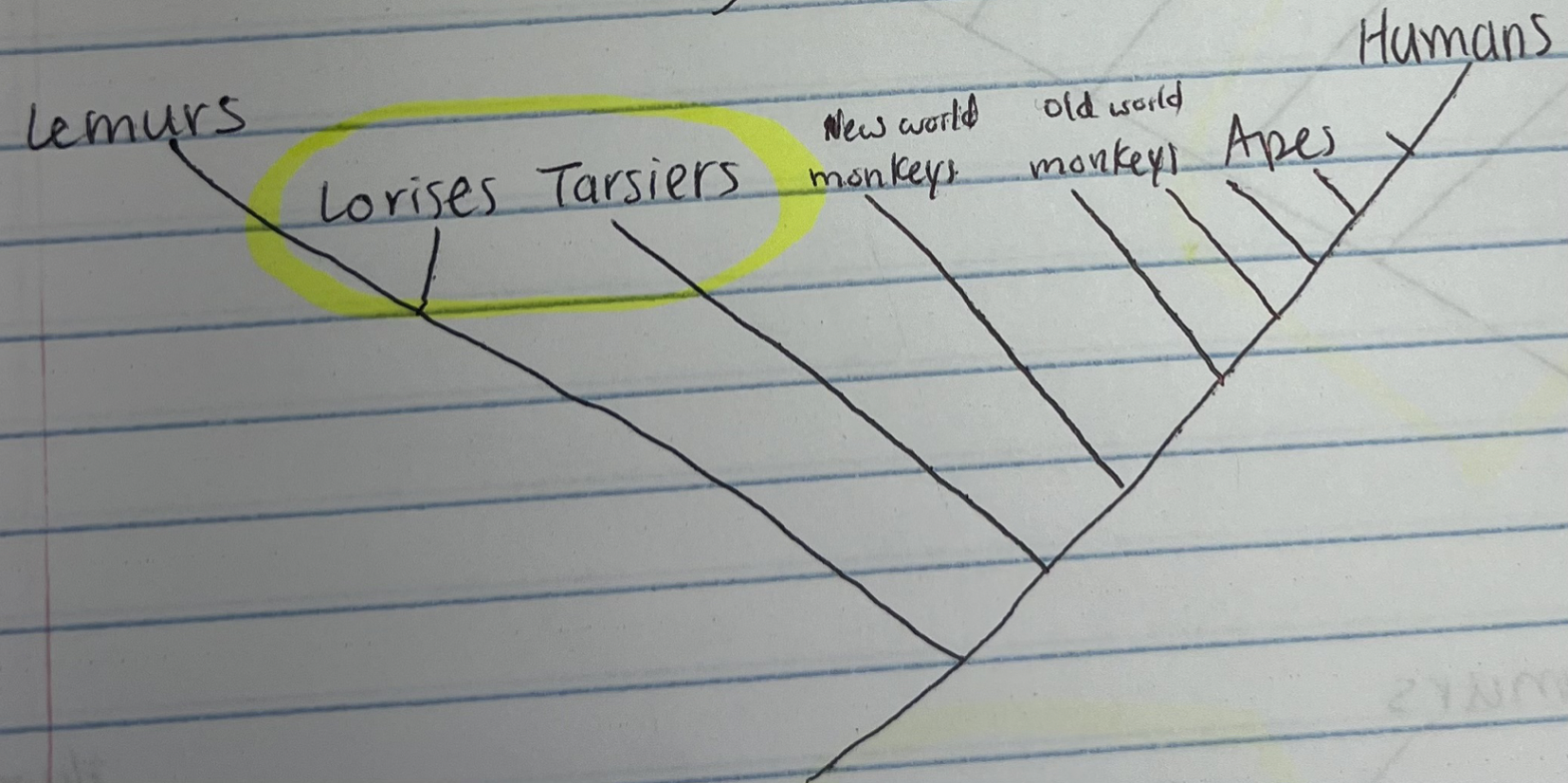
do not share a common ancestor
polyphyletic group
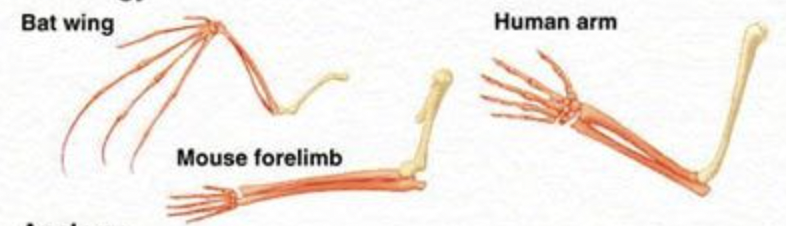
save function & evolutionary origin
homologous characters
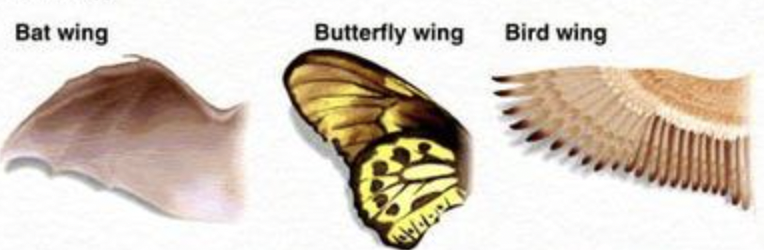
similar function but different evolutionary origin
analogous characters
belongs to everyone in the group
ancestral characters
new trait that evolved within a smaller group of organisms
derived characters
what is the role of synapomorphies (derived characters) in constructing a phylogenetic tree
they provide evidence of evolutionary relationships & help determine which groups share a common ancestor
explain the utility of molecular data in constructing a phylogenetic tree
they compare the sequences of their evolutionary related genes/proteins
explain the principle of parsimony regarding phylogenetic trees
2 hypotheses about vertebrate relationships
what is the importance of sex in maintaining genetic diversity?
allows for the mixing & combination of genes from 2 individuals, creating new genetic combinations in offspring (it does not always increase variation)
zygotic meiosis
haplontic life cycle
gametic meiosis
diplontic life cycle
sporic meiosis
haplodiplontic life cycle (alternation of generations)
explain why protists are a paraphyletic grouping of organisms
it doesn’t contain all descendants of its most recent common ancestor
what are the different modes of locomotion & nutritional strategies of protists
flagella, cilia, & pseudopodia
explain why protists, algae, and protozoa form paraphyletic groups within the eukaryotes
the representative taxa don’t contain all the descendants of their stem species
explain the importance of surface area-to-volume ratio in cell size
to ensure that the exchange of resources & waste occurs quickly enough for the cell to survive
single celled micro-organisms with a defined nucleus, mitochondria, and other organelles
unicellular
Composed of multiple cells that are similar to one another, often found in algae
Colonial organisms
simple multicellular
requires cell adhesion, cell communication, & specialized tissues
complex multicellular
evaluate the role of bulk flow in multicellular organisms
it allows for rapid exchange of gases between cells
describe why complex multicellularity requires cell adhesion, communication, & a genetic program for development
it enable cells to stick together, coordinate their actions, and differentiate into specialized tissues, allowing for the formation of intricate structures and functions within a multicellular organism, which would be impossible without such coordinated control and interaction between individual cells
describe the basic body plan of a fungus
the cell walls are made of chitin, body of fungi form a network of hyphae which is called a mycelium which infiltrate the food for the fungus
explain why the body design of fungi suits their form of heterotrophy
the thin, filamentous hyphal structure allows for maximal surface area and thus, maximal contact with the food substrate
discuss how fungal feeding is related to fungal growth
Fungi can grow quickly when food is plentiful (grows at the edges)
Branches create high surface area from absorption
Osmosis is important so the hyphal tips can swell and produces force for tip expansion
explain the difference btwn the cell walls of plants & fungi
plant cells maintain their shape with a cell wall made of cellulose & fungi have a cell wall made of chitin
distinguish btwn different kinds of symbiotic relationships involving fungi
mycorrhiza (fungi & plant roots) and lichens (fungi & cyanobacteria/green algae)
group of fungi that act as decomposers, feeding on dead & decaying wood, leaves, litter, & other organic matter. break down cellulose & lignin from wood
saprobes
they benefit to the detriment (and sometimes death) of their host
parasites
fungi attack nematodes & other microorganisms using a remarkable array of trapping devices to attract, capture, kill, & digest nematodes for food
predators
mutualists
explain why saprobic fungi are critical to earth’s carbon cycle
Were it not for the fungal decomposers, Earth's carbon cycle would fail. Great quantities of carbon atoms would remain trapped forever on forest floors and elsewhere. Instead, those carbon atoms are returned to the atmosphere in the form of CO2by fungal respiration, where they are again available for photosynthesis by plants
scavenge for nutrients released by saprotrophic microbes
arbuscular mycorrhizae
mineralize nutrients from organic matter and can thus access some forms of organic N directly
ectomycorrhizae
benefits of mycorrhizal associations
Mycorrhizal associations benefit both the fungus and the plant by the fungus getting organic compounds such as sugars and amino acids from plants. In return, the fungus allows the plant to better absorb water and minerals
explain the unique aspects of the fungal life cycle
Perfect fungi are sexually and asexually replicated, whereas imperfect fungi are only asexually reproduced (by mitosis)
single individual produces an offspring the same genetic makeup as the parent (binary fission & mitosis)
asexual reproduction
two parents combine their genetic makeup to create an offspring with a unique genetic makeup (meiosis & fertilization)
sexual reproduction
why are fungi more closely related to animals than plants?
they are heterotrophic
explain what’s meant by alternation of generations
plants alternate between two different life stages, or generations, in their life cycle
summarize the features that distinguish bryophytes from other plants
they have no vascular system, they absorb water & nutrients through body surface from soil
discuss the features that distinguish seedless vascular plants from algae & bryophytes
seedless vascular plants have several adaptations that algae and bryophytes lack, including vascular tissues and a dominant sporophyte generation. As in bryophytes, reproduction in seedless vascular plants depends on water as a transport medium for motile sperm cells.
leaves of small size with one vein & associated with steles that lack leaf gaps (lycophytes)
microphylls
leaves of large size with complex veins & associated with leaf gaps in the stele (ferns)
megaphylls
describe the difference btwn homospory & heterospory
homospory refers to the production of identical spores in size and shape. Heterospory refers to the production of two different types of spores
(earliest vascular plants: homospory; evolved multiple times: heterospory)
explain how the evolution of pollen enabled seed plants to thrive in terrestrial environments
allowed plants to reproduce without water
explain how seeds are an adaptation to a terrestrial environment
they allow plants to survive in dry conditions and reproduce without a constant water supply
explain the role of flowers in the evolutionary success of angiosperms
attract pollinators and protect their seeds
explain the role of fruits in the evolutionary success of angiosperms
providing protection and nutrition to the developing seeds, while ensuring the efficient dispersal upon maturity
explain how the evolution of alternation of generations makes plants well adapted for reproduction on land
allowed plants to thrive on land because the haploid spores produced by the sporophyte can disperse over large distances without the need for water
how is fern reproduction similar to moss reproduction?
Both moss and ferns exhibit alternation of a haploid generation and a diploid generation.
how is fern reproduction different from moss reproduction
in ferns, the sporophyte is only initially dependent on the gametophyte and eventually becomes free-living
in mosses, the sporophyte is completely dependent on the gametophyte.
describe the life cycle of a typical gymnosperm & give the major reproductive adaptations that evolved in gymnosperms
involves alternation of generations, with a dominant sporophyte in which the female gametophyte resides, and reduced gametophytes
all gymnosperms are heterosporous. The male and female reproductive organs can form in cones or strobili
explain the evolutionary significance of the pollen tube
allowing seed plants to reproduce on land without the need for water
parts of each whorl of a flower
calyx, corolla, androecium, gynoecium
consists of flattened sepals
usually outermost whorl
protect flower in bud
enhances reproductive sucess
calyx
consists of petals
may be fused
function to attract pollinators
enhances reproductive success
corolla
collective terms for stamens
stamen consists of a filament & anther
filament “stalk” is often threadlike
4 microsporangia at apex in swollen portion (anther)
androecium
collective term for carpel(s)
carpel consists of ovary, style, & stigma
ovules produced in ovary
ovary is the swollen lower portion (protecting ovules which develop into seeds)
gynoecium
describe how the flower forms pollen grains & ovules
pollen grains are produced within the anther, which is part of the male reproductive organ called the stamen, while ovules are formed inside the ovary, which is part of the female reproductive organ known as the pistil
describe the structure of the angiosperm female gametophyte
characterize the phenomenon of double fertilization in angiosperms in terms of the resulting zygote and endosperm
it involves two sperm cells; one fertilizes the egg cell to form the zygote, while the other fuses with the two polar nuclei that form the endosperm
explain how pollen & seeds are an adaptation to a terrestrial environment
they allow plants to reproduce effectively on land without the need for water to transport sperm
explain the relationships among ovules, seeds, & fruits
ovules are structures with the potential to develop into seeds & ovaries are structures with the potential to develop into fruits. Seeds are enclosed within fruits, which are mature, ripened ovaries.
explain the need for dispersal
it allows individuals to move away from their natal area, reducing competition for resources with their parents and siblings, avoiding inbreeding, and accessing new habitats with potentially better conditions for growth and reproduction, thus increasing the chances of successful establishment and population spread
what is the role of spores in plant dispersal?
to be dispersed via wind/water, allowing plants to spread their offspring far away from the parent plant to new locations
what is the role of seeds in plant dispersal?
transport to new sites for germination and the establishment of new individuals
describe the modes of asexual reproduction that occur in flowering plants
apomixis & vegetative reproduction
contrast the ways in which bryophytes and vascular plants cope with fluctuation in water availability
bryophytes rely on their ability to rapidly absorb water from the surrounding environment when it is available, essentially becoming saturated.
vascular plants utilize a complex root system and specialized tissues to transport water efficiently, allowing them to tolerate drier conditions by regulating water loss through stomata and adapting their root structure to access deeper water sources when necessary
components: epidermis & periderm
functions: protection & prevention of water loss
dermal tissue system
components: parenchyma tissue, collenchyma tissue, & schlerenchyma tissue
functions: photosynthesis, food storage, regeneration, support, & protection
ground tissue system
components: xylem & phloem tissue
functions: transport of water & minerals & transport of food
vascular tissue system
explain why obtaining CO2 from the air results in high rates of water loss
plants can partially close these stomata to maintain optimal carbon uptake
how does the cuticle & stomata allow leaves to control water loss?
thick waxy cuticles (the coating on leaves) create a barrier to evaporation
contrast how the waxy cuticle helps the leaf slow rates of water loss, but in doing so, also slows the diffusion of CO2 into leaves
the cuticle reduces the rate of water loss from the leaf surface. They can also reduce the rate of transpiration by blocking air flow across the leaf surface; When stomata close, cuticle waxes on the epidermal tissues increasingly affect this diffusion.
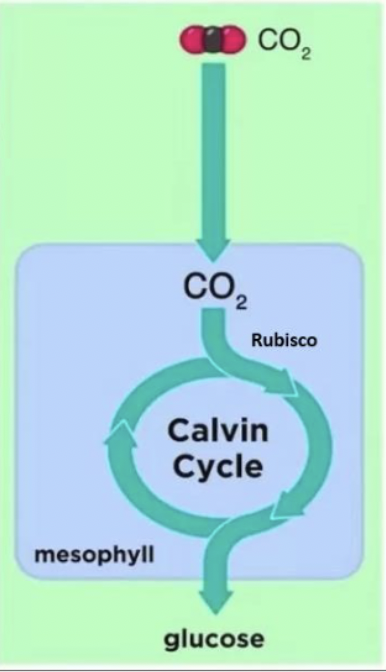
separation of initial CO2 fixation & Calvin cycle: no separation
stomata open: day
best adapted to: cool, wet environments
C3 photosynthesis
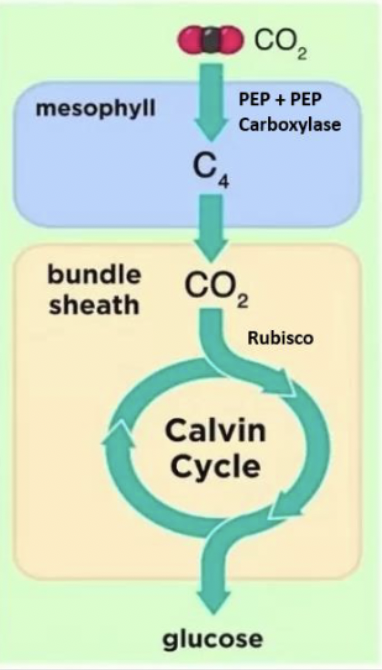
separation of initial CO2 fixation & Calvin cycle: no separation: btwn mesophyll & bundle-sheath cells (in space)
stomata open: day
best adapted to: hot, sunny environments
C4 photosynthesis
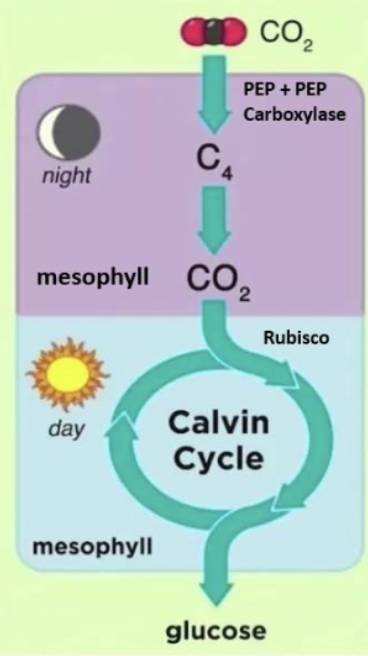
separation of initial CO2 fixation & Calvin cycle: no separation: btwn night & day (in time)
stomata open: night
best adapted to: very hot, dry environments
CAM photosynthesis
structure of xylem
the xylem tracheary elements consist of cells known as tracheids and vessel members, both of which are typically narrow, hollow, and elongated
differentiate between tracheids and vessel elements
tracheids are made up of single cells & vessels are made up of a group of cells
explain how water’s moved from roots to leaves of plants
through tissue called the xylem, in a process called transpiration
relate the movement of water in xylem to the properties of water
adhesion and cohesion allow the formation of a continuous column of water in the xylem
explain how transpiration provides the force that pulls water up the stem from the roots through xylem conduits with thick, lignified cell walls
causing water to evaporate from the leaves, generating a negative pressure (tension) that draws water upwards from the roots through the continuous column of water held together by cohesion (water molecules sticking to each other) and adhesion (water molecules sticking to the xylem cell walls)
in plants, they’re responsible for synthesizing the sugars required for plant growth
source tissues
in plants, they use the sugars for immediate use and store the rest for future metabolic needs
sink tissues
relate the structure of phloem cells to their function in moving carbohydrates from sources to sinks
each component functions together to enhance the transfer of carbohydrates and amino acids from a source to sink tissues, where they are utilized or stored
explain the pressure-flow mechanism of sugar transport in phloem
movement of water into the phloem creates turgor pressure in the phloem. the high turgor pressure forces movement of phloem sap from source to sink through a process called “bulk flow.” The sugars moved via bulk flow are then rapidly removed from the phloem at the sink
identify and describe the pathways water and minerals can take from the root hair to the vascular tissue
the apoplastic pathway (through the cell walls) and the symplastic pathway (through the cytoplasm of cells)
explain the role of the endoderm & Casparian strip in allowing roots to be selective in which nutrients they take in from the soil
the casparian strip prevents water and nutrients from entering the stele through an apoplast pathway
describe the modular nature of plant structure
construction of repeating units known as modules
explain the role of the apical meristem in plant growth patterns
trigger the growth of new cells in young seedlings at the tips of roots and shoots and forming buds
explain why an expanding internode cell grows more in length than in width
the wall is more extensible in one direction than another (it is easier to extend in the direction that is parallel to the long axis of the stem than it is in the direction perpendicular to the long axis of the stem)
explain how root development is similar to & different from stem development
both roots and stems grow from apical meristems, have regions of cell division, elongation, and differentiation, and respond to light and gravity. However, root apical meristems are covered by a root cap, the root has a single vascular bundle in the center, and branching occurs by the formation of new meristems from the pericycle; all these features are different from what is seen in stems.
lateral meristem that produces new xylem & phloem
vascular cambium
lateral meristem that maintains a protective layer of bark, replacing the epidermis as the plant grows thicker
cork cambium
synthesis & transport:
produced primarily in SAM & tips young leaves/transported by polar transport & through phloem
effects:
cell elongation & expansion (cell enlargement)
suppression of lateral bud growth (apical dominance)
flowering, fruit ripening, & inhibition of abscission (leaf falling)
tropisms ex: phototropism & gravitopism (geotropism)
auxin
 Note
Note  Flashcards (101)