Evolution Missing 23-24
 Studied by 1 person
 Call Kai
 Learn
Learn Practice Test
 Spaced Repetition
 Match
Match Flashcards
 Knowt Play
1/519

There's no tags or description
Looks like no tags are added yet.
Name | Mastery | Learn | Test | Matching | Spaced | Call with Kai |
|---|
No study sessions yet.
520 Terms
What is epigenetics?
a modification of the structure of DNA without a change in DNA sequence
Processes "above the genome" which alter transcription without affecting the DNA sequence
• Robust yet also flexible change
Methylation, histone modification etc
What does epigenetics allow?
• Allows animals and plants to change gene expression in response to their environment
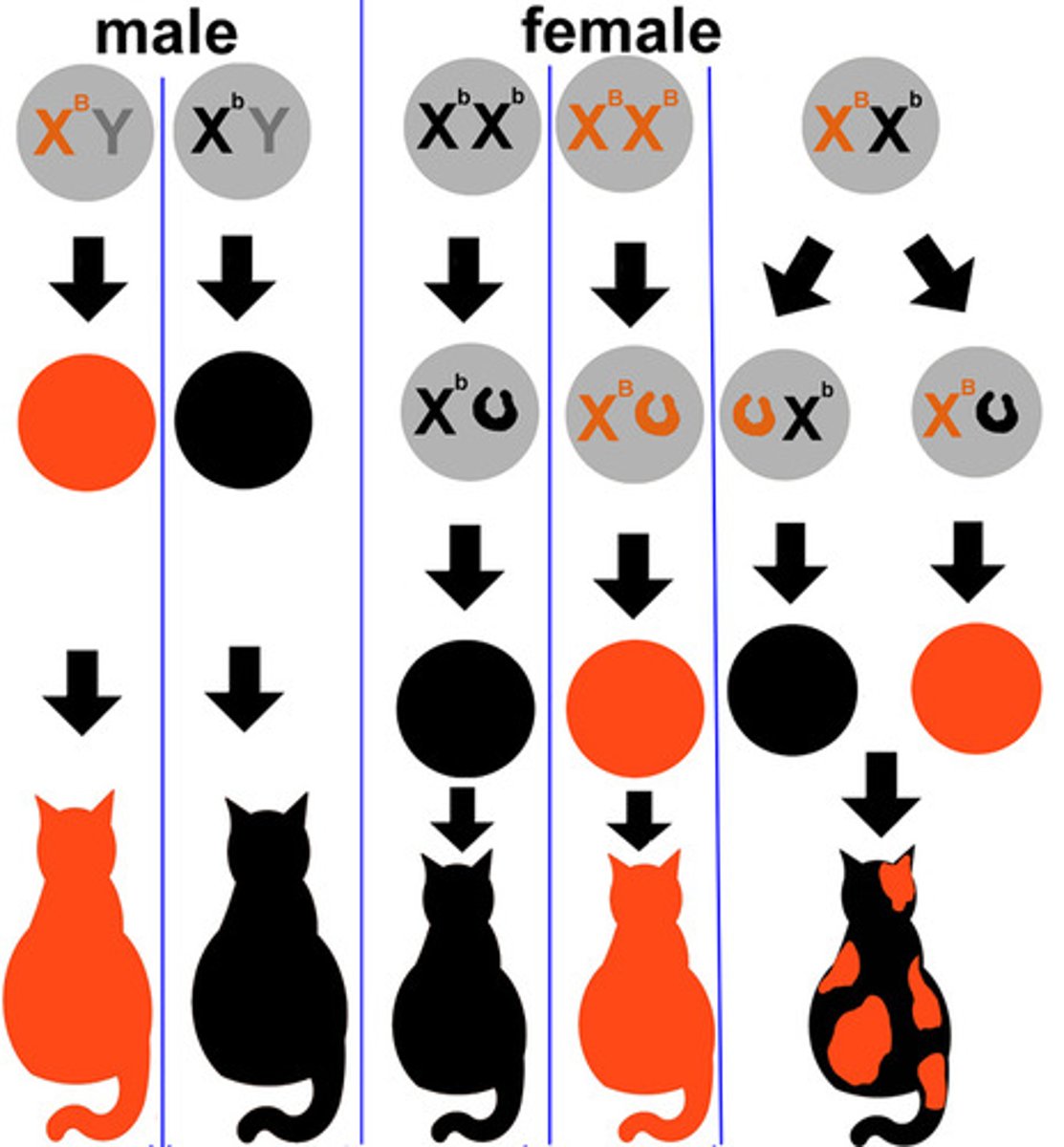
What is the epigenetics of X chromosomes in mammals?
- Females silence one copy of X (Barr body)
- X chromosome contains genes for fur colour in cats
What is the organisation of DNA in a cell?
• DNA is supercoiled into a compact and organised structure = chromatin
• Heterochromatin - densely packed, generally not expressed
• Euchromatin - open structure, often expressed
What chromosomes are in females and males?
Males: XY
Female : XX - silenced one X as Barr body
One from each parent
Random one scielenced
How can we see that which X gene is silenced is random?
By looking at fur colour in cats
- X chromosome contains genes for it
What is euchromatin?
loosely packed chromatin
What are the types of mechanism that can be called epigenetic?
- Chromatin
- DNA methylation
- Histone posttranslational modification
- Remodelling complexes (prevent expression)
etc
Where is DNA methylation found?
Found in gene bodies - animals, plants, fungi
- Found in promoters in vertebrates
• CpG (C-phosphate-G) islands in gene promoters
• CpG is generally rarer than expected by chance
- Humans have 42% GC, so expect 0.21*0.21 = 4.41%
- Actual frequency is ~1%
• Gene promoters often have much higher CpG frequency
What does a high methylation tend to mean?
Low transcription
What does the methylation do?
blocks transcription factor from binding
an increase decreaes transcription
What is the reason for epigenetics?
Epigenetics allows gene expression to respond to a stress in the environment

How can the epigenetic status of DNA change throughout animal and plant development?
Epigenetic status of DNA can change throughout animal and plant development
• Male vs. female mealybugs
• Paternal chromosomes silenced in males
Or:
- Flowering in Arabidopsis
- Flowering Locus C (FLC)
- Heterochromatic over winter
- No expression in spring → flowering
How can phenotypic variation be caused?
Phenotypic variation can be caused by epigenetic differences
- Different phenotypes are subject to selection)
- e.g. floral shape in Linaria (bilateral and radial symmetry
- DNA sequences identical, methylation status different
What can alter epigenetic modification?
External stimuli can alter epigenetic modification
- Can therefore play a role in adaptation to environmental change
eg.
- Heavy metal exposure in hemp
- Drought in rice
- Heat stress in Arabidopsis
- Bacterial infection in Arabidopsis
- Herbivore damage in Mimulus
Can epigenetics be inherited?
yes
Can a Epigenetically-regulated response be transmitted to offspring?
yes
How can we see epigenetics across generations in Mimulus?
Herbivore damage in Mimulus
• Leads to trichome production via epigenetic down-regulation of MgMYBML8
• Progeny of damaged plants have more trichomes even when they don't experience damage
How can we see that epigenetics can be inherites? in what example?
Epigenetics can be inherited - Daphnia (water fleas)
- Grow protective helmets in the presence of predators
- Mothers which have helmets but are no longer exposed to predators: offspring also develop with helmets
How can we see that epigenetics can be inherited in mice?
• Fear conditioning passed on to pups and grand-pups
• Odour-specific
• DNA methylation altered in acetophenone receptor gene
Coat colour in mice
- the agouti gene
- These mice have the same DNA sequence at agouti
- Mothers coat colour influences pups
• Even more pups of dark mouse mothers are dark, if their grandmother was also dark
If epigenetic marks on DNA are responsible for accurate and precise transcription, then what happens if they are altered?
- Cancer tissue often has reduced DNA methylation
- Some genes in cancer tissue are very highly methylated
• Silencing of tumour-suppressor genes
- Both lead to rapid growth of the cancer
What can happen If epigenetics causes variation in phenotypes?
Selection can act
What are epigenetic marks in a genome be affected by?
by DNA sequences
- e.g. CpG methylation cannot occur if there is a mutation
- Arabidopsis FLC alleles vary geographically
• Some early flowering accessions have mutations in FLC
• These accessions do not require vernalisation
Can epigenetic marks act independently of the DNA sequence?
So, epigenetic marks can act independently of the DNA sequence, but can be affected by the DNA sequence
What is interesting about Arabidopsis?
Its the model plant
Closely related to crops we grow
Why is epigenetics a major evolutionary force?
as it produces novel variation without 'waiting' for a DNA sequence mutation
What is evo-devo?
way of saying "the evolution of development"
Why do we want to study evo-devo?
Darwin even noticed that changes in how organisms develop could provide a means for evolution:
- "Any change in the embryo or larva will almost certainly entail changes in the mature animal."
- "Hardly any point gave me so much satisfaction when I was at work on the Origin as the explanation of the wide difference in many classes between the embryo and the adult animal, and the close resemblance of the embryos within the same class."
How did Haeckel (1860s/70s)interpret his observations wrong?
- "Ontogeny (development) recapitulates phylogeny"
- We evolved from a fish that evolved into a reptile that evolved into us, our embryos physically echo that history, passing through a fish-like stage and then into a reptile-like stage.
- Although this isn't true (human embryology isn't just an 'extension' of reptile embryology) he did make some excellent diagrams (and he faked a few too!)
What is being studied in evo-devo?
Evo-Devo is the study of how development evolves and determines the relationships between species based on their development
What have we learnt through the study of evo-devo?
Through the study of evo-devo we have learned:
- just as evolution tends to create new genes from parts of old genes, evolution alters developmental processes to create new and novel structures
- a similar developmental program in unrelated organisms can be conserved to give rise to the same phenotype
Why can evo-devo be described as a developmental toolkit?
Just as evolution tends to create new genes from parts of old genes, evolution alters developmental processes to create new and novel structures
- Changes in developmental pathways (e.g. timing and location of gene expression) can be modified to change the resultant phenotype
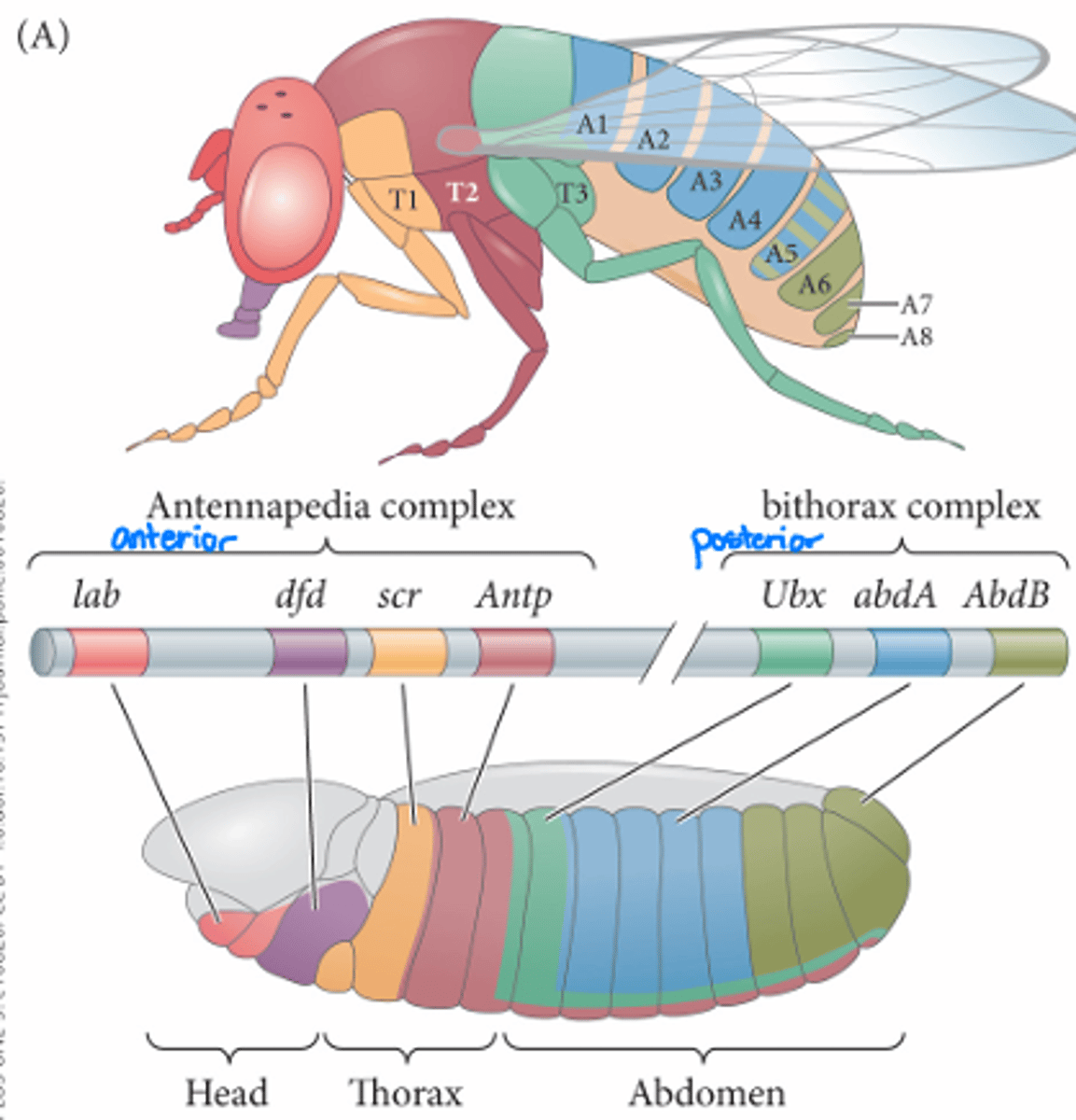
What are HOX genes?
- Homeobox protein binding domain-containing genes
- Control the animal body plan
- Control the fate of the segments (but do not create the actual features of the segments)
- HOX mutants show homeotic transformations (the transformation of one organ into another)
How many HOX genes are in drosophila?
8
- they are spatially and temporally organised
What is the model species used to investigate HOX genes?
Drosophila
How are the hox genes often named?
After their mutants

How many copies of hox genes are in humans?
2-4 copies
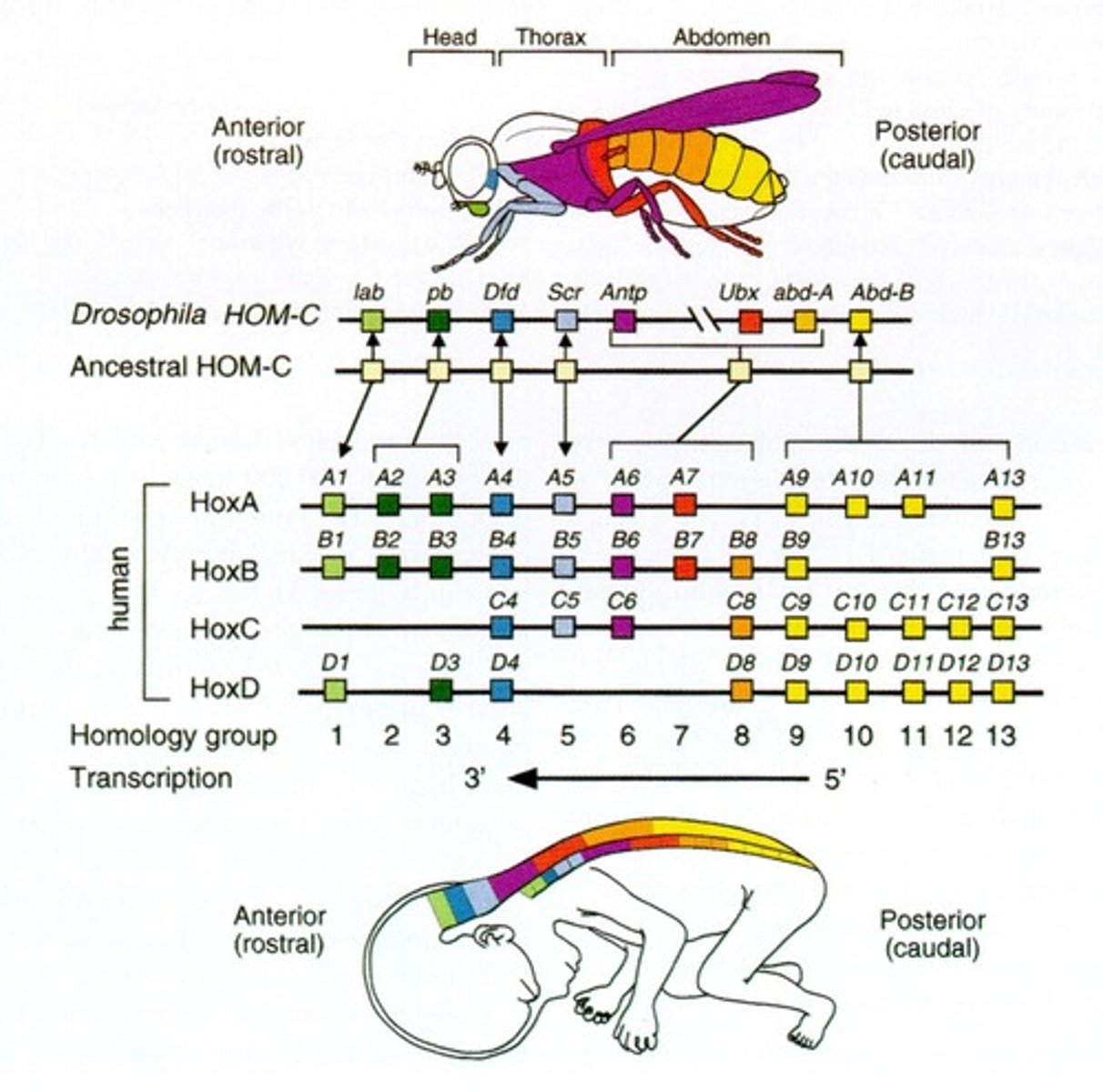
What can you see if u compare the HOX genes in drosophila and humans?
• HOX genes in animals
• 2-4 copies in humans - some copies maintained and some lost
• Gene order preserved
• Expression position preserved
• Conserved pattern
Why are their large changes in the development in flies and humans?
Changes in the development of flies vs. humans have taken place due to changes in the timing and position of HOX genes
- HOX genes still determine which segment will do what
What is the evolution of flowers?
evolved once during evolution of plants
This:
- Allowed pollination by animals
- Allowed speciation (floral incompatibilities: think back to the Mimulus example)
- Gave rise to an amazing evolutionary radiation
How is the basic plan of all flowers encoded?
The basic plan of all flowers is encoded in a very simple way (despite them being very different)
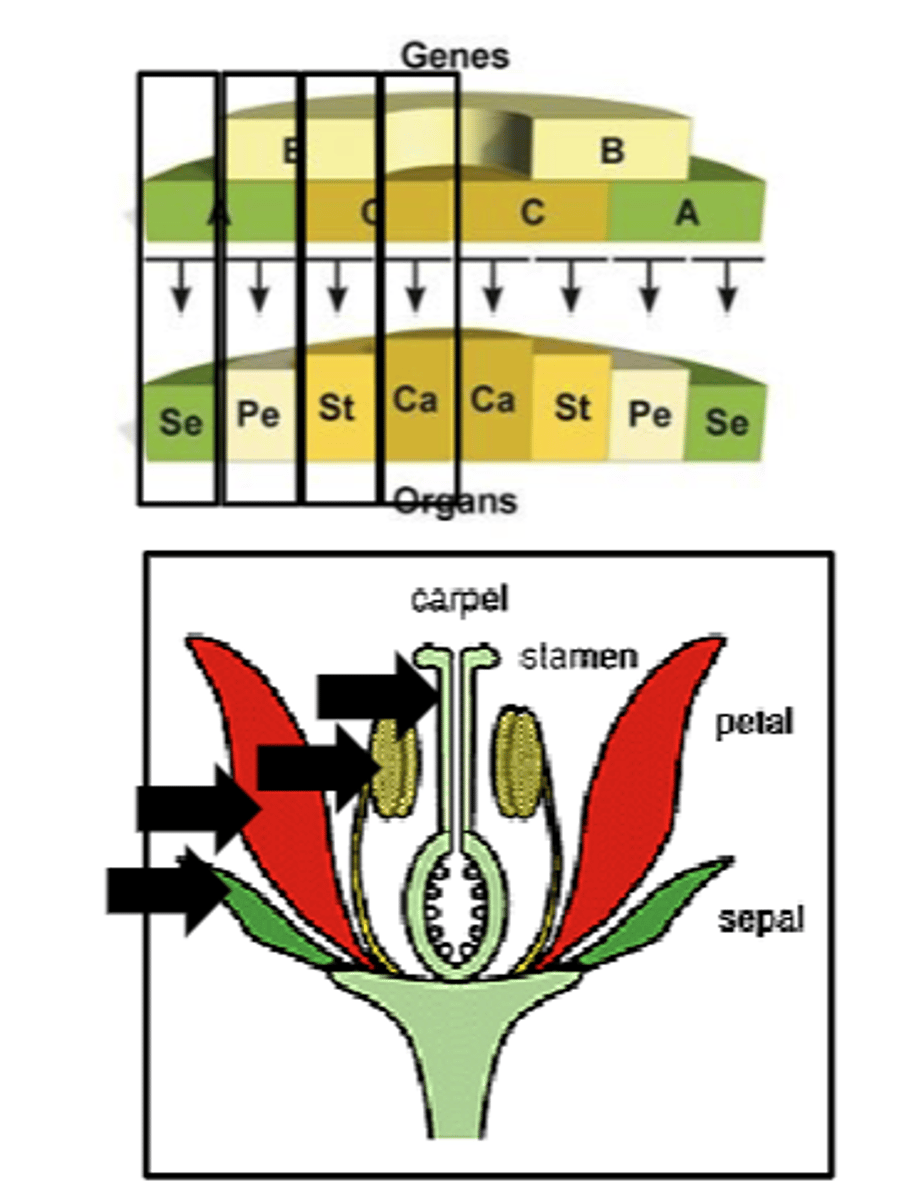
The ABC model of floral development
What is the basic structure of a flower? How do genes give rise to this?
If A expressed = sepal
If A and B = petals
if B and C = stamen
If C = carpel
What would happen if there is no A expression?
C expressed all way across
B normal place
Just carpel and stamens (no petals)
apetela
What would happen if no B?
Only A and C next to each other
Only sepals and carpels (no petals)
Apetala or pistillata
What is no C expressed?
No carpels
agamous
What does these mutations show?
show homeotic transformations (transformation of one organ to another?
What are the MADS box genes?
MADS box genes are the HOX's of the plant world
- M = MCM1 (yeast)
- A = AGAMOUS (Arabidopsis)
- D = DEFICIENS (snapdragon)
- S = SRF (humans)
1-5 members in animals and fungi, >100 in plants
What do the MADS box genes regulate?
Regulate many aspects of plant biology
- Floral initiation
- Floral development (know your ABCs)
- Root, pollen and seed development, vernalisation, response to hormones
How can evo-devo be used in the terms of convergent evolution?
A similar developmental program in unrelated organisms can be conserved to give rise to the same phenotype
• Genes are 'recruited' more than once to give rise to the same phenotype
e.g. Pax6 and eye development
What is shown by the convergent evolution of the Pax6 gene?
Many groups evolved complex eyes independently
• Best studied comparison is eye development in arthropods and vertebrates
- Same 'master gene', Pax6, is crucial to eye formation
- Pax6 controls assembling of a photosensitive cell with a pigment cell
• Present in the ancestor of all animals and 'recruited' where eyes evolved
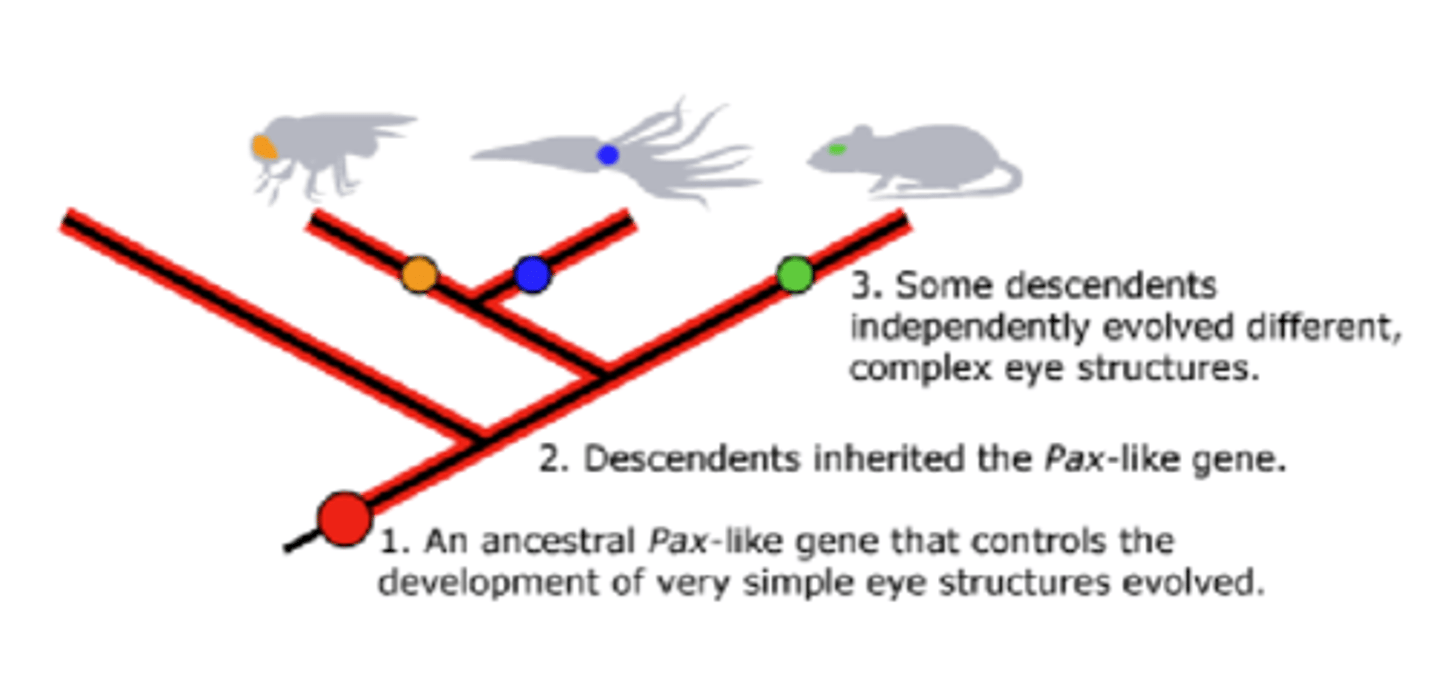
What happens if you get rid of the Pax6 gene?
will form a mutant eye so wont function
Whats an example of convergent evolution in plants?
Compound leaves and floral zygomorphy (symmetry)
NAM and CUC genes in diverse plants
• These proteins repress growth, giving rise to indentations in the leaf margin
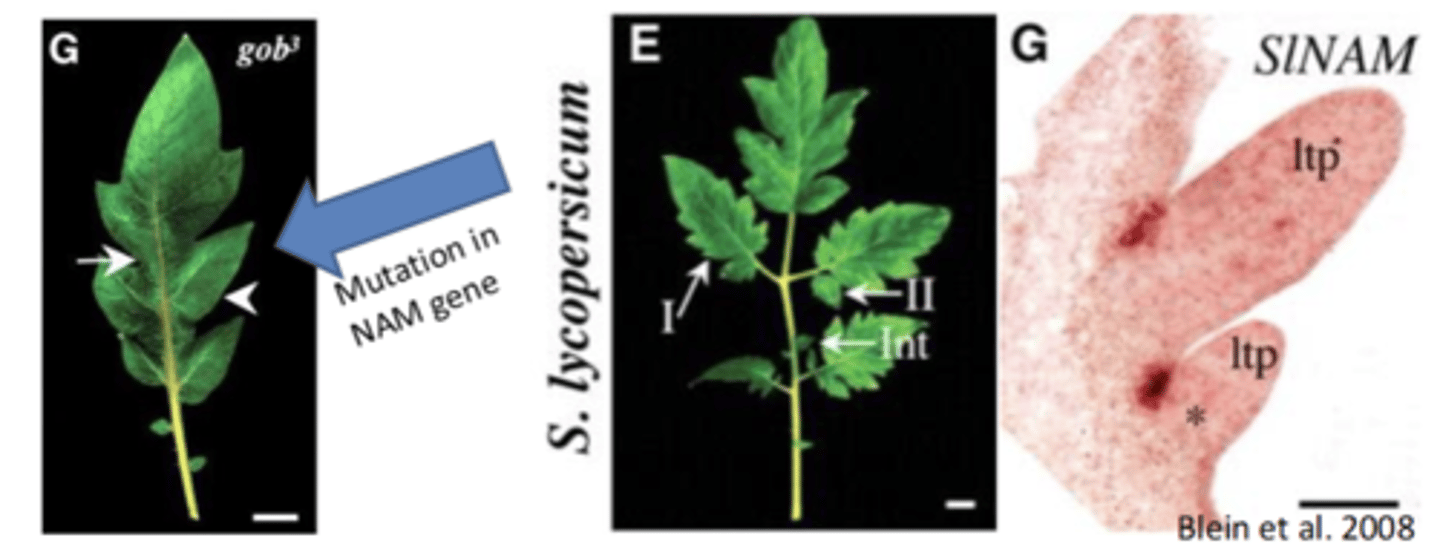
How has floral symmetry evolved?
• Floral zygomorphy (Left-Right symmetry) has evolved >38 times during angiosperm evolution (very common)
• Groups with zygomorphic flowers tend to have more species (selection on insect pollinators), e.g. Asteraceae, Orchidaceae, Fabaceae
What are the genetics of floral symmetry?
Wild Type has = Zygomorphic symmetry
Then if 2 cycloidea genes knocked out:
You get Mutant = Actinomorphic (radial symmetry)
What are the genetics of floral symmetry in a sunflower?
In Wild type: has many florets that make it up - has left right symmetry and radial symmetry (Zygomorphy and actinomorphy)
But if knockout Cycloidea
Florets are more tubule
Instead has actinomorphy and actinomorphy so loose left right symmetry
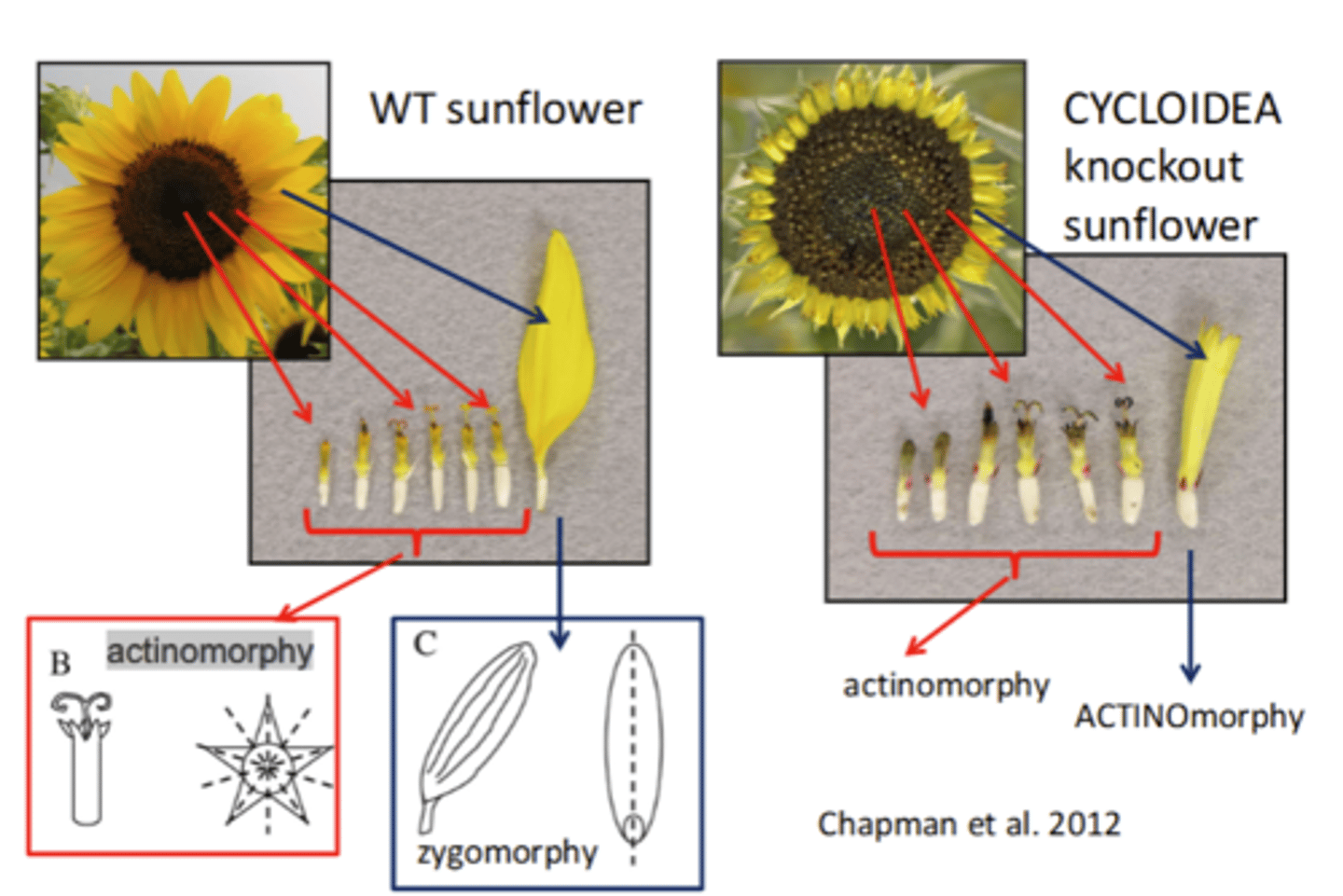
In what was the genetics of floral symmetry first discovered?
In snapdragon
What do cycloidea genes infer?
Left right symmetry
Conversion of actinomorphic to zygomorphic
What are examples of where The same gene can be recruited multiple times to confer the same phenotype in unrelated organisms?
e.g. Pax6 and CYCLOIDEA
What is Darwinian evolution?
Gradual change in response to selection
Can not fully explain present variety of life on earth
What is the bifurcation of lineages?
speciation
What is another way we can explain evolution?
Horizontal gene transfer and mass extinction
What is the current estimate of living species on earth?
2-50(-100)million
What percentage of all species that ever lived are extinct?
99.9%
Whats the average lifespan of species?
4 million years
What are the 2 ways that speciation happens?
- cladogenesis (splitting of lineages)
Allopatric Speciation (geographic separation leading to divergence) and
- Sympatric Speciation (evolution within the same area via reproductive isolation, often due to genetics or behavior)
Do extinction rates vary?
yes
What is mass extinction?
- global
- broad range of species
- short amount of time
>60% of species within
<1 million years
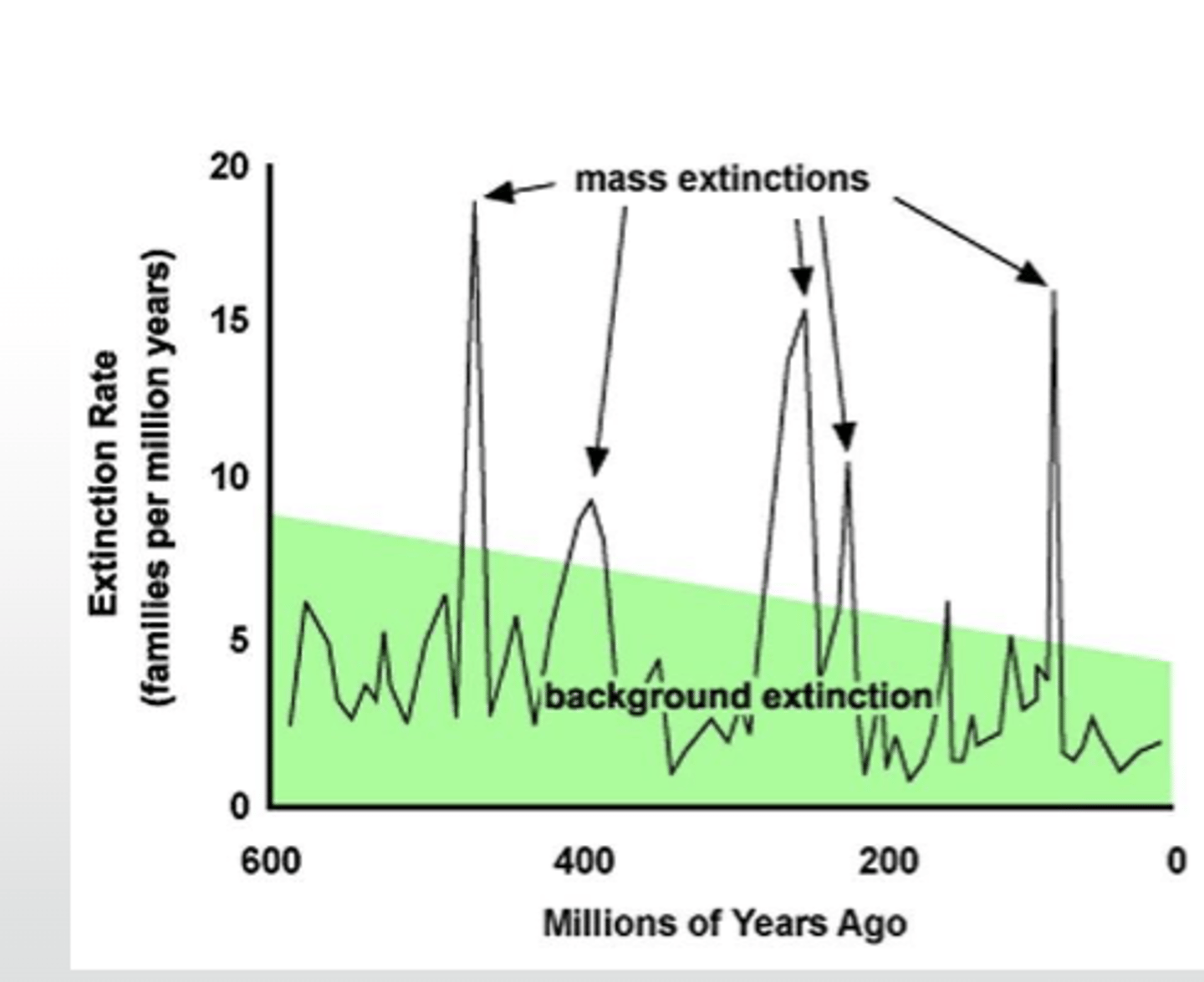
How many many mass extinctions have their been in the last 500 million years?
5
What are the big 5 mass extinctions?
I Ordovician - ~450mya
II Devonian - ~364mya
III Permian - ~251mya
IV Triassic - ~200mya
V Cretaceous - ~65mya
Why does a mass extinction(almost) always occur at the end of a geological era?
geologists and paleontologists defined the boundaries of these eras based on the dramatic changes observed in the fossil record, specifically the sudden disappearance of many species
What caused these mass extinctions?
Under considerable debate!
- No single cause
- Biosphere under long-term stress experiences a short-term shock ('press / pulse' model)
What was their impact?
# of species/genera extinct
Examples of well-known groups
What was the Ordovician extinction? What was badly affected?
- Two extinction bursts, ~450-440mya
- >60% of marine invertebrates (virtually no terrestrial life!)
- Badly affected: bivalves, echinoderms, corals, trilobites
- Continental drift (Gondwana over south pole), followed by widespread glaciation and drop in sea levels
What was the devonian extinction? what was badly affected?
~364mya, possibly series of extinctions over 25my period
- 50% of all genera, mostly marine
- Badly affected: agnathan (jawless) and placoderm fish (armoured), conodonts, trilobites, ammonites, reef builders (corals, sponges, etc)
- Environmental change: anoxia in lower ocean levels, sea level changes
What is the permian extinction? what was badly affected?
~251mya
- 50% of terrestrial and marine families equating to 70% of terrestrial species, 96% of marine species go extinct
- Badly affected: ammonites, trilobites (gone), echinoderms, brachiopods, insects (only known insect mass extinction)
Caused by: Impact? Volcanism? Methane release? Anoxia?
How could impact potentially have caused the permian extinction?
» Less understood than KT, the PT has several interesting factors
» Potential impact crater in S Atlantic, or off Australian coast
» Potential shocked quartz containing extraterrestrial noble gases
Not well supported
How may volcanism have caused the permian extinction?
» 251mya Siberian Traps release 2 million cubic kilometres of basalt lava.
» Covers 1.6 million square kilometres of Eastern Russia to depth of 400-3000m
» This basalt was released over a time period of 600 000 years (very quickly in geological terms)
» These eruptions caused global warming releasing frozen gas hydrates and massive amounts of methane, causing more warming, causing a runaway greenhouse effect
» The runaway greenhouse effect, along with gases from volcanic eruptions which formed acid rain, and poisoned the atmosphere with sulphuric, carbonic and nitric acids
» CO2 build up in the atmosphere, with continued warming would have fed back into the oceans, causing acidification of the oceans and deoxygenation
What were the results of the permian extinction?
» Opened up niche space for radiations of new species
» Increase in shore line with break up of super continent
» Dinosaurs could take over from mammal-like reptiles
What was the triassic extinction? what was badly affected?
- 200mya
- >50% of all genera
- Badly affected: conodonts (gone), amphibians, reptiles
- Caused by: Volcanism? Climate change?
What are conodonts?
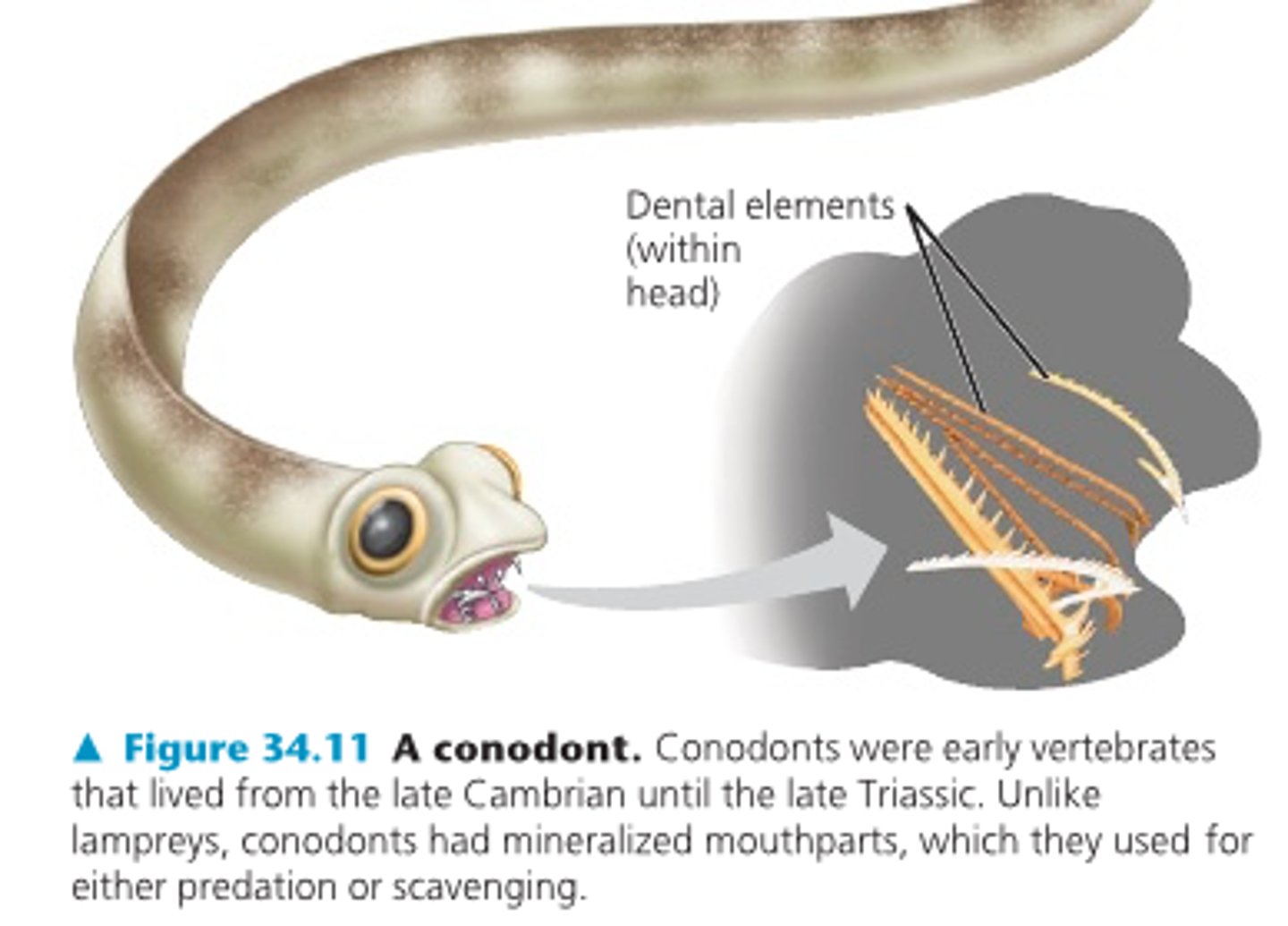
What was the cretaceous extinction?
~65mya
- 75% of all species
- Badly affected: ammonites (gone), belemnites (gone),dinosaurs (gone except birds), pterosaurs (gone),plesiosaurs (gone), plants
- Caused by: Impact? Widespread volcanism? Trees died (groups that survived are ground nesting ones)
What are the Deccan Traps?
A massive flood basalt in India.
What is the Chicxulub Crater?
- Evidence of a asteroid or comet impact on Earth in Carribean Sea near Yucatan Penninsula
- 180 km in diamter
- largest impact structure on Earth
- before no dinosaurs
What is the idea of snowball earth?
~850-650mya, global glaciation(s)
- controversial, not generally accepted
What was the oxygen catastrophe?
~2.4bya, big increase in atmospheric O2 (photosynthesis) saturation of minerals that can be oxidised
Severity much harder to judge, due to lack of fossil record(no multicellular life until Ediacaran = ~635-542mya!)
What was Goulds replay the tape of life idea?
- Whether a species goes extinct depends partially on genes, but also on 'bad luck'
- A species can adapt to environmental change, but not toa catastrophic event
- If we could replay the Tape of Life, would life on earth in 2011 look the same as it does now?
When were ediacaran biota around?
Ediacaran biota
- 635-542mya
- Mostly extinct beginning Cambrian
- Earliest multicellular life forms - many not leaving descendants?
What is the 6th mass extinction?
- Human activity causes extinction of species
- Habitat destruction, overexploitation, global climate change
- Estimate that 60% of species could go extinct in 100 years
- Global, broad range of species, short amount of time, and well within 'rule of thumb' criteria
Why may we be at the beginning of the 6th mass extinction?
- the rate at which species are dying far exceeds the norm
- many species on the brink or gone
- deforestation having an impact on the decline of species
- Industrial revolution
- The nuclear age
- plastics
- atomic test sites
how can habitat loss cause extinction?
eg. pubic louse
Habitat loss by grooming causing reduction in population
How have we affected life on earth?
- Coral bleaching: too hot water zooxanthellae expelled, killing coral turning white
- Bees: if loose them use masses of food crops
- threatened amphibians: fungus transported on humans can cause film on amphibians preventing them from respiring
Have we entered a new geological epoch?
» The demarcation of geological time is shown by the 'Golden Spike'
» There has to be a change preserved between one rock layer and another- eg Iridium layer, change in fossil deposits
What impacts are plastics having on species?
» We get rid of 8 million tons of plastic every year, dumped into the sea.
» Plastic does not biodegrade into harmless compounds, it just fragments
» These plastic particles, often smaller than 1mm in size are ingested and potentially cause many problems (reduce sperm count, mimic female hormones)
What is a phenotype made up of?
genotype + environment
What happens to phenotype when you add in quantitative traits?
Nature vs nurture
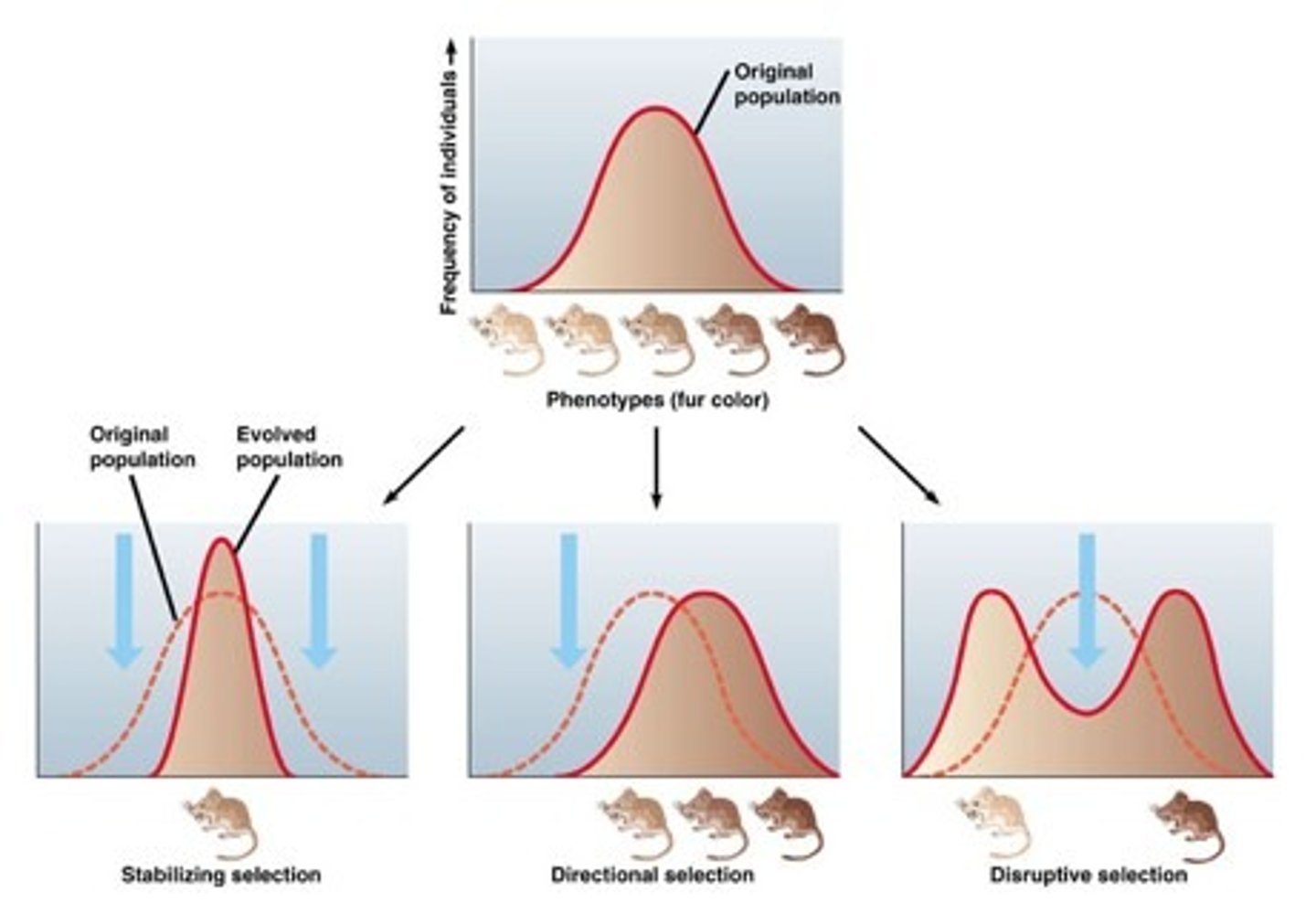
How is a phenotype controlled?
by a combination of the individual's genotype (their genetic makeup) and environmental factors
Phenotypic plasticity
What is phenotypic plasticity?
the ability of an organism to change its phenotype in response to changes in the environment.
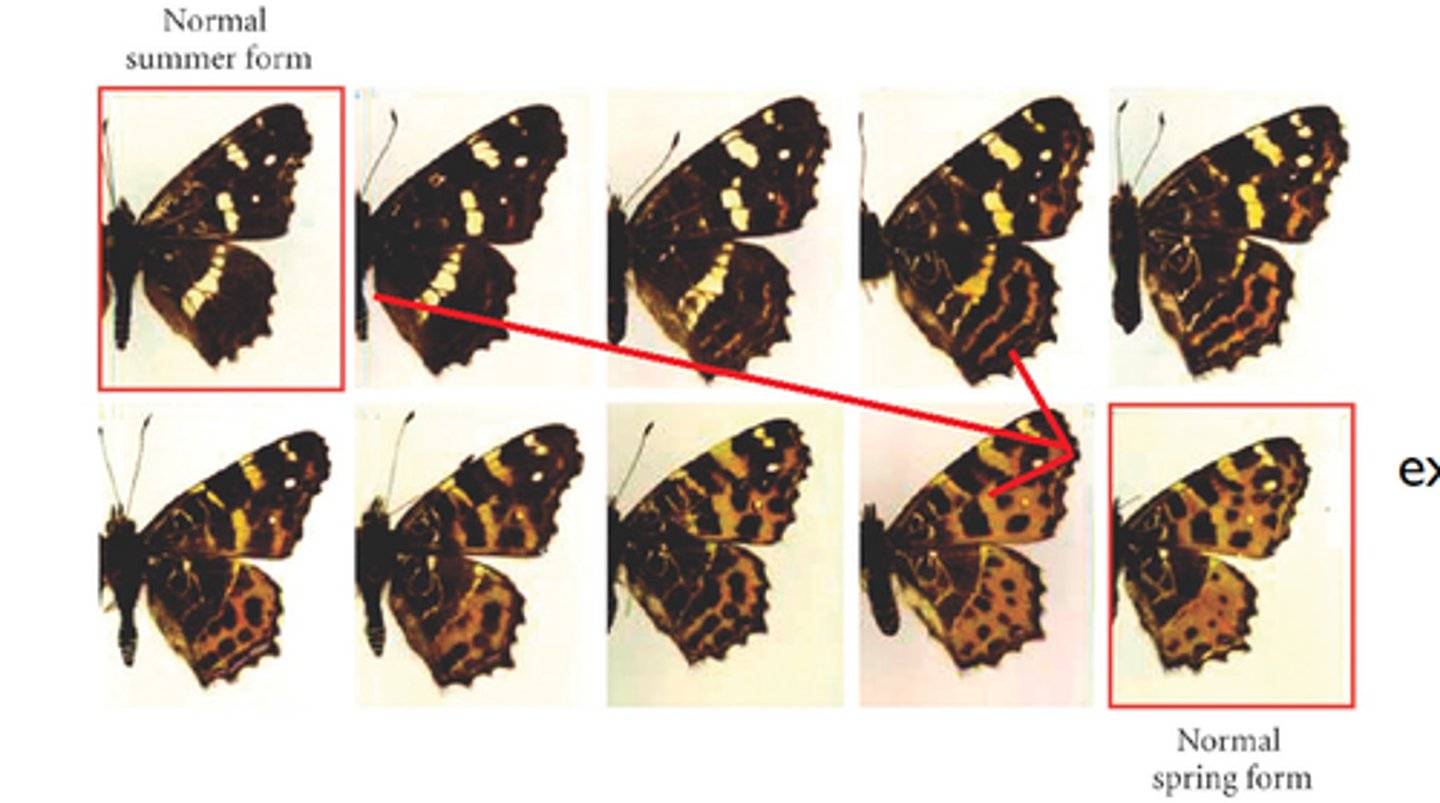
What is the importance of the environment overshadowed by?
Importance of the environment (through its effect as a cue on a plastic trait) has been known about for a long time but overshadowed by discovery of the structure of DNA →Neodarwinism
What does plasticity include?
all aspects of the phenotype in which expression varies as a result of environmental differences.
- Because plasticity causes variation in functional and fitness traits and in traits that contribute to all kinds of species interactions, it is now recognized to be of fundamental importance to both ecology and evolution
Is plasticity heritable?
Plasticity is heritable but only occurs when the environment is variable → complex
 Note
Note  Flashcards (90)