Biofoundations Unit 4

0.0(0)
Studied by 0 people
call kaiCall Kai
learnLearn
examPractice Test
spaced repetitionSpaced Repetition
heart puzzleMatch
flashcardsFlashcards
GameKnowt Play
Card Sorting

1/129

flashcard set

Earn XP

Description and Tags

Genes and Inheritance (1-40) Gene Expression (41-104)

Last updated 11:50 PM on 4/2/26
Name
Mastery
Learn
Test
Matching
Spaced
Call with Kai

No analytics yet

Send a link to your students to track their progress

130 Terms

1
New cards

Mitosis and Meiosis are the ________ of ________

mechanisms of inheritance

2
New cards

What is heredity?

The transmission of physical form parents to offspring

3
New cards

What is a phenotype?

Any observable characteristics of an individual

4
New cards

What are some examples of traits, in individuals and cells?

  • Individuals - large scale observable features like height, eye colors, or hair texture

  • Cells - the kinds of sugars it can use to make ATP, what kind of electron acceptor it uses, does it make a receptor for a certain hormone

5
New cards

What are polymorphic traits?

Traits with multiple forms

6
New cards

What is a phenotype?

The specific version of a trait that an individual has

Ex: The possible phenotypes for fur color in Labrador Retrievers
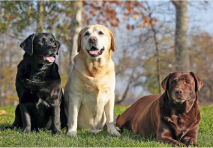
<p>The specific version of a trait that an individual has</p><p>Ex: The possible phenotypes for fur color in Labrador Retrievers</p>
7
New cards

True or False: The specific traits and phenotypes of an individual come from the collective action of that individual’s genotype

True

8
New cards

What are genes?

A region of the DNA of a chromosome that contains the info needed to produce a protein or RNA molecule

9
New cards

True or False: Most traits are monomorphic bc most genes of a species exist in multiple

False; most traits are polymorphic bc most genes of a species exist in multiple forms

10
New cards

What are alleles?

Multiple versions of a gene

11
New cards

What is cystic fibrosis and why is it a genetic disorder?

  • Cystic fibrosis – a genetic disorder that primarily affects the lungs 

  • Originates in one gene and has two alleles 

  • One allele produces a normal functional protein and one allele produces a protein that gets trapped in the endoplasmic reticulum 
<ul><li><p class="Paragraph SCXW214996520 BCX8" style="text-align: left;"><span style="line-height: 20.925px;">Cystic fibrosis – a genetic disorder that primarily affects the lungs&nbsp;</span></p></li></ul><ul><li><p class="Paragraph SCXW214996520 BCX8" style="text-align: left;"><span style="line-height: 20.925px;">Originates in one gene and has two alleles&nbsp;</span></p></li></ul><ul><li><p class="Paragraph SCXW214996520 BCX8" style="text-align: left;"><span style="line-height: 20.925px;">One allele produces a normal functional protein and one allele produces a protein that gets trapped in the endoplasmic reticulum&nbsp;</span></p></li></ul><p></p>
12
New cards

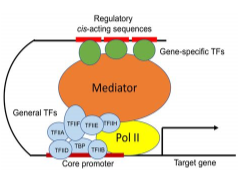
What happens during Cystic Fibrosis?

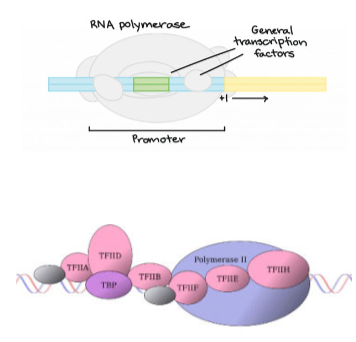
  • The cell of the lung normally produces a saline solution needed to allow our lungs to clear and remove mucus

  • This saline solution is made by a transporter protein in the plasma membrane called CFTR

  • In ppl w/ Cystic Fibrosis, the CFTR protein does not fold properly into its 3D shape, and this misfolding traps it in the endoplasmic reticulum, and blocks the production of saline

  • This causes mucus to becomes trapped and causes frequent and sometimes life-threatening lung infections
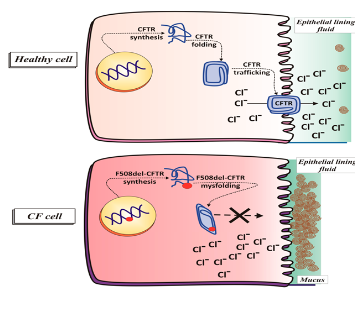
<ul><li><p>The cell of the lung normally produces a saline solution needed to allow our lungs to clear and remove mucus</p></li><li><p>This saline solution is made by a transporter protein in the plasma membrane called CFTR</p></li><li><p>In ppl w/ Cystic Fibrosis, the CFTR protein does not fold properly into its 3D shape, and this misfolding traps it in the endoplasmic reticulum, and blocks the production of saline</p></li><li><p>This causes mucus to becomes trapped and causes frequent and sometimes life-threatening lung infections</p></li></ul><p></p>
13
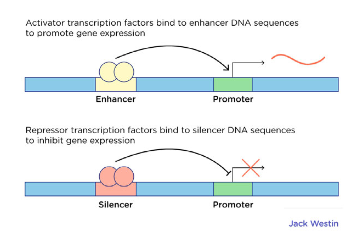
New cards

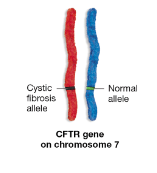
On what chromosome is the CFTR gene on? and what are the alleles on that gene?

  • CFTR gene is found on human chromosome #7 

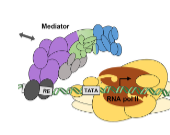
  • There are two alleles: “normal” CFTR (F) and “misfolded 
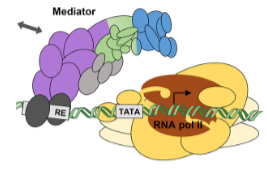
     CFTR (f) 

14
New cards

What is a genotype?

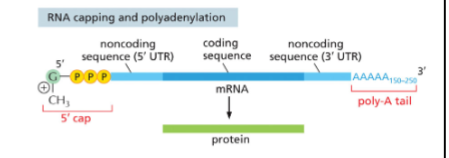
The specific combo of alleles that any one individual has

15
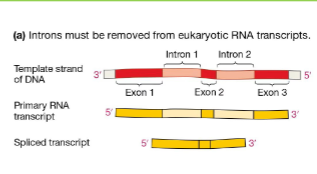
New cards

Fill in the Blank: Because our cells are _____, we have two copies of each chromosome, one from ____ and one from _____. Each person carries __ ______ for each gene.

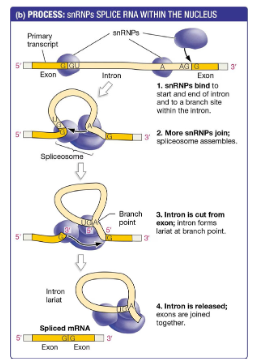
  • Diploid

  • Mom

  • Dad

  • 2 alleles

16
New cards

So what does diploidy mean? And give an example

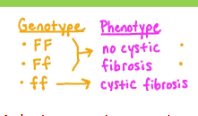
  • Diploidy - 3 possible genotypes

  • 3 Possible Genotypes for CFTR:

  1. FF: “normal” CFTR on both chromosomes

  2. Ff: One “normal” and one “misfolded” CFTR

  3. ff: “misfolded” CFTR on both chromosomes (Cystic Fibrosis result)

17
New cards

What is the difference between dominant and recessive Alleles?

  • Dominant Alleles (capitalized letter) - only one copy needs to be present for its phenotype to be expressed

  • Recessive Alleles (lowercase letter) - both copies need to be present for its phenotype to be expressed
<ul><li><p>Dominant Alleles (capitalized letter) - only one copy needs to be present for its phenotype to be expressed</p></li><li><p>Recessive Alleles (lowercase letter) - both copies need to be present for its phenotype to be expressed</p></li></ul><p></p>
18
New cards

What does it mean when we say that both alleles are the same on a genotype? (both are either capitalized or lowercase)

Homozygous genotype

19
New cards

What is the difference and outcome between homozygous dominant and homozygous recessive?

  1. If both are dominant then we say it is homozygous dominant 

  • The individual will have the phenotype of the dominant allele 

  1. If both are recessive then we say it is homozygous recessive 

  • The individual will have the phenotype of the recessive allele 

20
New cards

What does it mean when we say that both alleles are the different on a genotype? (alleles are either capitalized and lowercase)

In a genotype, if both alleles are different we say that genotype is heterozygous 

21
New cards

In a heterozygous genotype, which allele will always determine the phenotype of the individual?

The dominant allele

<p>The dominant allele</p>
22
New cards

What is gain of function?

where the mutation or allele has enhanced or new function that persists regardless of the presence of a normal allele 

23
New cards

What is loss of function?

where a mutant allele decreases or eliminates a protein’s function 

24
New cards

What is the difference between haplosufficiency and haploinsufficiency?

  • Haplosufficiency - If one allele can make enough of the normal protein to maintain normal function  

  • Haploinsufficiency - Dominant loss of function  

25
New cards

What are the two things Mendelian genetics allow us to do?

  • Predict the genotypes and phenotypes of the offspring of two parents 

  • Also use the genotypes and phenotypes of the offspring to predict the genotypes of the parents

26
New cards

How do Mendelian Genetic principles and rules come from the way chromatids are separated in meiosis?

  • Each gamete gets only one copy of each chromosomes are therefore only one of the possible alleles 

  • The allele that each gamete receives is randomly chosen due to independent assortment 

27
New cards

In a punnet sqaure, what is the difference between the genotypic and the phenotypic ratio?

  • Total up the different genotypes to determine the genotypic ratio 

  • The percentages of traits produced is the phenotypic ratio 

28
New cards

Exceptions to Mendel’s Genetic principles: True or False: Genes only have two alleles or traits

False

  • Not true: sometimes, genes can have multiple dominant alleles, multiple recessive alleles, or both 

  • Not True: sometimes alleles of a gene can be neither dominant nor recessive and produce more than two traits 

29
New cards

How would ABO blood types be an exception to Mendel’s assumed principle that genes only have two alleles?

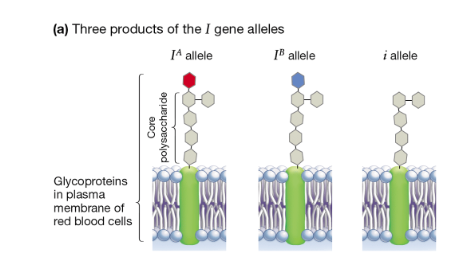
  • Blood types come from a single protein that is found in the plasma membrane of red blood cells and these proteins have several sugars attached to them in a long chains called glycoproteins

  • These sugar chains are built by an enzyme called ABO glycosyltransferase that exists in 3 different versions 

  • The gene for this protein is called I and has 3 alleles that make up Type A, B, O

  • This system has a genetic property called codominance 

  • Genes w/ co-dominance have multiple dominant alleles that do not blend their traits 

  • The gene for this protein called I and it has two dominant alleles and one recessive allele

  • W/ their alleles there are 6 possible genotypes and 4 possible phenotypes 
<ul><li><p class="Paragraph SCXW253981851 BCX8" style="text-align: left;"><span style="line-height: 20.925px;">Blood types come from a single protein that is found in the plasma membrane of red blood cells&nbsp;and these proteins have several sugars attached to them in a long chains called glycoproteins</span></p></li><li><p class="Paragraph SCXW253981851 BCX8" style="text-align: left;"><span style="line-height: 20.925px;">These sugar chains are built by an enzyme called ABO glycosyltransferase that exists in 3 different versions&nbsp;</span></p></li></ul><ul><li><p class="Paragraph SCXW234016946 BCX8" style="text-align: left;"><span style="line-height: 20.925px;">The gene for this protein is called<em> I </em>and has 3 alleles&nbsp;that make up Type A, B, O</span></p></li><li><p class="Paragraph SCXW234016946 BCX8" style="text-align: left;"><span style="line-height: 20.925px;">This system has a genetic property called<strong> codominance&nbsp;</strong></span></p></li></ul><ul><li><p class="Paragraph SCXW199190505 BCX8" style="text-align: left;"><span style="line-height: 20.925px;">Genes w/<strong> co-dominance</strong> have multiple dominant alleles that do not blend their traits&nbsp;</span></p></li><li><p class="Paragraph SCXW199190505 BCX8" style="text-align: left;"><span style="line-height: 20.925px;">The gene for this protein called<em> I </em>and it has two dominant alleles and one recessive allele</span></p></li><li><p class="Paragraph SCXW199190505 BCX8" style="text-align: left;"><span style="line-height: 20.925px;">W/ their alleles there are 6 possible genotypes and 4 possible phenotypes&nbsp;</span></p></li></ul><p></p>
30
New cards

Exceptions to Mendel’s Genetic principles: True or False: Sometimes dominant and recessive traits blend tg

True; this is called incomplete dominance

31
New cards

Exceptions to Mendel’s Genetic principles: Why is sickle cell anemia a product of incomplete dominance in the genes?

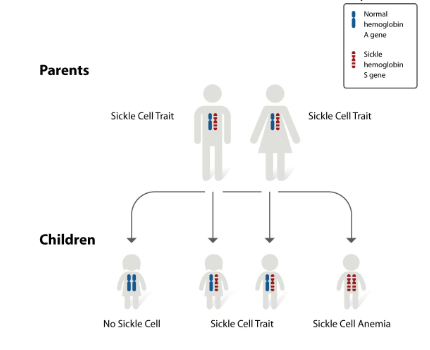
  • Sickle cell anemia – genetic disease caused by variations in the gene for hemoglobin

  • Two alleles for hemoglobin gene 

  • Hemoglobin A (HA) - functions normally 

  • Hemoglobin S (HS) - forms unusually long chains that distort the shape of red blood cells which forms a curved or sickle shape 

  • Three posssible genotypes and phenotypes 

  1. HAHA (homozygous dominant) - person ahs normally functiong hemoglobin 

  2. HSHS (homozygous recessive) - person has sickle cell anemia 

  3. HAHS (heterozygous) – person has a condition called sickle cell trait 

  • The curved blood cells Become trapped in blood vessels which can cause pain and swelling and Are easily destroyed in the blood vessels, causing the person to have fewer rbcs than they need (anemia) and fatigue 

  • In sickle cell trait: The rbc make both types of hemoglobin (a blended trait), Red blood cells will typically function normally and only a few sickle cells are made (normal hemoglobin is dominant), However, an acute attack of symptoms can happen called sickle cell crisis (usually only w/ extreme physical activity under stressful conditions) 
<ul><li><p> Sickle cell anemia – genetic disease caused by variations in the gene for hemoglobin  </p></li><li><p><span style="line-height: 20.925px;">Two alleles for hemoglobin gene&nbsp;</span></p></li></ul><ul><li><p class="Paragraph SCXW193796822 BCX8" style="text-align: left;"><span style="line-height: 20.925px;">Hemoglobin A (HA) - functions normally&nbsp;</span></p></li></ul><ul><li><p class="Paragraph SCXW193796822 BCX8" style="text-align: left;"><span style="line-height: 20.925px;">Hemoglobin S (HS) - forms unusually long chains that distort the shape of red blood cells which forms a curved or sickle shape&nbsp;</span></p></li><li><p class="Paragraph SCXW193796822 BCX8" style="text-align: left;"><span style="line-height: 20.925px;">Three posssible genotypes and phenotypes&nbsp;</span></p></li></ul><ol><li><p class="Paragraph SCXW120341536 BCX8" style="text-align: left;"><span style="line-height: 20.925px;">H<sup>A</sup>H<sup>A</sup> (homozygous dominant) - person ahs normally functiong hemoglobin&nbsp;</span></p></li><li><p class="Paragraph SCXW120341536 BCX8" style="text-align: left;"><span style="line-height: 20.925px;">H<sup>S</sup>H<sup>S</sup> (homozygous recessive) - person has sickle cell anemia&nbsp;</span></p></li><li><p class="Paragraph SCXW120341536 BCX8" style="text-align: left;"><span style="line-height: 20.925px;">H<sup>A</sup>H<sup>S</sup> (heterozygous) – person has a condition called sickle cell trait&nbsp;</span></p></li></ol><ul><li><p><span style="line-height: 20.925px;">The curved blood cells&nbsp;Become trapped in blood vessels which can cause pain and swelling&nbsp;and Are easily destroyed in the blood vessels, causing the person to have fewer rbcs than they need (anemia) and fatigue&nbsp;</span></p></li><li><p><span style="line-height: 20.925px;">In sickle cell trait: The rbc make both types of hemoglobin (a blended trait), Red blood cells will typically function normally and only a few sickle cells are made (normal hemoglobin is dominant), However, an acute attack of symptoms can happen called sickle cell crisis (usually only w/ extreme physical activity under stressful conditions)&nbsp;</span></p></li></ul><p></p>
32
New cards

Exceptions to Mendel’s Genetic principles: Fill in the Blank: _______ is when the effect of one gene can be altered or hidden by another

Epistasis

33
New cards

Exceptions to Mendel’s Genetic principles: In some ppl who have a type A or type B genotype, their blood type is not either of those types, but instead type O (how does ABO blood groups use epistasis?)

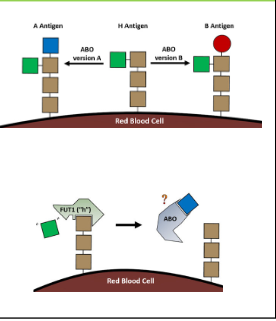
  • The sugar chains on a rbc are made by a metabolic chain of enzymes and Types A B and O are due to the last sugar added to that chain 

  • The gene for the enzyme in the chain directly in front of I is H 

  • H has two alleles: The dominant H allele makes an enzyme that functions normally and add the H sugar and The recessive h allele makes an enzyme that cannot add the H sugar 

  • The I enzyme requires the H sugar to be added to function normally 

  • In ppl who are homozygous dominant for H or heterozygous the enzyme adds the H sugar correctly so the I enzyme can add the A or B sugars normally 

  • In ppl who are homozygous recessive for H, the enzyme does not add the H sugar 

  • Now the I enzyme cannot add A or B sugars so an hh individual will always have type O blood no matter what their I genotype is 
<ul><li><p><span style="line-height: 20.925px;">The sugar chains on a rbc are made by a metabolic chain of enzymes&nbsp;and Types A B and O are due to the last sugar added to that chain&nbsp;</span></p></li><li><p><span style="line-height: 20.925px;">The gene for the enzyme in the chain directly in front of <em>I </em>is <em>H</em>&nbsp;</span></p></li><li><p><span style="line-height: 20.925px;"><em>H </em>has two alleles: The dominant H allele makes an enzyme that functions normally and add the H sugar&nbsp;and The recessive h allele makes an enzyme that cannot add the H sugar&nbsp;</span></p></li><li><p><span style="line-height: 20.925px;">The<em> I</em> enzyme requires the H sugar to be added to function normally&nbsp;</span></p></li><li><p><span style="line-height: 20.925px;">In ppl who are homozygous dominant for H or heterozygous the enzyme adds the H sugar correctly so the I enzyme can add the A or B sugars normally&nbsp;</span></p></li></ul><ul><li><p class="Paragraph SCXW74535669 BCX8" style="text-align: left;"><span style="line-height: 20.925px;">In ppl who are homozygous recessive for H, the enzyme does not add the H sugar&nbsp;</span></p></li><li><p class="Paragraph SCXW74535669 BCX8" style="text-align: left;"><span style="line-height: 20.925px;">Now the I enzyme cannot add A or B sugars so an hh individual will always have type O blood no matter what their I genotype is&nbsp;</span></p></li></ul><p></p>
34
New cards

Exceptions to Mendel’s Genetic principles: Sometimes variations in a single gene can change the development of multiple traits. What is this called?

Pleiotropy

35
New cards

Exceptions to Mendel’s Genetic principles: How is sickle cell a product of pleiotropy?

The sickle cell phenotype is a single genetic change that causes multiple changes in systems throughout the body like skin and eye damage, blood clots, high blood pressure, heart disease 
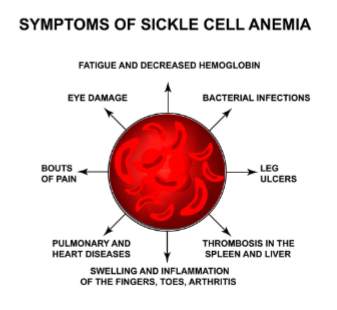
<p><span style="line-height: 20.925px;">The sickle cell phenotype is a single genetic change that causes multiple changes in systems throughout the body like skin and eye damage, blood clots, high blood pressure, heart disease&nbsp;</span></p>
36
New cards

Exceptions to Mendel’s Genetic principles: What are polygenic traits?

When complex traits arise from the action of multiple genes

37
New cards

Exceptions to Mendel’s Genetic principles: How is human height an example of polygenic traits?

  • Development of human height is influenced by at least 10k known genetic alleles 

  • Polygenic traits typically develop according to a normal distribution  

  • Normal Distribution (Bell Curve) – the average is most commonly found in individuals 

  • As you move up or down in either direction that traits become progressively more rare
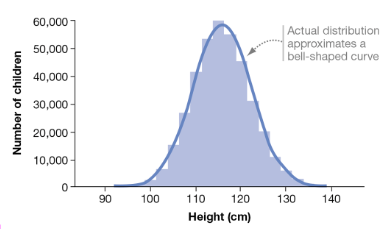
<ul><li><p class="Paragraph SCXW33475580 BCX8" style="text-align: left;"><span style="line-height: 20.925px;">Development of human height is influenced by at least 10k known genetic alleles&nbsp;</span></p></li></ul><ul><li><p class="Paragraph SCXW33475580 BCX8" style="text-align: left;"><span style="line-height: 20.925px;">Polygenic traits typically develop according to a normal distribution &nbsp;</span></p></li></ul><ul><li><p class="Paragraph SCXW33475580 BCX8" style="text-align: left;"><span style="line-height: 20.925px;"><strong>Normal Distribution (Bell Curve)</strong> – the average is most commonly found in individuals&nbsp;</span></p></li></ul><ul><li><p class="Paragraph SCXW33475580 BCX8" style="text-align: left;"><span style="line-height: 20.925px;">As you move up or down in either direction that traits become progressively more rare</span></p></li></ul><p></p>
38
New cards

Exceptions to Mendel’s Genetic principles: True or False: Sometimes, environmental factors contribute to the development of a trait 

True

39
New cards

Exceptions to Mendel’s Genetic principles: How do environmental factors lead to development of a trait?

  • Genetic alleles explain only abt 80% of the variations we see in human genetics/DNA 

  • The other 20% is explained by the influence of the individual’s environment like: Availability of food and other nutrients, Lvl of physical activity, Exposure to environmental pollution 

40
New cards

Exceptions to Mendel’s Genetic principles: How can environmental effects happen in single traits?

  • Enverinoment effects can happen in simple traits to 

  • Siamese cats have a variant allele in the genes that determine coat color 

  • The enzyme that makes the dark color of their fur is called tyrosinase 

  • Tyrosinase is sensitive to temperature 

  • In the cooler parts of the body, the tyrosinase enzyme is active and those parts become dark 

  • In the warmer parts of the body, the tyrosinase enzyme is inactive and those part stay white 

41
New cards

For all organisms, where do their traits directly come from?

The expression of the genetic instructions in the cell’s DNA

42
New cards

Fill in the Blank: In genetics, we use the generic term ______ to describe all of the genetic instructions contained w/i a cell or virus

genome

43
New cards

Fill in the Blank: Chromosomes and other genetic material (like plasmids) are made up of many individual instructions called ______

genes

44
New cards

What is the function of genes?

Each gene is a set of instructions for making one or more proteins or RNA molecules

45
New cards

What is gene expression?

The process by which the info encoded in a gene becomes a functional product of a cell or organism

46
New cards

Why is it important for us to understand gene expression?

  • The traits and functions of an organism is based on the set of structures they have and the functions their cells can perform 

  • The structures a cell has and the functions it can perform are determined by the set of proteins that their genome carries instructions to make 

  • In order to understand how cells function we must understand how those genetic instructions become proteins and how those proteins perform their functions in the cell 

47
New cards

True or False: In order for cells of all types to stay alive and perform the necessary functions of life they must turn the instructions in their DNA into proteins

True

48
New cards

True or False: Protein’s aren’t really that important in cells

False; proteins are responsible for forming most of the structures and carrying out most of the functions in life in cells

49
New cards

What is the central dogma?

The set of rules by which govern the process of how DNA becomes a protein

<p>The set of rules by which govern the process of how DNA becomes a protein</p>
50
New cards

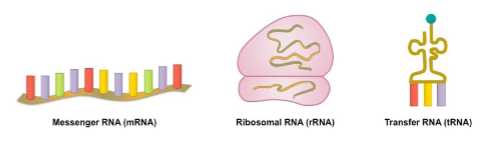
What are the types of RNAs?

  • Messenger RNA (mRNA) 

  • Transfer RNA (tRNA) 

  • Ribosomal RNA (rRNA) 

  • Other non coding RNAs 

<ul><li><p class="Paragraph SCXW12847100 BCX8" style="text-align: left;"><span style="line-height: 20.925px;">Messenger RNA (mRNA)&nbsp;</span></p></li></ul><ul><li><p class="Paragraph SCXW12847100 BCX8" style="text-align: left;"><span style="line-height: 20.925px;">Transfer RNA (tRNA)&nbsp;</span></p></li></ul><ul><li><p class="Paragraph SCXW12847100 BCX8" style="text-align: left;"><span style="line-height: 20.925px;">Ribosomal RNA (rRNA)&nbsp;</span></p></li></ul><ul><li><p class="Paragraph SCXW12847100 BCX8" style="text-align: left;"><span style="line-height: 20.925px;">Other non coding RNAs&nbsp;</span></p></li></ul><p></p>
51
New cards

What is the general process of the central dogma?

  • Genetic info needed to make all of the proteins of the cell is stored in the sequence of the DNA molecules of the cell’s genome 

  • Info stored in a gene’s DNA sequence is copied into an RNA sequence using the process of transcription 

  • Info transcribed into an RNA sequence is used by the ribosomes of the cell to make a protein using the process of translation 

<ul><li><p class="Paragraph SCXW200450091 BCX8" style="text-align: left;"><span style="line-height: 20.925px;">Genetic info needed to make all of the proteins of the cell is stored in the sequence of the DNA molecules of the cell’s genome&nbsp;</span></p></li></ul><ul><li><p class="Paragraph SCXW200450091 BCX8" style="text-align: left;"><span style="line-height: 20.925px;">Info stored in a gene’s DNA sequence is copied into an RNA sequence using the process of transcription&nbsp;</span></p></li></ul><ul><li><p class="Paragraph SCXW200450091 BCX8" style="text-align: left;"><span style="line-height: 20.925px;">Info transcribed into an RNA sequence is used by the ribosomes of the cell to make a protein using the process of translation&nbsp;</span></p></li></ul><p></p>
52
New cards

What is transcription?

Transcription - copying the info stored in DNA into an RNA molecule 

53
New cards

How does transcription work?

  • DNA base pairs are temporarily separated by breaking the hydrogen bonds 

  • Genetic sequence in DNA is read from beginning to end 

  • As it is being read, a copy of that sequence is made using the rules of complementarity 
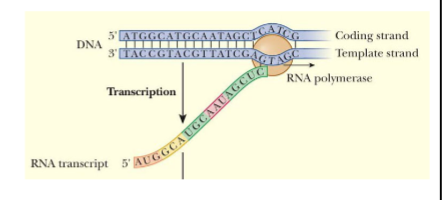
<ul><li><p class="Paragraph SCXW33772463 BCX8" style="text-align: left;"><span style="background-color: transparent; line-height: 20.925px;">DNA base pairs are temporarily separated by breaking the hydrogen bonds</span><span style="line-height: 20.925px;">&nbsp;</span></p></li></ul><ul><li><p class="Paragraph SCXW33772463 BCX8" style="text-align: left;"><span style="background-color: transparent; line-height: 20.925px;">Genetic sequence in DNA is read from beginning to end</span><span style="line-height: 20.925px;">&nbsp;</span></p></li></ul><ul><li><p class="Paragraph SCXW33772463 BCX8" style="text-align: left;"><span style="background-color: transparent; line-height: 20.925px;">As it is being read, a copy of that sequence is made using the rules of complementarity</span><span style="line-height: 20.925px;">&nbsp;</span></p></li></ul><p></p>
54
New cards

What enzyme performs transcription?

RNA polymerase

55
New cards

What are the types of RNA polymerase?

  • RNA polymerases 1 (Pol 1) - inn nucleus (nucleolus), makes some ribosome components 

  • RNA polymerase 2 (Pol 2) - makes mRNA 

  • RNA polymerase 3 (Pol 3) - makes some small non-coding RNAs 

56
New cards

What does RNA polymerase do exactly in transcription?

  • RNA polymerase slides along the DNA molecule, reading the genetic sequence of one strand to make an almost exact copy of the opposite strand 

  • The strand that is read by the RNA polymerase is the template strand 

  • The strand that will be copied is called the coding strand 
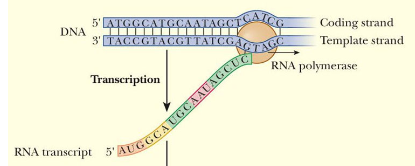
<ul><li><p class="Paragraph SCXW146741012 BCX8" style="text-align: left;"><span style="background-color: transparent; line-height: 20.925px;">RNA polymerase slides along the DNA molecule, reading the genetic sequence of one strand to make an almost exact copy of the opposite strand</span><span style="line-height: 20.925px;">&nbsp;</span></p></li></ul><ul><li><p class="Paragraph SCXW146741012 BCX8" style="text-align: left;"><span style="background-color: transparent; line-height: 20.925px;">The strand that is read by the RNA polymerase is the template strand</span><span style="line-height: 20.925px;">&nbsp;</span></p></li></ul><ul><li><p class="Paragraph SCXW146741012 BCX8" style="text-align: left;"><span style="background-color: transparent; line-height: 20.925px;">The strand that will be copied is called the coding strand</span><span style="line-height: 20.925px;">&nbsp;</span></p></li></ul><p></p>
57
New cards

True or False: Bc RNA polymerase does not use base T (thymine) in its copies, and uses Uracil (U) instead, it is not almost exact 

True

58
New cards

True or False: Complementarity works exactly the same in DNA and RNA. In DNA: A pairs w/ T, G pairs w/ C and in RNA: A pairs w/ T and G pairs w/ C

False; Complementarity works differently in DNA and RNA. In DNA: A pairs w/ T and G pairs w/ C. In RNA: A pairs w/ U and G pairs w/ C
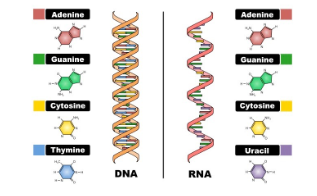
<p>False; Complementarity works differently in DNA and RNA. In DNA: A pairs w/ T and G pairs w/ C. In RNA: A pairs w/ U and G pairs w/ C</p>
59
New cards

Fill in the Blank: RNA molecules made during transcription by RNA polymerase are called ______.

mRNA

60
New cards

Where is mRNA made?

  • Prokaryotic cells - cytoplasm

  • Eukaryotic cells - nucleus first then mRNA is transported into the cytoplasm (in picture)
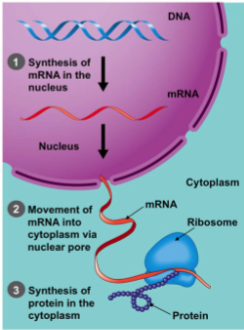
<ul><li><p>Prokaryotic cells - cytoplasm</p></li><li><p>Eukaryotic cells - nucleus first then mRNA is transported into the cytoplasm (in picture)</p></li></ul><p></p>
61
New cards

What happens once mRNA is in the cytoplasm?

Once in the cytoplasm, that genetic RNA message is grabbed by a ribosome which uses it to make a protein 

62
New cards

Proteins are what?

Long chains of amino acids
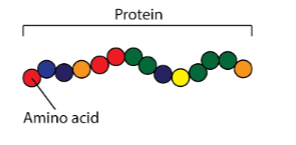
<p>Long chains of amino acids</p>
63
New cards

What are the types of bonds that hold each amino acid tg?

peptide bonds

64
New cards

True or False: a typical protein is a chain of amino acids group

False; a typical protein is a chain of hundreds of amino acids

65
New cards

What is a protein sequence and why is it so important?

  • If we were to read the order of amino acids in a protein, that is called its protein sequence 

  • The information to make this protein sequence is stored in the genes of our chromosomes  

66
New cards

True or False: Each single protein has the same protein sequence

False; each single protein has a unique protein sequence

67
New cards

Fill in the Blank: The genetic sequence of an RNA molecule is organized into 3 letter words called ______

codons

68
New cards

Since each of these codons corresponds to a particular amino acid in the protein sequence, what are rules that define which amino acid corresponds to each codon?

Genetic code
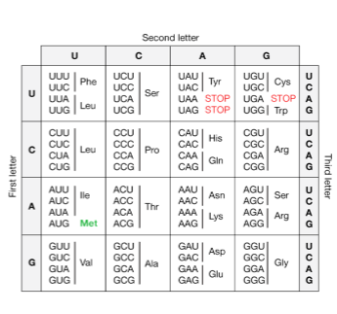
<p>Genetic code</p>
69
New cards

Why are methionine (MET) and STOP codons special?

  • Methionine (AUG) - codon that tells the ribosome where to start translating the mRNA 

  • STOP codon – tells the ribosome when the protein is complete and to translating 
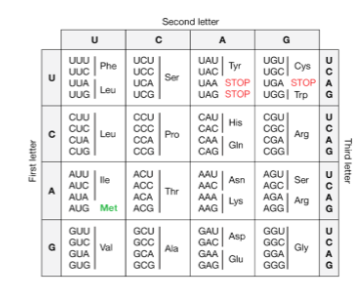
<ul><li><p class="Paragraph SCXW27605008 BCX8" style="text-align: left;"><span style="line-height: 20.925px;">Methionine (AUG) - codon that tells the ribosome where to start translating the mRNA&nbsp;</span></p></li></ul><ul><li><p class="Paragraph SCXW27605008 BCX8" style="text-align: left;"><span style="line-height: 20.925px;">STOP codon – tells the ribosome when the protein is complete and to translating&nbsp;</span></p></li></ul><p></p>
70
New cards

What is the part of the cell that does the translation?

Ribosome

71
New cards

How does the ribosome translate? What does it need?

  • Ribosome slides along an mRNA molecule and reads the codons of the genetic sequence and creates the new protein chain 

  • Requires special helper RNA molecules called tRNA (transfer RNA) 

  • tRNA will form base pairs w/ the mRNA which allows it to carry the correct amino acid into the ribosome Requires 

72
New cards

What are the systems of control of gene expression?

  1. Chromatin Remodeling – the cell can regulate how tightly or loosely chromatin is packed 

  1. Transcription Control – the cell can control the timing and volume of transcription of individual genes 

  1. RNA Processing – after transcription, RNA must be modified before it exits the nucleus 
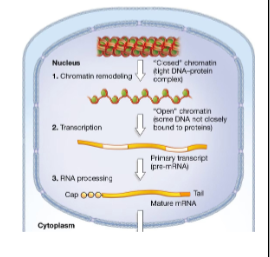
<ol><li><p class="Paragraph SCXW71167297 BCX8" style="text-align: left;"><span style="line-height: 20.925px;">Chromatin Remodeling – the cell can regulate how tightly or loosely chromatin is packed&nbsp;</span></p></li></ol><ol start="2"><li><p class="Paragraph SCXW71167297 BCX8" style="text-align: left;"><span style="line-height: 20.925px;">Transcription Control – the cell can control the timing and volume of transcription of individual genes&nbsp;</span></p></li></ol><ol start="3"><li><p class="Paragraph SCXW71167297 BCX8" style="text-align: left;"><span style="line-height: 20.925px;">RNA Processing – after transcription, RNA must be modified before it exits the nucleus&nbsp;</span></p></li></ol><p></p>
73
New cards

In cells, what is DNA found as and how many do humans have and what are the functions of it?

  • In cells, DNA is found as one more extraordinarily long double-stranded molecules called chromosomes 

  • In humans: 23 pairs of chromosomes, two sets each, so 46 total chromosomes per ell 

  • In humans, total length of all chromosomes ins a 3.2 billion base pairs 

  • Approximately 20% of chromosomal DNA are genes called Coding DNA 

  • Remaining 80% has a variety of functions, much of which is still unknown as non-coding DNA 

74
New cards

True or False: Even w/i a single gene, there are DNA sequences that do not directly code for an RNA or Protein 

True
75
New cards
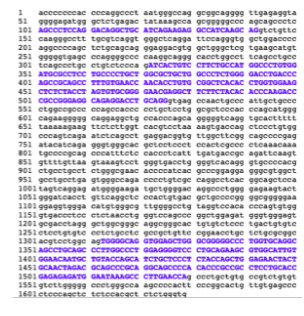
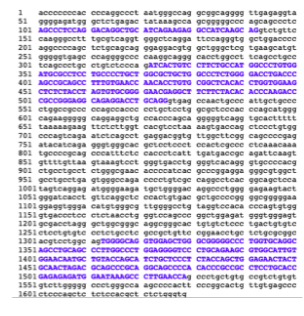
<p>What does the image represent? This is the genetic sequence for insulin</p>

What does the image represent? This is the genetic sequence for insulin

  • Parts in purple represent the sequence that contain he genetic code for insulin protein (Exons) 

  • Parts in Black will be removed from the RNA before it leaves the nucleus, (introns) 
<ul><li><p class="Paragraph SCXW98769925 BCX8" style="text-align: left;"><span style="line-height: 20.925px;">Parts in purple represent the sequence that contain he genetic code for insulin protein (Exons)&nbsp;</span></p></li></ul><ul><li><p class="Paragraph SCXW98769925 BCX8" style="text-align: left;"><span style="line-height: 20.925px;">Parts in Black will be removed from the RNA before it leaves the nucleus, (introns)&nbsp;</span></p></li></ul><p></p>
76
New cards

What is the coding region of a gene?

The coding region of a gene begins at the transcription initiation site 

77
New cards

True or False: The coding region of a gene is the same as the start codon

False; the start codon is where RNA polymerase starts transcription starts, while the coding region is where exon and intron sequences will alternate as we move along the strand

<p>False; the start codon is where RNA polymerase starts transcription starts, while the coding region is where exon and intron sequences will alternate as we move along the strand </p>
78
New cards

True or False: there is several types of regulatory DNA sequences

True

79
New cards

Fill in the Blank: ________ ________ ________ allow the cell to exercise transcriptional control over individual genes

DNA regulatory sequences

<p>DNA regulatory sequences</p>
80
New cards

What are the gene sequences that are used by RNA polymerase and its helper proteins to bind to the DNA for transcription

Core promoter

<p>Core promoter</p>
81
New cards

What are the helper proteins for RNA polymerase and what do they do?

  • The helper proteins for RNA polymerase are called general transcription factors 

  • A transcription factor is any protein that is able to bind to dna regulatory sequences and can increase or decrease the rate of gene transcription by RNA polymerase 

<ul><li><p class="Paragraph SCXW48259398 BCX8" style="text-align: left;"><span style="line-height: 20.925px;">The helper proteins for RNA polymerase are called general transcription factors&nbsp;</span></p></li></ul><ul><li><p class="Paragraph SCXW48259398 BCX8" style="text-align: left;"><span style="line-height: 20.925px;">A transcription factor is any protein that is able to bind to dna regulatory sequences and can increase or decrease the rate of gene transcription by RNA polymerase&nbsp;</span></p></li></ul><p></p>
82
New cards

True or False: In order to be used by enzymes, DNA must be fully unwound and the base pairing separated. RNA polymerase cannot do this on its own, it needs the general transcription factors to assist.

True

83
New cards

Why is using general transcription factors to assist a super power?

  • The successful interaction of all these transcription factors is requried for transcription to happen 

  • Bc this is true, the cell can regulate transcription by regulating the interaction of thse proteins 
<ul><li><p class="Paragraph SCXW215646659 BCX8" style="text-align: left;"><span style="line-height: 20.925px;">The successful interaction of all these transcription factors is requried for transcription to happen&nbsp;</span></p></li></ul><ul><li><p class="Paragraph SCXW215646659 BCX8" style="text-align: left;"><span style="line-height: 20.925px;">Bc this is true, the cell can regulate transcription by regulating the interaction of thse proteins&nbsp;</span></p></li></ul><p></p>
84
New cards

What does the cell use to regulate the interaction of the general transcription factors and how do they work?

  • The cell regulates the interaction of the general transcription factors w/ accessory promoters 

  • DNA sequences that either stabilize or interfere w/ the interaction of the general transcription factors w/ the core promoter 

<ul><li><p class="Paragraph SCXW250138772 BCX8" style="text-align: left;"><span style="line-height: 20.925px;">The cell regulates the interaction of the general transcription factors w/ accessory promoters&nbsp;</span></p></li></ul><ul><li><p class="Paragraph SCXW250138772 BCX8" style="text-align: left;"><span style="line-height: 20.925px;">DNA sequences that either stabilize or interfere w/ the interaction of the general transcription factors w/ the core promoter&nbsp;</span></p></li></ul><p></p>
85
New cards

True or False: In eukaryotic cells, most accessory promoters are located near the actual gene and in extrons. Those that are far away are called promoter-proximal elements.

  • False

  • In eukaryotic cells, most accessory promoters are located thousands of bases away from the actual gene or in introns

  • Some are not and they are called promoter-proximal elements

<ul><li><p>False</p></li><li><p>In eukaryotic cells, most accessory promoters are located thousands of bases away from the actual gene or in introns</p></li><li><p>Some are not and they are called promoter-proximal elements</p></li></ul><p></p>
86
New cards

What are the two types of accessory promoters?

  • Enhancers – accesory promoters that increase transcription of a gene by stabilizing the general transcription factors 

  • Silencers – accesory promoters that decrease transcription of a gene by interfering w/ the general transcription factors

<ul><li><p class="Paragraph SCXW96774584 BCX8" style="text-align: left;"><span style="line-height: 20.925px;">Enhancers – accesory promoters that increase transcription of a gene by stabilizing the general transcription factors&nbsp;</span></p></li></ul><ul><li><p class="Paragraph SCXW96774584 BCX8" style="text-align: left;"><span style="line-height: 20.925px;">Silencers – accesory promoters that decrease transcription of a gene by interfering w/ the general transcription factors</span></p></li></ul><p></p>
87
New cards

Fill in the Blank: Accessory promoters can also have _______ ________ to them

regulatory proteins

88
New cards

What is the difference between the two types of regulatory proteins that bind to accessory proteins?

  • Transcriptional Activator – a protein that binds to an enhancer sequence which stabilizes the interaction btwn the general transcription factors and increase transcription/the amt of mRNA made from the gene 

  • Transcriptional Repressor – a protein that binds to a silencer sequence and inhibits the interaction btwn the general transcription factors and decrease transcription/the amt of mRNA made from the gene
<ul><li><p class="Paragraph SCXW15971717 BCX8" style="text-align: left;"><span style="line-height: 20.925px;">Transcriptional Activator – a protein that binds to an enhancer sequence which stabilizes the interaction btwn the general transcription factors and increase transcription/the amt of mRNA made from the gene&nbsp;</span></p></li></ul><ul><li><p class="Paragraph SCXW15971717 BCX8" style="text-align: left;"><span style="line-height: 20.925px;">Transcriptional Repressor – a protein that binds to a silencer sequence and inhibits the interaction btwn the general transcription factors and decrease transcription/the amt of mRNA made from the gene</span></p></li></ul><p></p>
89
New cards

Activator and repressor proteins cannot directly interact w/ the general transcription factors (TFs). What must they interact through?

A large protein complex called the Mediator
<p>A large protein complex called the Mediator</p>
90
New cards

What must happen for the enhancer or silencer sequences that are far away from the gene must do?

Must form DNA loops to interact w/ the mediator
<p>Must form DNA loops to interact w/ the mediator</p>
91
New cards

How does the mediator regulate the transcriptional control?

  • If there are more activators than repressors, then the Mediator stabilizes the general TFs and transcription happens 

  • If there are more repressors than activators, then the mediator inhibits the general TFs and transcription is blocked 
 

<ul><li><p class="Paragraph SCXW144078261 BCX8" style="text-align: left;"><span style="line-height: 20.925px;">If there are more activators than repressors, then the Mediator stabilizes the general TFs and transcription happens&nbsp;</span></p></li></ul><ul><li><p class="Paragraph SCXW144078261 BCX8" style="text-align: left;"><span style="line-height: 20.925px;">If there are more repressors than activators, then the mediator inhibits the general TFs and transcription is blocked&nbsp;</span></p></li></ul><p class="Paragraph SCXW144078261 BCX8" style="text-align: left;"><span style="line-height: 20.925px;">&nbsp;</span></p>
92
New cards

What is the process of translation?

  1. The chromatin in the region of the chromosome containing the gene is decondensed 

  1. Decondensing the chromatin opens up the DNA and allows accessory TFs (repressors and activators) to bind 

  1. DNA loops are formed so that the accessory TFs can bind to and interact w/ the mediator 

  1. Mediator interacts w/ the general TFs; activators stabilize general TFs while repressors inhibits them 

93
New cards

What must a transcribed mRNA do before it goes through translation?

RNA processing

94
New cards

What are the 3 types of RNA processing?

  1. Capping the 5’ end

  2. Polyadenylation of the 3’ end

  3. Removal (splicing) of introns

95
New cards

What is the 5’ and the 3’ end made out of and why is it important?

  • 5’ cap is made by adding guanosine triphosphate (GTP) 

  • 3’ end has a long string of adenine nucleotides called the poly-A tail 

  • Capping and Polyadenylation is used for 

  1. Nuclear export signal that allows mRNA to exit though the nuclear pore 

  2. They prevent the mRNA from being immediately broken down in the cytoplasm 

  3. They act as signals that help the ribosome to bind to the mRNA during translation 
<ul><li><p><span style="line-height: 20.925px;">5’ cap is made by adding guanosine triphosphate (GTP)&nbsp;</span></p></li><li><p><span style="line-height: 20.925px;">3’ end has a long string of adenine nucleotides called the poly-A tail&nbsp;</span></p></li><li><p><span style="line-height: 20.925px;">Capping and Polyadenylation is used for&nbsp;</span></p></li></ul><ol><li><p class="Paragraph SCXW246483081 BCX8" style="text-align: left;"><span style="line-height: 20.925px;">Nuclear export signal that allows mRNA to exit though the nuclear pore&nbsp;</span></p></li><li><p class="Paragraph SCXW246483081 BCX8" style="text-align: left;"><span style="line-height: 20.925px;">They prevent the mRNA from being immediately broken down in the cytoplasm&nbsp;</span></p></li><li><p class="Paragraph SCXW246483081 BCX8" style="text-align: left;"><span style="line-height: 20.925px;">They act as signals that help the ribosome to bind to the mRNA during translation&nbsp;</span></p></li></ol><p></p>
96
New cards

Fill in the Blank: Transcription of a gene copies the entire coding region including all _______ and ______. Before the mRNA is ready to be translated the ______ must be removed from the mRNA

  • Exons

  • Introns

  • Introns

97
New cards

What is the processing of removing introns called and where is it done?

  • Splicing

  • Performed in the nucleus by a structure called the spliceosome

98
New cards

What is the spliceosome built from and what can we call the spliceosome?

  • The spliceosome is built from several smaller RNA-containing proteins called snRNPs (small nuclear ribonucleoproteins) 

  • Bc the enzyme functions of the spliceosome are dependent on RNA, we call the spliceosome a ribozyme 
<ul><li><p class="Paragraph SCXW170247076 BCX8" style="text-align: left;"><span style="line-height: 20.925px;">The spliceosome is built from several smaller RNA-containing proteins called snRNPs (small nuclear ribonucleoproteins)&nbsp;</span></p></li></ul><ul><li><p class="Paragraph SCXW170247076 BCX8" style="text-align: left;"><span style="line-height: 20.925px;">Bc the enzyme functions of the spliceosome are dependent on RNA, we call the spliceosome a ribozyme&nbsp;</span></p></li></ul><p></p>
99
New cards

How does splicing work?

  1. Binding of the snRNPs and formation of the spliceosome on the MRNA causes the formation of an RNA loop 

  2. This loop is then cut by the spliceosome at the beginning of the intron 

  3. The beginning of the intro is then permanently bonded to the end of the intron at a spot called the branch site 

  4. The far end of the intron is cut and the two exons are connect tg w/ a covalent bond 
<ol><li><p class="Paragraph SCXW191581700 BCX8" style="text-align: left;"><span style="line-height: 20.925px;">Binding of the snRNPs and formation of the spliceosome on the MRNA causes the formation of an RNA loop&nbsp;</span></p></li><li><p class="Paragraph SCXW191581700 BCX8" style="text-align: left;"><span style="line-height: 20.925px;">This loop is then cut by the spliceosome at the beginning of the intron&nbsp;</span></p></li><li><p class="Paragraph SCXW191581700 BCX8" style="text-align: left;"><span style="line-height: 20.925px;">The beginning of the intro is then permanently bonded to the end of the intron at a spot called the branch site&nbsp;</span></p></li><li><p class="Paragraph SCXW191581700 BCX8" style="text-align: left;"><span style="line-height: 20.925px;">The far end of the intron is cut and the two exons are connect tg w/ a covalent bond&nbsp;</span></p></li></ol><p></p>
100
New cards

True or False: Approx 70% of genes can be alternatively spliced (or spliced in multiple ways)

True

Explore top notes

note
Chapter 7
Updated 531d ago
0.0(0)
note
ANSC 301 VOCABULARY
Updated 1293d ago
0.0(0)
note
Sociology Test
Updated 226d ago
0.0(0)
note
Lessons 3 and 4 Science Notes
Updated 517d ago
0.0(0)
note
ap lang exam review
Updated 793d ago
0.0(0)
note
AP Psch pg 163-184
Updated 520d ago
0.0(0)
note
Organic Chemistry
Updated 1015d ago
0.0(0)
note
Chapter 7
Updated 531d ago
0.0(0)
note
ANSC 301 VOCABULARY
Updated 1293d ago
0.0(0)
note
Sociology Test
Updated 226d ago
0.0(0)
note
Lessons 3 and 4 Science Notes
Updated 517d ago
0.0(0)
note
ap lang exam review
Updated 793d ago
0.0(0)
note
AP Psch pg 163-184
Updated 520d ago
0.0(0)
note
Organic Chemistry
Updated 1015d ago
0.0(0)

Explore top flashcards

flashcards
Perfect Squares 1-30
30
Updated 759d ago
0.0(0)
flashcards
Physics 10
164
Updated 685d ago
0.0(0)
flashcards
Chapter 15 and 16 Vocab
25
Updated 1033d ago
0.0(0)
flashcards
Parallèles Ép2 P1
45
Updated 310d ago
0.0(0)
flashcards
Sp1 VS Months & Days
31
Updated 1168d ago
0.0(0)
flashcards
German Final
134
Updated 296d ago
0.0(0)
flashcards
Exam 1
121
Updated 1151d ago
0.0(0)
flashcards
Perfect Squares 1-30
30
Updated 759d ago
0.0(0)
flashcards
Physics 10
164
Updated 685d ago
0.0(0)
flashcards
Chapter 15 and 16 Vocab
25
Updated 1033d ago
0.0(0)
flashcards
Parallèles Ép2 P1
45
Updated 310d ago
0.0(0)
flashcards
Sp1 VS Months & Days
31
Updated 1168d ago
0.0(0)
flashcards
German Final
134
Updated 296d ago
0.0(0)
flashcards
Exam 1
121
Updated 1151d ago
0.0(0)