GESTALT PSYCHOLOGY
 Studied by 0 people
 Call with Kai
 Learn
Learn Practice Test
 Spaced Repetition
 Match
Match Flashcards
 Knowt Play
1/7

There's no tags or description
Looks like no tags are added yet.
Name | Mastery | Learn | Test | Matching | Spaced | Call with Kai |
|---|
No study sessions yet.
8 Terms
What is the core of Gestalt psychology?
Core idea: The whole is other than the sum of its parts.
Gestalt psychology argues that psychological phenomena cannot be understood by breaking them into isolated elements. The mind actively organises experience into meaningful wholes.
This position directly opposes elementarism and associationism, which attempted to explain mental life as the sum of basic sensations.
Historical Context and founders
Germany, early 20th century
Decline of structuralism (Wundt)
Rise of functionalism in the USA
Emergence of Gestalt psychology as a reaction against atomistic explanations of perception
Founders:
Max Wertheimer
Wolfgang Köhler
Kurt Koffka
Central principle: The mind organizes experience according to intrinsic laws.
Max Wertheimer and the Phi Phenomenon
Wertheimer demonstrated that perception is not a passive reception of stimuli.
Phi phenomenon:
Two alternating lights are perceived as continuous movement
Movement is not in the stimuli but in perception
“We do not perceive two separate flashes, but a single movement… a quality of the whole.” (Wertheimer)
Application:
Cinema works by the phi phenomenon (24 frames per second create apparent motion)
Wolfgang Köhler and Insight Learning
Köhler studied problem-solving in chimpanzees.
Key idea: Learning occurs through insight, not trial-and-error.
Example:
A chimpanzee suddenly puts two sticks together to reach a banana
Learning is the restructuring of the perceptual field
This challenged behaviourist explanations of learning.
Kurt Koffka and the Concept of Form
Koffka emphasized that psychological processes are organized totalities.
“A melody is not a sum of notes.”
The meaning of each part depends on the structure of the whole.
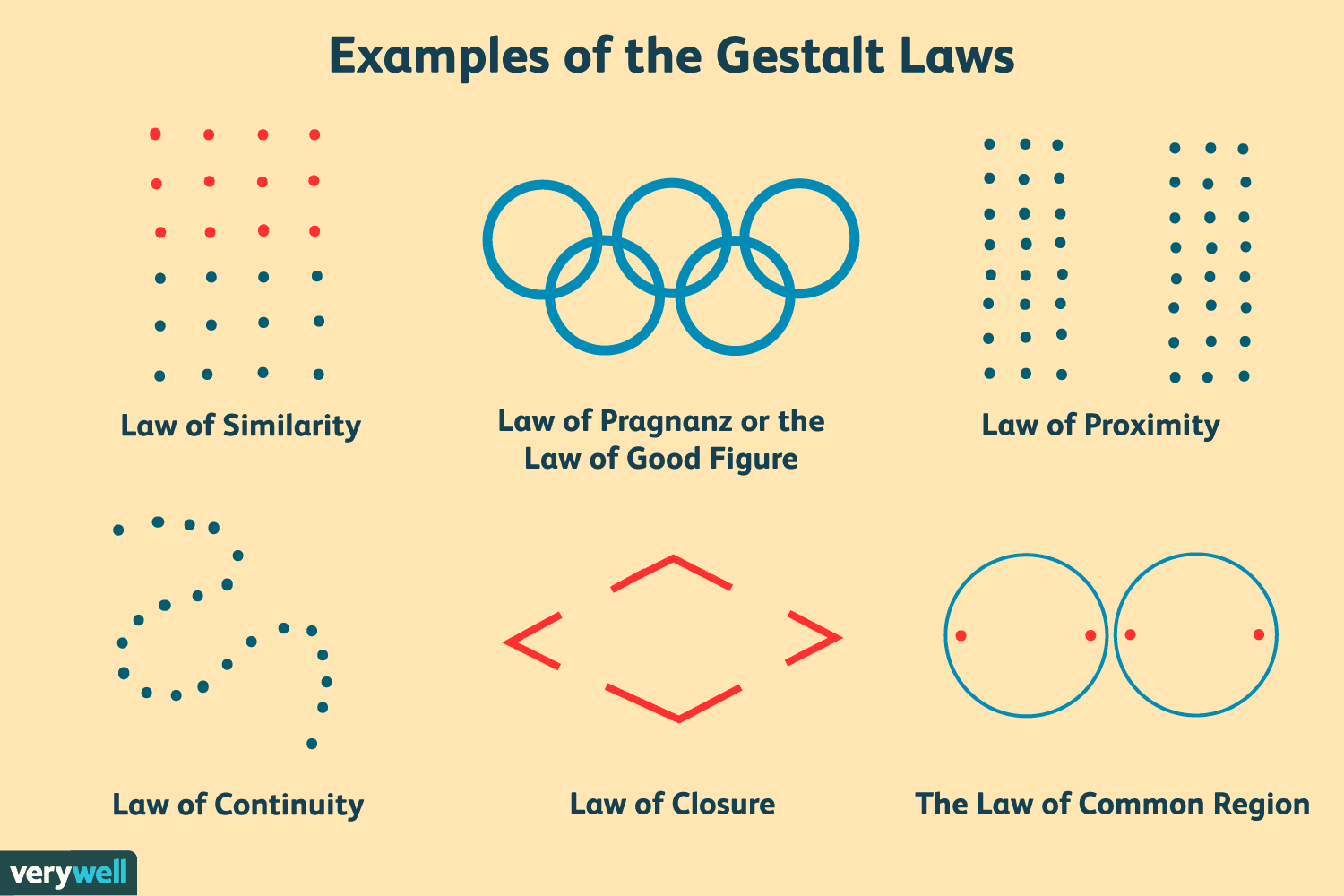
Laws of Perceptual Organisation (Gestalt Laws)
Proximity: Elements close together are grouped
Similarity: Elements similar in shape or colour are grouped
Continuity: We perceive continuous patterns
Closure: We complete incomplete figures
Prägnanz (Good Form): Preference for simple, stable shapes
These laws show that perception follows internal organising principles.
Criticism: Behaviorism
Behaviourists argued that Gestalt psychology:
Lacked precision
Relied on subjective experience
Was not sufficiently measurable
“Psychology must stick to objective observations of behaviour.” (Watson)
Gestalt Legacy
Gestalt psychology influenced later approaches:
Kurt Lewin: Behaviour as a function of person + environment
Carl Rogers: The person as an organised whole
Cognitive psychology: Active mental organisation
Conclusion: The mind is not passive but an active organising system.
 Note
Note  Flashcards (39)