Issues and Debates
 Call Kai
 Learn
Learn Practice Test
 Spaced Repetition
 Match
Match Flashcards
 Knowt Play
1/15

There's no tags or description
Looks like no tags are added yet.
Name | Mastery | Learn | Test | Matching | Spaced | Call with Kai |
|---|
No analytics yet
Send a link to your students to track their progress
16 Terms
Issue
(Note that you don’t need this definition, it’s just for clarity.)
An issue in psychology refers to a source of conflict that, if ignored, could undermine the value of theories and research.
The issues are:
• Gender bias
• Cultural bias
• Ethical issues
These are separate! Do not, for example, mention cultural bias in a gender bias essay.
Debate
(Note that you don’t need to know this definition, it’s just for clarity.)
A debate in psychology is seen as an academic argument that lasts over many years and often appears to have no resolution.
The debates are:
• Free will vs Determinism
• Nature vs Nurture
• Holism vs Reductionism
• Ideographic vs Nomothetic approaches to studying behaviour
Issue: Gender bias AO1
Note: the definitions are underlined and in bold in case you get a shorter question on one.
We are striving for universality, which is the desire to generalise findings and/or theory to everyone (males and females). Unfortunately, gender bias exists.
Gender bias is when one gender is treated less favourably than the other, often referred to as sexism.
This can result in androcentrism, where theories are based on male behaviour but applied to females. Therefore, male behaviour is seen as the norm whereas female behaviour is seen as deviant and is thus misunderstood and even pathologised.
For example, although women outnumber men in psychology courses, men dominate senior academic roles, which may lead to research focusing more on male interests.
Alpha bias is the exaggeration of differences between genders, often devaluing one in comparison to the other. For example, in his theory of monotropy, Bowlby suggested that a child’s primary attachment must be to the mother, and that this relationship is more important than attachments to the father or others.
The problem with alpha bias is that it causes a misrepresentation of behaviour since differences are exaggerated.
In contrast, beta bias is when theories minimise gender differences, assuming findings from one gender apply universally. For example, the fight-or-flight stress response was developed from male ps but was long considered universal until Taylor et al. (2000) showed that females often adopt a tend-and-befriend response rather than fighting or fleeing.
The problem with beta bias is that it causes a misrepresentation of behaviour since differences are minimised.
Issue: Gender bias AO3
One implication of gender bias in psychological research is the reinforcement of harmful stereotypes, particularly against women. For example, in the psychodynamic approach, Freud suggested that women are morally inferior due to their lack of a developed superego, stemming from penis envy and the absence of an Oedipus complex. Such biased theories can be used to justify discriminatory practices, influencing societal attitudes and reducing opportunities for women in areas like employment, leadership, or education. When flawed research is accepted as scientific truth, it can validate prejudice and institutional sexism. Therefore, gender bias in research can have damaging real-world consequences, especially when findings are used to inform policy or shape public perceptions.
Another implication is that gender bias can lead to methodological flaws, reducing the validity and generalisability of psychological findings. For example, studies have shown that female participants may perform better when male researchers are more friendly, indicating that researcher behaviour can influence outcomes. This suggests that biased methods can distort results, leading to inaccurate conclusions about gender differences. Thus, biased methodologies not only misrepresent gender but also undermine the reliability of psychological research.
One way to reduce gender bias in psychology is through feminist psychology, which challenges androcentric assumptions and promotes inclusivity. Feminist psychologists argue that women should be studied in meaningful, real-life contexts and actively participate in research, rather than being treated as passive subjects. They also emphasise diversity within and between genders. This helps redress imbalances in psychological research and provides more accurate, representative findings. Therefore, feminist psychology offers a constructive framework for reducing gender bias and improving the validity of psychological research.
Gender bias has had long-standing consequences in psychology, both historically and in modern-day research practices. Historically, major psychological theories were developed by male researchers and tested predominantly on male participants, such as Asch and Zimbardo. In publishing, male-dominated peer review processes may overlook research focused on women’s experiences. This has limited the progression of female academics. Even today, underrepresentation of women in senior research roles can perpetuate androcentrism and restrict the scope of psychological inquiry. Thus, addressing gender bias is crucial not only for scientific accuracy but also for promoting equality within the discipline and ensuring that psychology reflects the experiences of all genders.
Issue: Cultural bias AO1
Note: the definitions are underlined and in bold in case you get a shorter question on one.
We are striving for universality, which is the desire to generalise findings and/or theory to everyone (across cultures). Unfortunately, culture bias exists.
Culture bias occurs when researchers judge or interpret behaviour using the standards of their own cultural group. This becomes a problem when psychological theories, often developed in Western, individualist societies, are assumed to apply universally. As a result, behaviours that differ from Western norms may be incorrectly viewed as abnormal or inferior.
A key component of culture bias is ethnocentrism. This is the tendency to see one’s own cultural values as superior and to use them as the default viewpoint. For example, Ainsworth’s Strange Situation was developed in the US and reflected American ideas about “ideal” attachment behaviour, such as separation anxiety. When used in non-Western cultures, these behaviours did not always appear in the same way, leading to the inaccurate conclusion that some cultures had “less secure” attachment.
To counter this, psychologists emphasise cultural relativism, which is the idea that behaviour should be understood within the cultural context in which it occurs. What is considered normal in one culture may not be in another, and therefore research methods should adapt to cultural differences. Cultural relativism highlights that no behaviour is inherently superior or inferior; it is simply rooted in different cultural experiences.
Finally, cross-cultural research can be approached through etic and emic perspectives. An etic approach studies behaviour from outside the culture and seeks universal principles, which risks imposing Western assumptions when exported globally. An emic approach, in contrast, focuses on understanding behaviour from within a culture and recognises unique cultural phenomena, like culture-bound syndromes such as Koro syndrome. Current psychological research aims to balance these perspectives to avoid cultural distortion.
Issue: Cultural bias AO3
One implication of cultural bias is that culturally biased research has historically produced misleading conclusions, particularly in IQ testing. Early IQ tests, created within Western, individualist cultures, assumed knowledge and problem-solving styles valued in Europe and the US. When applied to non-Western groups, these tests often gave significantly lower IQ scores. This suggests that differences reflected cultural exposure, not actual intelligence. Misinterpretation led to harmful racial stereotypes and claims that some groups were intellectually inferior. Therefore, research that ignores cultural context can create invalid conclusions with serious social consequences, showing the importance of culturally sensitive methods.
An issue is that culture bias affects the diagnosis of mental illness. Diagnostic tools such as DSM were developed in Western cultures. Behaviours considered symptoms in the West—such as hearing voices—may be interpreted as spiritual experiences in some non-Western cultures. As a result, individuals from African-Caribbean backgrounds living in Western countries are disproportionately diagnosed with schizophrenia, not necessarily due to higher prevalence but due to cultural misinterpretation. This demonstrates that imposing Western diagnostic criteria (an etic approach) risks over-pathologising behaviours that are normal within another cultural framework.
A further issue of cultural bias is the oversimplified distinction between individualist and collectivist cultures. Traditionally, Western societies like the USA are seen as valuing independence, while countries such as Japan and China are viewed as prioritizing community and interdependence. However, globalization has increasingly blurred these lines. Research shows that younger generations in typically collectivist cultures now score similarly to Western peers on measures of individualism. This shift suggests that early cultural frameworks may have overgeneralized, reinforcing stereotypes.
Modern psychology is moving beyond simplistic cultural distinctions. Research often assumes fundamental differences between individualist and collectivist cultures, but globalisation has blurred these boundaries. Studies show that young people in Japan and China (typically collectivist cultures) increasingly score similarly to Western participants on individualism measures. This suggests that early cultural frameworks may have overgeneralised, creating stereotypes rather than capturing dynamic cultural change. Recognising this helps modern psychology avoid outdated assumptions and develop theories that reflect contemporary cultural diversity, increasing validity.
While cultural bias is often seen as a major issue in psychology, some evidence suggests it may be overstated. The idea that psychological findings can only be applied within the culture they were studied in overlooks the possibility of universal human behaviours. For example, research found that men and women across various cultures showed similar preferences when choosing partners. This suggests that such preferences may be biologically rooted rather than culturally shaped. This supports the idea of universal human behaviours, reducing the notion that psychological research is hugely culture biased.
Issue: Ethical implications AO1
Ethical implications arise when psychological research risks creating conflict between gaining valuable knowledge and protecting the rights and well-being of participants and the wider groups they represent.
Ethical guidelines, such as those produced by the BPS, exist to ensure that psychological research protects participants’ dignity, rights, and welfare. They emphasise principles like informed consent, confidentiality, and avoiding psychological or social harm.
Socially sensitive research describes research where there may be potential social consequences for participants and the wider groups they represent.
So socially sensitive research includes studies on topics that are controversial or have important social consequences, such as childhood development, family relationships, intelligence, or sexuality. The findings from such research may influence social policies, public attitudes, and how certain groups are treated.
Sieber and Stanley (1988) identified four stages of the research process where ethical issues can occur.
First, the research question may be sensitive if it suggests group differences or reinforces stereotypes (e.g., asking whether certain children are “less capable” could stigmatise them).
Second, the conduct of research must protect confidentiality, especially when working with families or children; for example, studies exploring difficult early experiences could reveal personal information that must be kept secure.
Third, the institutional context matters because organisations funding or reporting the research (e.g. the media, schools, or government departments) may misinterpret or misuse findings.
Finally, the interpretation and application of findings can have wide-ranging societal effects. For example, Bowlby’s work on maternal deprivation influenced childcare policy, leading to the belief that children should not be separated from their primary caregiver, which shaped hospital visiting rules and adoption practice.
Because socially sensitive research can affect families, communities, and whole social groups beyond the participants themselves, psychologists must consider both the direct and indirect consequences of their work. This ensures that research contributes positively to understanding while minimising potential harm.
That’s what you would use for an essay, but for smaller questions, you’ll need this:
Ethical issues: DIPC
• Deception - ps should not be deliberately misled. If they are, they should be debriefed at the end.
• Lack of informed consent - ps should be aware of aims, procedures, and their right to withdraw before the study.
• Protection from harm - ps should not be exposed to more risk than they would be in everyday life. Harm could be psychological or physical.
• Confidentiality – ps’ anonymity must be respected and names should not be recorded.
How to deal with these?
• Give a debrief at the end of the study.
• Offer counselling afterwards.
• Ask if they're okay with their data being published afterwards. If not, you can ask to use initials instead of their real name.
Issue: Ethical implications AO3
Socially sensitive research can lead to significant societal benefits when conducted ethically. For example, Rutter’s Romanian orphan study highlighted the long-term effects of severe early deprivation, influencing institutions, including the importance of stable, high-quality caregiving. This shows how such research can influence policy and promote better outcomes for vulnerable groups, demonstrating psychology’s potential to drive positive social change. Therefore, not conducting socially sensitive could actually have implications as certain systems, such as institutions, may be prevented from being improved.
An issue is that socially sensitive research risks harming the wider groups they represent. For example, research into racial differences in IQ, such as Yerkes’ study, was used to justify discriminatory policies and reinforce prejudice. If findings are misinterpreted or lack validity, they can perpetuate stigma, especially when applied by institutions like the media or government. This highlights the need for rigorous ethical oversight and careful interpretation of findings.
Research into socially sensitive areas can promote greater understanding and reduce prejudice toward marginalised groups. Studies involving disabled individuals or homosexual relationships have helped increase societal acceptance and representation. By giving voice to underrepresented populations, socially sensitive research fosters inclusivity and challenges stereotypes. This therefore makes it a valuable tool for social progress and ethical advocacy.
A key consideration in socially sensitive research is whether the potential benefits outweigh the possible costs to individuals and the wider social groups involved. For instance, research into genetic explanations for criminality may offer benefits such as improved early intervention or rehabilitation programmes. However, it also carries the risk of labelling individuals as “predisposed” to crime, which could lead to discrimination or reduced life opportunities. This demonstrates that even if research has scientific or societal value, the psychological, social, and political costs must be carefully weighed. Ethical committees therefore play a crucial role in assessing whether the anticipated benefits justify the potential harm. Therefore, cost–benefit analysis is essential in guiding whether socially sensitive research should be conducted, ensuring that psychological knowledge advances without causing disproportionate harm to vulnerable groups.
Debate: Free will and determinism AO1
Note: the definitions are underlined and in bold in case you get a shorter question on one.
The debate between free will and determinism concerns the extent to which human behaviour is the result of autonomous choice versus external or internal forces.
Free will assumes that humans are able to choose their behaviour, and that internal (biological) or external (environmental) influences can be rejected at will. This idea is central to the humanistic approach, which believes that humans have conscious awareness and are capable of making their own decision, thus their behaviour is determined by their own choices.
In contrast, determinism proposes that behaviour is caused by factors beyond our control. Hard determinism asserts that all behaviour has identifiable causes, whether biological, environmental, or psychic.
Biological determinism explains behaviour to be caused by internal biological factors such as genetics, neurochemicals, brain structures, and hormones. For example, the biological approach would argue that high levels of dopamine and low levels of serotonin cause OCD.
Environmental determinism, as seen in the behaviourist approach, argues that behaviour is caused by past experience and controlled by external forces in the environment. For example, the behaviourist approach describes behaviour to be a result of conditioning and reinforcement.
Psychic determinism claims that behaviour is controlled by unconscious forces and innate drives. This is rooted in Freud’s psychodynamic approach, which states that behaviour is driven by unconscious conflicts and repressed childhood experiences.
Soft determinism offers a middle ground, suggesting that behaviour can be caused by a person’s own character, highlighting that humans still have an element of free will. For example, the cognitive approach includes the idea of schema, which are mental frameworks built from experience. Although schemas guide behaviour, individuals can reflect on and challenge them through cognitive interventions like CBT, therefore humans have a little free will.
Psychology’s scientific emphasis on causal explanations involves using controlled lab experiments (e.g., Pavlov, Skinner, Bandura) to control extraneous variables and therefore establish cause and effect. The IV must be what is determining the DV, not EVs.
Debate: Free will and determinism AO3
Note: you do need at least one free will point in a 16 marker. Also, if for some reason, you get an 8 maker on just determinism or just on free will, it’s fine because you’d need to mention the other side of the debate anyway.
One criticism of determinism is that it undermines personal responsibility. This is because if behaviour is entirely shaped by biological, environmental, or unconscious forces, individuals may not be accountable for their actions. For example, biological determinism would suggest that criminal behaviour results from genetic predispositions, such as variants of the MAOA gene linked to aggression. In legal contexts, this raises ethical concerns as if a defendant claims their actions were biologically determined, it could be argued they lacked free will and shouldn’t be punished. This risks weakening the justice system’s foundation of moral accountability, making determinism problematic when applied to law.
The concept of free will has had a positive impact on psychological wellbeing. For example, Roberts et al. (2000) found that adolescents with a strong belief in fatalism were more likely to develop depression, whereas those with an internal locus of control were mentally healthier. Therefore, this suggests that believing we have control over our actions may promote resilience and reduce vulnerability to mental illness. Thus, even if we don’t have free will, the fact that we think we do appears to benefit mental health, supporting its inclusion in psychological models.
(Note: it’s important to say BELIEVING because internal locus of control doesn’t really mean you have free will, it’s more just that if you believe you have free will you can be mentally healthier)
A strength of determinism is its role in advancing scientific understanding and treatment of mental illness. For instance, schizophrenia has been linked to biological factors such as abnormally high levels of dopamine, supported by brain scans and neurochemical research. This deterministic view has led to the development of antipsychotic drugs that target dopamine receptors, helping many patients manage symptoms. This ability to predict and treat behaviour based on biological causes shows determinism’s value in clinical psychology.
However, hard determinism may oversimplify the causes of schizophrenia. For instance, antipsychotics do not work for all patients, and alternative treatments like family therapy or combined drug-therapy approaches are often more effective. This suggests that a combination of factors, such as biology and the environment, may cause schizophrenia. Therefore, hard determinism alone may lack explanatory power, and a more flexible approach like soft determinism may better reflect the complexity of human behaviour.
Debate: Nature-Nurture AO1
The nature-nurture debate argues whether genetic inheritance (nature) or environmental influences (nurture) contribute more significantly to human behaviour.
The nature side claims that behaviour is shaped by innate biological factors, such as genes, hormones, and neurochemistry. The biological approach is on the nature side because, for example, it would explain that high levels of dopamine and low levels of serotonin cause OCD.
In contrast, the nurture perspective claims that behaviour is learned through interaction with the environment. This includes factors such as learning, socialisation, and experience. For example, the behaviourist approach is on the nurture side as it proposes that individuals are born as a 'blank slate' (tabula rasa) and that all behaviour is acquired through conditioning and reinforcement.
Interactionism offers a middle ground, proposing that nature and nurture contribute jointly to behaviour, influencing each other over time. This is reflected in models like the diathesis-stress model, which suggests that genetic vulnerability interacts with environmental stressors to trigger psychological outcomes such as schizophrenia. The cognitive approach takes an interactionist view as it suggests that both innate biological factors and environmental influences work together to shape cognitive processes like memory, perception, and problem-solving. This is because it involves cognitive neuroscience, which is the study of how brain structures influence internal mental processes (i.e. the nature side), and it also involves schema, which are explained to develop through experience (i.e. the nurture side).
Debate: Nature-Nurture AO3
There is research supporting the nature side of the debate, showing that biological mechanisms such as genetics and neurochemistry play a significant role in the development of mental disorders. Studies into depression demonstrate that selective serotonin reuptake inhibitors (SSRIs) are effective in reducing symptoms by increasing levels of serotonin in the synapse. Furthermore, placebo trials consistently show that SSRIs outperform placebos suggesting that high levels of serotonin are a key factor in the disorder. Therefore, the effectiveness of SSRIs provides evidence that depression is significantly linked to neurochemical imbalances rather than just environmental influences.
There is research support for the nurture side of the debate, showing how environmental factors can shape behaviour through learning and experience. Watson and Rayner’s Little Albert experiment demonstrated that a neutral stimulus (a white rat) could be conditioned to elicit a fear response when repeatedly paired with a loud noise. Over time, Albert began to show fear not only to the rat but also to similar stimuli like a rabbit and a fur coat. This study illustrates how emotional responses such as fear can be acquired through classical conditioning, without any biological predisposition. Therefore, the study highlights the role of environmental input in shaping behaviour, especially during early development.
Research into schizophrenia provides strong support for the interactionist stance. Tienari et al. found that adopted children with a genetic risk for schizophrenia were more likely to develop the disorder if raised in dysfunctional environments. This demonstrates that genetic vulnerability is not the only factor and that environmental factors play a crucial role in triggering the condition. This supports the diathesis-stress model and highlights the importance of considering both the nature and the nurture side in psychological research.
The interactionist approach is strengthened by epigenetic research, which shows that biological and environmental influences interact across generations. Epigenetic studies demonstrate that environmental experiences, such as trauma, can lead to chemical changes that modify how genes are expressed. These epigenetic markers can then be passed on to offspring, meaning that environmental factors experienced by one generation can biologically influence the next. For example, research on animals has shown that exposure to chronic stress can alter gene expression related to stress responses, and these altered patterns appear in their offspring despite the offspring never encountering the original stressor. Therefore, this supports the interactionist view because it shows that environmental experiences (nurture) can directly shape biological functioning (nature), which then influences behaviour.
Debate: Holism and reductionism AO1
This debate is an argument on whether human behaviour is best explained by breaking it down into smaller constituent parts, or by looking at the whole person and considering multiple factors.
Holism:
Holism is the view that behaviour should be understood as a whole system rather than reduced to individual components. For example, the humanistic approach views individuals as whole beings and emphasises the interconnectedness of experiences, emotions and values.
Reductionism:
In contrast, reductionism is the belief that human behaviour can be best explained by breaking it down into smaller, constituent parts.
Reductionism can be divided into biological and environmental forms. Biological reductionism explains behaviour in terms of physiological processes, such as genetics, neurochemistry, and brain structure. Environmental reductionism, associated with the behaviourist approach, reduces behaviour to stimulus-response associations, such as learning through classical or operant conditioning.
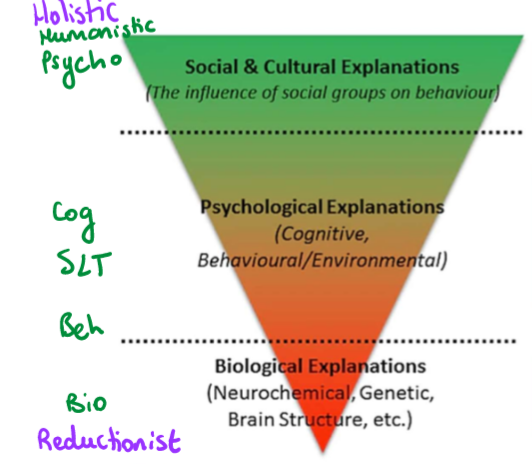
Levels of explanation:
See image attached.
Psychologists often refer to “levels of explanation” to illustrate how behaviour can be understood at varying degrees of complexity, for example, the cause of OCD may be understood in many different ways.
In the levels of explanation hierarchy, the lowest level of explanation is extreme reductionism. This level is biological explanations and the biological approach exemplifies this level. This level would explain OCD in terms of underproduction of serotonin and hypersensitivity in the basal ganglia.
The mid-level is psychological explanations, where cognitive, behavioural and environmental explanations fall. The cognitive approach exemplifies this level because it is machine reductionist and simplifies complex mental processes into their simplest parts, like how a machine works. In terms of OCD, this level would focus on how obsessive thoughts lead to compulsions being acted out in order to gain relief.
The high-level is social and cultural explanations, which focuses on the influence of social groups on behaviour. This level is holistic, and can be exemplified by the humanistic approach. Here, OCD would be understood as socially abnormal behaviour (e.g. repetitive handwashing).
Debate: Holism and reductionism AO3
Reductionism:
A strength of reductionism is that biological reductionism has led to the development of effective drug therapies. By reducing mental disorders to neurochemical imbalances, such as low serotonin in OCD, researchers have been able to create treatments like SSRIs that target these specific biological mechanisms. These drugs have contributed to a significant reduction in hospitalisation since the 1950s and are considered more humane because they do not blame the patient for their condition. They also offer fast, accessible relief from symptoms, which is especially valuable for severe disorders. This shows that reductionist explanations can produce practical treatments, thus improving realworld outcomes.
A weakness of reductionism is that it oversimplifies complex human behaviour. For instance, explaining depression solely in terms of serotonin imbalance ignores situational factors like trauma. This means that important psychological or social causes, such as bereavement or trauma, may be overlooked. As a result, treatments based on reductionist explanations, like antipsychotics, may only address the symptoms rather than the underlying cause of the disorder. This reduces the validity of reductionist explanations because they fail to capture the full complexity of human experience. Therefore, relying solely on reductionist explanations can lead to incomplete understanding and potentially ineffective treatment.
Holism:
A weakness of holism is its limited empirical evidence and difficulty in testing. This us because holistic explanations often involve multiple interacting factors, which makes it hard to isolate variables and establish cause and effect. For example, the humanistic approach is often criticised for lacking scientific rigour because concepts like self-actualisation cannot be objectively measured. This means holistic theories struggle to produce reliable and replicable findings. Therefore, although holism offers depth, its lack of testability limits its scientific credibility.
A strength of holism is that holistic explanations provide a more complete understanding of behaviour by considering how multiple factors interact rather than isolating single causes. For example, the humanistic approach views individuals as whole beings and emphasises personal growth, emotions and subjective experience. This perspective underpins clientcentred therapy, which focuses on the individual’s unique needs and experiences rather than reducing their difficulties to one specific cause. Client-centred therapy has shown to be effective as a treatment for depression and anxiety. Therefore, holism is useful in counselling, where understanding the full range of influences on a person leads to a richer and more valid explanation of behaviour.
Debate: Idiographic and nomothetic AO1
This debate is an argument on whether emphasis should be placed on individual cases as a means of understanding behaviour, or if it should be placed upon groups of people in order to formulate general laws of behaviour.
Idiographic:
An idiographic approach focuses on the individual and emphasises uniqueness and subjective experience. This approach to psychological investigation uses qualitative methods in research, such as case studies. For example, the humanistic approach is idiographic because it focuses on understanding each person’s unique, subjective experience rather than creating general laws of behaviour.
Nomothetic:
On the other hand, a nomothetic approach aims to establish laws and generalisations that apply to many people. It uses quantitative methods in research as it collects large amounts of numerical data from groups of people rather than individuals. Therefore, a nomothetic approach focuses on similarities between people and gaining objective knowledge. For example, in the behaviourist approach, Skinner studied the responses of hundreds of rats in order to develop the laws of learning (i.e. operant conditioning).
Debate: Idiographic and nomothetic AO3
Idiographic:
A strength of the idiographic approach is that it provides detailed insight into individual behaviour. For example, in the psychodynamic approach. Freud’s case study of Little Hans allowed him to explore unconscious conflict and phobia development in depth, leading to the formulation of the Oedipus complex. This idiographic method helped generate hypotheses about psychosexual development that influenced wider theory, showing how individual cases can contribute meaningfully to psychological understanding.
However, a limitation of the idiographic approach is that it lacks scientific credibility. For example, Freud’s case study of Little Hans relied heavily on subjective interpretation and unstandardised observations provided by Hans’ father. The absence of measurable variables means the findings cannot be replicated or tested objectively. Therefore, because idiographic methods typically use qualitative data and avoid standardised procedures, they are often criticised for being less reliable and less objective than nomothetic approaches. Thus, this makes it difficult to establish cause and effect relationships or verify whether the conclusions drawn genuinely reflect psychological processes rather than researcher bias.
Nomothetic:
A strength of the nomothetic approach is that it is highly scientific, using controlled methods that allow psychologists to establish reliable, generalisable laws of behaviour. For example, Bandura’s Bobo doll experiment used standardised procedures and controlled observations to measure how children imitated behaviour after watching an adult model. Because the study was conducted under controlled laboratory conditions, cause and effect could be established and so Bandura could conclude that children imitate the behaviour they observe, especially if they see this behaviour being rewarded. The use of large groups and replicable methods also meant the findings could be generalised to wider populations. Therefore, the nomothetic approach’s scientific rigour and emphasis on controlled, replicable research means it can produce reliable psychological theories.
Both:
The idiographic and nomothetic approaches can be viewed as complementary rather than contradictory, as each contributes something different to psychological understanding. For example, the idiographic case study of HM, who had his hippocampus removed and subsequently suffered severe memory impairment, provided detailed qualitative data about the role of the hippocampus in memory. These initial findings then prompted nomothetic research using brain scans on larger groups, which identified consistent patterns linking the hippocampus to long-term memory formation. This shows how idiographic findings can generate ideas that nomothetic methods later test and generalise, demonstrating that both approaches work together to build a fuller picture of human behaviour.
Explore top notes

