3.2.1 Business objectives
 Call Kai
 Learn
Learn Practice Test
 Spaced Repetition
 Match
Match Flashcards
 Knowt Play
1/13

There's no tags or description
Looks like no tags are added yet.
Name | Mastery | Learn | Test | Matching | Spaced | Call with Kai |
|---|
No analytics yet
Send a link to your students to track their progress
14 Terms
What are the 4 business objectives?
Profit Maximisation
Revenue Maximisation
Sales Maximisation
Satisficing
At what point does profit maximisation occur?
MC=MR
Draw the profit maximisation point on a diagram
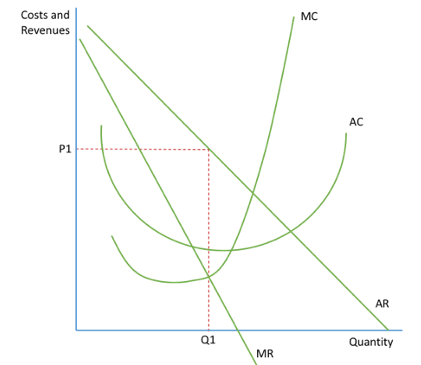
Why do firms profit-maximise? (4)
Dividends to distribute to shareholders, CEOs and owners.
Pressure from shareholders as they vote on directors at annual general meetings (AGM)
Bonuses to CEOs and Managers
Reinvestment into the firm → Research and development for future profits
Business expansion
Firm survival in a competitive atmosphere
Owners do not want to fund losses; the bank may stop lending
What happens if firms produce beyond the profit-maximising price? (2)
The cost of producing one extra unit will exceed the revenue gained from one extra unit
Results in higher costs and lower profits
At what point does revenue maximisation occur?
MR=0
Draw the revenue maximisation point on a diagram
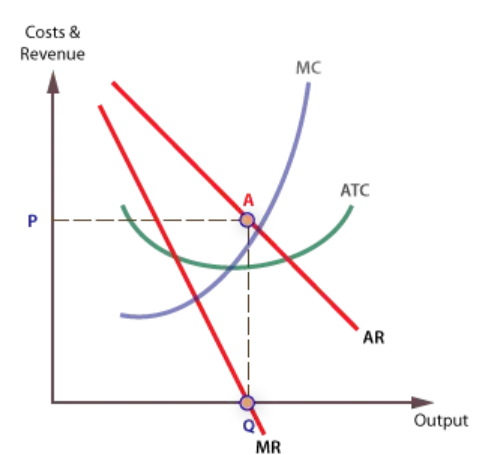
Why would firms want to maximise revenue? (6)
Economies of Scale (LR)
To deter new entry (reduce price, increase quantity and market share)
Over time, rivals might leave the market, reducing competitive pressure and making demand more price-inelastic
Avoid the CMA, which might investigate anti-competitive behaviour
Create brand loyalty + win customers
Amazon follows an objective of revenue maximisation to dominate the market and create brand recognition
The principal-agent problem
Managers are rewarded bonuses and incentives based on revenue they bring to the firm
At what point does sales maximisation occur?
AC=AR
Draw the sales maximisation point on a diagram
(point B)
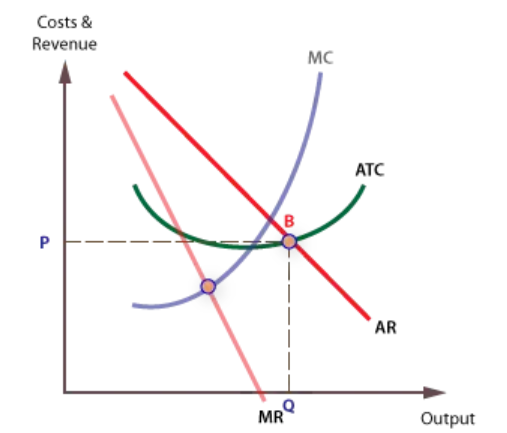
Why would firms want to maximise sales? (6)
Economies of Scale (SR)
Deter new entry → charge a limit price, as there are no supernormal profits to be made
Start up and create brand awareness → Deliveroo, Uber, Amazon Kindle
Win more market share → more aggressive than revenue maximisation. E.g., Aldi, Lidl
Build up monopoly power → price inelastic demand to raise prices in the future
Public sector organisations → aim to allocate efficiently
At what point does profit satisficing occur?
Occurs anywhere between profit + sales maximising points
Why would a firm want to profit satisfice? (4)
Due to the principal-agent problem, managers might make enough profits to satisfy owners while increasing their own benefit
Enough for higher bonuses but also enough for shareholders
Win market share but have enough for shareholders
Avoid the CMA but have enough to reinvest
Where do profit maximisation and revenue maximisation overlap? (4)
Industries where there are very large fixed costs and relatively small variable costs + also in natural monopoly
The additional cost or marginal cost of extra orders is therefore relatively small
Short-run profit, therefore, becomes crucially dependent on how much revenue is gained
E.g., airlines, trains, passenger ferries, and hotels

