polymer hydrolysis and disposal
 Call Kai
 Learn
Learn Practice Test
 Spaced Repetition
 Match
Match Flashcards
 Knowt Play
1/6

Earn XP
Description and Tags
addition and condensation
Name | Mastery | Learn | Test | Matching | Spaced | Call with Kai |
|---|
No analytics yet
Send a link to your students to track their progress
7 Terms
how are condensation polymers hydrolysed?
in the presence of a strong acid/specific enzyme
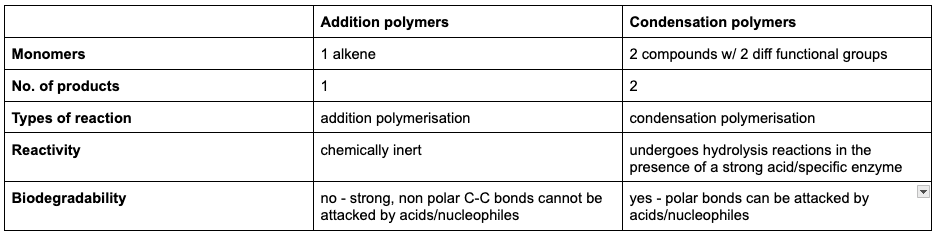
can you complete this table?
yes!
give the methods of polymer disposal:
landfill
incineration
recycling
give the benefits and drawbacks of disposing of (addition) polymers in landfill:
benefits:
useful for disposing of plastics which:
are too diff to recycle
are too diff to separate from other materials
there is not enough plastic to extract to make it economically viable
drawbacks:
decomposition of waste in landfill produces methane - greenhouse gas
risk of water contamination from waste leaching
large amounts of land needed - unsustainable and expensive
give the benefits and drawbacks of incineration as a method of polymer disposal:
benefits:
method of disposal if the plastics can’t be recycled
E from burning can be used to generate electricity
drawbacks:
can release toxic fumes so must be monitored e.g. PVC produces toxic HCl fumes
flue gas scrubbers used to neutralise toxic gases produced by firing a base at the flue gases
give the benefits and drawbacks of recycling as a form of polymer disposal:
benefits:
cheaper
less CO2 produced than incineration
reduces reliance on landfill
preserves non-renewable raw materials e.g. crude oil
drawbacks:
can be contaminated w/ other materials when being recycled
diff to recycle due to wide variety of diff plastics
diff to remake original plastic from recycled material
sorting and process recycling of plastics more expensive than incineration
golf balls recovered from lakes and ponds can be used again even after being in water for several years - explain why these golf balls do not biodegrade (1)
either:
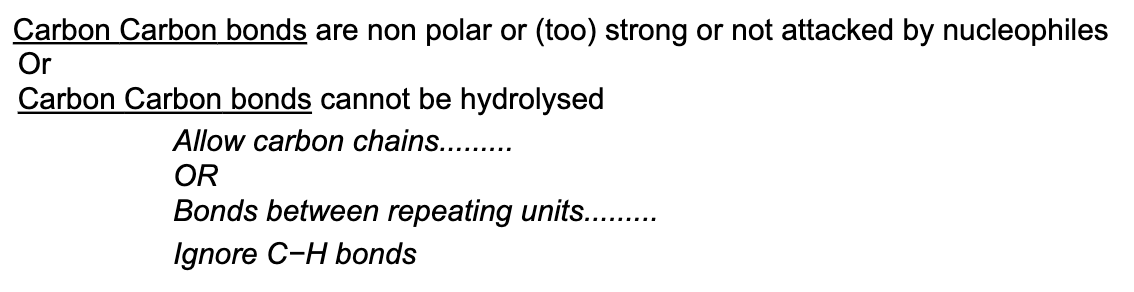
C-C bonds are non polar/strong/not attacked by nucleophiles
C-C bonds cannot be hydrolysed