Ch 2 ISP 205
 Studied by 0 people
 Call Kai
 Learn
Learn Practice Test
 Spaced Repetition
 Match
Match Flashcards
 Knowt Play
1/13

There's no tags or description
Looks like no tags are added yet.
Name | Mastery | Learn | Test | Matching | Spaced | Call with Kai |
|---|
No analytics yet
Send a link to your students to track their progress
14 Terms
During about which dates do people living on the equator see the Sun in the northern half of the sky?
From March 21 until September 21
On December 21 of each year, the Sun reaches the zenith for people living on the
tropic of Capricorn (latitude = 23.5 degrees S).
Suppose you lived in a place where you noticed that the Sun was always above your horizon for 12 hours each day (and below it for the other 12 hours). What could you conclude about your location?
You live on the equator.
We should expect Northern Hemisphere summers on Mars to be __________ Southern Hemisphere summers on Mars.
colder than
we should expect Northern Hemisphere winters on Mars to be __________ Southern Hemisphere winters on Mars.
warmer than
When is Earth closest from the sun?
Winter
Which statement best describes how variation in the Earth-Sun distance affects the seasons?
The variation in Earth–Sun distance over the course of each year has virtually no effect on the seasons.
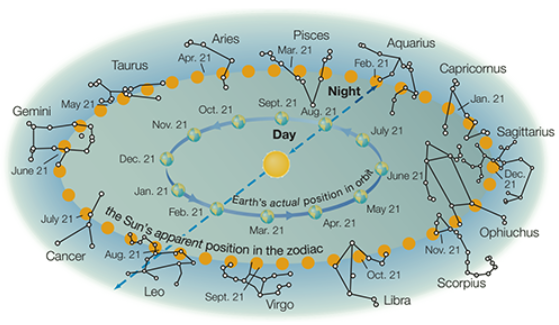
A viewed from Earth, in which zodiac constellation does the Sun appear to be located on April 21?
Aries
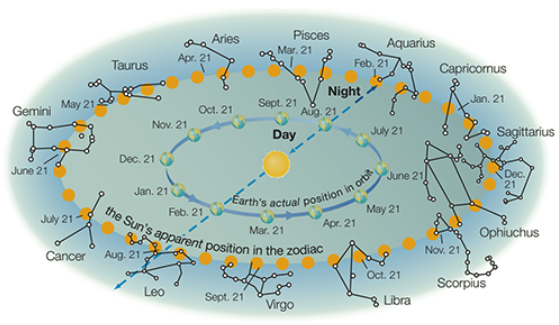
If the date is April 21, what zodiac constellation will you see setting in the west shortly after sunset?
Taurus
Where does the Sun remain above the horizon all day (never setting) on the December solstice?
Everywhere between the Antarctic Circle (latitude 66.5°S) and the South Pole
For any particular location on Earth, why are lunar eclipses observed more frequently than solar eclipses?
A lunar eclipse is visible over a much larger region of Earth than a solar eclipse.
During an annular eclipse:
the Moon is too far away from Earth to block the entire Sun from view.
If you are standing in the Moon’s partial shadow (penumbra) during a solar eclipse, you would see
the Sun with a portion of it blocked by the Moon.
If you are watching a penumbral lunar eclipse, meaning a lunar eclipse during which the Moon is in Earth’s partial shadow (penumbra), you would see
a full moon, but slightly dimmer than normal.
 Note
Note  Flashcards (84)