BIOC 4331 Lecture 5

0.0(0)
Studied by 0 people
call kaiCall Kai
learnLearn
examPractice Test
spaced repetitionSpaced Repetition
heart puzzleMatch
flashcardsFlashcards
GameKnowt Play
Card Sorting

1/44

flashcard set

Earn XP

Description and Tags

Last updated 4:32 PM on 4/6/26
Name
Mastery
Learn
Test
Matching
Spaced
Call with Kai

No analytics yet

Send a link to your students to track their progress

45 Terms

1
New cards

What is horizontal (lateral) gene transfer?

Transfer of genes between species, most common in bacteria, which can falsely suggest close evolutionary relationships.

2
New cards

What are homologs?

Proteins with similar sequences due to shared evolutionary origin.

3
New cards

What are paralogs?

Homologous proteins found within the same species.

4
New cards

What are orthologs?

Homologous proteins found within different species.

5
New cards

What does hypervariable mean in protein sequences?

Positions with no functional or structural role, free to mutate.

6
New cards

What does invariant mean in protein sequences?

Positions required for function or 3D structure that must not change.

7
New cards

What does a “conservativesubstitution mean?

A residue changes to another with similar properties (e.g., Asp -> Glu)

8
New cards

What does sequence identity mean in protein sequence alignment?

The percentage of positions with identical amino acids between aligned sequences.

9
New cards

Which substitutions give the highest alignment scores?

Identical amino acids and conserved substitutions (e.g., Asp -> Glu)
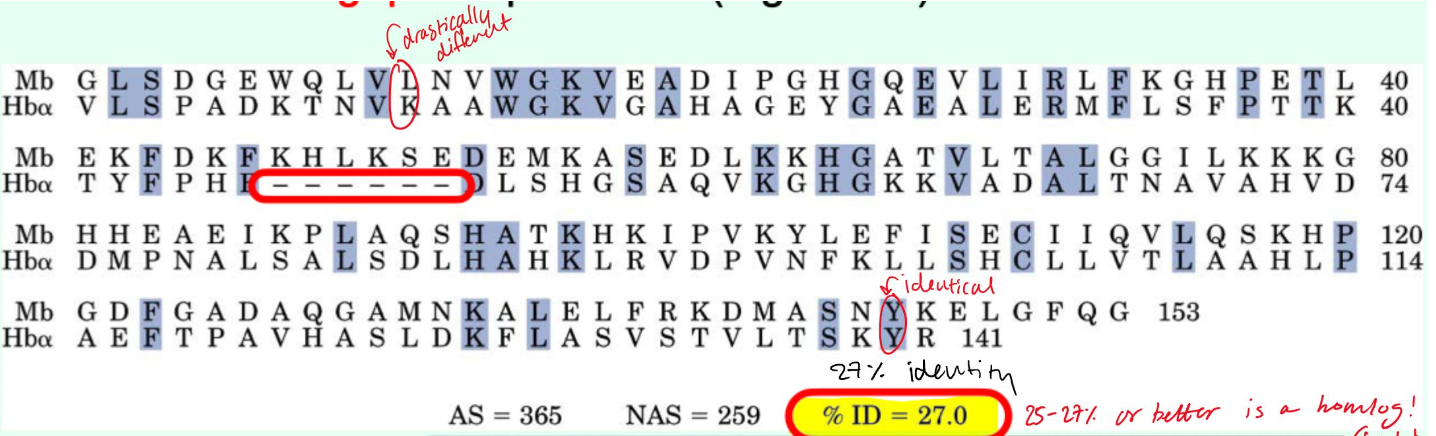
<p><strong>Identical</strong> amino acids and <strong>conserved</strong> substitutions (e.g., Asp -&gt; Glu)</p>
10
New cards

How are gaps treated in sequence alignments?

They are penalized
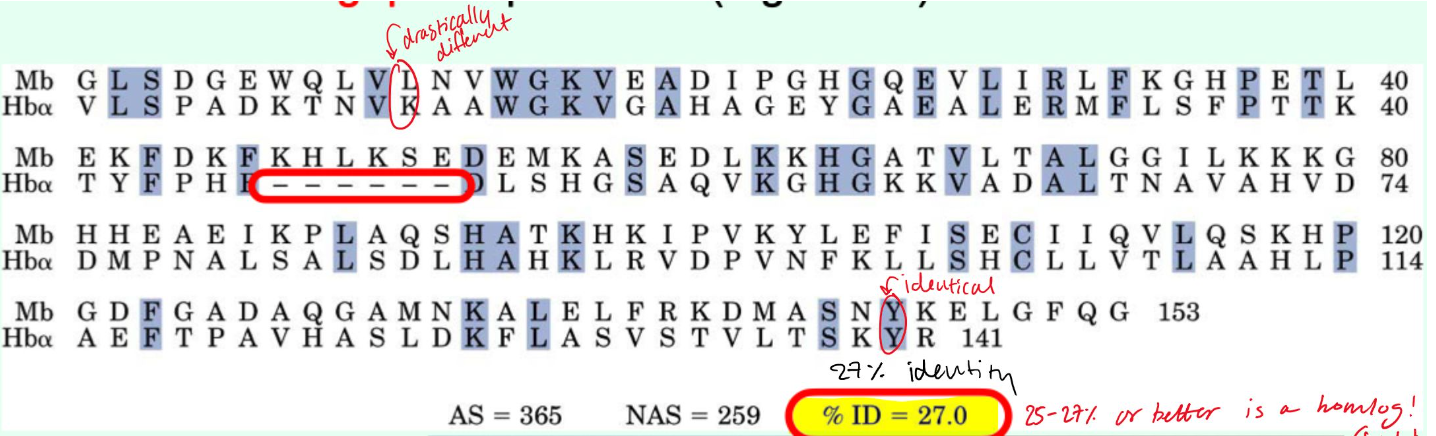
<p>They are <strong>penalized</strong></p>
11
New cards

Roughly what percent identity suggest proteins are homologs?

~25-27% identity or higher

12
New cards

What is a cofactor?

A non-protein molecule required for protein function.

13
New cards

What amino acids commonly form ionic interactions?

Negatively charged Asp/Glu (acidic) with positively charge Lys/Arg (basic)
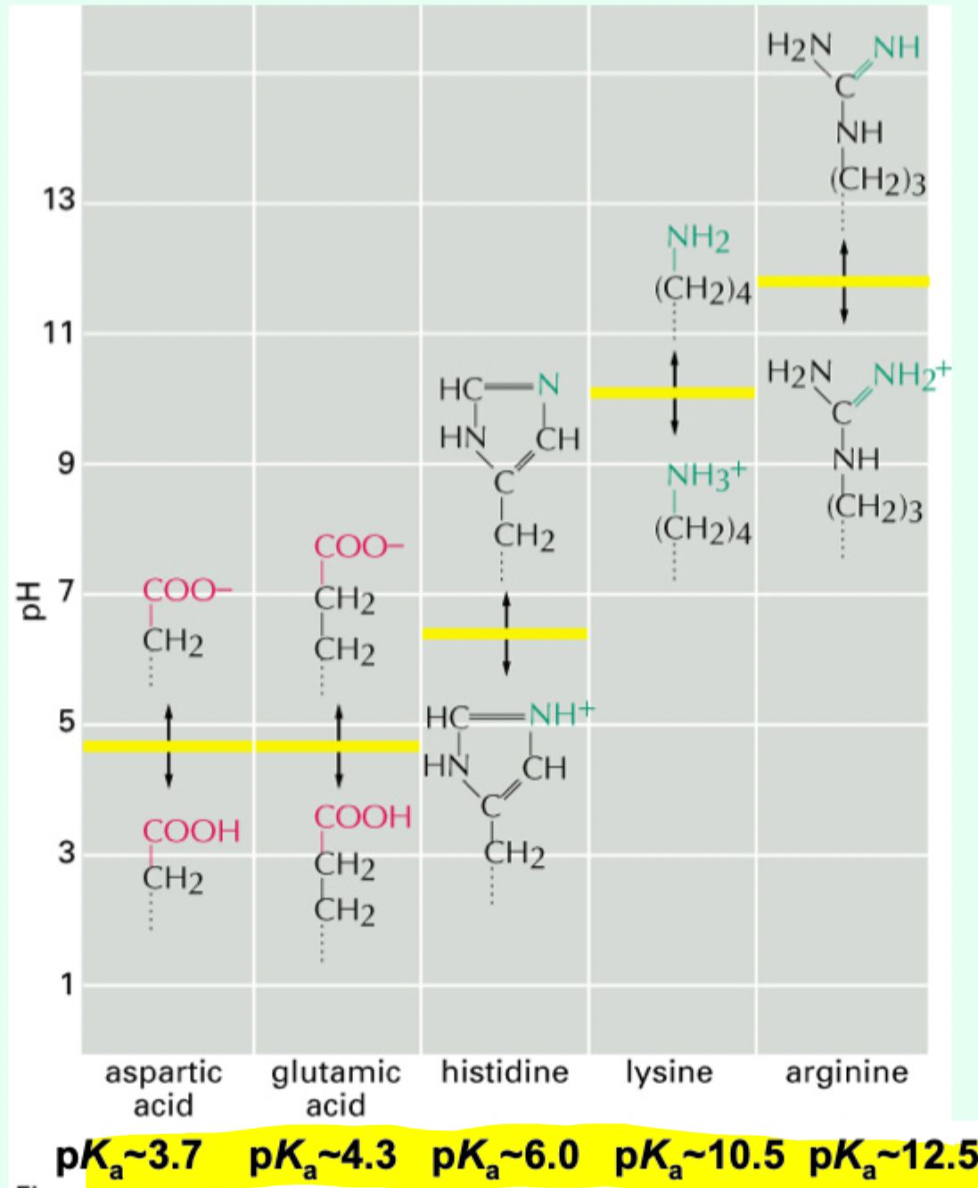
<p>Negatively charged <strong>Asp/Glu</strong> (<strong>acidic</strong>) with positively charge <strong>Lys/Arg</strong> (<strong>basic</strong>)</p>
14
New cards

What other parts of protein can participate in ionic interactions?

N- and C- termini and post-translational modifications (glycosylation, phosphorylation)

15
New cards

What is secondary structure in proteins?

The stable, energetically favorable 3D conformations that a polypeptide adopts as building blocks (e.g., α-helices and β-sheets).
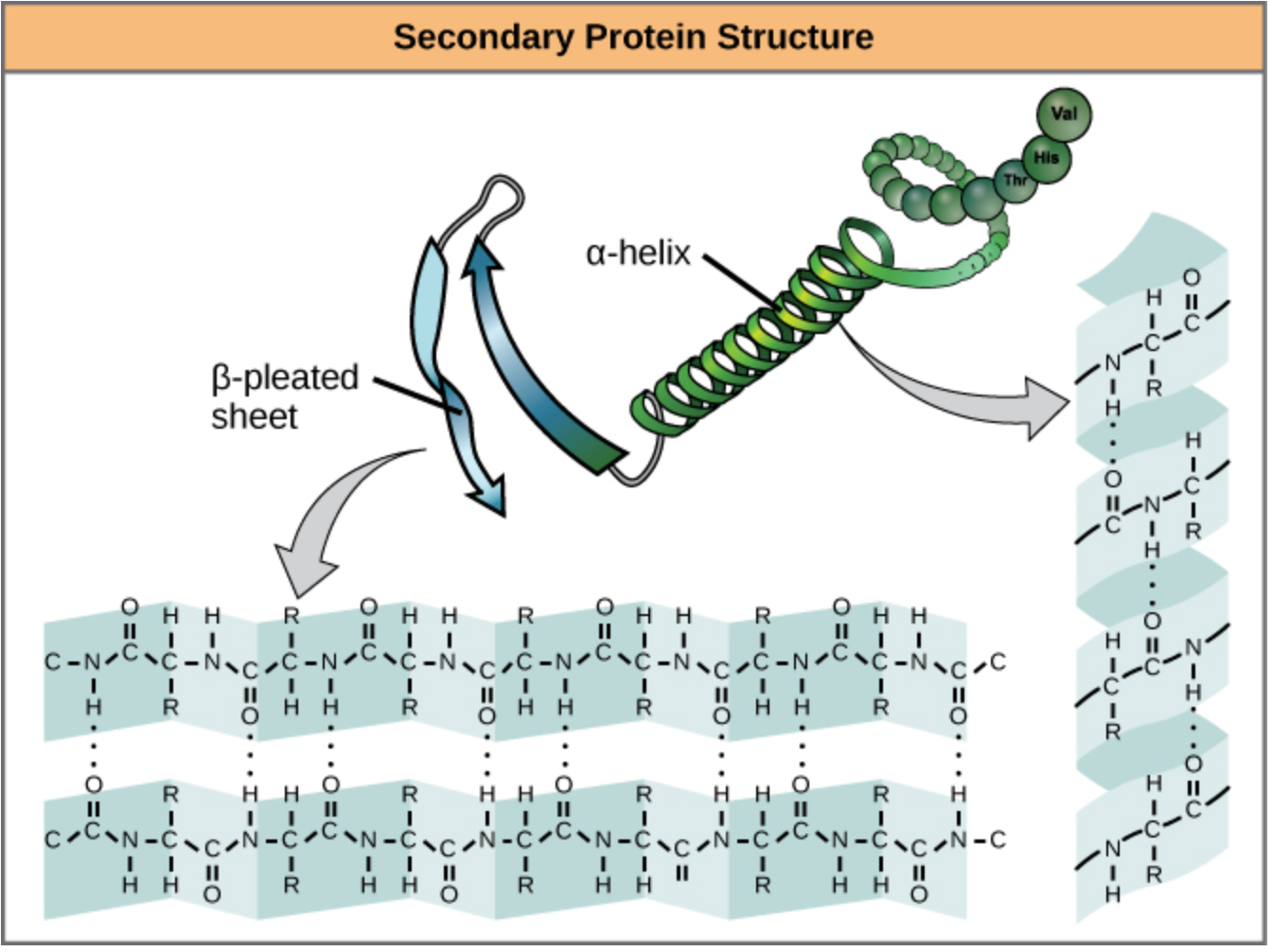
<p>The <strong>stable</strong>, <strong>energetically favorable 3D conformations</strong> that a polypeptide adopts as <strong>building blocks</strong> (e.g., <strong>α-helices and β-sheets</strong>).</p>
16
New cards

What are the two principle contributors that constrain protein secondary structure?

The peptide bond and the amino acid side-chain

17
New cards

What key property does the peptide bond have?

Partial double-bond character, making it planar.
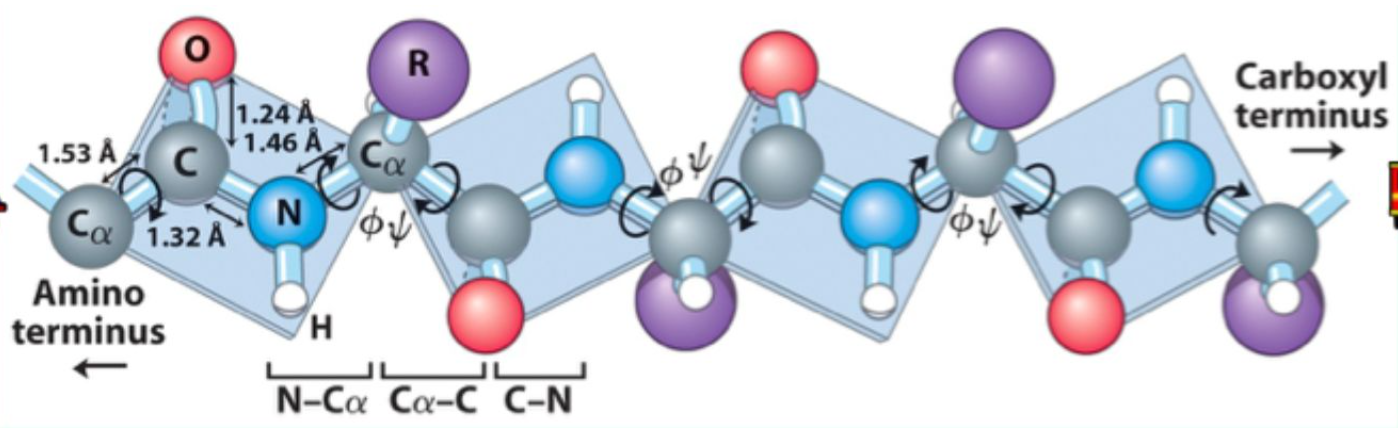
<p>Partial <strong>double-bond character</strong>, making it <strong>planar</strong>.</p>
18
New cards

Why can't the peptide C-N bond rotate freely?

Because electrons are delocalized, giving the bond double-bond character.
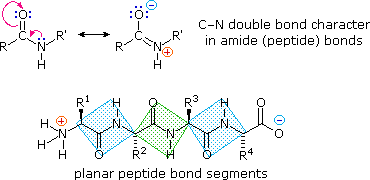
<p>Because electrons are <strong>delocalized</strong>, giving the bond<strong> double-bond character</strong>.</p>
19
New cards

Are most peptide bonds cis or trans?

Trans (lower energy, less steric hinderance)
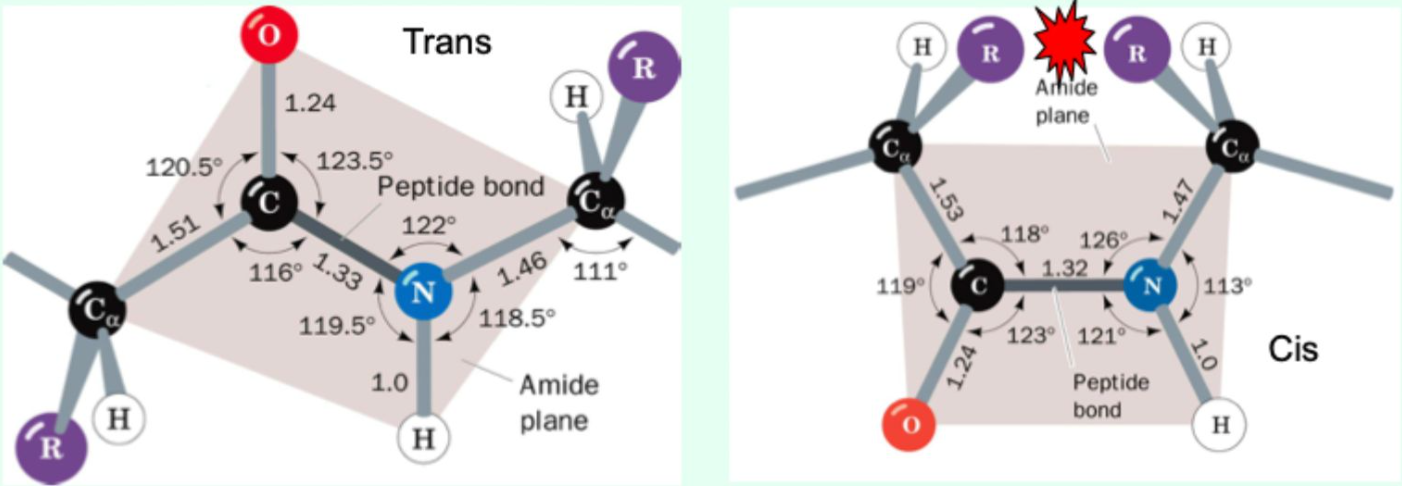
<p><strong>Trans</strong> (<strong>lower energy, less steric hinderance</strong>)</p>
20
New cards

Which amino acid commonly allows cis peptide bonds?

Proline (<10% of Pro are in cis configuration)

21
New cards

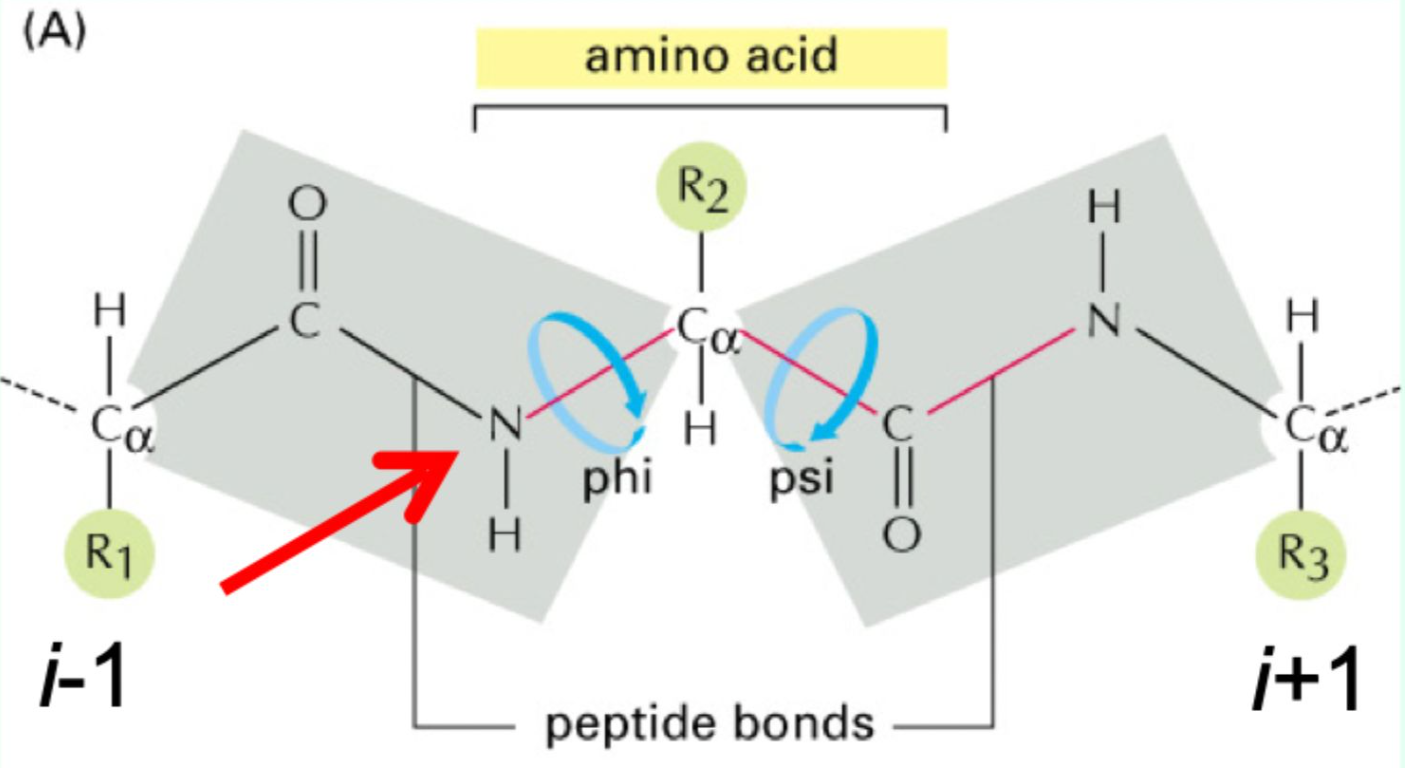
What backbone bonds allow rotation?

φ (phi): N–Cα

ψ (psi): Cα–C(=O)
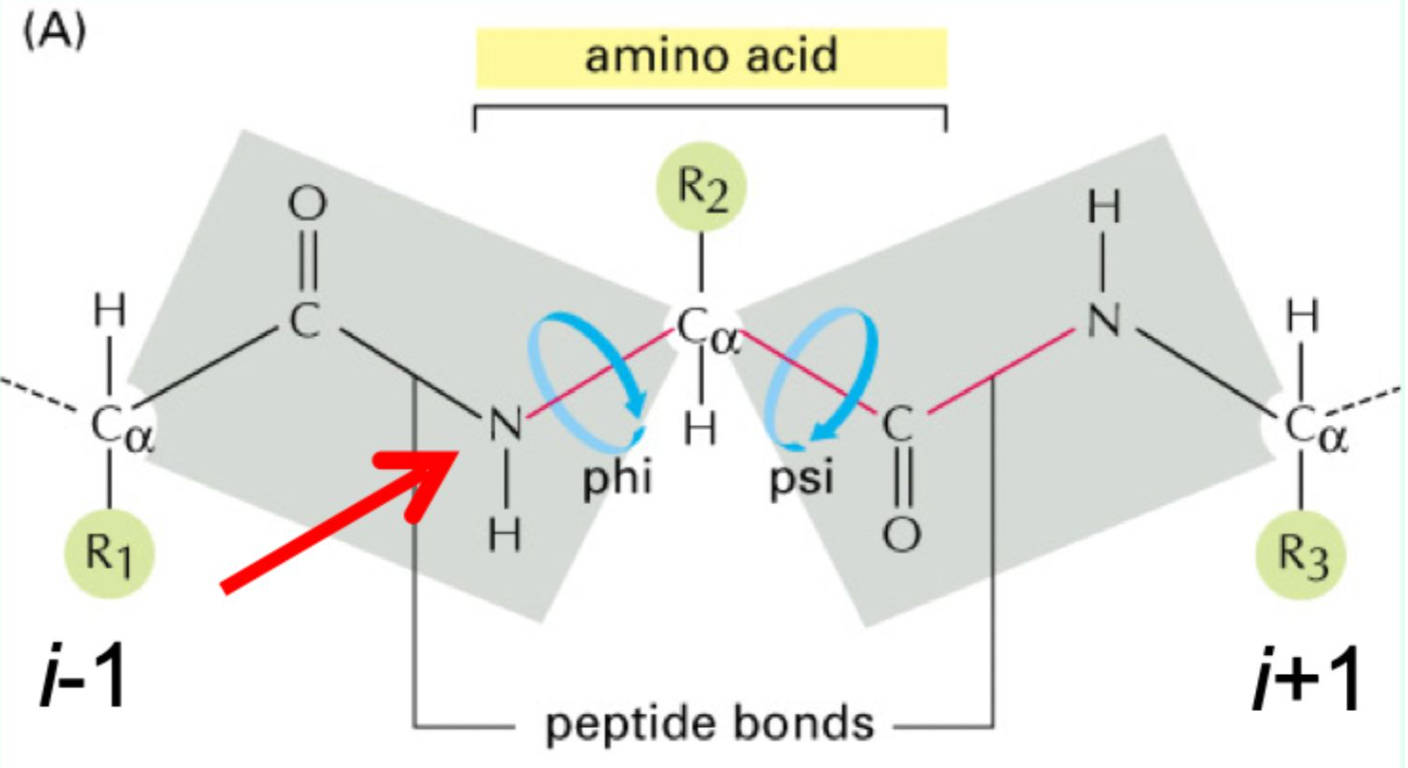
<p><strong>φ</strong> (<strong>phi</strong>): N–C<sub>α</sub> </p><p><strong>ψ</strong> (<strong>psi</strong>): C<sub>α</sub>–C(=O)</p>
22
New cards

What do φ and ψ angles define?

The 3D conformation of the protein backbone.
<p>The <strong>3D conformation</strong> of the protein backbone.</p>
23
New cards

What is the repeating backbone order of atoms and torsion angles in a polypeptides chain?

N → φ (phi)→ Cα → ψ (psi) → C=O → peptide bond, repeated along the chain (Never fi(phi)ght the Alpha ps(i)yChO).
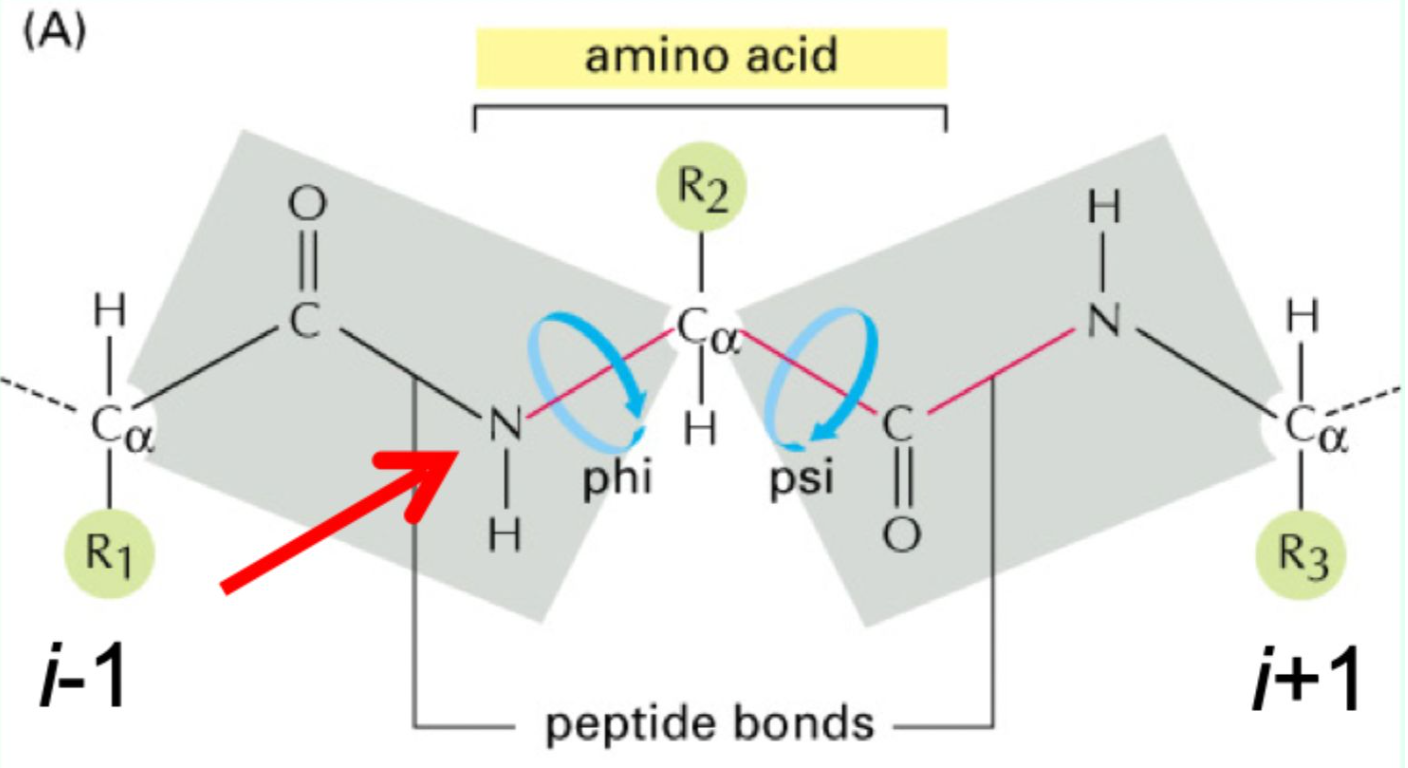
<p>N → φ (phi)→ C<sub>α</sub> → ψ (psi) → C=O → peptide bond, repeated along the chain (<strong>N</strong>ever fi(<strong>phi</strong>)ght the <strong>Alpha</strong> <strong>ps(i)</strong>y<strong>C</strong>h<strong>O</strong>).</p>
24
New cards

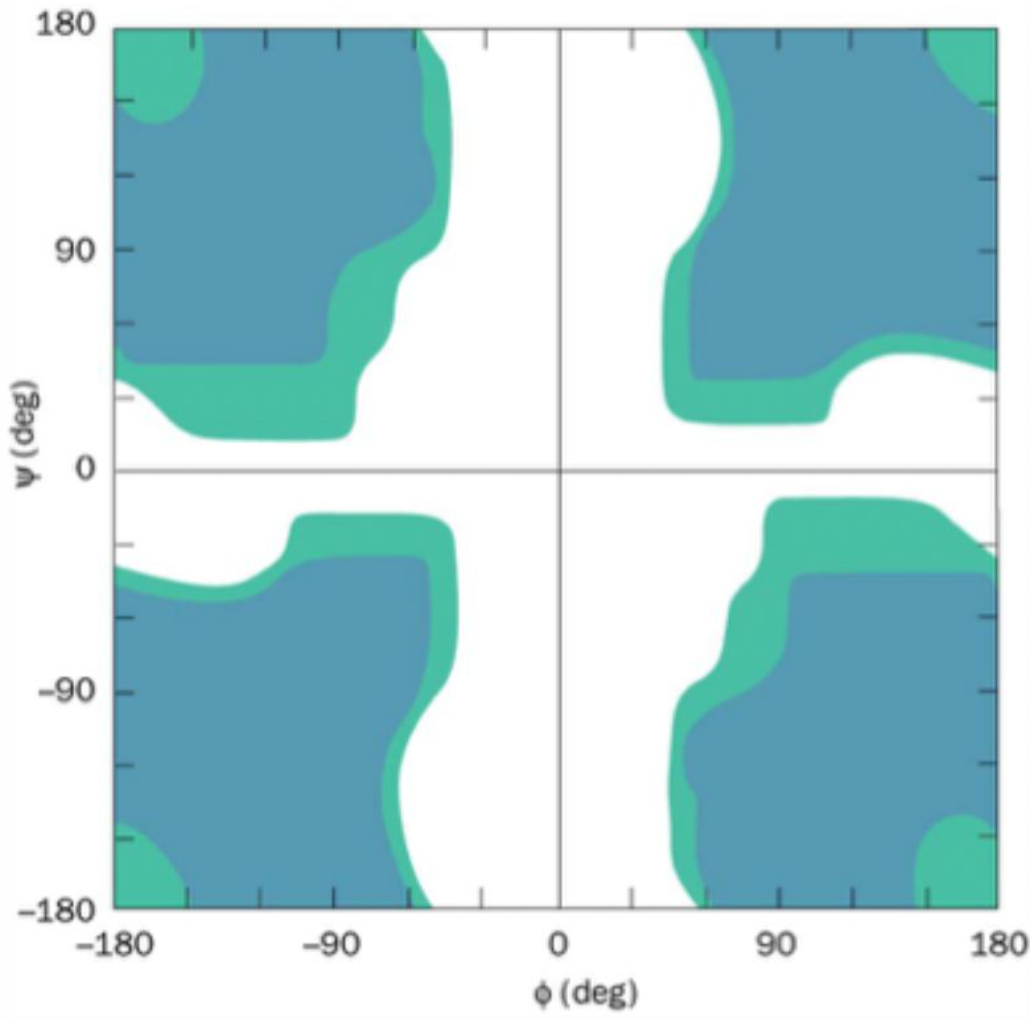
What is Ramachandran plot?

A plot of φ vs. ψ angles showing allowed backbone conformations.
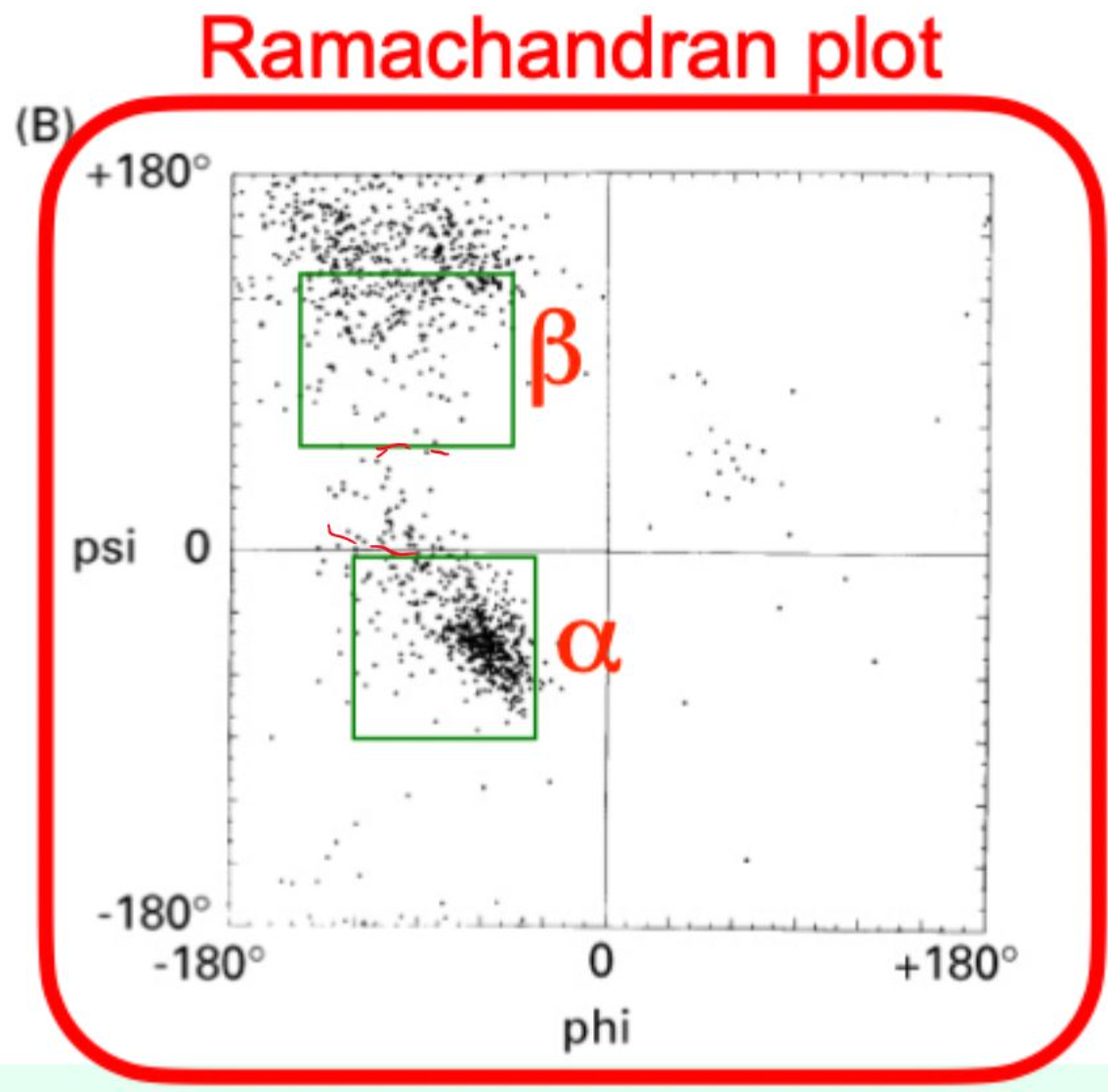
<p>A plot of <strong>φ vs. ψ angles</strong> showing allowed <strong>backbone conformations</strong>.</p>
25
New cards

Which amino acid is most restricted on the Ramachandran plot?

Proline (φ ≈ −60° due to side-chain covalent bonding)
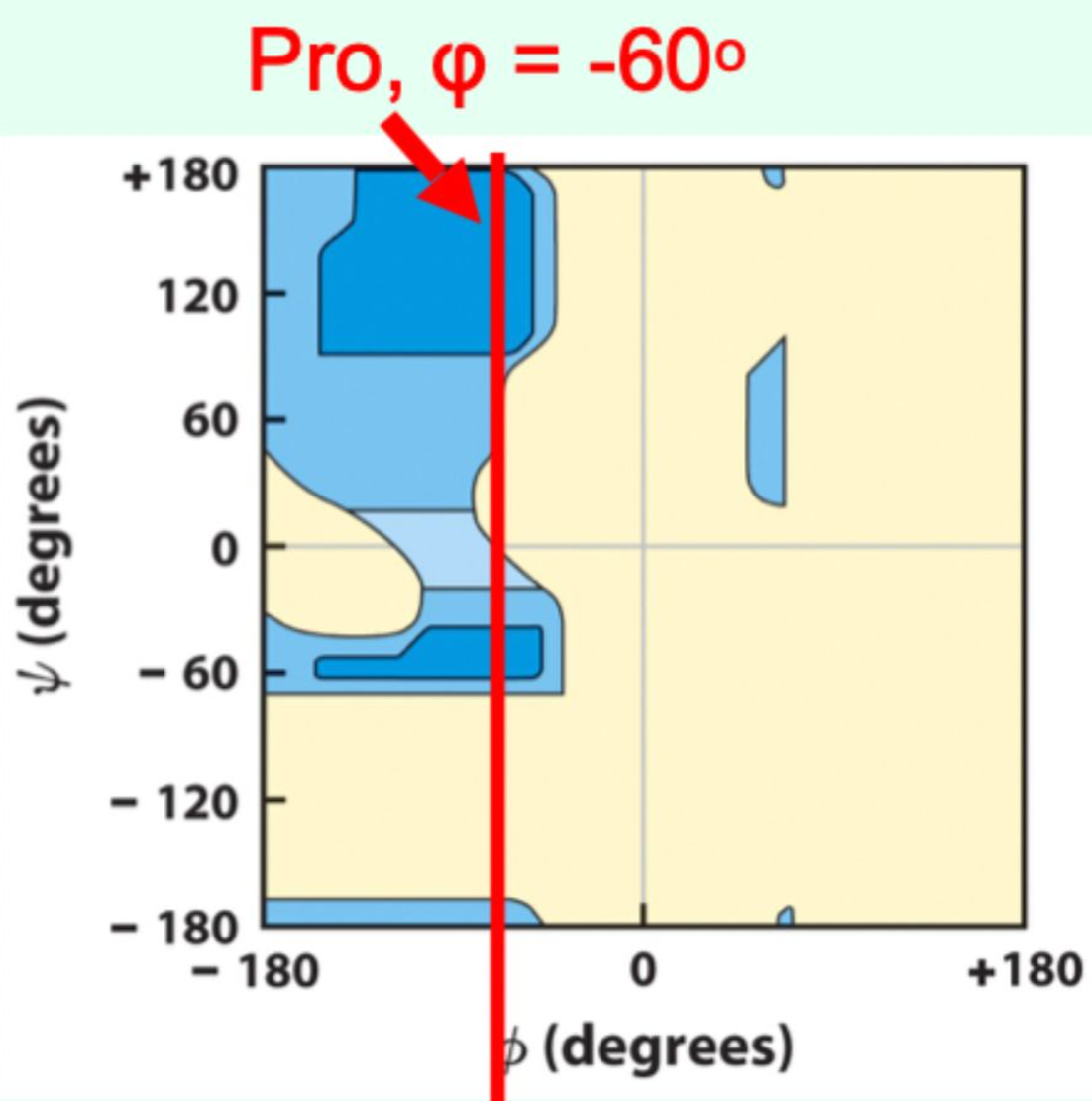
<p><strong>Proline</strong> (<strong>φ ≈ −60°</strong> due to side-chain <strong>covalent</strong> bonding)</p>
26
New cards

Which amino acid is most flexible on the Ramachandran plot?

Glycine (no side chain)
<p><strong>Glycine</strong> (no side chain)</p>
27
New cards

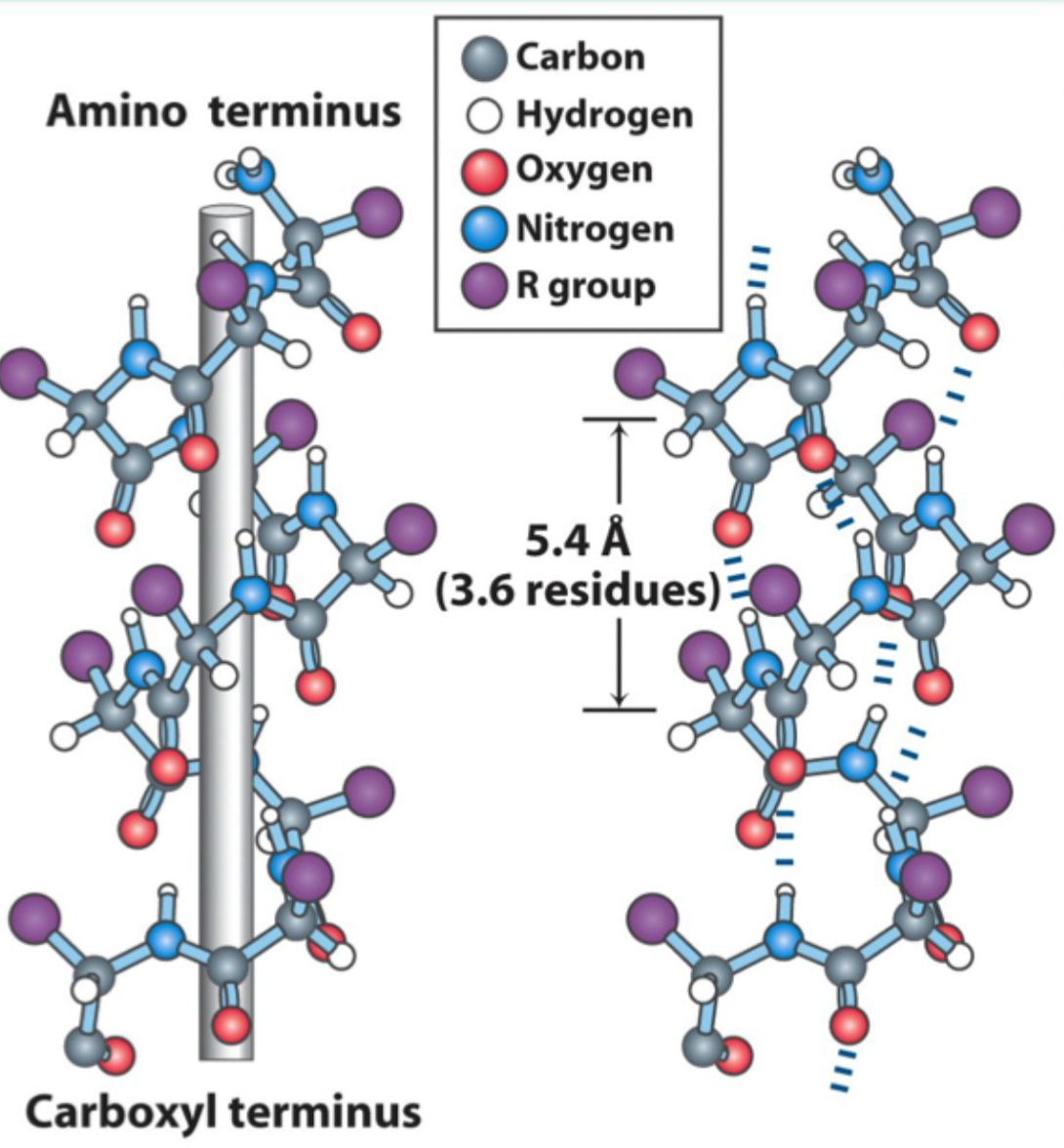
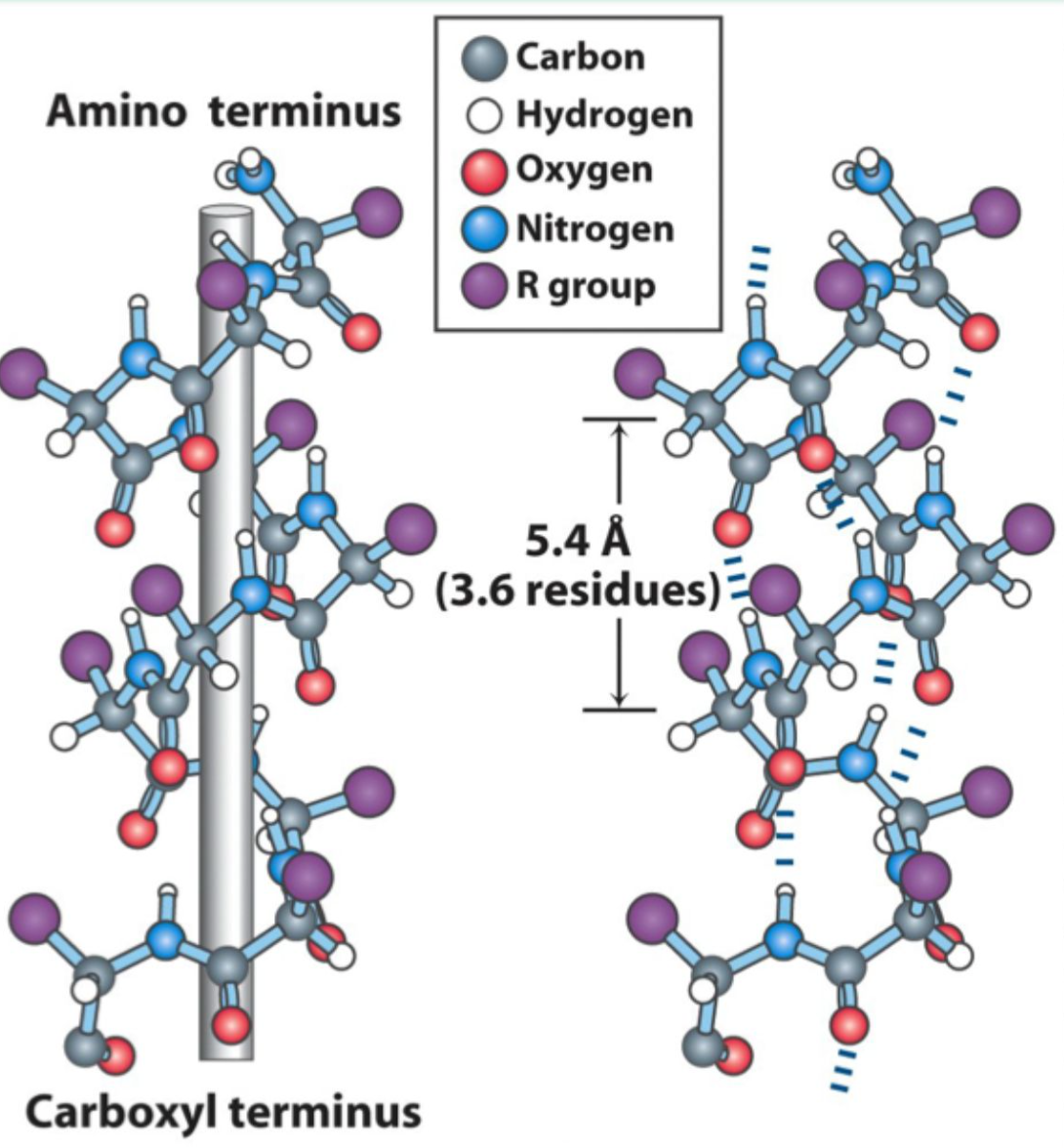
How many residues per turn are in an α-helix?

3.6 residues (5.4 Å) per turn.
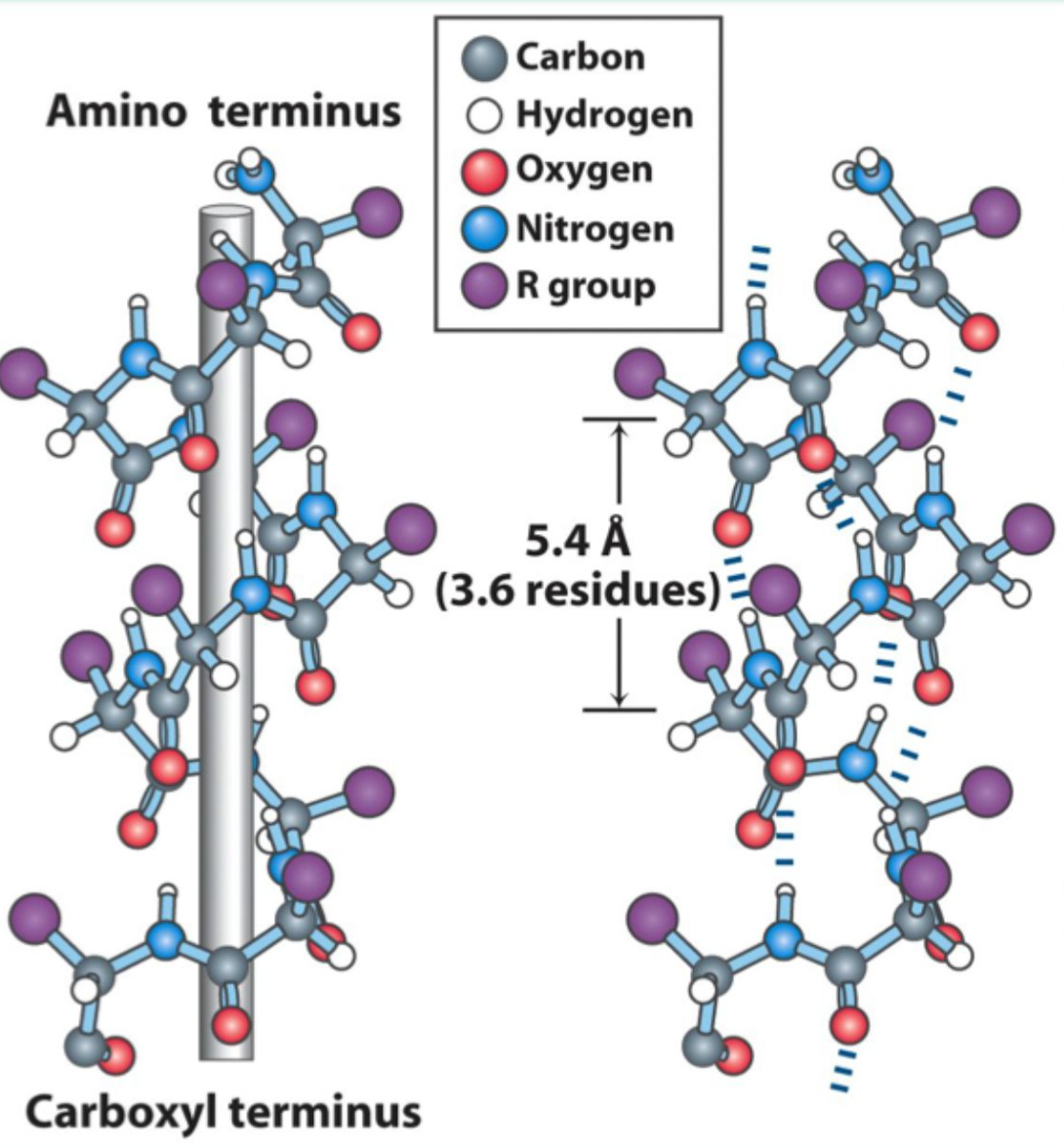
<p><strong>3.6 residues</strong> (<strong>5.4 Å</strong>) per turn.</p>
28
New cards

What hydrogen bonding pattern stabilizes an α-helix?

C=O of residue i hydrogen bonds to N–H of residue i+4.
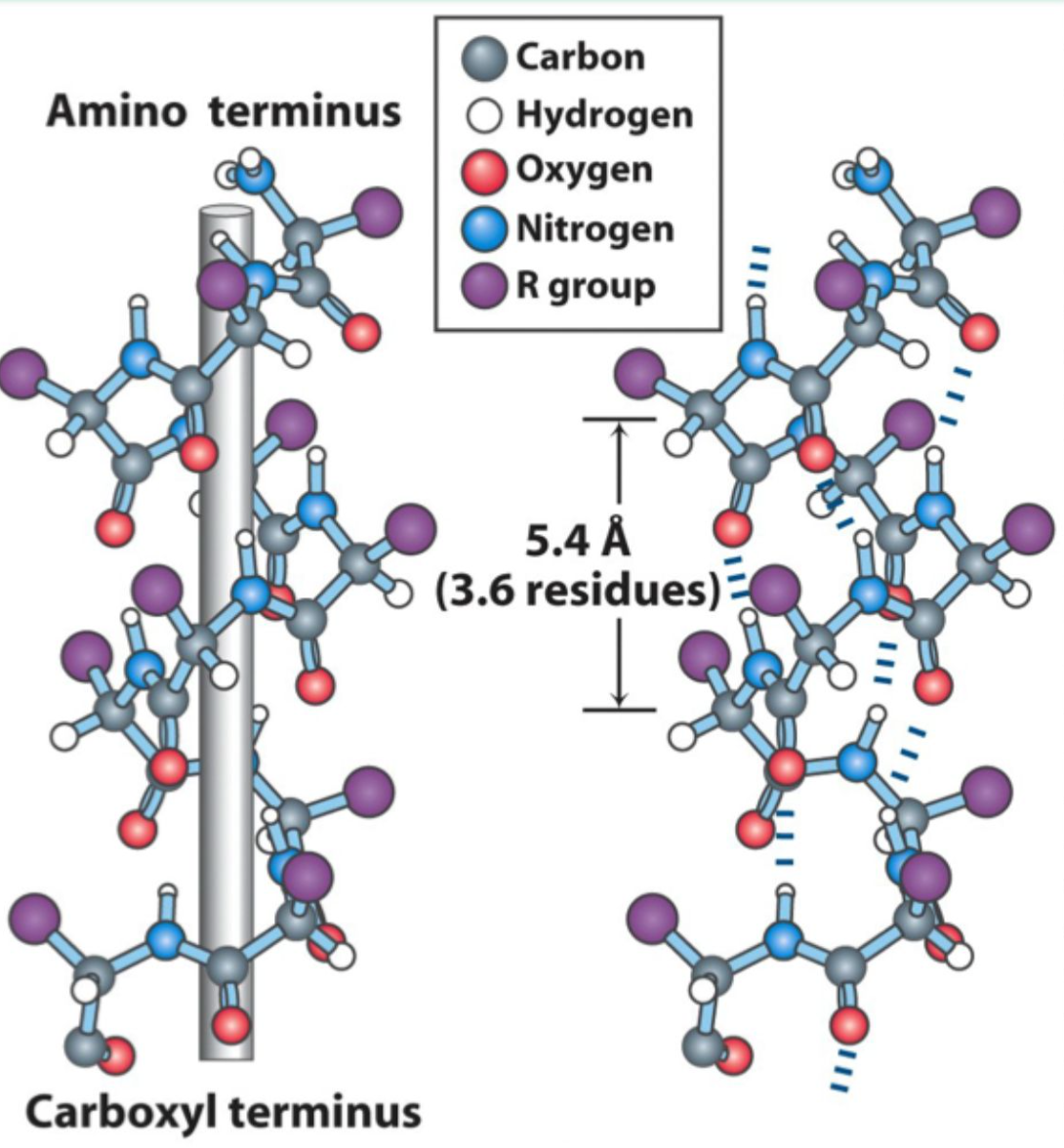
<p><strong>C=O of residue i</strong> hydrogen bonds to <strong>N–H of residue i+4</strong>.</p>
29
New cards

Is the α-helix right-handed or left-handed?

Right-handed
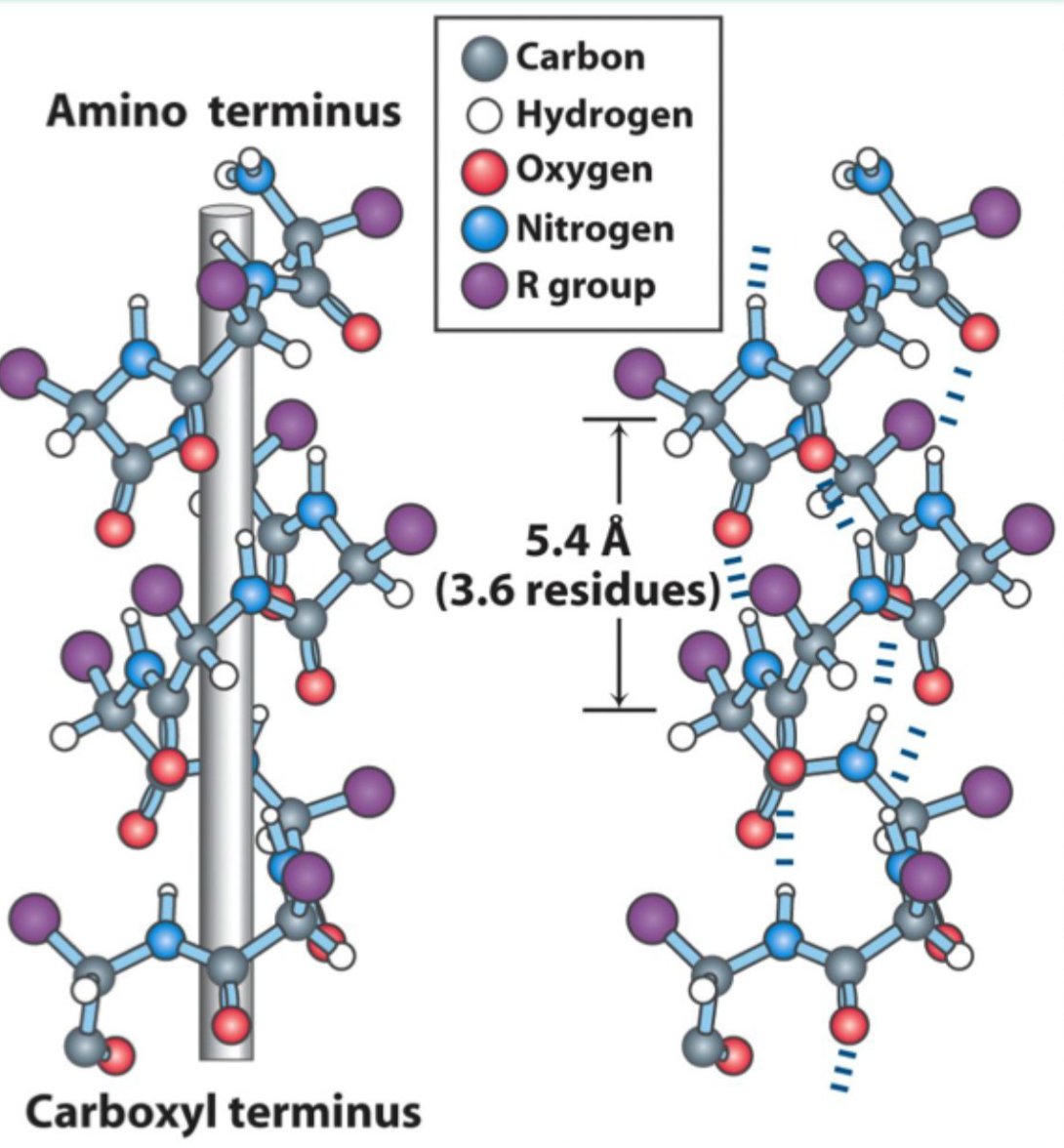
<p><strong>Right</strong>-handed</p>
30
New cards

Which amino acids destabilize α-helices?

Proline (kink due to rigid φ = -60°) and Glycine (too flexible)
<p><strong>Proline</strong> (kink due to rigid <strong>φ = -60°</strong>) and <strong>Glycine</strong> (<strong>too</strong> <strong>flexible</strong>)</p>
31
New cards

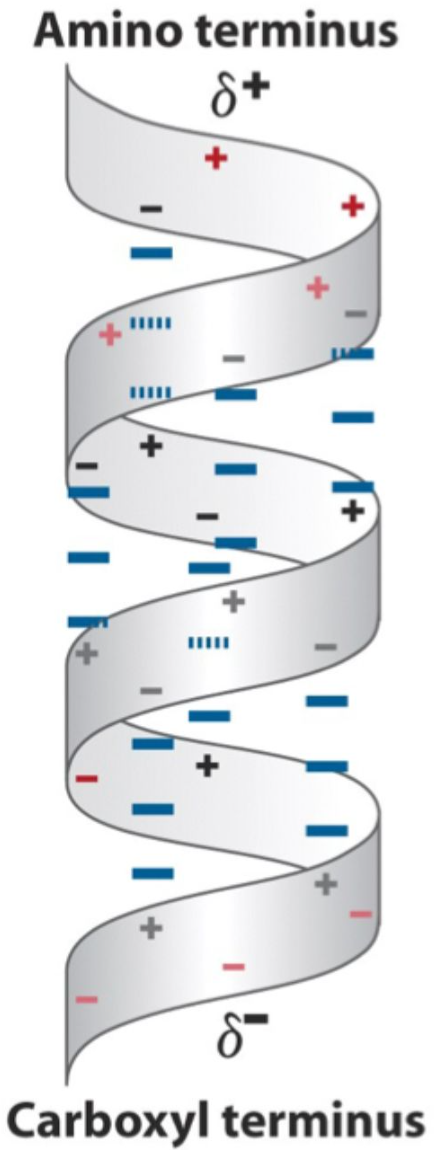
Why does an α-helix have a dipole moment?

All C=O groups point toward the C-terminus and all N–H groups point toward the N-terminus, creating a dipole.
<p>All <strong>C=O groups</strong> point <strong>toward the C-terminus</strong> and all <strong>N–H groups</strong> point <strong>toward the N-terminus</strong>, creating a <strong>dipole</strong>.</p>
32
New cards

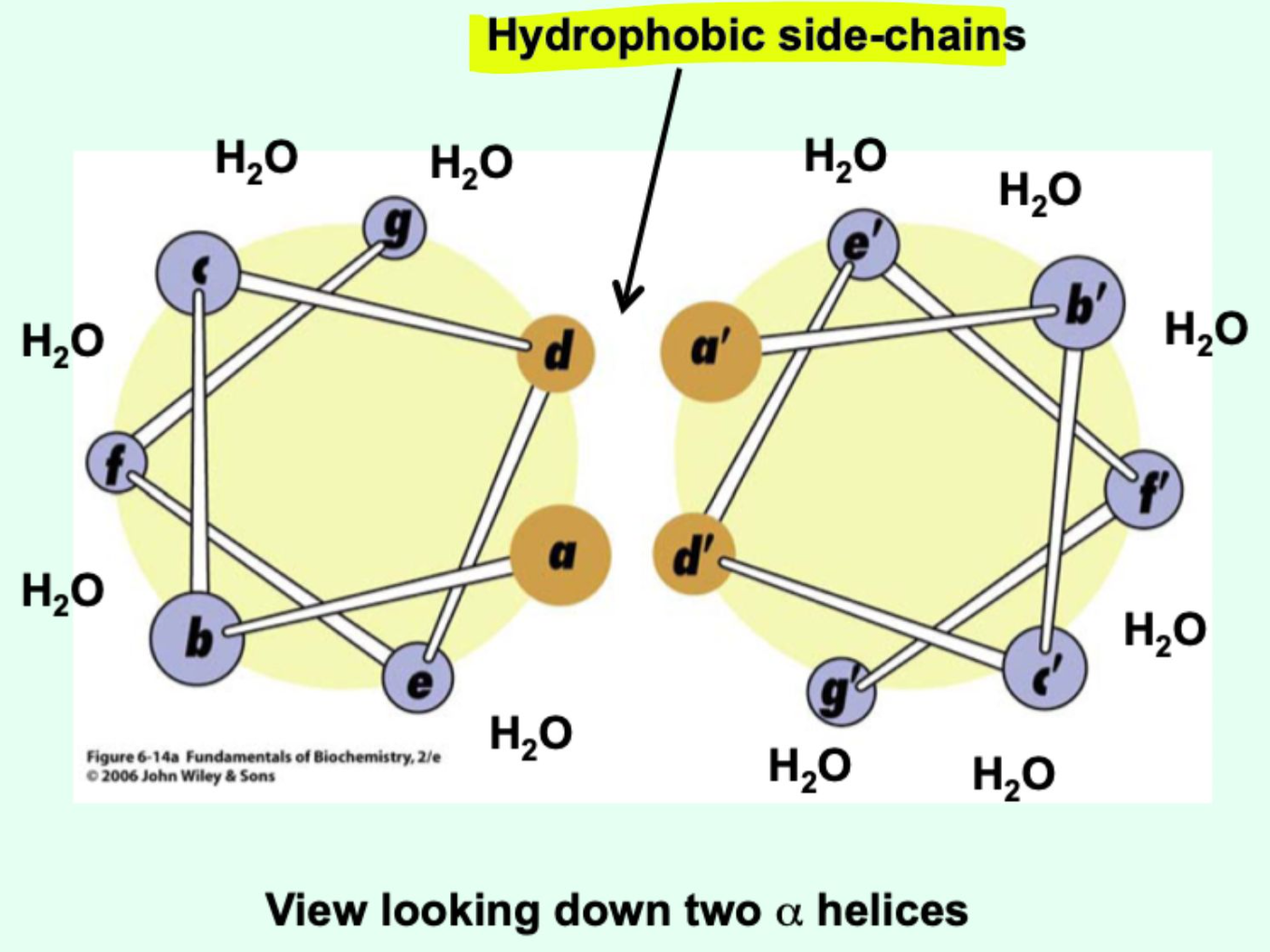
What does “amphipathic α-helix” mean?

An α-helix with one polar (hydrophilic) face and one non-polar (hydrophobic) face.
<p>An α-helix with <strong>one polar (hydrophilic) face</strong> and <strong>one non-polar (hydrophobic) face</strong>.</p>
33
New cards

In a soluble protein, how does an amphipathic α-helix orient?

Polar face interacts with water

Non-polar face interacts with other parts of the protein
<p><strong>Polar</strong> face interacts with <strong>water</strong></p><p><strong>Non-polar</strong> face interacts with <strong>other parts of the protein</strong></p>
34
New cards

In a membrane protein, how does an amphipathic α-helix orient?

Non-polar face interacts with lipid

Polar face interacts with other protein regions
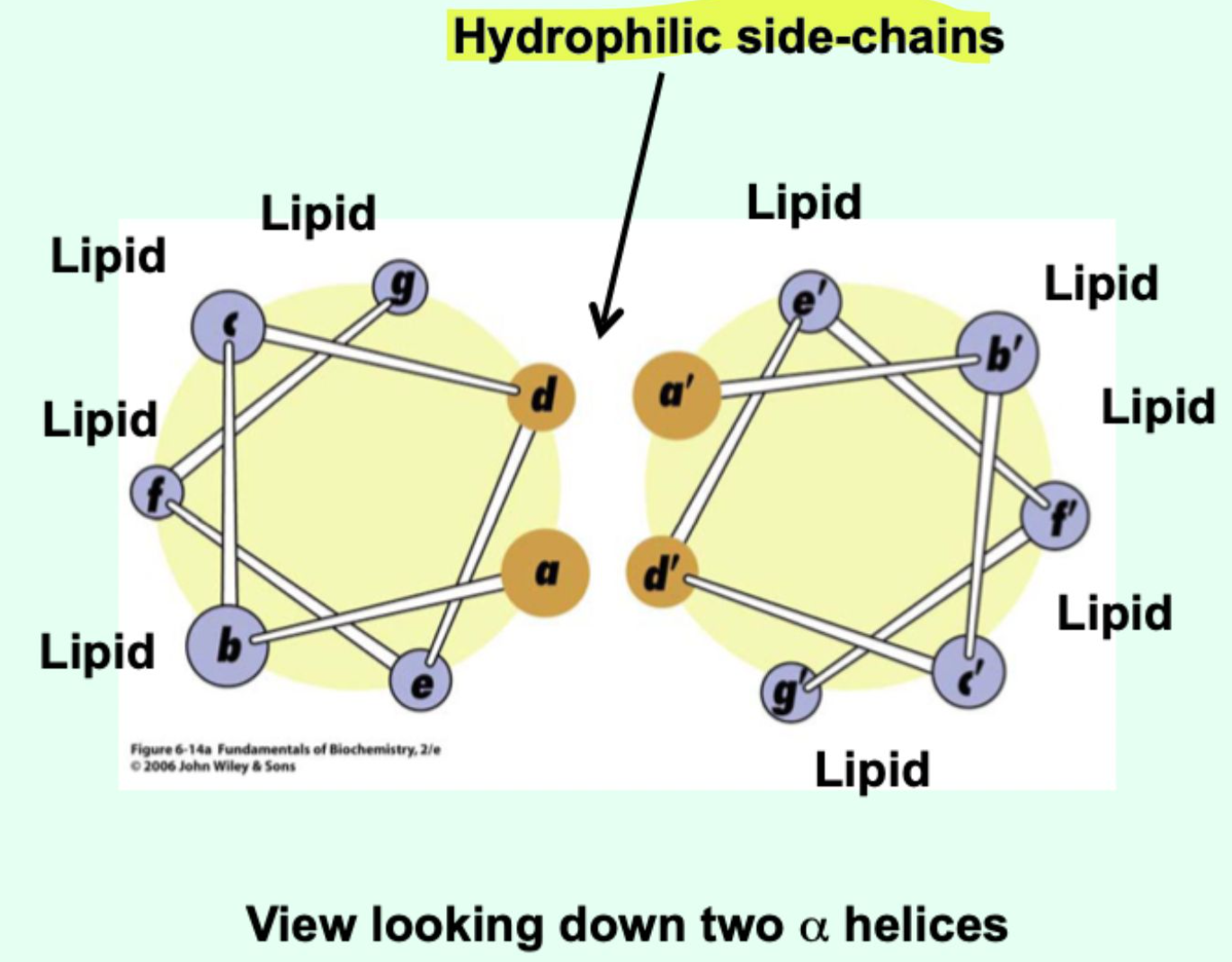
<p><strong>Non-polar </strong>face interacts with <strong>lipid</strong></p><p><strong>Polar</strong> face interacts with <strong>other protein regions</strong></p>
35
New cards

What do amphipathic helices promote?

They promote helix-helix interactions.

36
New cards

Which β-sheet type has stronger hydrogen bonding?

Antiparallel β-sheets (more linear and optimally aligned, so stronger and more stable)
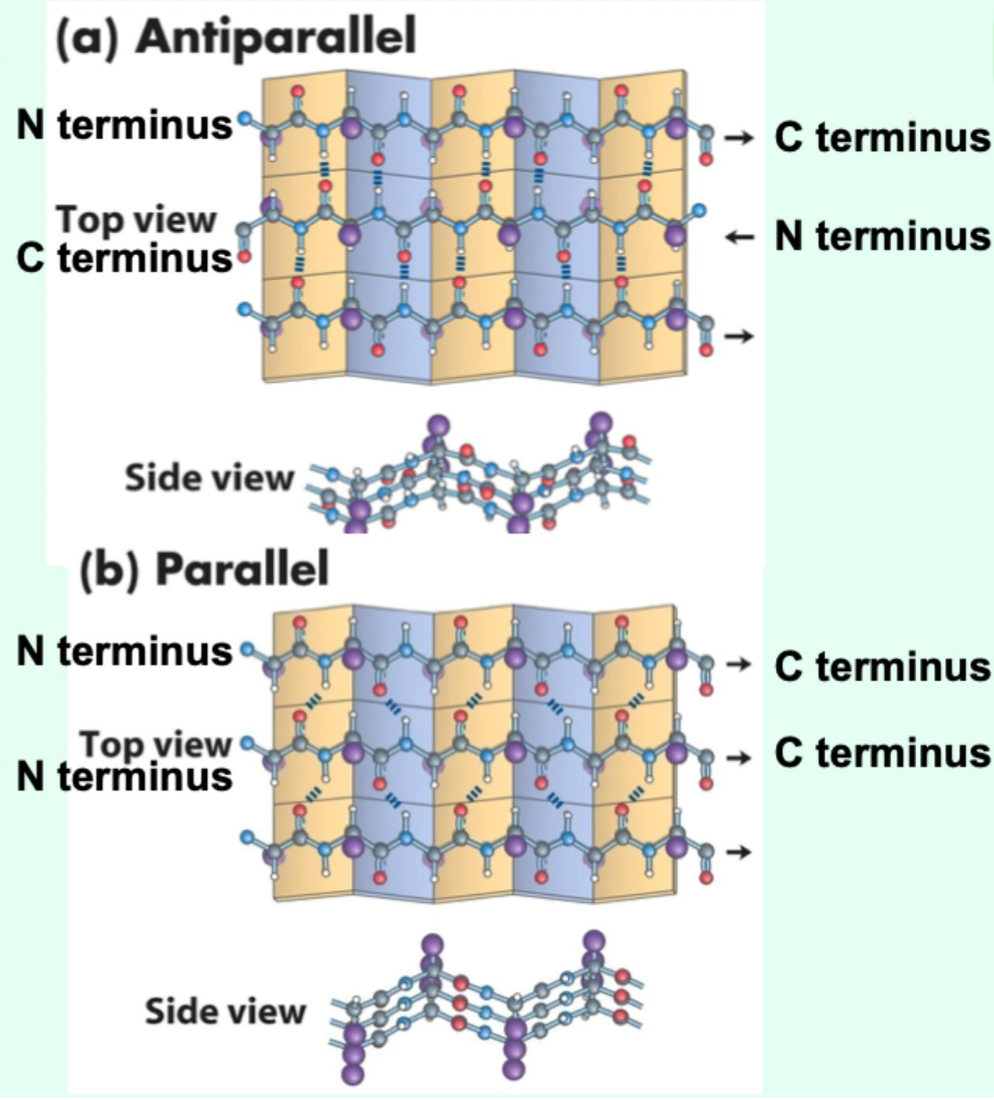
<p><strong>Antiparallel</strong> β-sheets (<strong>more linear </strong>and optimally <strong>aligned</strong>, so <strong>stronger</strong> and <strong>more stable</strong>)</p>
37
New cards

What β-sheet arrangements are possible?

Antiparallel, parallel, or mixed.
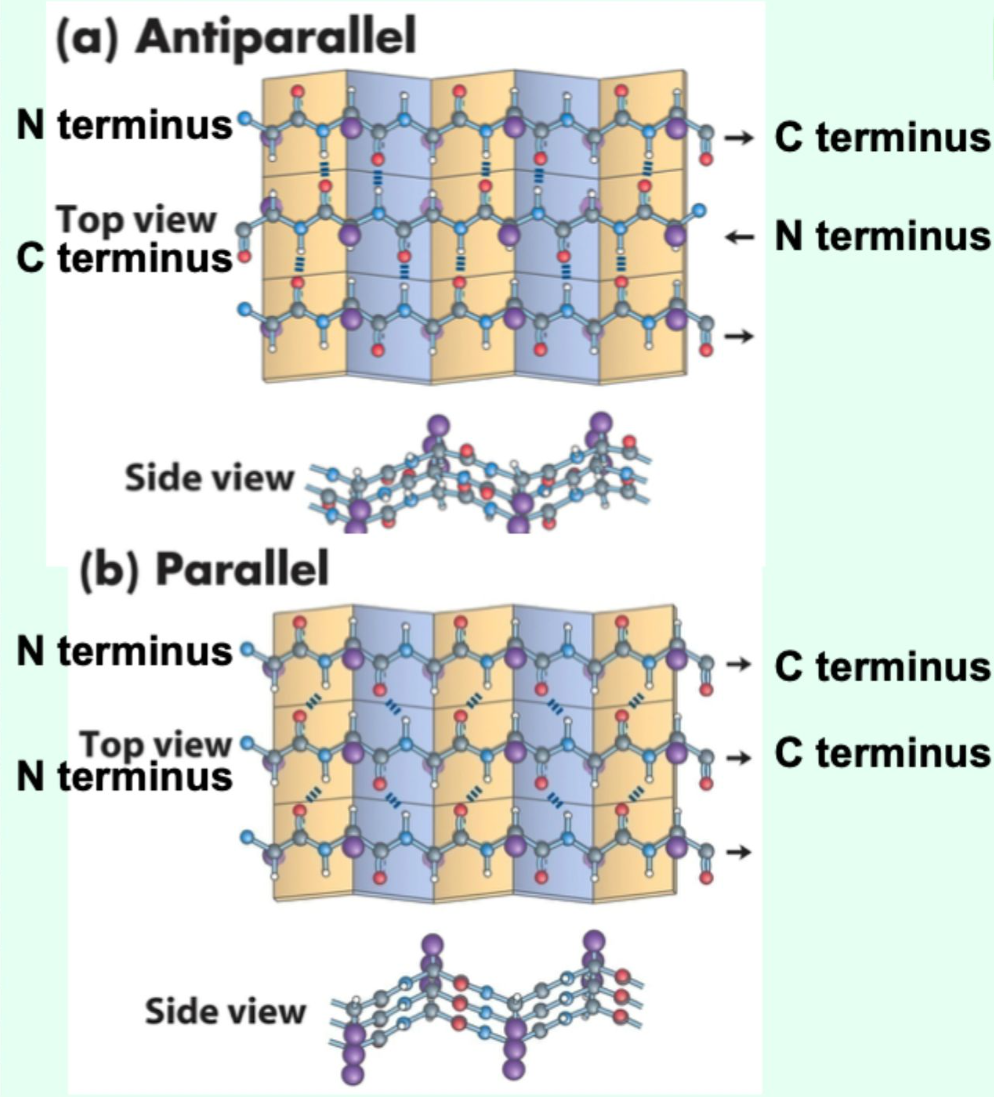
<p>Antiparallel, parallel, or mixed.</p>
38
New cards

What twist do β-sheets exhibit?

Right-handed twist
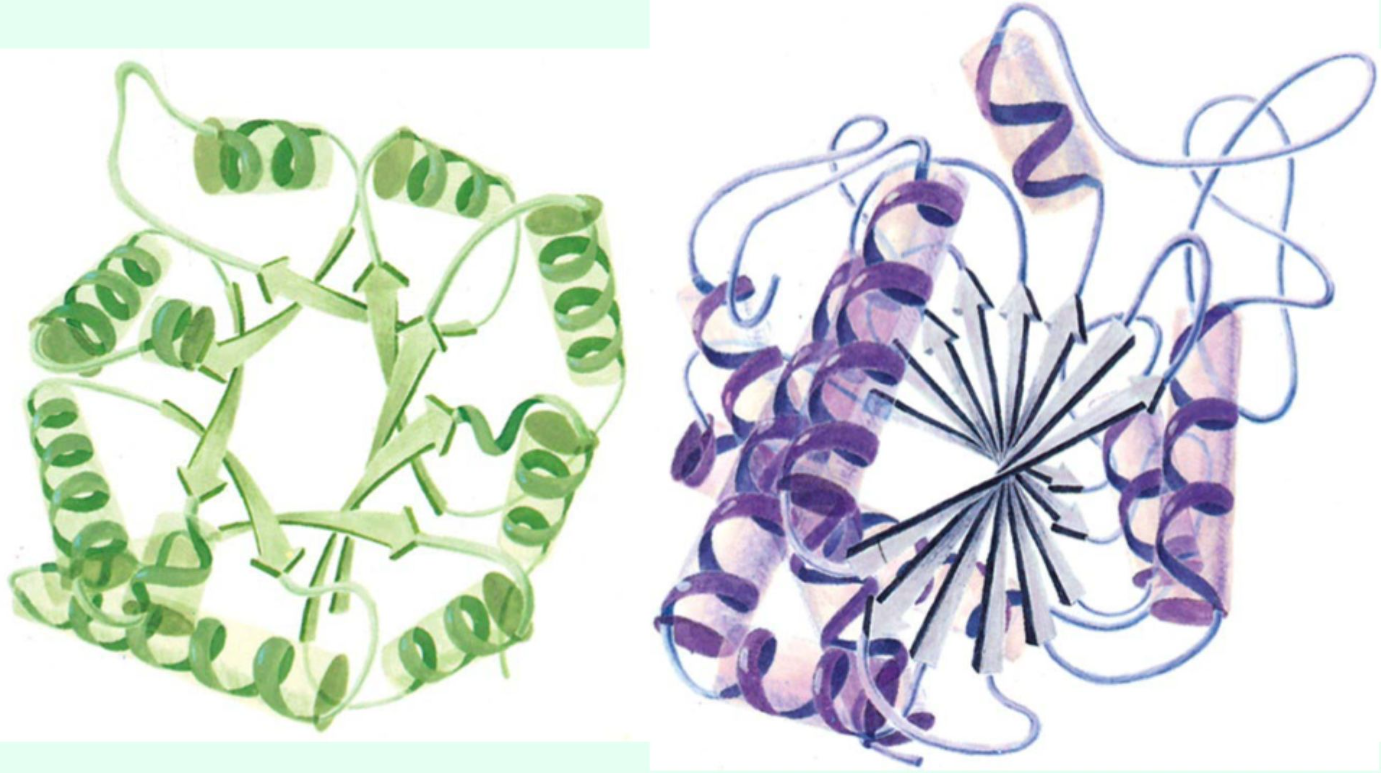
<p><strong>Right</strong>-handed twist</p>
39
New cards

What is the function of turns and loops?

They connect α-helices and β-sheets.
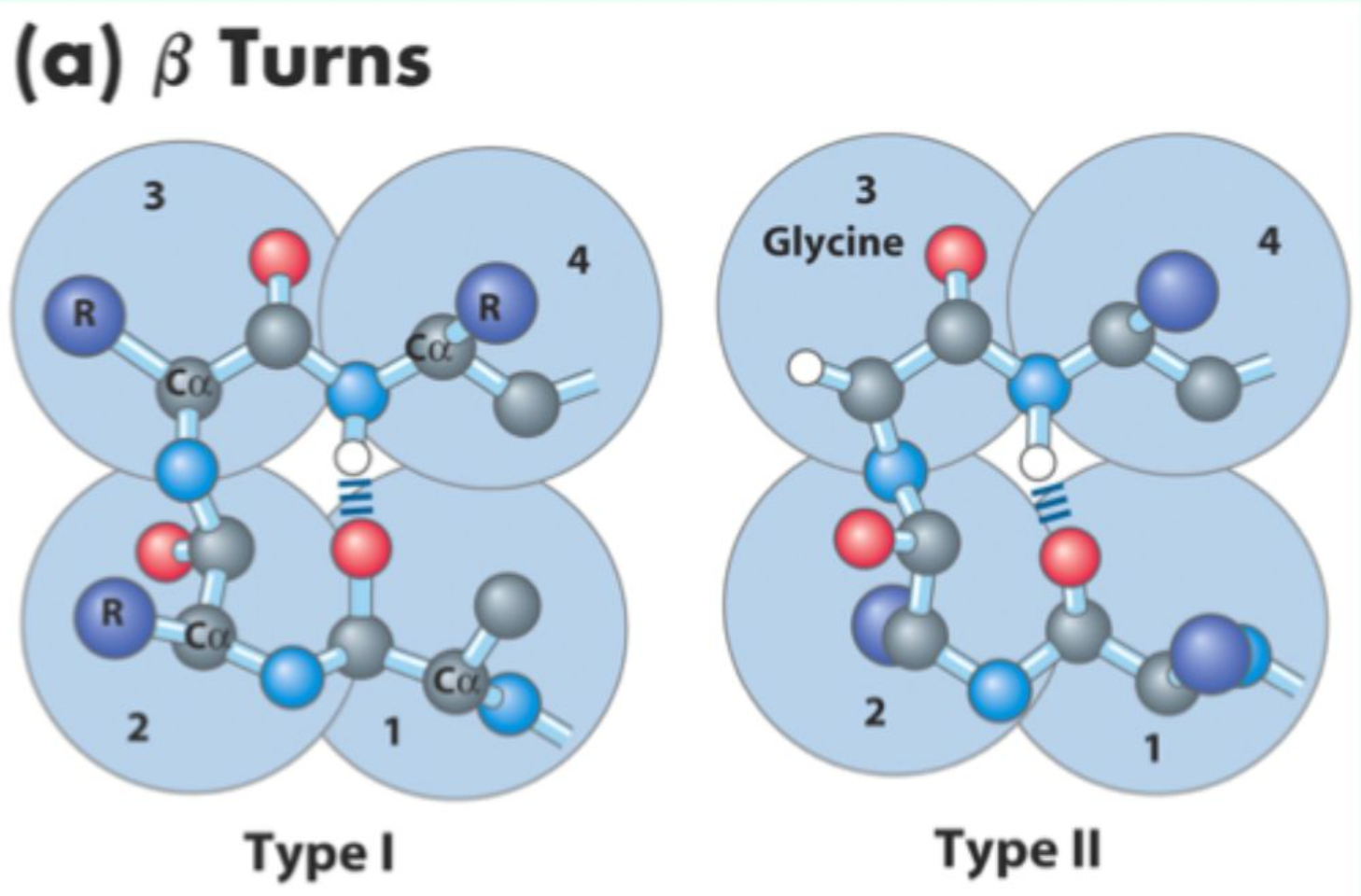
<p>They <strong>connect α-helices and β-sheets</strong>.</p>
40
New cards

Which amino acids are commonly found in turns?

Glycine and Proline

41
New cards

Which β-turn types should you know?

Type I, Type II, Type I', Type II'
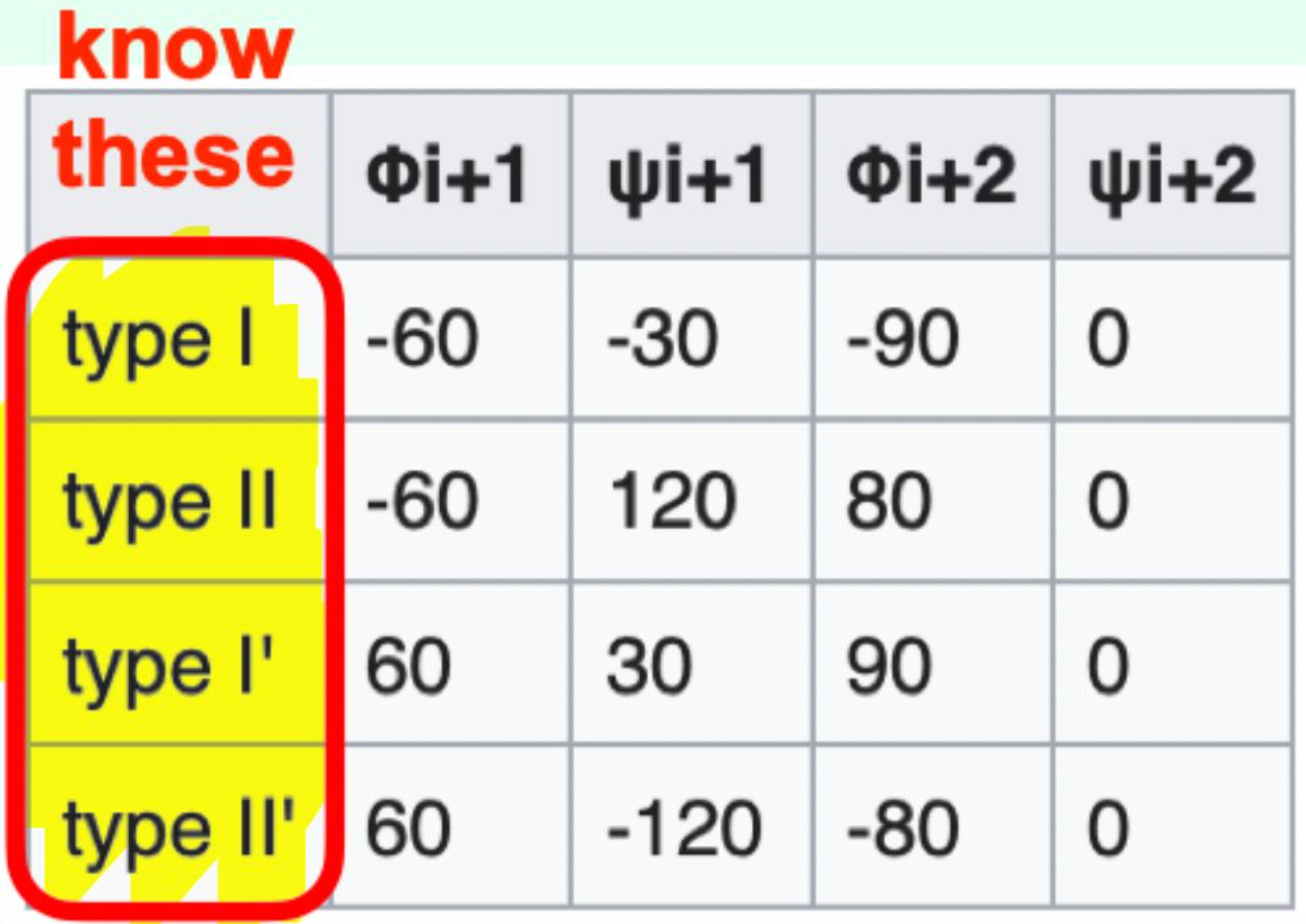
<p>Type I, Type II, Type I', Type II'</p>
42
New cards

Which β-turn type has φi+1 = (−) and ψi+1 = (−)?

Type I β-turn (− / −)
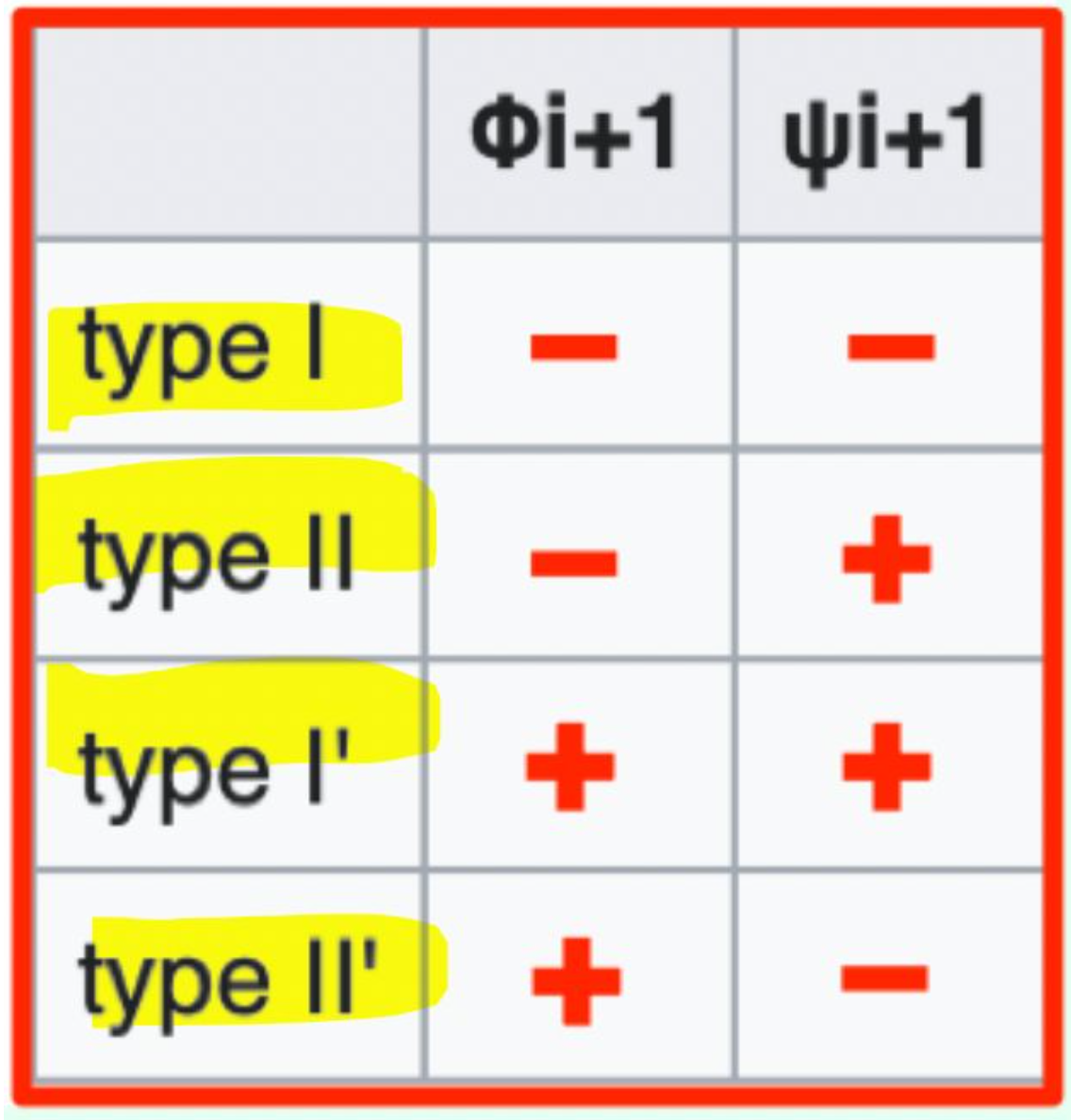
<p><strong>Type I</strong> β-turn <strong>(− / −)</strong></p>
43
New cards

Which β-turn type has φi+1 = (−) and ψi+1 = (+)?

Type II β-turn (− / +)
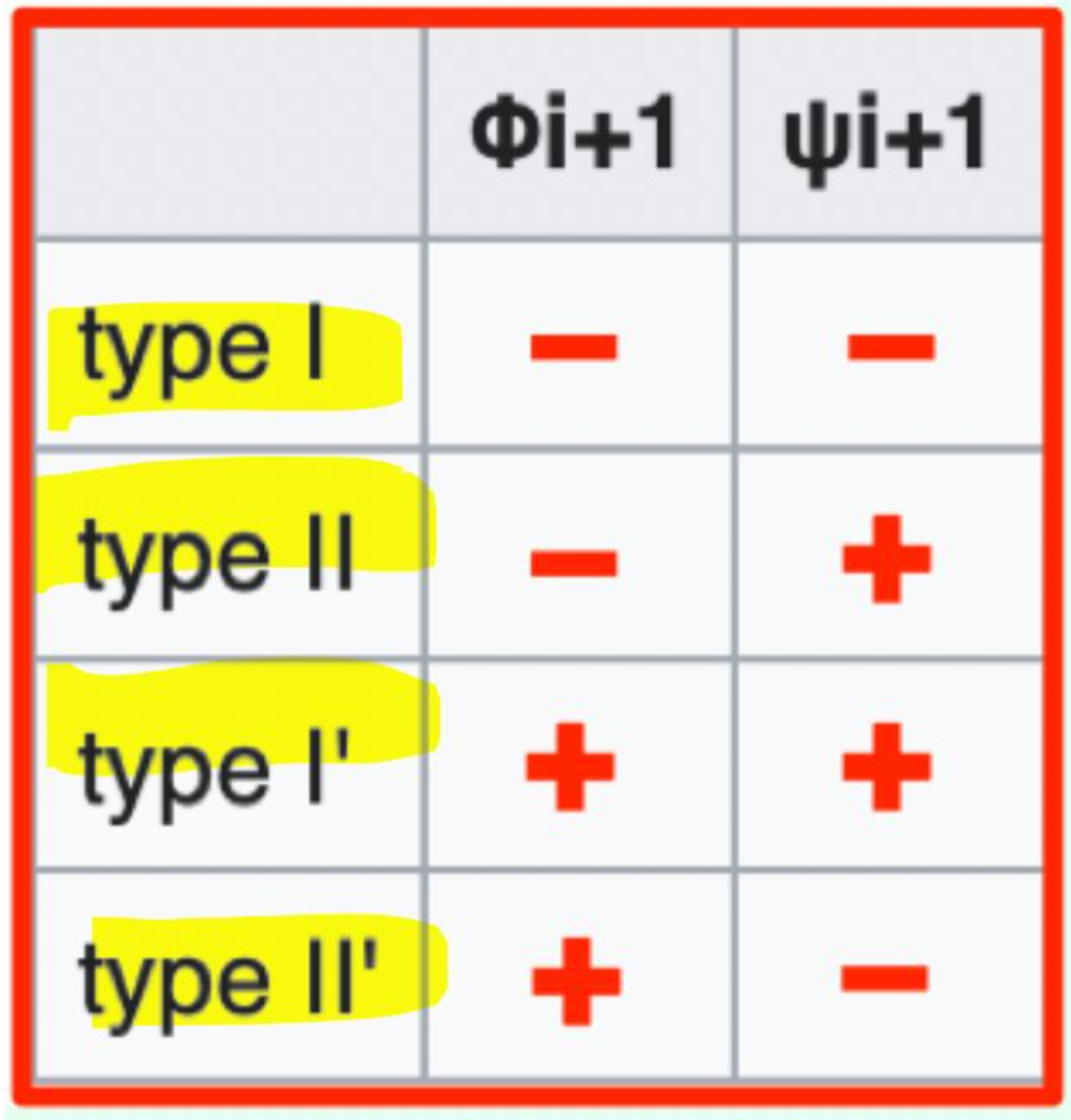
<p><strong>Type II </strong>β-turn<strong> (− / +)</strong></p>
44
New cards

Which β-turn type has φi+1 = (+) and ψi+1 = (+)?

Type I′ β-turn (+ / +)
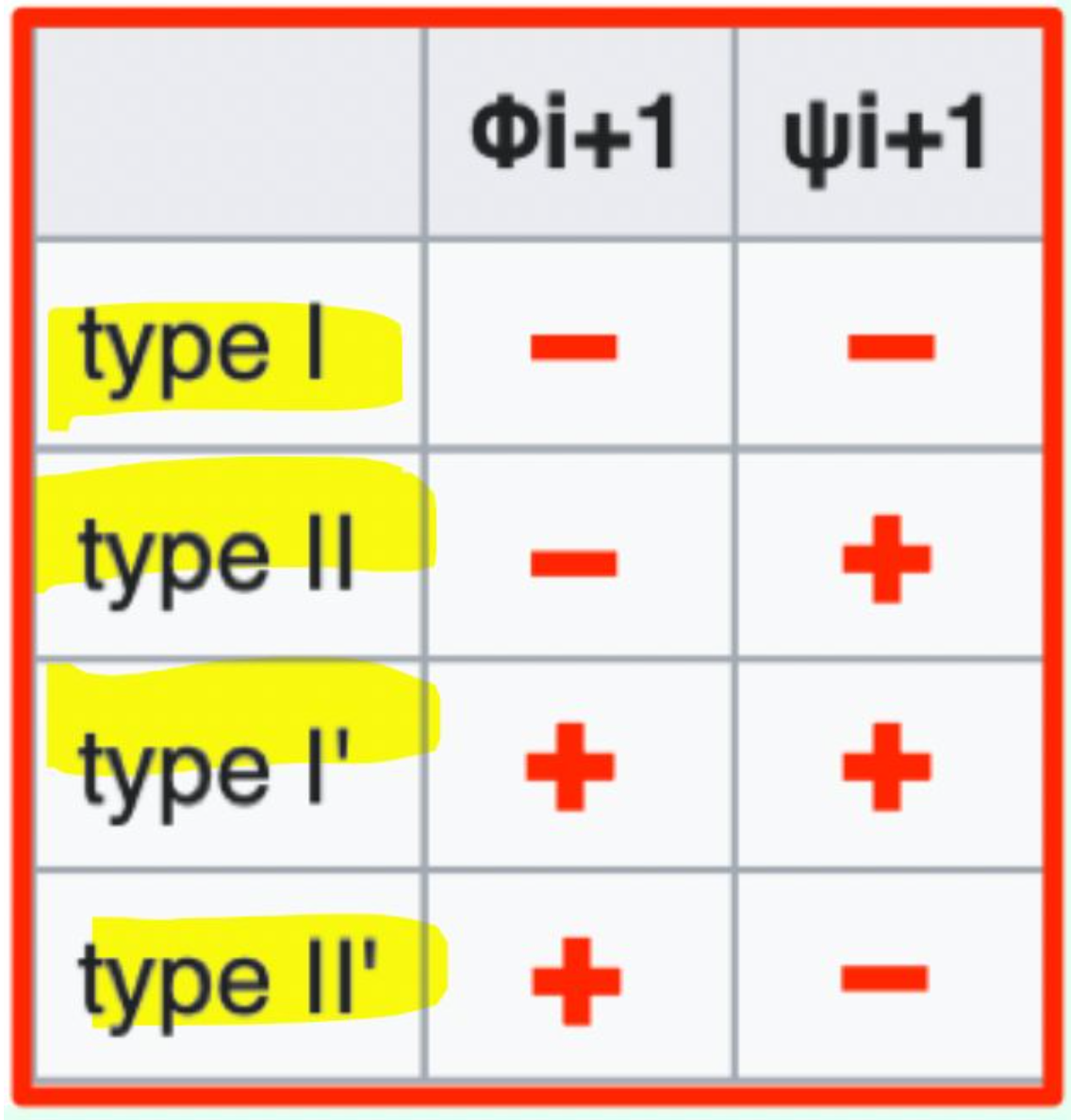
<p><strong>Type I′</strong> β-turn <strong>(+ / +)</strong></p>
45
New cards

Which β-turn type has φi+1 = (+) and ψi+1 = (-)?

Type II′ β-turn (+ / −)
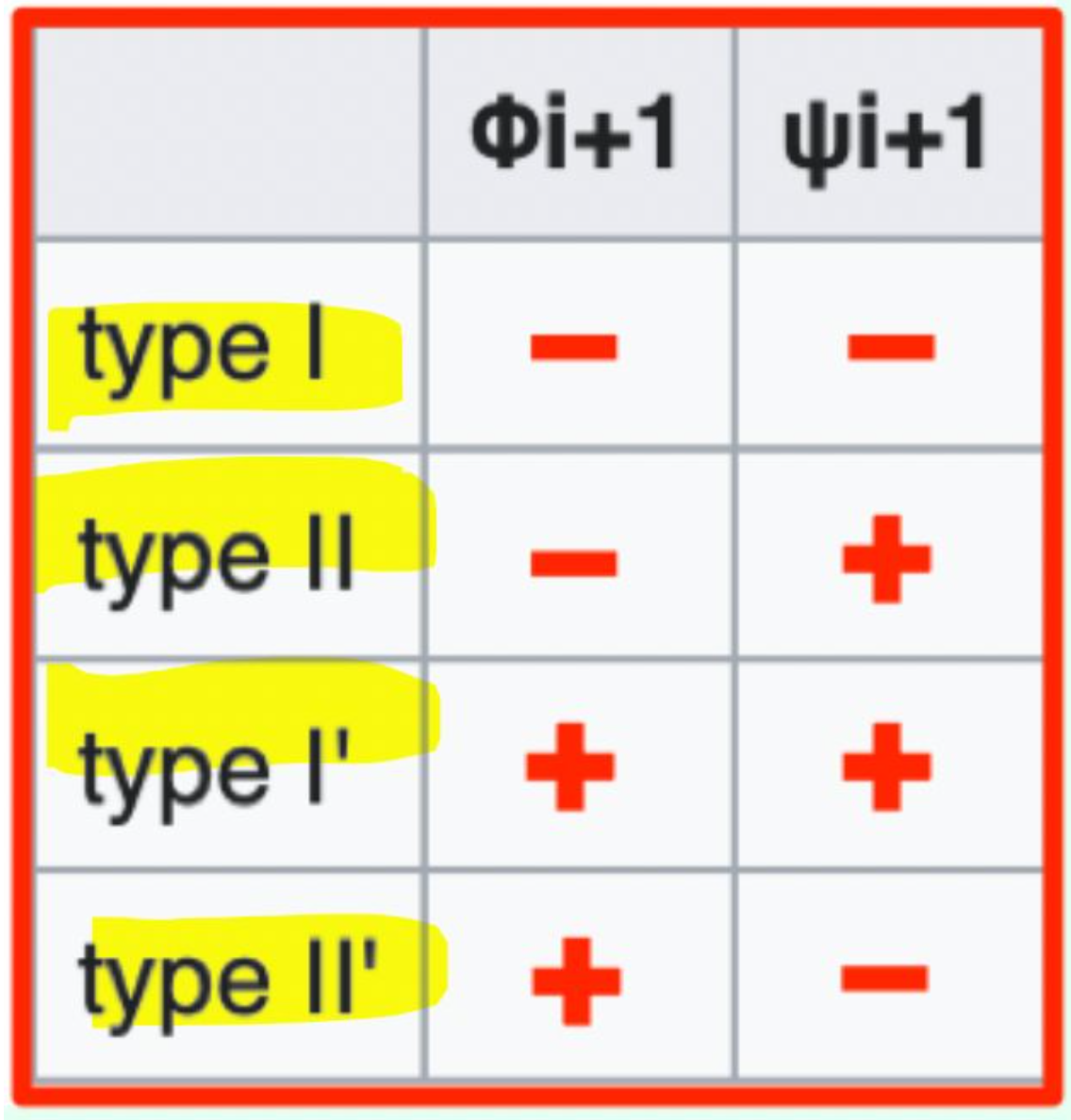
<p><strong>Type II′</strong> β-turn <strong>(+ / −)</strong></p>

Explore top notes

note
Excretory system
Updated 713d ago
0.0(0)
note
Module 1.5a Sleep: Consciousness
Updated 187d ago
0.0(0)
note
Chapter 14-Natural Resources
Updated 1040d ago
0.0(0)
note
Napoleon
Updated 1169d ago
0.0(0)
note
AP World Unit 2
Updated 349d ago
0.0(0)
note
Excretory system
Updated 713d ago
0.0(0)
note
Module 1.5a Sleep: Consciousness
Updated 187d ago
0.0(0)
note
Chapter 14-Natural Resources
Updated 1040d ago
0.0(0)
note
Napoleon
Updated 1169d ago
0.0(0)
note
AP World Unit 2
Updated 349d ago
0.0(0)

Explore top flashcards

flashcards
Así se dice 2 Cap. 2
51
Updated 1006d ago
0.0(0)
flashcards
List 1B
86
Updated 934d ago
0.0(0)
flashcards
Chapter 9- Management
91
Updated 1105d ago
0.0(0)
flashcards
Key Terms ITI Exam 2
58
Updated 784d ago
0.0(0)
flashcards
Exam 1
89
Updated 1149d ago
0.0(0)
flashcards
Economics
61
Updated 894d ago
0.0(0)
flashcards
Así se dice 2 Cap. 2
51
Updated 1006d ago
0.0(0)
flashcards
List 1B
86
Updated 934d ago
0.0(0)
flashcards
Chapter 9- Management
91
Updated 1105d ago
0.0(0)
flashcards
Key Terms ITI Exam 2
58
Updated 784d ago
0.0(0)
flashcards
Exam 1
89
Updated 1149d ago
0.0(0)
flashcards
Economics
61
Updated 894d ago
0.0(0)



