bus man unit 3 aos 2
 Call Kai
 Learn
Learn Practice Test
 Spaced Repetition
 Match
Match Flashcards
 Knowt Play
1/97

Earn XP
Description and Tags
fricking skibidi
Name | Mastery | Learn | Test | Matching | Spaced | Call with Kai |
|---|
No analytics yet
Send a link to your students to track their progress
98 Terms
human resource management
the area of a business that is responsible for managing the relationship between the employees and the business in order to achieve objectives of both
HR strategies
recruitment
induction
training
performance management
resolving disputes
termination
aim of HRM
to ensure the best staff are hired
make sure they are motivated and have the skills to performance their job to a high standard
responsibilities of HRM
before the employee starts working:
creating job descriptions
recruiting and selecting new employees
while the employee is working in the business
inducting employees
training employees
motivating employees
managing workplace disputes
when the employee leaves the business
managing termination
connection between HRM and business objectives
employees are the human resources used to achieve business objectives
motivation
the drive that a person has to work hard towards the achievement of business or personal goals
theories of motivation
maslow’s hierarchy of needs
locke and latham’s goal setting theory
lawrence and nohria’s four drive theory
maslow’s hierarchy of needs
5 level of needs:
physiological
safety
social
self-esteem
self-actualization
lower needs must be satisfied before an individual can move to the next level of needs
once a need is met, it no longer motivates
advantages of maslow’s
tailored to each employee’s individual needs
social and esteem needs emphasize good relationship and corporate culture
physiological eneds can be easily provided by the business
disadvantages of maslow’s
needs of all employees are not uniform
time consuming and difficult to work out where each employee is on the hierarchy
difficult to assess when a level has been ‘satisfied’
locke and latham’s goal setting theory
a theory of motivation that focuses on the process of setting and attaining goals that lead to increased effort and task focus
clarity, challenge, commitment, feedback, task complexity
advantages of locke and latham
goals align with organizational objectives, increased effectiveness
feedback improves relationship between employee and manager
disadvantages of locke and latham
time consuming to periodically meet with employees to set goals and provide feedback
it may be difficult to align personal goals with organizational goals
lawrence and nohria’s four drive theory
the four drives:
acquire
the desire to own basic and complex needs
bond
desire to seek strong working relationships
defend
not desirable in workplace
learn
desire to explore and develop understanding, learn new skills
the drives drives act independently but are present in each individual
strategies for drive to acquire
praise
recongiition
performance related pay
strategies for drive to bond
collaborative tassk
culture of openness
managers are people-oriented
strategies for drive to learn
set meaningful, interesting, challenging work
set variety of tasks
strategies to avoid drive to defend
create fair and trustworthy processes
provide job secuity and safe workplace
advantages of lawrence and nohria
drive to bond emphasizes teamwork and good relationships, improving corporate culture
drive to learn offers opportunities for training and development
drive to learn motivates employees as they are given chance to challenge themselves
disadvantages of lawrence and nohria
teamwork and culture of openness in drive ot bond can create conflict
desire to learn can be expensive because of training
purpose isn’t addressed in this theory (like self-actualization)
the relative strength of each drive varies in individuals and varies over time, so hard to guage which is most motivating
motivational strategies
performance related pay
career advancement
investment in training
support
sanction
performance-related pay
A financial reward to employees whose work has reached or exceeded a set standard
can be a:
ongoing pay rise
bonus (one off)
commissions
share plans
profit sharing
performance appraisal is conducted to determine if employees will receive PRP
primarily short term motivator
adv of PRP
targets are normally clear so employees know what they need to achieve
can improve productivity levels as staff knows their work will be financially rewarded
disadv of PRP
generates a competitive culture where team members don’t work together
can cause conflict amongst employees if they feel the assessment is unfair
difficult to emasure prodictivity levels in some types of jobs
businesses may not be able to afford extra cost
career advancement
promoting employees to positions that include more responsibility and more pay
motivation provided through:
remuneration
job experience
ambition and status
strategies to support career advancement:
job enlargement
job enrichment
job rotation
long term motivator
adv of career advancement
helps the business retain its talented employees
employees may work hard for several years in anticipation of getting a promotion
helps build a positive culture where employees are valued
disadv of career advancement
may demotivate employees that are overlooked for promotion
can cause competition and rivalry amongst staff
there may be a lack of outside perspective if only promoting from within
investment in training (strategy)
the process of enhancing employees’ knowledge and skills to help them perform bettter in their job
can be short or long term motivator
employees perform their job better immediately
shows them that the business is investing in them
adv of training (strategy)
indicates the business values its employees and the contribution they make
creates a sense of loyalty and attachment to business
better trained employees feel more confident and can perform role better
disadv of training (strategy)
expensive
if up-skilled employees are not given the opportunity to use the skills, they may be disappointed
well-trained employees might resign and take their new skills to another business
support
designed to show care, encouragement. and acknowledgement for employees’ work
support strategies:
counselling services
mentoring
general mangement support
can be short term and long term motivation
adv of support
can improve mental wellbeing of employees and reduce absenteeism
can reduce staff turnover as employees know they are supported
it can help build relationships within business
disadv of support
needs a positive culture to work effectively
relies on amanger exercising good communication and interpersoanl skills
sanction
penalities for poor performance or disobeying a policy
examples:
reprimand
disciplinary counselling
dismissal
loss of benefits
written warnings
only a short term motivator, cuz in the long term it impacts relationships and create negative culture
adv of sanction
can stop undesirable behaviours
quick to implement
disadv of sanction
can create a culture of fear
can cause resentment in employees
negatively impact relationships
can cause disputes and union involvement
training
the process of improving an employee’s skills and knowledge so they are able to perform their job more fficiently and effectively
analysis for when and what training is needed
organisational analysis
training that everyone needs to achieve the strategic objectives
task analysis
training for specific skills needed for a specific job to be perform
person analysis
training for an individual employees to perform their role
on the job training
training that occurs at the workplace and often involves completing a task
e.g. coaching, mentoring
adv of on the job training
employee is being trained on the specific tools ot equipment they will be using in their role
employees practice under the supervision of more experienced staff
training is tailored to meet specific needs of the business
cost effective - not paying for outside course provider
disadv of on the job training
quality of trainer may vary if mentor/coach is not trained in how to act in this role
training may not be adequately planned, making it hard for employee to grasp some concepts
trainer may pass on bad habits to trainee
trainer may have to leave their own duties to carry out the trianing
off the job training
training that occurs away from the workplace in a more formal environment
e.g. lectures, conferences, online training
adv of off the job training
learning from specialists and experts
less opportunity to be interrupted by workplace issues, therefore able to focus on training
provides opporutnity for networking and information-sharing between employees of different businesses
employee may receive a formal qualification
disadv of off the job training
more expensive if paying course fees, transport, and accomodation
lost working time and potential output from employees who are attending training
employees with these new skills/qualifications may leave the business to gain a job elsework
skills acquired may not directly relate to the workplace
employee objectives
earning a higher wage or income
getting a promotion
improving job-related skills
achieving work life balance
job security
performance management
the process used to evaluate and improve individual and business performance
performance management strategies
MASE
management by objectives
appraisals
self-evaluation
employee observation
management by objectives
where managers and employees establish, measure and monitor goals together for a specific period
participative
at the end of the review process, feedback is provided
adv of management by objectives
a reward based system and improves motivation
helps build relationship and communication between management and employees
employees feel more connected with the direction of the business
disadv of management by objectives
time consuming to do the negotiation and review stages
relies on goals being achievement
may create a competitive environment
performance appraisals
measures how well an employee has perfromed their job, provides feebdack to employees and establishes plans to improve performance
usually done annually
adv of performance appraisals
outcome helps management make important decisions such as promotions and terminations
identifies employee’s needs for training and development
helps business identify how functional areas such as recruitment and selection are performing
effectiveness of training and development programs can be determined
disadv of performance appraisals
can be biased, and may cause conflict and resentment
time consuming for both manager and employee
self-evaluation
an employee self-assesses both their performance related to criteria and their contribution to the team
often the first step in the performance management process
employees may keep documentary evidence of their achievements
adv of self-evaluation
helps improve communication between managers and employees
allows employees to play an active role in performance management
can highlight the need for training that the employee feels would be helpful
disadv of performance management
can be difficult for employee to give themselves a fair assessment without seeming conceited
employee may find it difficult to know how to measure their own performance obectively
employee observation
feedback is received from a variety of sources that witness an employee during their daily work
360 degree feedback → collected from a range of people that the employee deals with
adv of employee observation
training needs can be identified via feedback given
the perspectives of a range of people are considered - increases fairness
disadv of employee observation
feedback provided may not be accurate or effective as reviewer may not have full or enough information regarding employee’s performance
time consumign to gather feedback
entitement
benefits a business must legally provide an employee upon termination
transition
benefits which are not legally enforceable but may and should be provided to employees upon termination as a form of corporate social responsibility
voluntary termination
resignation
retirement
involuntary termination
redundancy (can be voluntary or involuntary)
dismissal
resignation
voluntary termination that occurs when an employee leaves the workplace, usuaslly to go to another job
entitlement considerations:
payment for completed work and accrued benefits (annual leave, long service leave etc)
business is entitled to notice
transition considerations:
business tends not to offer transitional benefits
an exit interview is recommended to find out why the employee is leaving
retirement
voluntary termintaion where an employee decides to leave the paid workforce
entitlement considerations:
payment for accrued benefits
employee must notify business of their intention to retire
transition considerations:
allow older employees to reduce the number of working hours leading up to retirement
assistance to organise finances such as pension and superannuation
support employees to find volunteering or community activites
redundancy
voluntary or involuntary termination of employment by an employer because it no longer needs a particular job to be done by anyone or needs fewer people to do a particular type of job
entitlement considerations:
employees are entitled to a redundancy package, notice, pay and accrued benefits, and time off to attend interviews
transition considerations:
outplacement services are specialised assistance given to redundant employees to assist them to find new job
conselling, resume writing, interview techniques
offer employees training in new areas to help them find a new job
dismissal
involuntary termination of an employement contract due to an unacceptable behaviour or performance
entitlement considerations:
payment for accrued benefits
transition considerations
some businesses may use career transition services
workplace relations
the relationship between employers and employees in determining wages, conditions, and methods of resolving disputes should they arise
aims to create optimum working relationships, increased business productivity, and greater business competitiveness
causes of disputes
differing views on how profits generated should be distributed
participants in workplace relations
on the side of employees:
employees
trade unions
on the side of employers:
employers
human resources managers
employer associations
government:
fair work commission
fair work ombudsman
fair work division of federal court and federal circuit court
employee
a person working for another person or business for wages or salary
negotiate and vote on new agreements about pay and conditions
vote on new agreements about pay and conditions
participate in dispute resolution
union
organisation formed to represent and protect the rights of workers in a particular industry
employees join a union have to pay an annual fee, and in return the union:
represents employees when negotaiting pay and conditions
provide advice to employees
acts as spokesperson to the media
support and represent employees during dispute
organise indsutrial action by applying tot he FWC
employer association
organisation that provides a range of advice to businesses and represent their interests in workplace relation issues
acts as a spokeperson to the media
HR manager
manages the overall relationship the business has with employees in order to increase the efficiency of both employees and business
participate in the resolution of disputes and may act as a mediator to resolve disputes internally
liaise with employer associations, unions, and FWC
how can HR managers promote good workplace relations
create a common purpose
participative management
treat employees and their complaints seriously
provide fair pay and working conditions
use effective communication
fair work commission
australia’s national workplace relations tribunal
its role is to assist employees and employers to maintain fair and productive workplaces
provides a safety net of minimum pay and work conditions by creating awards
approve collective/enterprise agreements
hearing unfair dismissal applications
approving applications to take indsutrial action
resolving workplace disputes through mediation, concciliation, and arbitration
methods of detemrining wages and conditions
awards
enterprise agreements
individual contracts
these are underpinned by the national employment standards (NES)
awards
sets out the minimum pay rates and conditions for those in a particular industry
FWC makes awards
reviewed every 4 years
applies to employees in an industry
businesses must meet or exceed NES standards
adv of awards
reduces costs for business
no time spent negotiating an agremeent with employee
stability and predictability beacuse a single set of rules apply across the industry
disadv of awards
inflexible for the business as same rules apply regardless of size or location of business
harder to link productivity gains to wages and conditions
less incentive for a participative approach, decreasing employee empowerment
enterprise agreement
results from negotiations bewteen an employer and union and is ratified bt the FWC, setting out the terms and conditions of employment at a workplace
created via the process of enterprise bargaining, and is submitted to FWC for approval
lasts up to 4 years
applies to an individual workplace
must be better off overall than the award
adv of enterprise agreement
increased flexibility because business can tailor pay and conditions
easier
disadv of enterprise agreement
can be time consuming to negotiate conditions of enterprise agreements
can cause conflict between employer of employee due to ongoing negotiation
increases the costs to the business because of higher wages and better conditions
individual contract
sets out wages and conditions agreed between a single employee and a business
negotiated between the employer and employee
it lasts for however long it has been determined to be during negotiation
applies to individual employee
conditions must be better off overall than award and enterprise agreement
adv of individual contract
promotes hard work and higher productivity
other employees may use other employees to benchmark their performance
employees may feel more valued/appreciated if they can bargain for higher pay
disadv of individual contract
may create tension and/or competition in workplace
greater time needed to negotiate contracts with specific employees
increased costs to business when offering higher pay and conditions
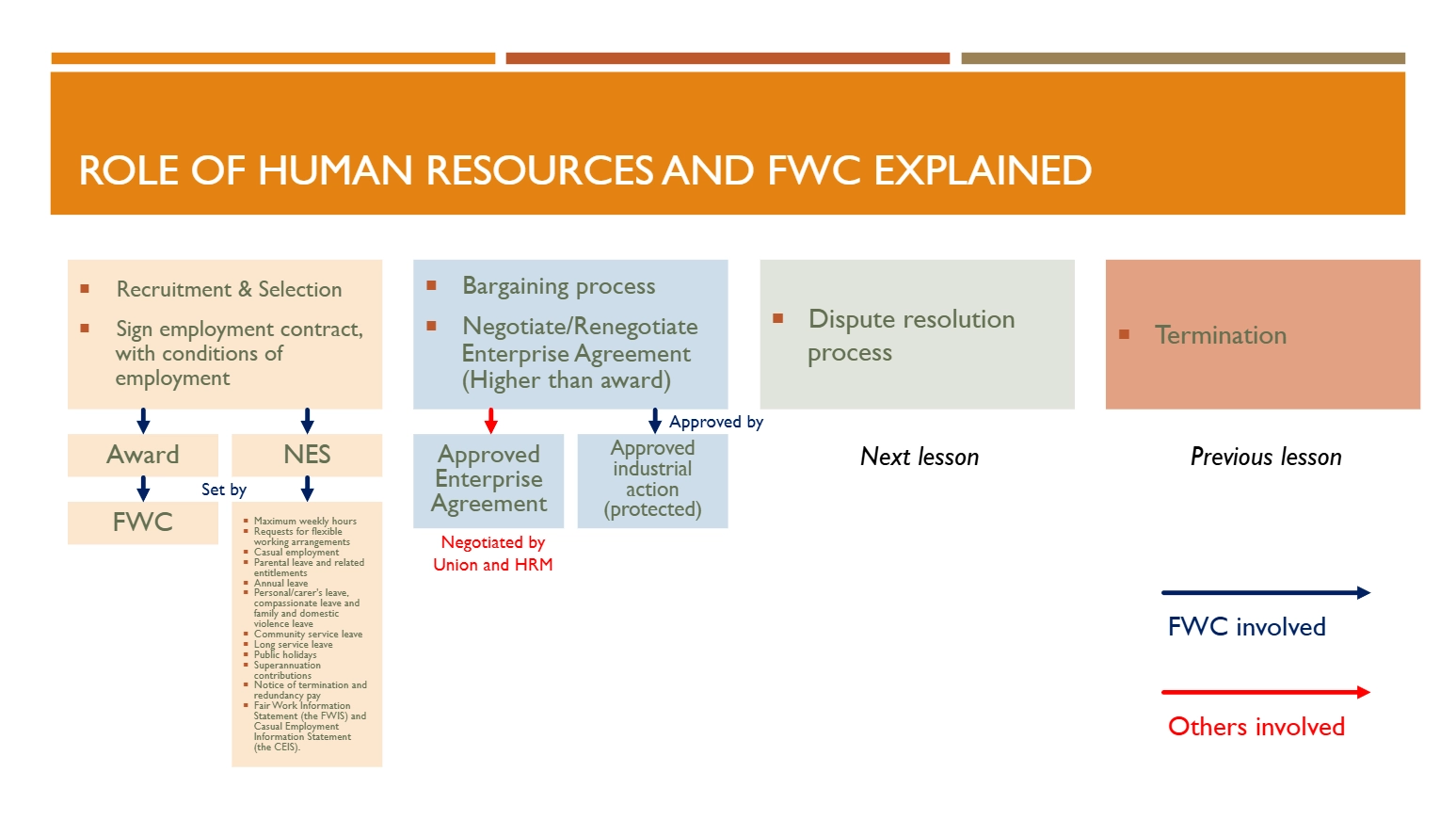
role of human resources and FWC
disputes
a workplace disagreement bewteen employees or between employees and employer
dispute resolution
a formal systematic procedure that permits employees to complain about matters that affect them and their work
effective dispute resolution helps employers maintain good relationships with employees through dealing with disputes at an early stage
protected industrial action
strike → employees withdraw from work for a period of time
work to rule → workers only perform bare minimum required
stop-work meeting → employees stop work to hold a meeting during work hours
picket line → employees physically demonstrate outside premises and prevent labour and deliveries entering
lockout → employer doesn’t let employees into the workplace
methods od dispute resolution
mediation
arbitration
mediation
an independent third party dacilitates discussion between two parties to help them reach their own agreement
mediator does not provide advice
mediator can be HR manager, extenral private mediator or member of FWC
outcome is decided by parties and can be informal or formal (legally binding)
adv of mediation
parties more likely to be satisfied with the decision as they have made decisions themselves
less formal than arbitration so more likely to maintain relationships
can be cheap as FWC provides this service for free
disadv of mediation
may take a long time to reach a decision beacuse parties must come to agreement by themselves
if a contract is not signed then the decision is not legally binding
arbitration
both parties put their case forward to an independent third party who then makes the final decision which is legally binding
FWC can act as the independent tribunal
adv of arbitration
a decision will be made because the arbitrator makes a decision
parties must abide by the decision because it is legally binding
disadv of arbitration
occurs in a formal environemnt which may be intimidating and negative to relationship of parties
the parties do not have a say in the decision so they may be dissatisfied with the outcome
dispute resolution procedure
employee or representative meet with manager to discuss and try to resolve problem
employee or rep meet with senior manager to discuss and try resolve the problem
dispute referred to an independent mediator
disputer referred to FWC for conciliation
dispute is arbitrated by FWC and a legally binding decision is made

