Economics
 Call Kai
 Learn
Learn Practice Test
 Spaced Repetition
 Match
Match Flashcards
 Knowt Play
1/19

There's no tags or description
Looks like no tags are added yet.
Name | Mastery | Learn | Test | Matching | Spaced | Call with Kai |
|---|
No analytics yet
Send a link to your students to track their progress
20 Terms
Scarcity:
the limited nature of society’s
resources
Principle #1:
People Face Tradeoffs
All decisions involve tradeoffs.
Examples:
Going to a party the night before your midterm
leaves less time for studying.
Having more money to buy stuff requires working
longer hours, which leaves less time for leisure.
Protecting the environment requires resources
that could otherwise be used to produce
consumer goods.
Society faces an important tradeoff:
efficiency vs. equality
Efficiency: when society gets the most from its
scarce resources
Equality: when prosperity is distributed uniformly
among society’s members
Tradeoff: To achieve greater equality,
could redistribute income from wealthy to poor.
But this reduces incentive to work and produce,
shrinks the size of the economic “pie.”
Principle #2:
The Cost of Something Is What You Give Up to Get It
The opportunity cost of any item is
whatever must be given up to obtain it.
Principle #3:
Rational People Think at the
Margin
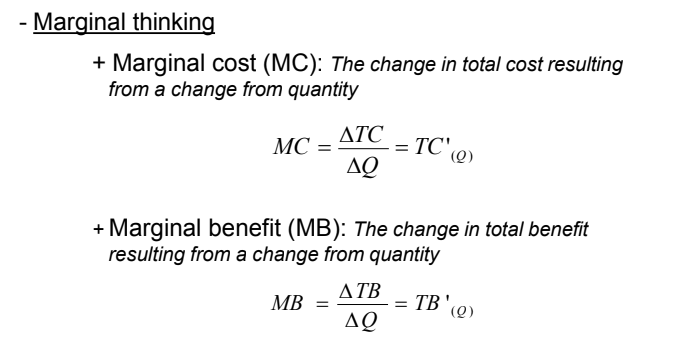
Marginal cost (MC): The change in total cost resulting
from a change from quantity
MC = ΔTC/ΔQ
Marginal benefit (MB): The change in total benefit
resulting from a change from quantity
MB = ΔTB/ΔQ
Principle #4:
People Respond to Incentives
Examples:
When gas prices rise, consumers buy more
hybrid cars and fewer gas guzzling SUVs.
When cigarette taxes increase,
teen smoking falls.
Principle #5:
Trade Can Make Everyone Better Off
Rather than being self-sufficient,
people can specialize in producing one good or
service and exchange it for other goods.
Countries also benefit from trade & specialization:
Get a better price abroad for goods they produce
Buy other goods more cheaply from abroad than
could be produced at home
Principle #6
Markets Are Usually A Good Way to Organize Economic Activity
Market: a group of buyers and sellers
(need not be in a single location)
“Organize economic activity” means determining
what goods to produce
how to produce them
how much of each to produce
who gets them
The invisible hand works through the price system:
The interaction of buyers and sellers
determines prices.
Each price reflects the good’s value to buyers
and the cost of producing the good.
Prices guide self-interested households and
firms to make decisions that, in many cases,
maximize society’s economic well-being.
Invisible hand
A market economy allocates resources through
the decentralized decisions of many households
and firms as they interact in markets.
Each of these households and firms
acts as if “led by an invisible hand”
to promote general economic well-being.
Economics mechanism
Market economies rely on private ownership, competition, and supply/demand forces to determine production and prices, fostering innovation and efficiency. Conversely, planned economies (command systems) have centralized government control over resources, setting production goals and prices directly, prioritizing stability and state goals over consumer choice
Principle #7:
Governments Can Sometimes
Improve Market Outcomes
Market failure:
when the market fails to allocate society’s resources efficiently
Causes:
Externalities, when the production or consumption
of a good affects bystanders (e.g. pollution)
Market power, a single buyer or seller has
substantial influence on market price (e.g. monopoly)
In such cases, public policy may promote efficiency.
Principle #8:
A country’s standard of living
depends on its ability to produce goods & services.
The most important determinant of living standards:
productivity, the amount of goods and services
produced per unit of labor.
Principle #9:
Prices rise when the
government prints too much money.
Inflation: increases in the general level of prices.
Principle #10:
Society faces a short-run tradeoff between inflation and unemployment
Factors of production:
labor
land
capital (buildings & machines used in
production)
Law of demand
lượng tăng giá giảm và ngược lại
Law of supply
lượng tăng giá tăng
Accounting profit
=total revenue minus total explicit costs
Economic profit
=total revenue minus total costs (including
explicit and implicit costs)

