KNES 355 Intro to Growth (unit 1)
 Studied by 0 people
 Call with Kai
 Learn
Learn Practice Test
 Spaced Repetition
 Match
Match Flashcards
 Knowt Play
1/56

There's no tags or description
Looks like no tags are added yet.
Name | Mastery | Learn | Test | Matching | Spaced | Call with Kai |
|---|
No analytics yet
Send a link to your students to track their progress
57 Terms
Why do we study GMD?
growth, maturation development
to learn about normal pattern of biological variation at individual and population levels in humans
once you understand normal patterns you can determine origins, causes and biological significance of variation
What can be modified during growth and development?
physical env
nutritional env
training env
social env
to optimize a child’s growth, health and performance potential
What is human biological variability?
the range of possible values for any measurable characteristics (physical) of humans at the levels of
individual
group
pop.
What is biological variability influenced by?
genetics, prenatal env, nutritional status
What does somatic refer to?
a body cell of an organism, usually with a diploid number of chromosomes in the nucleus
tissues/organs or biological systems comprised of these cells
gross morphological features such as height, weight and BMI
What are the steps of practical applications of understanding human variability?
Assess normalcy of GMD status
Assess normalcy of rates of change or progress
predict future outcomes (tracking)
interpret effect of physical activity or exercise on biological outcomes
What is the pediatric stage?
prenatal (1st, 2nd, 3rd trimester)
childhood (early, middle, late adolescence)
What is the adulthood stage?
young (19-40years)
middle (40-60)
older (60 years)
menopause and andropause happens between middle and older
What are the different parts of peri-natal and infancy?
prenatal: egg (twinning), embryo (sex and organ), fetus (growth)
Infancy: birth to one year
perinatal: 1st week of life
neo-natal: 1st month of life
postnatal: 2nd to 12th month of life
When is early childhood?
1-5 years
When is mid-childhood?
6-8 female
6-10 male
when is late childhood?
9-10 females
11-12 male
When is adolescence?
11-19 female
13-22 male
What is growth?
increase in size
What is maturation?
progress towards mature state
timing and tempo vary
relates biological time to calendar time
What is development?
behavior competence, learning appropriate behaviors expected by society
cognitive, emotional, social and motor
One word to describe growth, maturation and development?
growth: distance
maturation: speed, timing
Development: driving rules
Growth requires:
a quantitative change in size
not limited to childhood/adolescence
What is growth status?
size attained at any point in time
based on age and maturity
compared with norms/references
things are only bigger or smaller by comparison
What is one of the best indicators of overall health and nutrition?
growth status
reflects genetics and env, influences
height and weight for age
BMI for age = mass (kg)/height² (m)
What is hyperplasia?
increase in number of cells
What
What is accretion?
increase in interstitial material
Increase in muscle cell thickness and length does NOT equal:
increase in number of cells
obvious shape change in muscle due to cell growth
How does growth in skeletal muscle tissue look like?
cell number only increases until infancy and then stays the same
cell size continues to rise from prenatal to adolescence but faster in childhood and adolescence
What is size?
a difference in physical magnitude
multi-dimensional at cell/tissue/body levels
can be measured qualitatively and quantitatively (large/small)
From birth to 20 years, there is a change in:
mass distribution and segment lengths
What influences size in childhood?
mostly growth but also tempo or rate of growth so also maturation
What is size influenced by in adulthood?
due to residual growth potential and usually stops in mid 20s
What is the exception to how size is influenced?
fat muscle bone
changes can be increased or decreased
mass, volume, thickness, density
variation in size due to different factors at different stages of the lifespan
Does size matter?
Yes
What is the NFL draftees size example?
more that were drafted born early in the year
physically bigger= more coaching attention= more trained
What is the relative age effect?
overrepresentation of children born earlier in the year on elite junior teams
youth sports is typically arranged by chronological order
often creates an advantage for oldest child in group
coaches may mistake greater physical growth for greater ability
What are the implications of the relative age effect for older athletes?
more likely to be selected for elite teams
receive better coaching/training
experience more success
more likely to be viewed as gifted
What are the implications of the relative age effect for younger athletes?
less likely to be selected for elite teams
more likely to fall behind/dropout
impact on self-perception
Size is a surrogate measure for __________ __________.
underlying pathology
👉 we use size as a stand-in (a clue) for what’s really going wrong inside.
What are the relevant size measures?
body mass, BMI
fat mass, fat %
bone density
What is shape?
distribution of mass within an object
change in geometric proportionalities
has functional impacts
human shape changes with growth
Are there consequences to growth-related changes in shape?
yes
changes may be beneficial, neutral or detrimental
ex: female pelvis is wider and shallower compared to male pelvis
How can maturation be described?
tempo and timing of physical changes
progress towards a mature state
maturation=process, maturity=status
distance travelled on the way to adulthood
most biochemical and physiological systems mature by an early adulthood
What are the characteristics of maturation?
specific changes in tissues, organs and systems
secondary sex characteristics only at puberty
skeletal changes are continuous before birth to adulthood
quantitative changes (size)
qualitative changes (shape)
Growth recap
primarily refers to size
can be measured in height, weight, BMI
can proceed without changes in maturation
Maturation recap
primarily refers to tempo and timing of attaining size
can be indicated by secondary sex characteristics, skeletal age, menarche, somatic age
typically involves increased growth of some somatic features
What is the behavioral context of development?
learning appropriate behaviors expected by society
cognitive, emotional, social, moral, motor
What is the biological context of development?
continuous, age-related, sequential
Growth vs. development
growth
primarily refers to size
chiefly structural
easily measured (height, weight)
development
complexity and progress
chiefly functional
more difficult to measure (neuromotor control, skill level, social behavior)
What is the difference between human vs. non-primate growth?
extended childhood growth
rapid adolescent growth
How is non-primate growth?
growth and development is smooth and continuous from birth to adulthood
How is primate mammal growth different from non-primate growth?
sexual development occurs long after infancy
neurological development is 90% complete before a human can reproduce
What is scammon’s curves of systemic growth?
as % of total gain between birth and 20 years
differential tissue growth
general growth curve (sigmoidal shape)
body mass
skeletal tissue
cardiorespiratory system
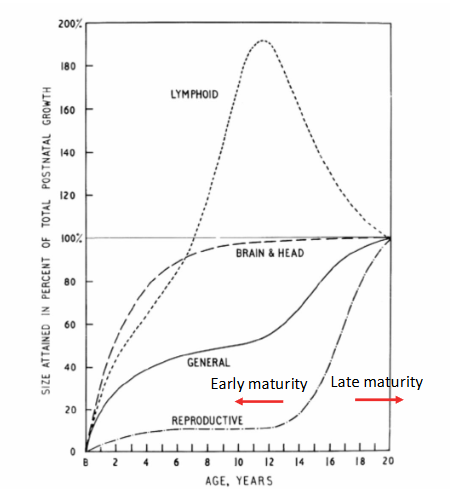
the Scammon’s curves of systemic growth only represents ______ of height by the general curve, not the correct _________.
shape
numbers
How does maturation influence the growth curve?
timing of change
rate of change
but not the FINAL ADULT OUTCOME
Human growth is different than animal growth because…
humans have extended childhood growth
What are the human growth features?
the longest growing primates
delayed somatic growth, not brain growth
long period of infant dependency
extended childhood growth period
resurgence of rapid growth at adolescence
followed by sexual and physical maturity
What is the most distinct aspect of human growth vs non human primates?
the delayed timing and rapid tempo of the human growth spurt
What are the advantages of human growth traits?
extended period for brain development
time for acquisition of survival skills, socialization, play, developing sociocultural skills
GMD are all influenced by:
Genetics: sets limits
Environment: sets likelihood of attaining potential (adult height)
Maturity: rarely influences final growth outcomes, but determines when you arrive (the age at which you achieve final height)
 Note
Note  Flashcards (24)