T1: Learning & Cognition
 Call Kai
 Learn
Learn Practice Test
 Spaced Repetition
 Match
Match Flashcards
 Knowt Play
1/116

There's no tags or description
Looks like no tags are added yet.
Name | Mastery | Learn | Test | Matching | Spaced | Call with Kai |
|---|
No analytics yet
Send a link to your students to track their progress
117 Terms
Cognition
Cognition encompasses the activities (smth you do) of “the mind” (mental rep.)
Involves the acquisition and use of knowledge (informed by sensing and ‘feeling”).
Mental processes that cognition includes
perception, attention, memory, decision-making, reasoning, problem-solving, imagining, planning and executing actions
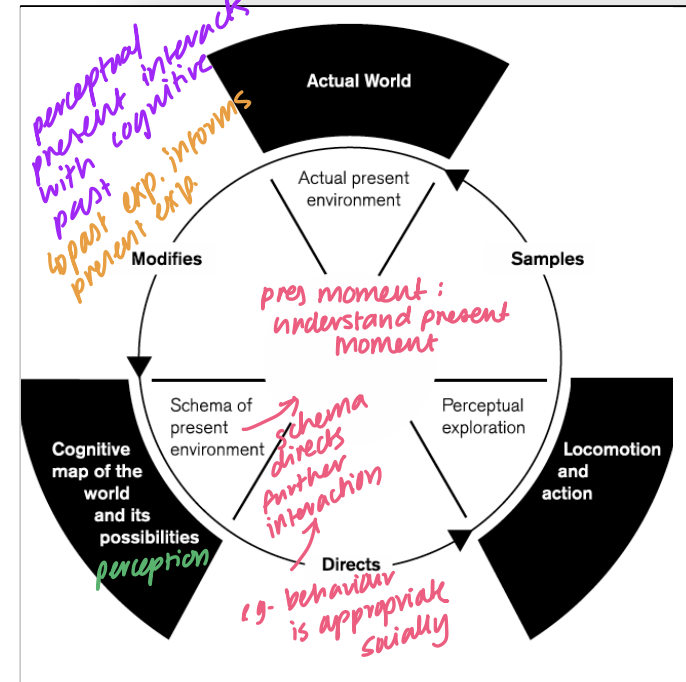
The Perceptual-Cognitive Cycle
In any given moment, our current experience is a product of integrating the perceptual present and the cognitive past...
Anactive,embodied,emotionalagent embedded in the physical and socio-cultural world
Talk through The Perceptual-Cognitive Cycle
Cognitive agent
“mentally represent” their world
eg. A cognitive agent can represent to itself a goal like obtaining an object from a location that is not in its immediate environment.
eg. Ollie salivates to the sound of his treats being opened.....
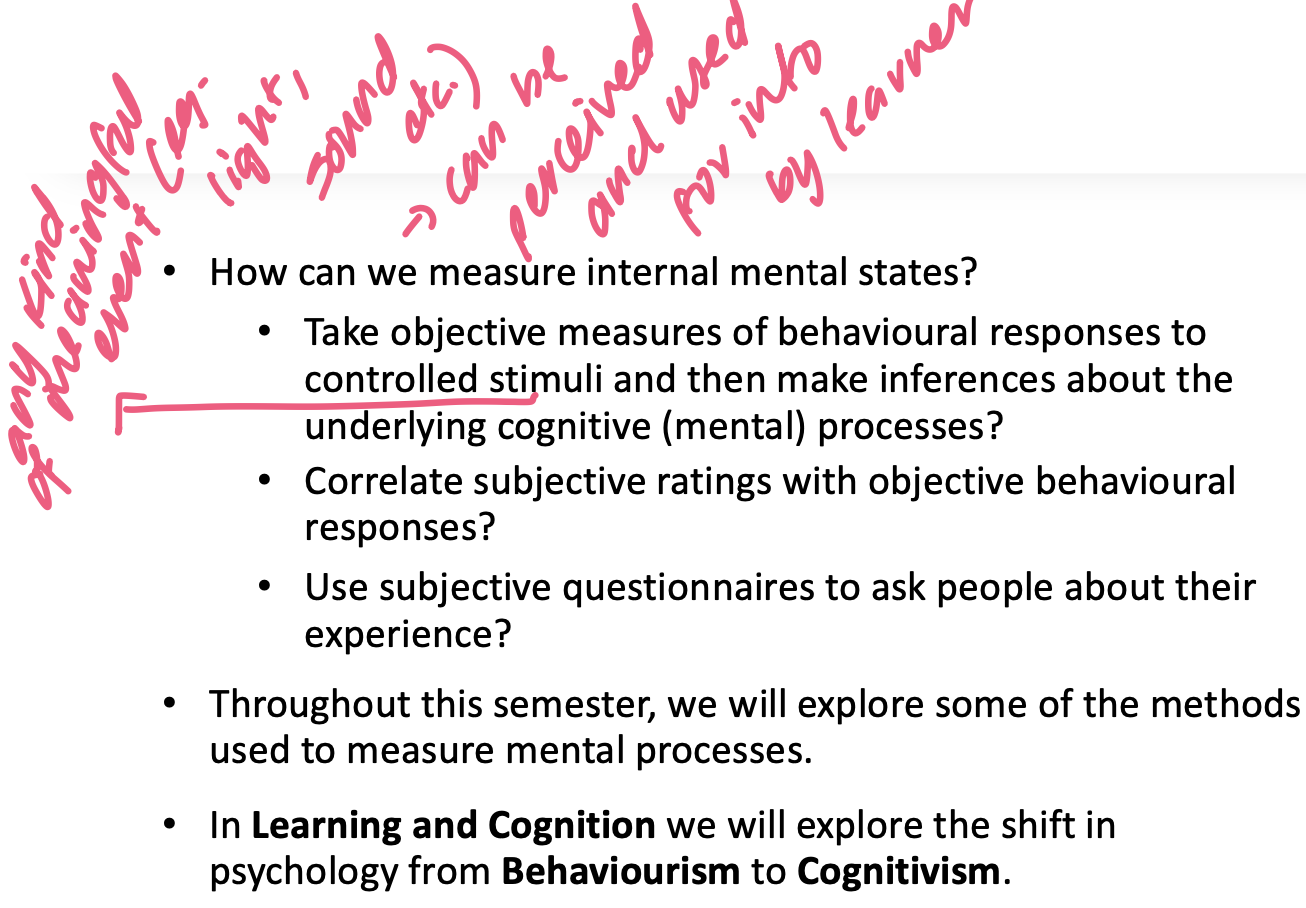
Measuring the mind
Learning
Learning is the set of biological, cognitive and social processes through which organisms make meaning from their experiences, producing long-lasting changes in their behaviour, abilities, and knowledge.
Learning helps us to recognise important things from past experiences and predict the future. (IMPORTANT)
Foundations of learning
Two fundamental forms of non-associative learning are shared by all species: sensitisation and habituation
Sensitisation
A temporary state of heightened attention and responsivity that accompanies sudden and surprising events. The learner remains alert to potentially threatening stimuli and has an increased response to subsequent stimuli.
Habituation
The gradual diminishing of attention and responsivity that occurs when a stimulus persists without being associated with threatening or rewarding consequences (i.e., it is safe to ignore and to fade into the background noise).
Significance of associations in conditioning
It is important to learn associations between stimuli that reliably predict biologically significant events, and to learn to respond adaptively.
Biologically significant stimuli that relate to survival
Stimuli that naturally cause either defensive (fight, flight, freeze) or appetitive (approach) reflex responses.
Stimuli that are inherently punishing (aversive) or rewarding (appetitive)
The effects of such stimuli on our physiology is not learned
called UCS in classical conditioning: naturally produces autonomic (invol.) response
Conditioning as associative learning
learning associations (relationships) between stimuli, and/or between stimuli and behavioural responses.
Classical conditioning
Learning a predictive relationship between an originally neutral event and a biologically significant event that itself naturally causes an autonomic reflex response, so that the previously neutral event becomes a meaningful stimulus that can then produce the autonomic reflex response on its own
Classical conditioning with key words
Learning a predictive relationship between a neutral stimulus and an unconditioned stimulus and its unconditioned response, so that the neutral stimulus becomes a conditioned stimulus that can cause a conditioned response on its own.
Before conditioning
The neutrality of stimuli that have not yet been associated with appetitive or aversive stimuli.
The innate reflex responses of the learner that occurs to stimuli that are naturally rewarding (appetitive) or punishing (aversive or threatening)
During conditioning
Experiencing a predictive relationship (association) between a neutral stimulus and a biologically relevant stimulus.
After conditioning
The previously neutral stimulus can now produce a learned reflex response in preparation for (or expectancy of) a biologically relevant stimulus.
Pavlov Eg
Before:
NS - bell
UCS - food
UCR - salivation
During:
Bell is repeatedly presented immediately before the food which evokes salivation (UCR). Then again after delay (eg. day, week etc)
After:
CS, the bell, evokes the CR, salivation, on its own in absence of UCS
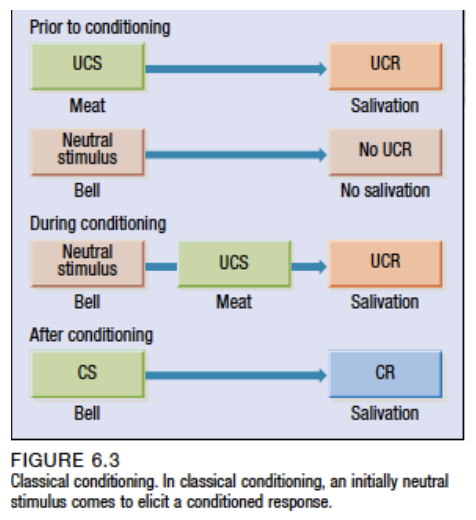
Classical conditioning has occurred when:
The reflex salivation response occurs when presented on its own in response to the formerly neutral stimulus
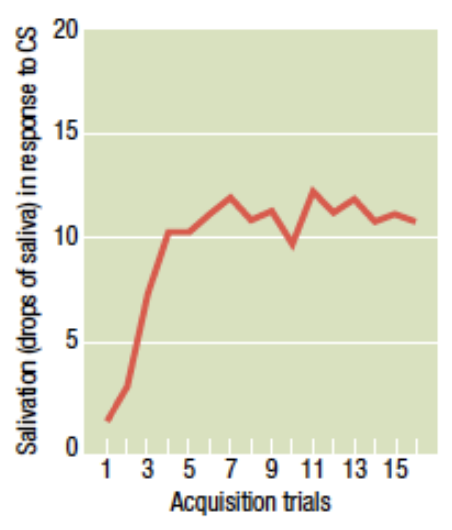
CCR acquisition
Stimulus generalisation
classically conditioned response would generalise (transfer) to other similar stimuli
eg. all bell sounds
occurs naturally
Stimulus discrimination
must be trained to only exhibit CR to specific CS
Extinction
Extinguish the classically conditioned response by presenting CS without UCS repeatedly over time
Spontaneous recovery
If you rest Ollie after a series of extinction trials and then present the bell again, the conditioned response will return.
Extinction spaced over multiple sessions will gradually prevent spontaneous recovery (at least in contexts similar to the extinction context).
Rapid reacquisition
Ollie would re-learn the conditioned salivation response more quickly than he did the first time.
Watson’s belief
Behaviourism: believing that environmental conditions are everything
Little Albert Watson & Raynor
Alfred was not afraid of stimuli but showed startle response + distress to metal bar strike sound
UCS-UCR was the sound and fear response
Albertwasexposedtotwoinstancesoftherat followed by the loud sound in an initial session, and another five instances a week later.
• Thiswassufficienttoproduceanextreme conditioned fear response to the white rat alone
• Generalisation also occurred to other furry animals, and Santa’s white beard.
• They did not get a chance to extinguish the response.
Operant conditioning
Behaviour is shaped by the learner’s history of experiencing rewards and punishments for their actions.
According to Skinner – our behaviours are shaped by our history of experiencing rewards and punishments as consequences.
The Skinner Box
Pressing the lever was the target behaviour, which could be
strengthened through reinforcement and weakened through punishment.
a controlled environment in which to study the behavior and learning of laboratory animals
For example, the rat might receive a food pellet each time it presses the lever. In this case, we would say that the lever-pressing has been positively reinforced by receiving a rewarding consequence.
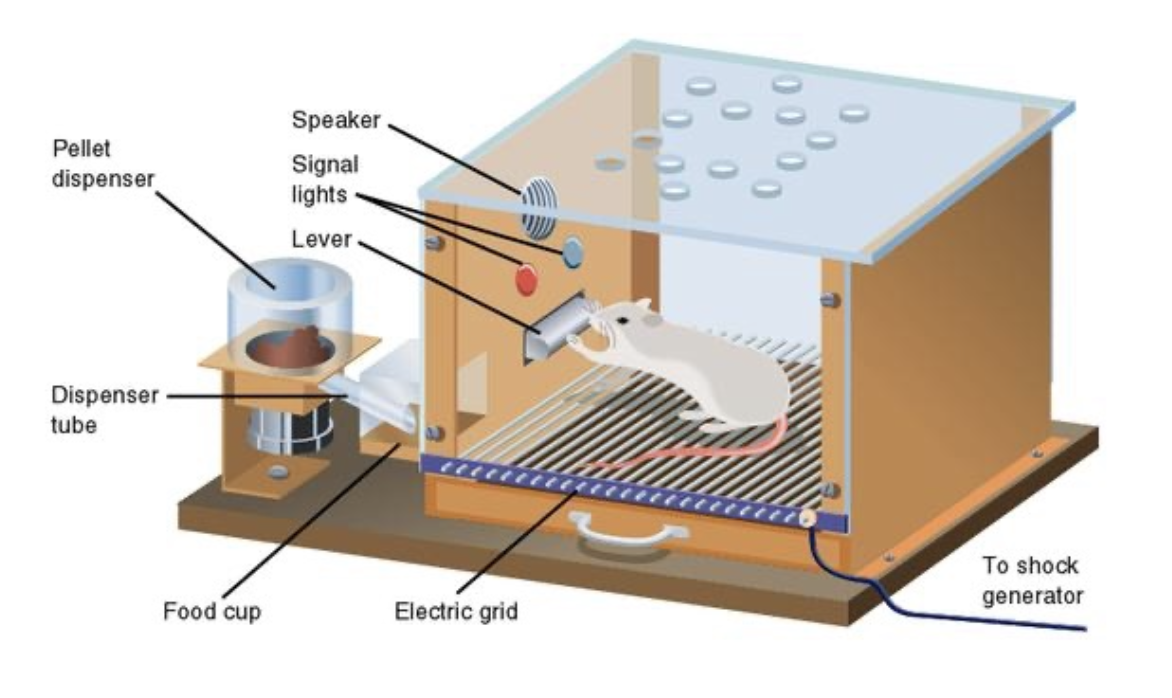
Reinforcement
A behaviour is reinforced (strengthened) whenever a desirable outcome is the consequence.
Behaviours that are reinforced are more likely to be repeated.
A reinforcer is any consequence of a behaviour that makes that behaviour more likely to recur in future.
Reinforcers can be either positive (+) or negative (-).
Positive reinforcement
An animal will learn to reproduce a behaviour if the consequence is receiving something pleasant.
Positive reinforcer is something pleasant that is added to increase behaviour
Negative reinforcement
An animal will learn to reproduce a behavior if the consequence is that something unpleasant will stop.
Negative reinforcer something unpleasant that is removed to increase behaviour
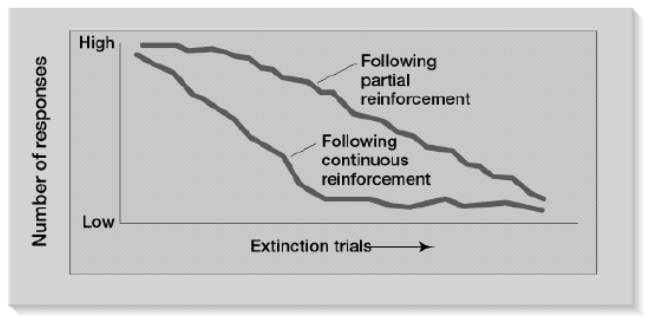
Continuous reinforcement vs partial
Continuous reinforcement rarely occurs in natural environments
Behaviour is usually reinforced on a partial “schedule”.
Partial reinforcement
Partial reinforcement leads to more persistent learning because the learner becomes accustomed to reinforcement occurring on some occasions and not others.
Continuous reinforcement
Continuous reinforcement leads to rapid extinction once the reinforcer is withheld.
Extinction of reinforced behaviour
Extinction of an operantly conditioned behaviour occurs when reinforcement is withheld.
Not immediate - sometimes there is a brief increase in responding referred to as an extinction burst followed by decrease in trained behaviour.
The figure shows that responses that have been reinforced on a partial schedule will be slower to extinguish than those reinforced continuously
Shaping
Shaping reinforces successive approximations to the desired behaviour (reinforcing small steps).
Start by reinforcing a high frequency component of the desired response.
Then drop this reinforcement – behaviour becomes more variable again.
Await a response that is still closer to the desired response – then reintroduce the reinforcer.
Keep cycling through as closer and closer approximations to the desired behaviour are achieved.
Enables the moulding of a response that is not normally part of an animal’s repertoire.
for more complex behaviours
Punishment
A behaviour is punished (weakened) whenever the learner experiences an undesirable consequence for that behaviour.
Behaviours that are followed by punishment are less likely to be repeated.
A punisher is any consequence of a behaviour that makes that behaviour less likely to recur in future
Punishers can also be either positive (+) or negative (-).
Positive punishment
An animal will stop producing a behaviour if the consequence is the presentation of an unpleasant stimulus.
Positive punisher
• An unpleasant stimulus that weakens behaviour when added as consequence of the behaviour
Negative punishment
An animal will stop producing a behaviour if the consequence is that something desirable is taken away.
• Negative punisher
• A pleasant stimulus that weakens behaviour when removed as a consequence of the behaviour
When is punishment effective
Contingency – the relationship between the behaviour and the punisher must be clear
Contiguity – the punisher must follow the behaviour swiftly (occur close tgt in time)
Consistency – the punisher needs to occur for every occurrence of the behaviour (not sustainable)
Drawbacks of punishment
Positive punishment rarely works for long-term behaviour change.
It tends to only suppress behaviour.
It does not teach a more desirable behaviour.
• Produces negative feelings in the learner, which do not promote new learning.
• Harsh punishment may teach the learner to use such behaviour towards others (social learning).
If the threat of punishment is removed, the behaviour returns. Why?
Reinforcer drives behaviour so if punishment is partial , then partial reinforcement can occur and competes so behaviour is maintained
eg. crossing red light
More effective alternatives to punishment
Stop reinforcing the problem behaviour (extinction).
Reinforce an alternative behaviour that is both constructive and incompatible with the undesirable behaviour.
Reinforce the non-occurrence of the undesirable behaviour.
Generate your own examples for each of these.
Controlling and predicting ‘voluntary’ behaviour
Learners pay attention to the stimuli that predict when rewards and punishments will occur signal likelihood of rewards/ punishment
They learn to recognise the antecedents’ (pre cursors or cues) to reward or punishment
They learn that the rewarding or punishing outcome is contingent on (depends on) producing a particular behaviour.
This can be leveraged to control when a learner will produce a behaviour.
For example, if a green light reliably signals the availability of reward, there is no point pressing the lever if the green light has not been illuminated. (assoc. bw GL (antecendent) and lever (CC))
The relationship between the green light and it’s associated reward is classically conditioned.
The relationship between pressing the lever and receiving the food is operantly conditioned.
ABC model
“ABC model” of operant conditioning
• Antecedent →Behaviour →Consequence
Antecedent
a formerly neutral stimulus that becomes a conditioned stimulus through its association with the rewarding consequences.
Behaviour
operantly conditioned through the consequence
Discriminant stimuli
An antecedent becomes a discriminative stimulus when it signals which of two or more behaviours is appropriate in a particular context.
eg. in a Skinner Box, a green light may signal food availability whereas a red light may signal foot-shock.
Learning the relationship between the discriminant stimuli and the unconditioned stimuli is based on a classically conditioned CS-UCS association.
Producing the correct behaviour in response to the correct stimulus context is operantly conditioned through reward (positive reinforcement), shaping and extinction of incorrect responses.
Latent learning
Tolman challenged the traditional behaviourist account with another classic experiment in which he demonstrated that learning could occur in the absence of rewards and punishments.
Cognitive map
mental representation of the spatial characteristics of a familiar environment.
Results of Tolman experiment
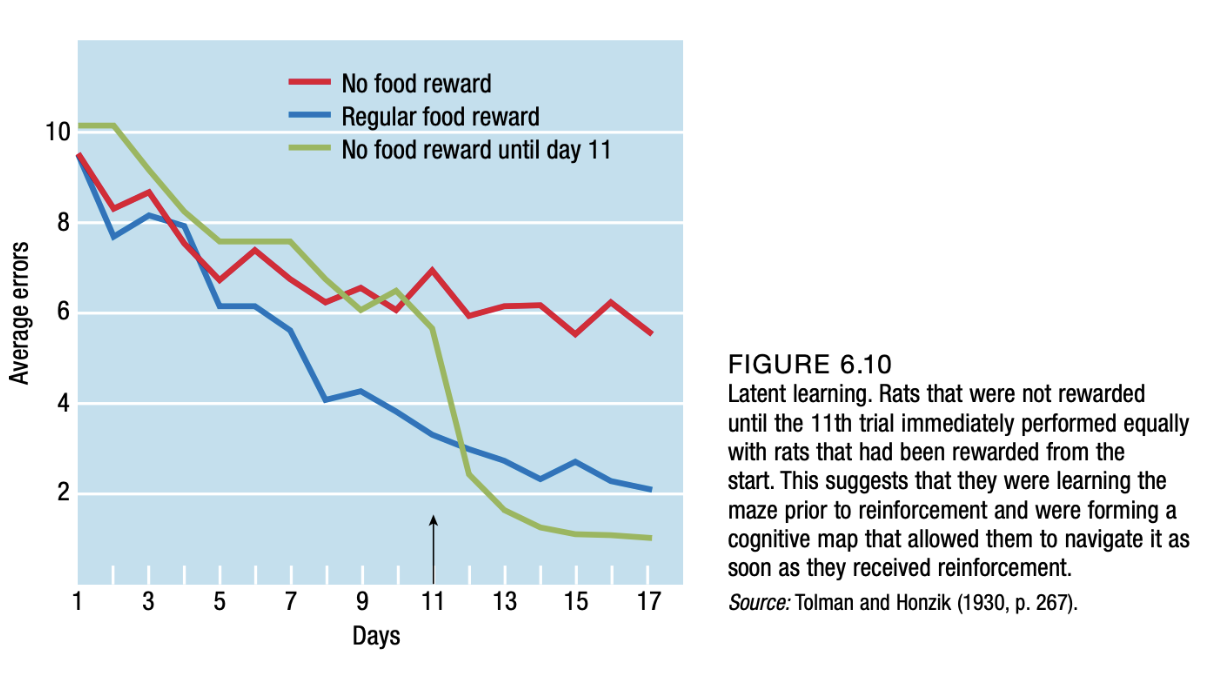
Linking tolman experiment to latent learning
• Latent learning means“hidden”learning
• The Group C (greenline) rats’ learning was not observable (latent) until the gaol was provided.
• Rewards affect whether the learned behaviour will be demonstrated, not whether learning has occurred.
• Learning can occur in the absence of directly experienced rewards and punishments.
Observational learning
is another example of how learning can occur without direct experience of reinforcement or punishment.
Learning takes place “socially” and “ vicariously” through observing others (“models”).
Albert Bandura is the psychologist most associated with the study of observational learning.
Observational learning takes place through active judgement and constructive processes – that is, it involves cognitive processes of mental representation.
Bobo doll
Three groups of 4-year-old children watch the same film of an adult behaving aggressively towards a ‘bobo doll’.
Groups differ only in the final scene of the film:
1. Observe adult positively reinforced
2. Observe adult punished
3. Observe no consequencesChildren then play in a room of toys, including a Bobo doll.
Observed through a one-way mirror
Record how many of the aggressive behaviours are reproduced by each child.
Then given a reward to show the experimenter the behaviours they had seen in the film.
Film of adult “modelling” aggression
The model walked up to an adult-size Bobo doll and ordered him to “clear the way”.
After glaring at the doll, the model exhibited four novel aggressive responses, each accompanied by a distinctive verbalisation:
The model laid the Bobo doll on its side, sat on it, and punched it in the nose while remarking, "Pow, right in the nose, boom, boom."
The model then raised the doll and pommelled it on the head with a mallet. Each response was accompanied by the verbalisation, "Sockeroo ...stay down."
The model then kicked the doll about the room, and these responses were interspersed with the comment, "Fly away.”
The model threw rubber balls at the Bobo doll, each strike punctuated with "Bang."
This sequence was repeated twice.
Group 1: positive reinforcement
In the model-rewarded condition, a second adult appeared with a supply of candies and soft drinks and informed the model that he was a "strong champion" and that his superb aggressive performance clearly deserved a generous treat.
Group 2: Positive Punishment
In the model-punished condition, the reinforcing agent appeared on the scene shaking his finger menacingly and commenting reprovingly, "Hey there, you big bully. You quit picking on that clown. I won't tolerate it.
Group 3: No Consequences
Children in the no-consequences condition viewed the same film as shown to the other two groups except that no reinforcement ending was included.
After the film
After the film each child played alone in a room with several toys, including a bobo doll.
First, observed through a one-way mirror to see whether they reproduced the aggressive actions (no-incentive)
Then, asked to reproduce the actions for reward (incentive)
Results of bandura exp.
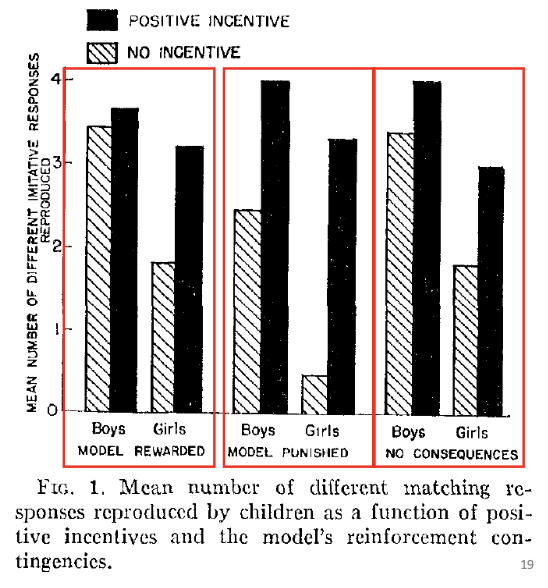
Social cognitive learning theory
Bandura’s study demonstrated vicarious reinforcement and vicarious punishment that learning can occur socially through observation, in the absence of directly experienced consequences.
Performance of aggressive acts is influenced by mental representations of observed consequences.
Knowledge remained latent in the model-punished group until a reward was introduced.
Memory
A set of storage systems and processes for encoding, storing, and retrieving information acquired through our senses and for relating this information to previously acquired knowledge and experience.
The mental representation of knowledge within memory systems stored within neural networks of the brain.
Multi store model of memory
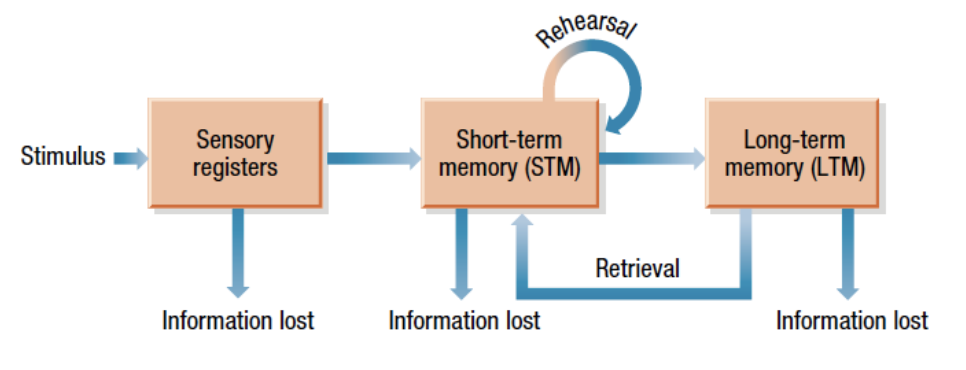
Encoding
The processes involved in attending to and acquiring information from experiences and mental processes
Attention to elements of an experience
Interpretation and integration of experience with prior knowledge
Storage
Memory traces are stored in networks of neurons throughout the brain.
For example:
neurons in the visual cortex store information about the sights that were part of an experience;
neurons in the amygdala store information about the emotions that were experienced
Different kinds of memories are stored in different networks.
Storage capacity and duration differ between the different memory systems.
Retrieval
“Remembering”, “knowing” and ”doing” personal reminiscence of past experiences
remembering facts, executing practiced, motor skills
conditioned responses
Explicit and implicit retrieval processes
Retrieval is a reconstructive and (sometimes) error-prone process.
Memory updates after retrieval through ‘reconsolidation’
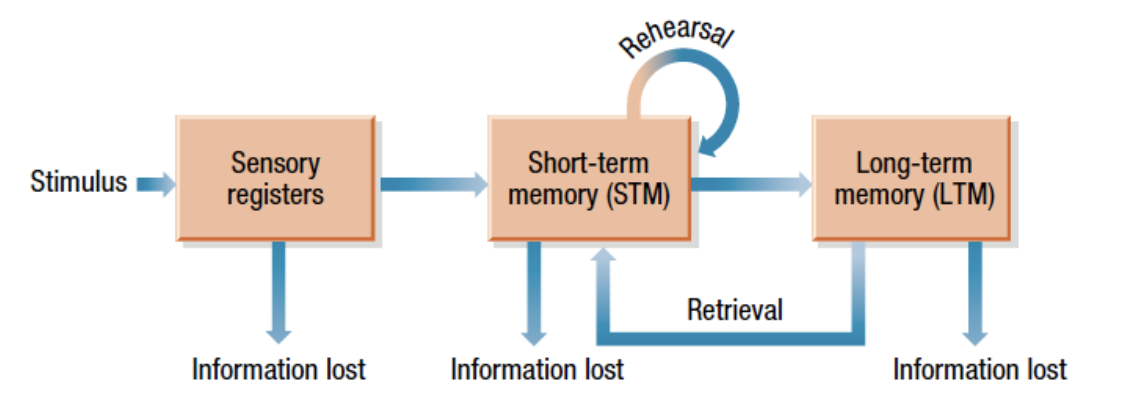
Walkthrough of multi store model
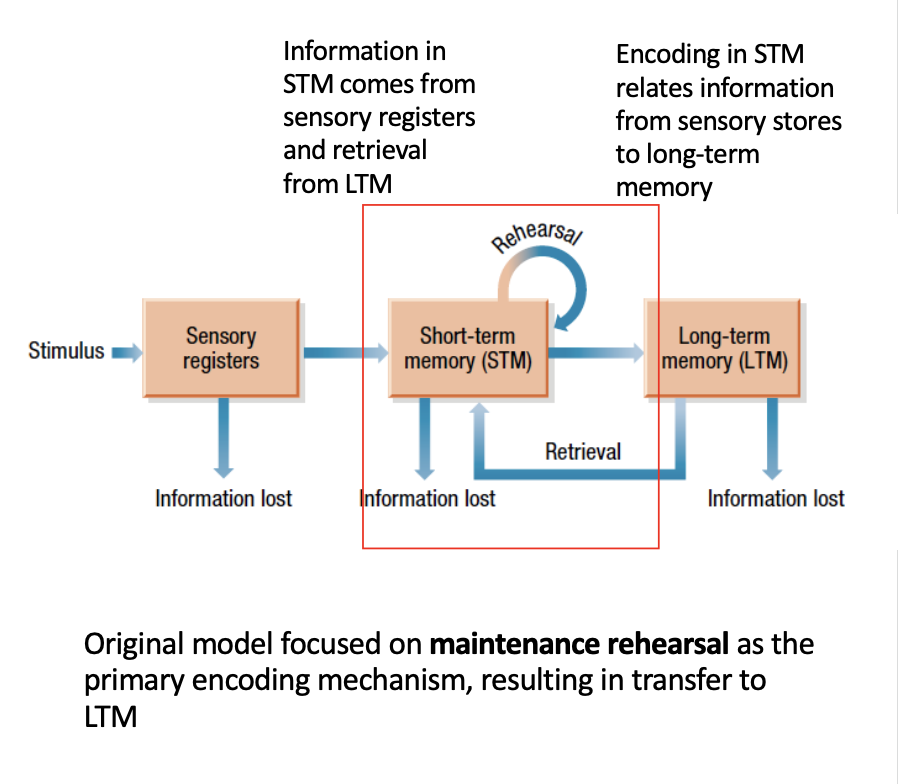
Encoding occurs when we attend to information in the sensory registers and bring it into STM for rehearsal.
Rehearsal strengthens the memory trace producing storage in LTM. Retrieval occurs when information is brought from LTM and represented in STM.
As we will discuss in our next lecture, STM is now better known as ‘working memory’.
It allows us to integrate the perceptual present (from sensory memory) with the cognitive past (from LTM) to encode new information and update LTM.
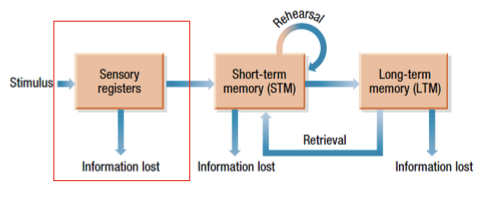
Sensory memory
• A temporary, sensory-based representation of input received through sensory channels.
• Only some of the information stored in sensory memory will be retained.
• Iconic (visual) and Echoic (auditory)memory.
Brief duration (decays quickly)\
Large capacity (relative to STM).
• So, what’s the evidence for this.....?
George sperling
• George Sperling (1960) used a series of ingenious experiments to determine the capacity and duration of iconic memory
• Full-report versus partial report methods.
How sperling’s iconic memory test works
Participants are seated at a computer display. They first see a central ‘fixation cross’ that they are to attend to. This is replaced by a randomly selected array of 12 upper- case consonant letters (to avoid potential words being spelled), presented in three rows of 4 letters.
The letter array remains on screen for a fraction of 1 second – 50 milliseconds. One 20th of a second.
When the letters disappear, participants are required to say aloud as many of the letter names that they can remember from the array.
Full report capacity measure issue
got about 4-5 typically but by the time they reported the first few, the iconic trace had faded bc duration limited
therefore capacity was being underestimated in full report
How he fixed this issue: partial report
AFTER display - participants were cued which row they had to say (1st,2nd,3rd) and they recalled almost all of these letters, this meant all letters could have been available all along
therefore, much higher capacity relative to STM
How he measured duration of iconic memory
kept the partial report method but introduced a delay between the stimulus disappearing and the cue being presented.
He then systematically varied how long that delay was.
By around 500 milliseconds, performance had dropped to roughly 1 item
half a second
STM
A temporary store in which we integrate current sensory experience with long-term memory to achieve current goals
Our conscious representation of ‘the present moment’.
Capacity of STM
7 ± 2 items
General Duration of STM
15-30 secs
Measuring verbal STM capacity (digit span task)
Immediate serial recall of verbally presented digits (i.e., number names) in the order they were presented
The length of sequence is increased by one item after
each successful attempt to determine the upper limit or “span”.
A participant’s span is reached when they fail on two trials at a given series length.
So, if you were unable to recall both trials for a series of 8 items, then your digit span would be 7 items.
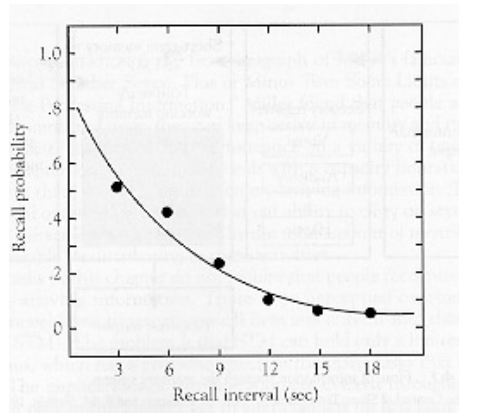
Measuring duration of STM (The Brown-Peterson task)
Recall the names of 3 consonants (e.g., “D-P-R”)
Memory probed (tested) at 3-second retention intervals.
To prevent rehearsal, participants were required to count backwards from a given number in 3’s until told to stop (eg. hear “D-P-R–306”)
Count backwards (aloud) from 306 until asked to recall the sequence of letter names.
Forgetting due to “trace decay”or interference from previous trials?
Maintenance rehearsal and transfer to LTM
• Verbal rehearsal keeps information active in STM and strengthens the trace to increase the chance it will be stored in LTM.
• Evidence?
serial recall vs free recall
serial is when it has to be repeated in the same order vs free recall is when order doesn’t matter
What effects free recall
the position of the items in the studied list
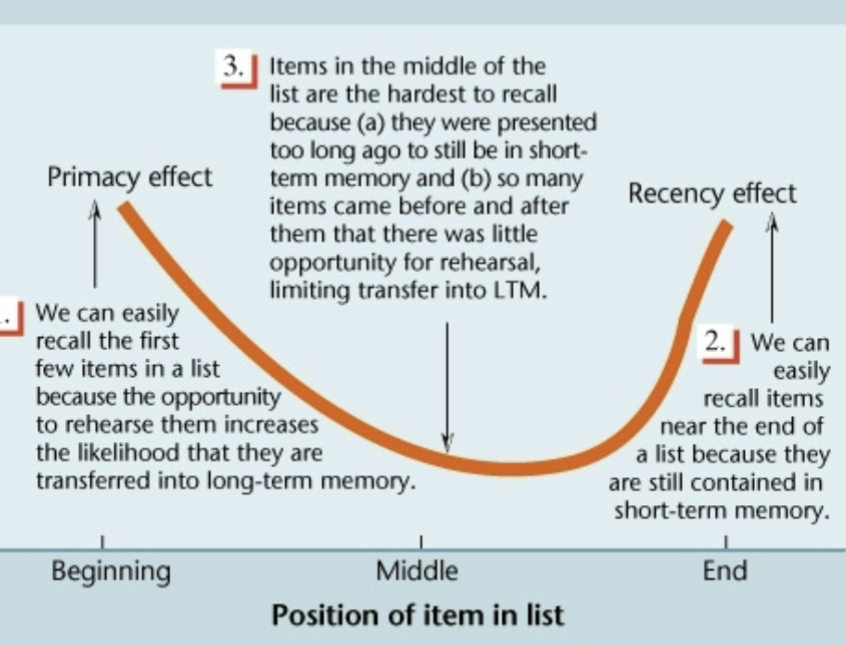
Primary effect
provides evidence for transfer to long-term memory for items that receive more rehearsal
therefore first items are easy to recall bc had the most chance to rehearse
evidence for LTM (maintenance rehearsal)
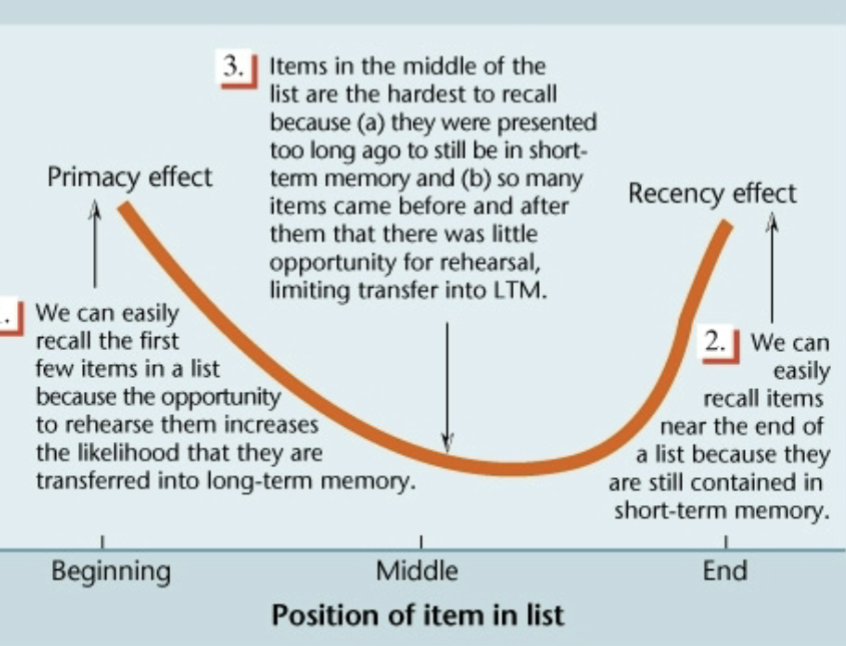
Recency effect
reflects availability of information still in short-term memory
the items at end of list are still contained in STM so easily recalled
STM evidence
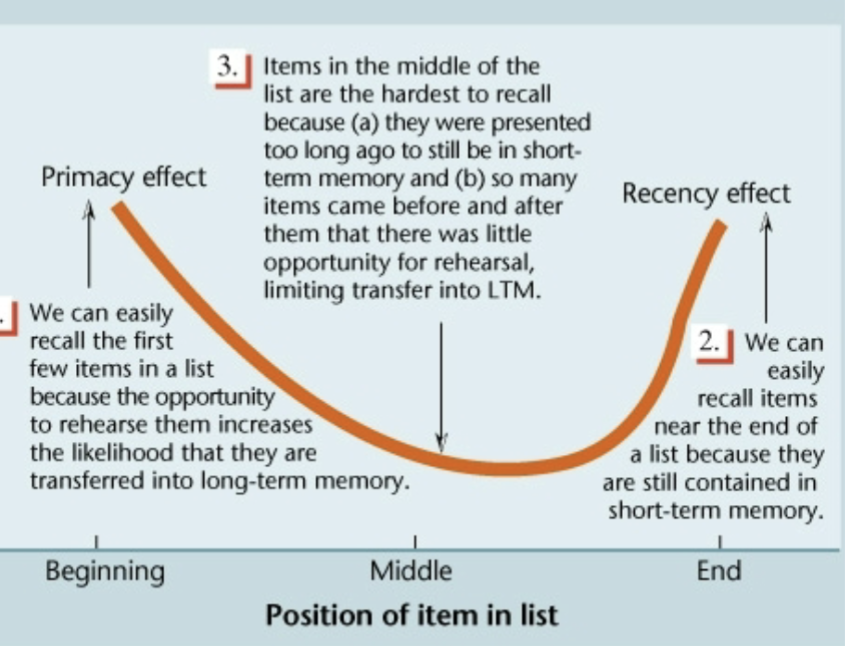
Why middle of list forgotten
too long ago to be in STM
not LTM: not enough rehearsal bc so many went before and after
STM to Working Memory transition (Craik & Tulving)
Levels of processing study was a step in transition to thinking of STM as meaningful processing
The purpose of a STM is to encode information meaningfully.
Meaningful processing of information during encoding will produce long-term memory traces
‘Shallow’ processing is less effective for long-term retention.
Craik & Tulving
deeper processing more likely to encode LTM and shifts understanding to working-memory rather than a a shallow STM system for rote rehearsal.
STM is a mental workspace
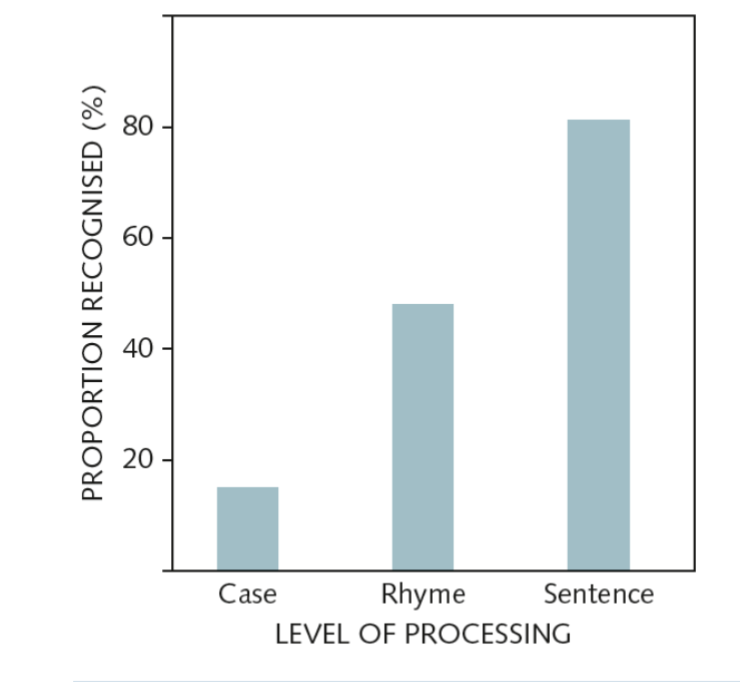
Study: you get 60 words to remember on the screen one at a time (you think its about response time to question), 20 of them ask - is the word in upper case or lower case, another q might be does this rhyme with x , next 20 would be “does this word fit in this sentence”
Each 20 words is diff depth of processing so increased depth of processing increases likelihood
Alan Baddeley working system model
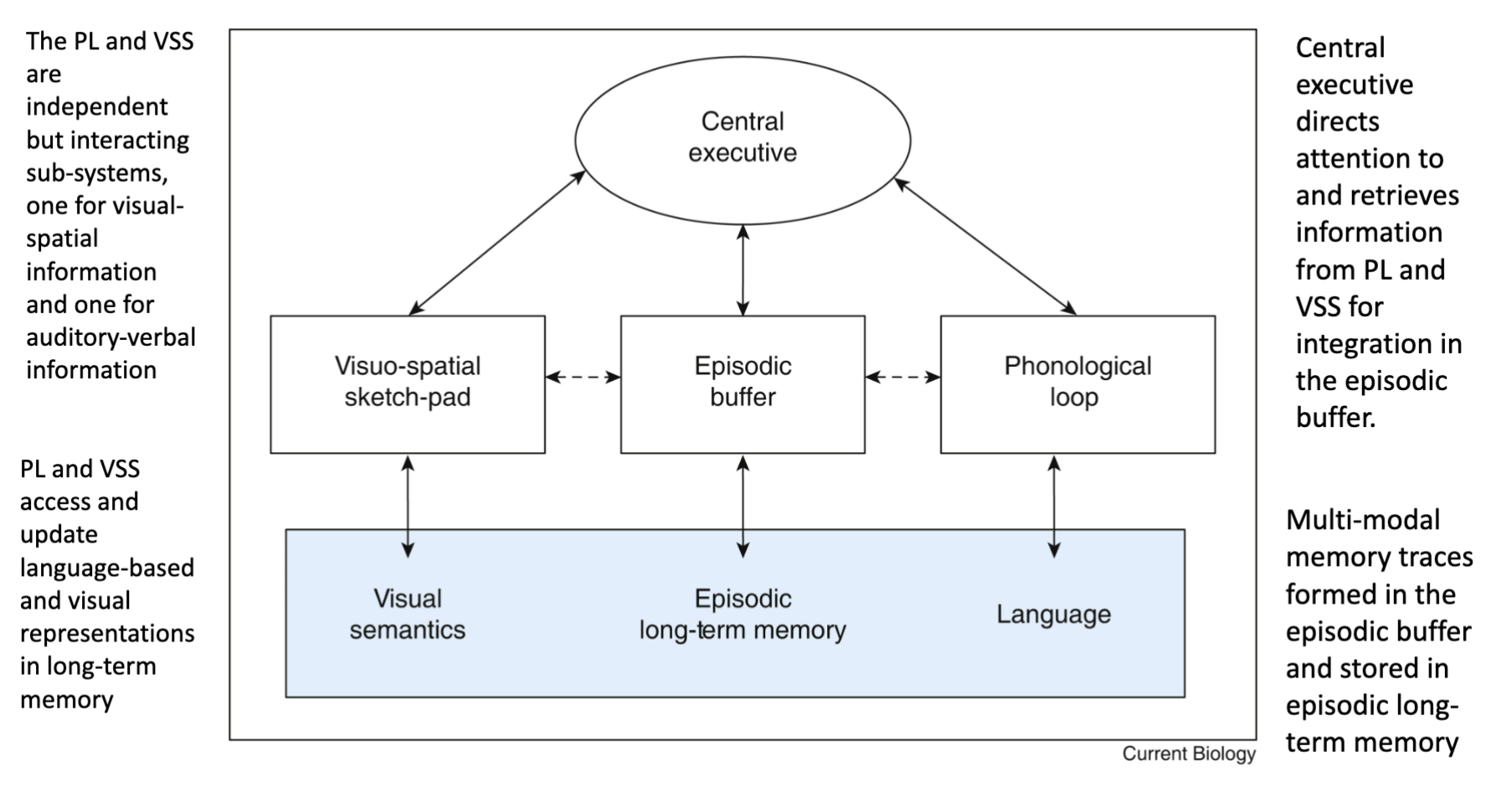
Introduced model of working memory
several components of working memory system lead to long term memory
central executive is our retentional processes that direct info to these systems
episodic buffer is basically the integration of everything into our current experience with then gets stored in LTM as episodic memory
Summary
Phonological loop plus visual-spatial sketchpad, with an integrated multi- modal representation in the episodic buffer. Attention to encoding and retrieval processes controlled by central executive.
Active workspace for reasoning and problem-solving, not mere maintenance and rehearsal of information.
The phonological loop
doing digit span backwards - this is a test of working memory system inst. of just a STM system - it’s bc we’re working with it to change it
Visuo-spatial sketchpad
A temporary store for representations of visual and spatial information such as faces, objects written words and cognitive maps
Enables the mental manipulation of visually and spatially represented information.
Mental rotation of objects
Visual and spatial mnemonics
Mental arithmetic
“Cognitive maps” for navigation
Visuo-spatial sketchpad
Tap different squares in that order that experimenter taps would be STM test but in backwards order would be working memory test
Central executive
Executive processes are used in planning and coordinating complex behaviour:
Goal orientation
Focus attention
Control of social behaviour
Switching between tasks, updating memory, inhibition of distracting information
Planning and problem solving
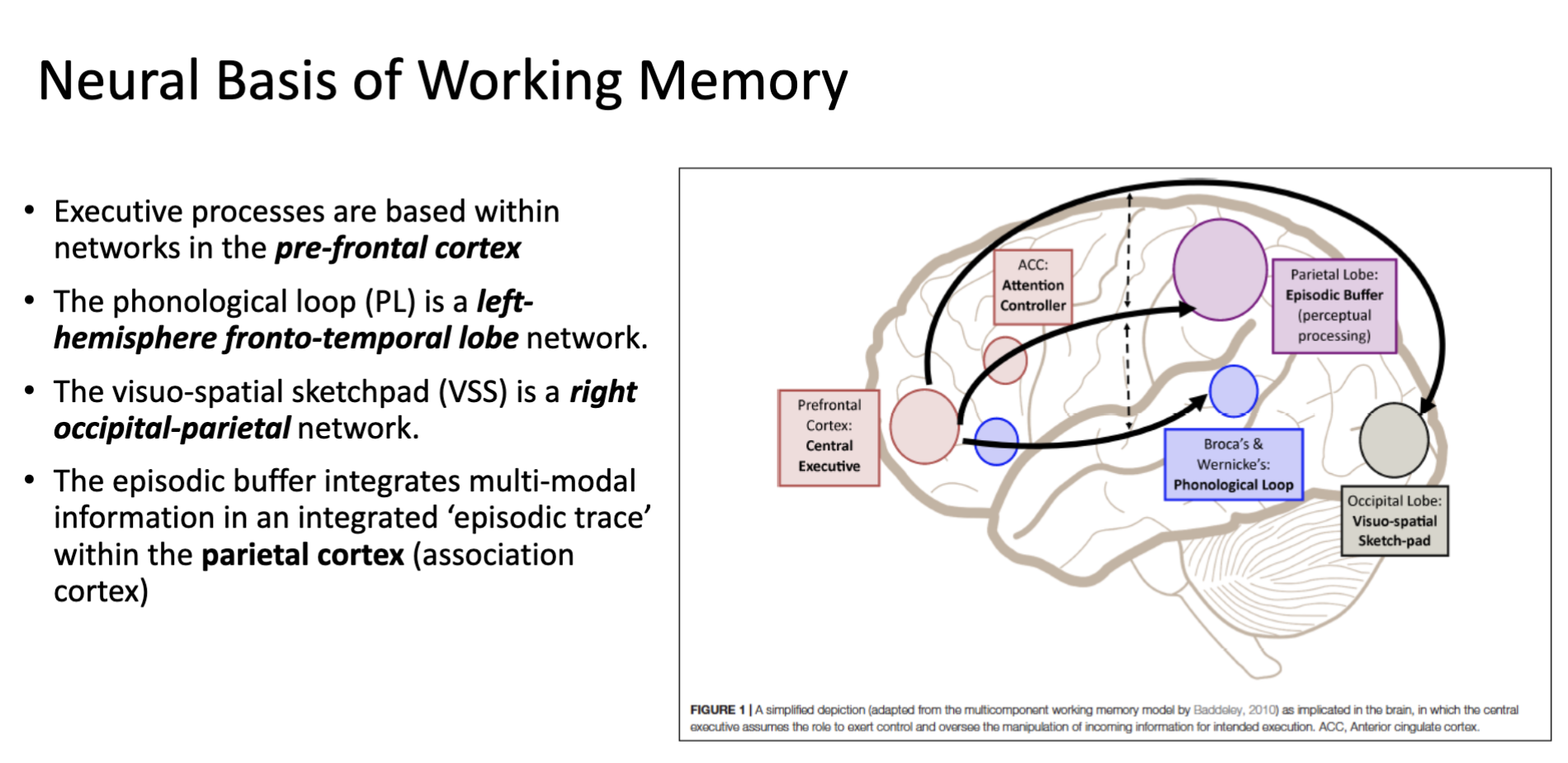
Neural basis and locations for working memory
Declarative memory (explicit)
Knowing what, why, where, and when”
Facts, events, locations, autobiographical knowledge
Reminiscence of personally experienced events
Hippocampal-dependent
Non-declarative memory (implicit)
“knowing how”
Motor skills (e.g., riding a bike)
Habits (proceduralised memories - driving the route to work without thinking)
Cognitive skills (e.g., reading)
Non - hippocampal dependent
Declarative (explicit memory) sub divisions
Endel Tulving
Episodic memory and semantic memory
Episodic memory
Vivid first-person recall of personally experienced events
When/where memories
Contextualised memory
‘Mental time travel’
Semantic memory
General knowledge of facts about the world and yourself
What/Why memories.
Abstract knowledge (includes abstract self-knowledge)
Indications of non declarative memory
when previous experience facilitates (improves) performance on a task
The improvement in performance does not require
conscious recollection of the prior learning experiences.
getting better at smth with practice + learning associations bw recurring stimuli in environment