#20 ASTR 1000 Smartwork Homework
 Call Kai
 Learn
Learn Practice Test
 Spaced Repetition
 Match
Match Flashcards
 Knowt Play
1/9

There's no tags or description
Looks like no tags are added yet.
Name | Mastery | Learn | Test | Matching | Spaced | Call with Kai |
|---|
No analytics yet
Send a link to your students to track their progress
10 Terms
Place the main-sequence lifetime of each of the following stars in order from shortest to longest.
1. Rigel: mass 24M, luminosity 85000L
2. Canopus: mass 8.5M, luminosity 13600 L
3. Achernar: mass 7M, luminosity 3150L
4. Capella Aa: mass 3M, luminosity 76L
5. Sirius A: mass 2M, luminosity 25L
6. the Sun: mass 1M, luminosity 1L
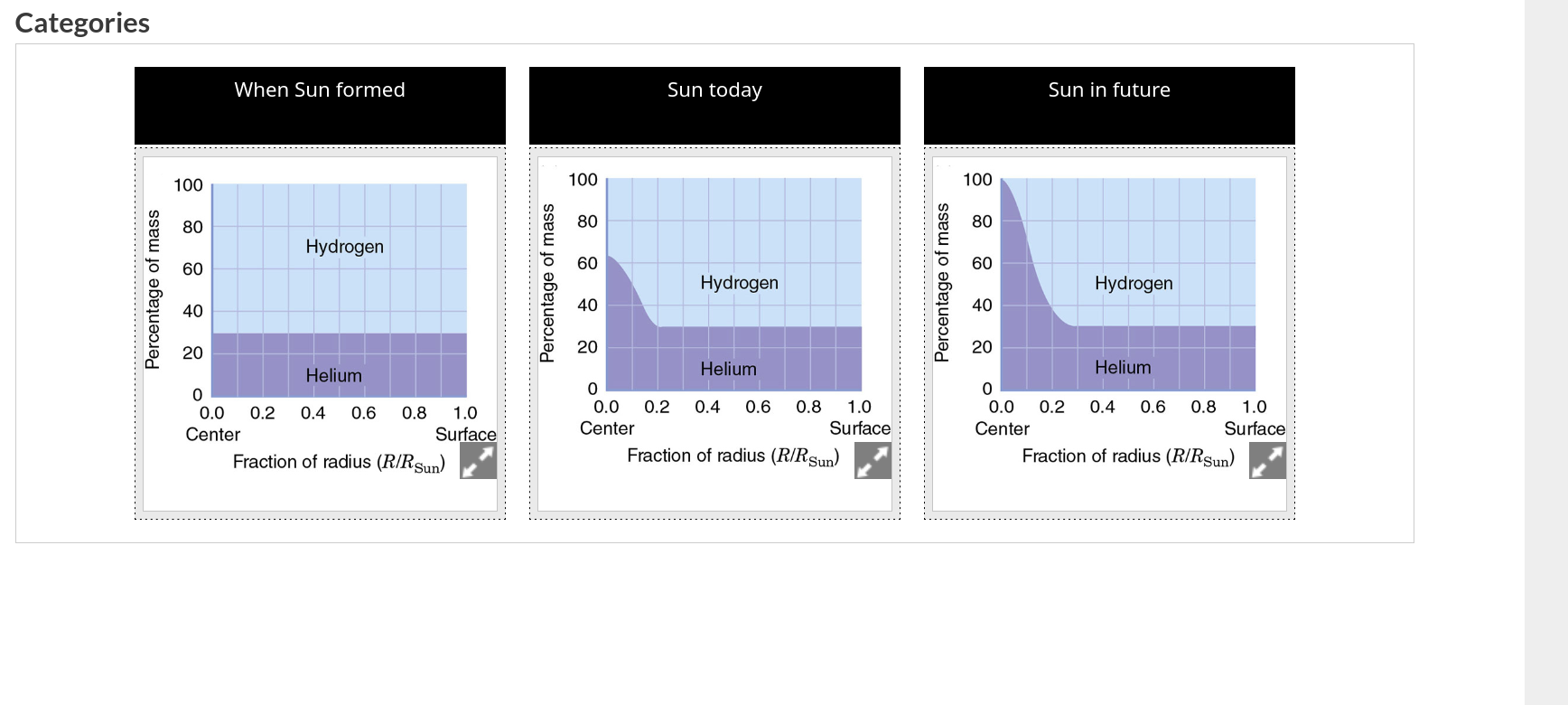
The following graphs relate the amount of hydrogen (shown as light-blue regions) and helium (shown as light-purple regions) within the Sun at three different moments in time. On each graph, the horizontal axis denotes the fraction of radius (distance from the center), and the vertical axis denotes the percentage of mass (the relative amounts of hydrogen and helium).
Match each graph to the appropriate evolutionary stage of the Sun.
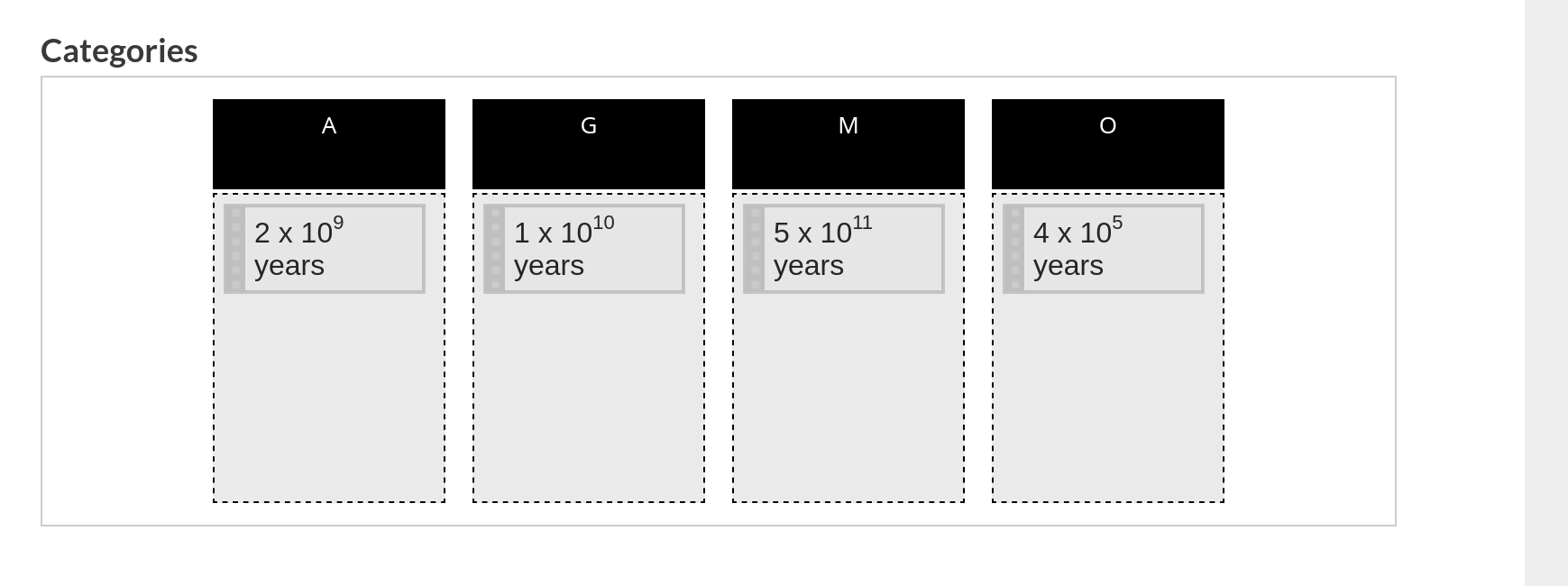
Match the spectral type of a star to its approximate main-sequence lifetime.
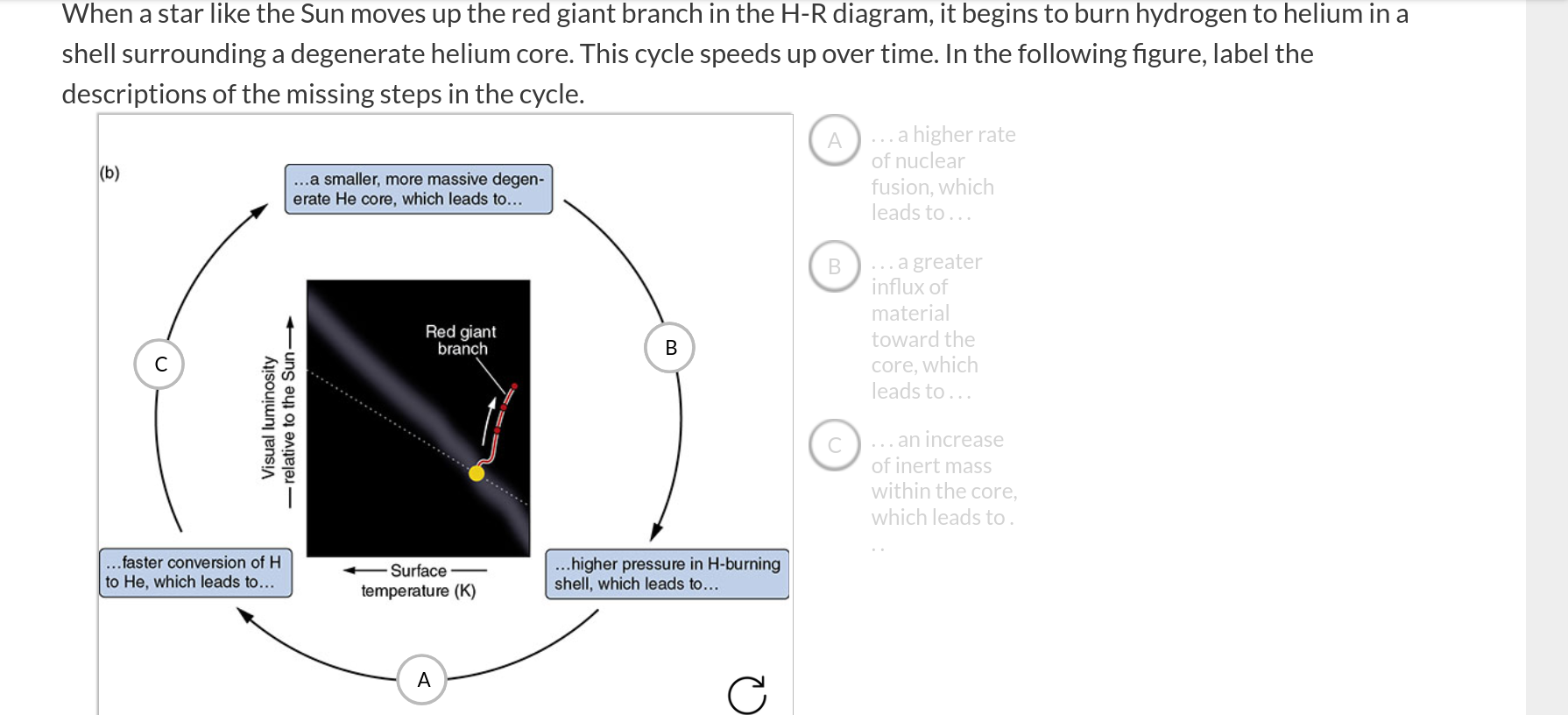
When a star like the Sun moves up the red giant branch in the H-R diagram, it begins to burn hydrogen to helium in a shell surrounding a degenerate helium core. This cycle speeds up over time. In the following figure, label the descriptions of the missing steps in the cycle.
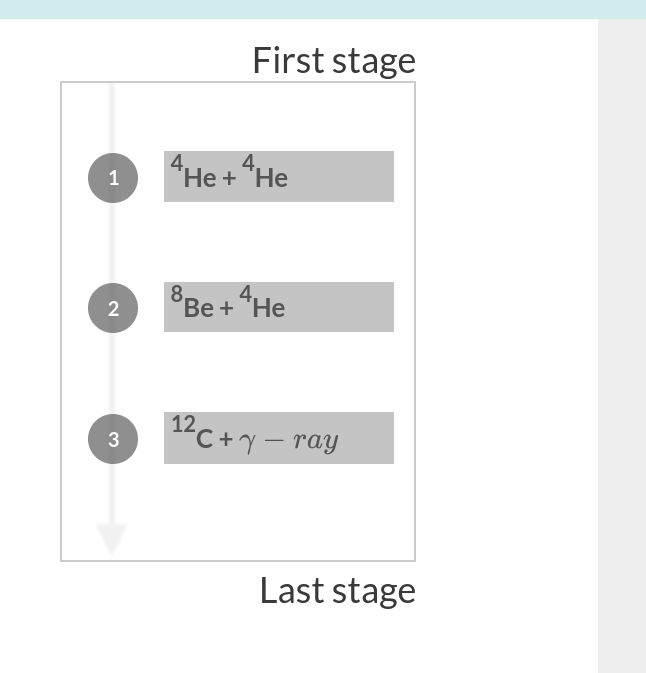
The triple-alpha process of nuclear fusion involves three elements, three nuclei of one element, and three stages. Place the steps in order from first to last.
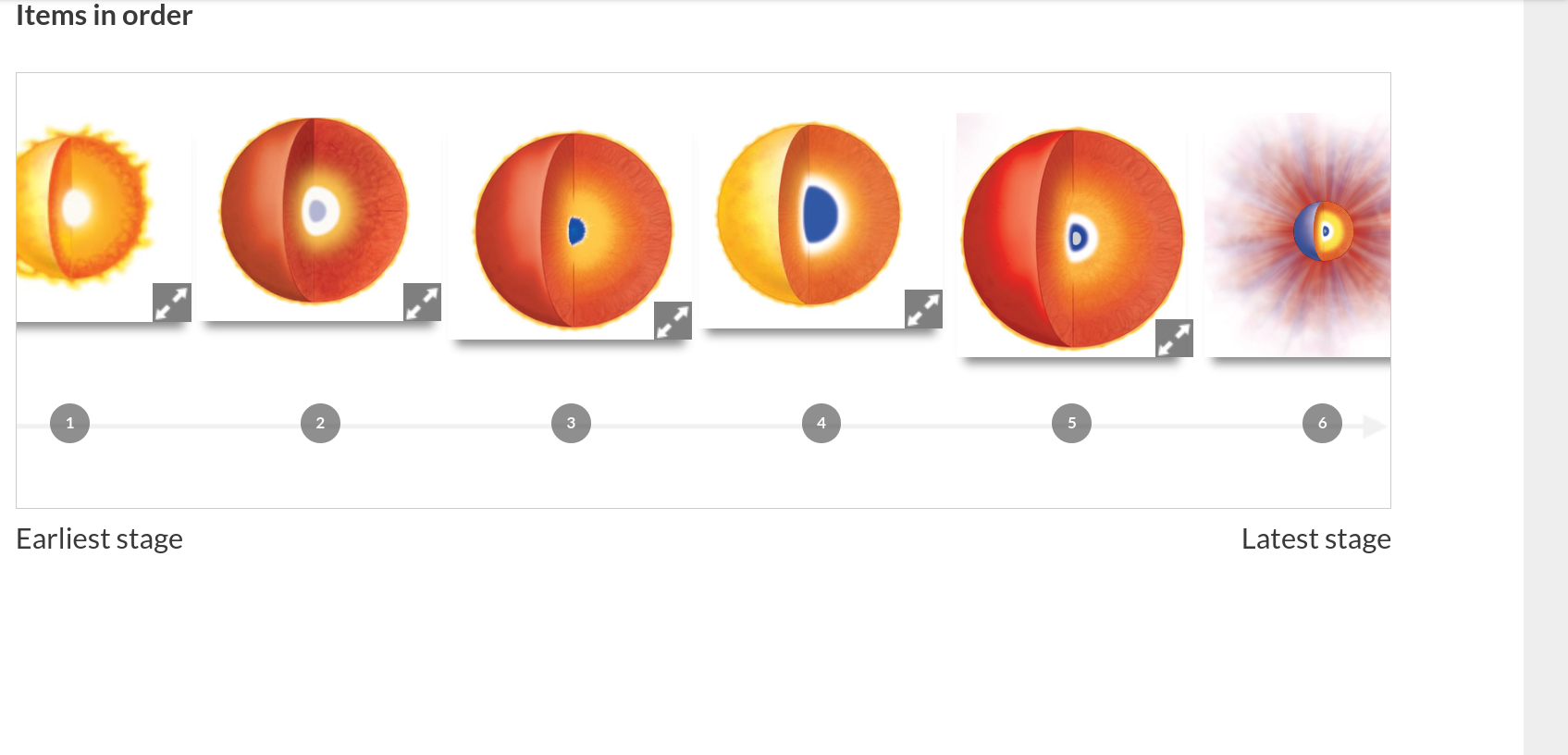
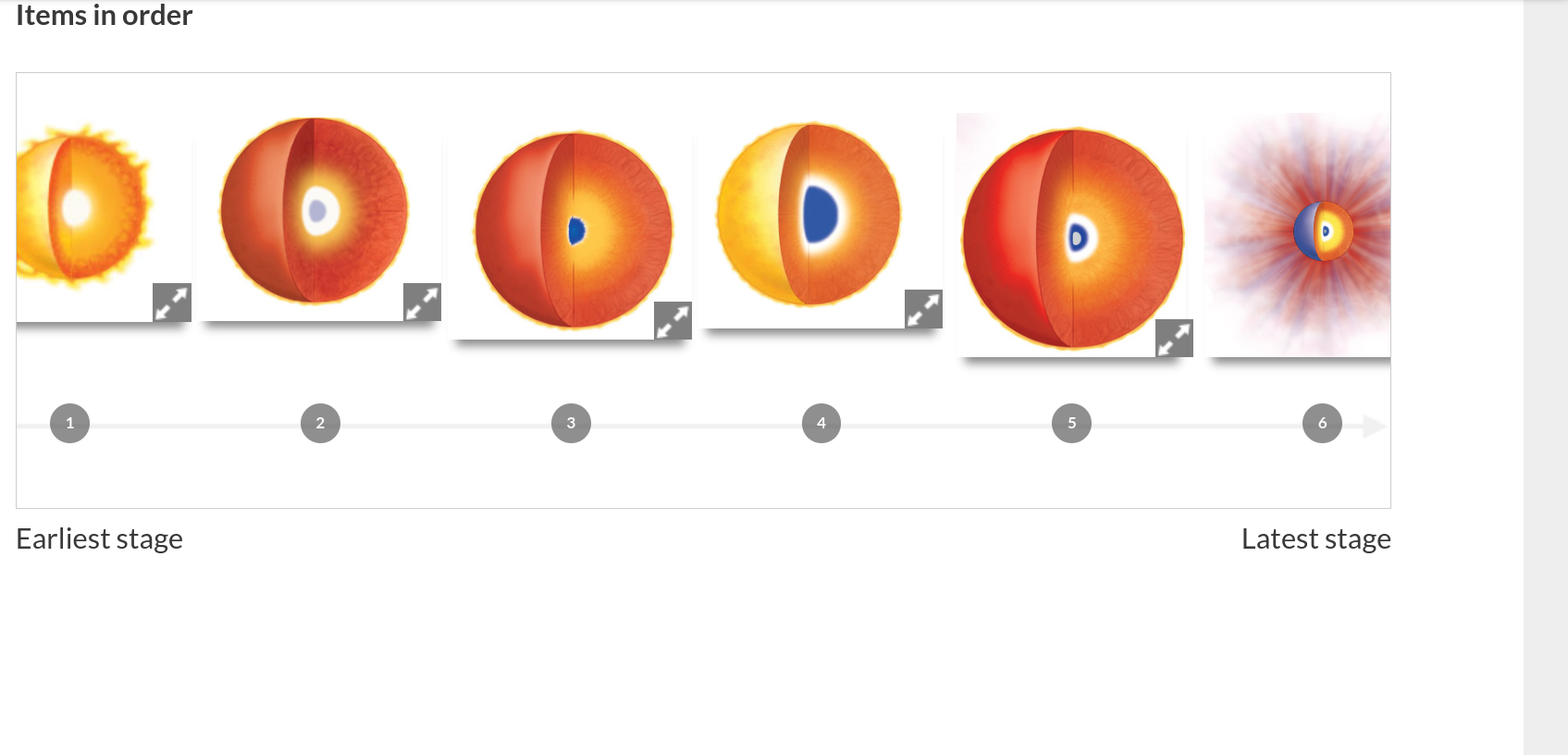
Rank the images of a star's changing interior from earliest to latest stage in its evolutionary sequence.
The following image is a cross section of a red giant star. Place each label in the correct position on the image.

The following image shows a cross section of a horizontal branch star. Place each label in the correct position on the image.
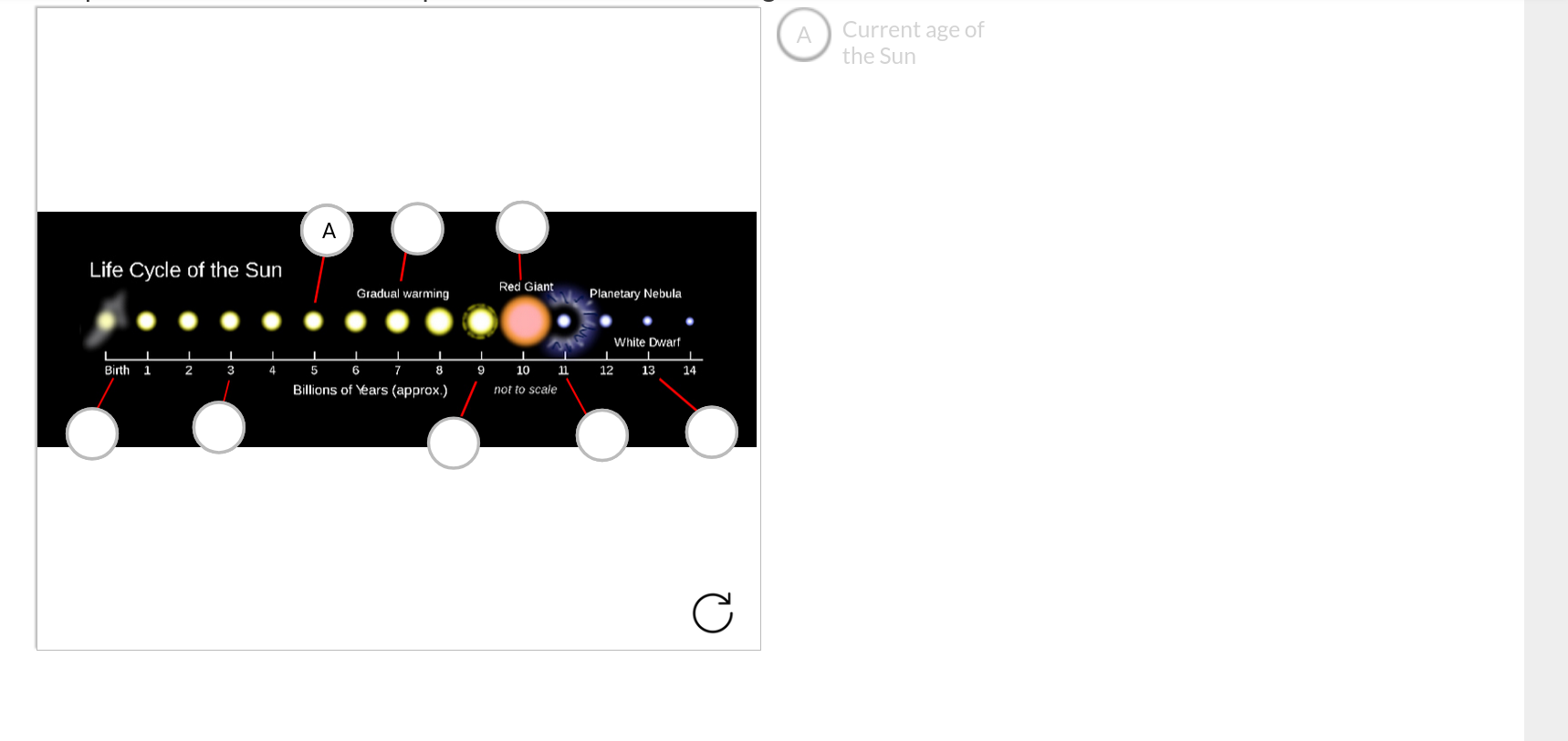
Which point on the timeline corresponds to the Sun's current age?
Sort the following characteristics of degenerate and nondegenerate gases:
Degenerate Gases
Temperature change affects only some particles
Pressure and temperature are independent
Pressure comes from density of particles
Increasing internal pressure leads to contraction
Non-Degenerate Gasses
Temperature change affects all particles
Pressure and temperature are related
Pressure comes from particle motion
Increasing internal pressure leads to expansion
Explore top notes

