Y10 Biology - Genetics and Chromosomes
 Call Kai
 Learn
Learn Practice Test
 Spaced Repetition
 Match
Match Flashcards
 Knowt Play
1/36

There's no tags or description
Looks like no tags are added yet.
Name | Mastery | Learn | Test | Matching | Spaced | Call with Kai |
|---|
No analytics yet
Send a link to your students to track their progress
37 Terms
DNA
Genetic material passed down through generations, stored in the nucleas of a cell.
How do nucleotides bond?
They use covalent bonds to bond sugar to phosphate and hydrogen bonds to bond base to base.
Female Chromosomes
two X chromosomes, one maternal one paternal
Male Chromosomes
one X chromosome (maternal) one Y chromosome (one paternal)
Number of chromosomes
46 (23 pairs), first 22 pairs are autosomal, 23rd are sexual
Genotype
An organism's genetic makeup, or allele combinations.
Phenotype
An organism's physical appearance, or visible traits.
Mitosis
cell division in order to grow or repair
Meiosis
cell division to produce gametes
Heterozygous
having two different alleles for a trait
Homozygous
two of the same alleles for a trait
Interphase
Cell grows, performs its normal functions, and prepares for division by duplicating
Prophase
The first stage of mitosis where chromatin condenses into visible chromosomes, the nuclear envelope breaks down, and spindle fibers begin to form.
Metaphase
The second stage of mitosis characterized by the alignment of chromosomes along the metaphase plate, ensuring proper separation.
Anaphase
The third stage of mitosis where sister chromatids are pulled apart to opposite poles of the cell by the spindle fibers.
Telophase
The final stage of mitosis where chromosomes de-condense back into chromatin, the nuclear envelope re-forms, and the cell prepares to divide.
Cytokinesis in Mitosis
The process that follows mitosis, where the cytoplasm divides, resulting in two separate daughter cells.
Prophase I
The first stage of meiosis where homologous chromosomes pair up and exchange genetic material through crossing over.
Metaphase I
The stage of meiosis where homologous chromosome pairs align at the metaphase plate, preparing for separation.
Anaphase I
The stage of meiosis where homologous chromosomes are pulled apart to opposite poles, reducing the chromosome number by half.
Telophase I
The stage of meiosis where the cell divides into two haploid cells, each containing half the number of chromosomes.
Cytokinesis in Meiosis I
The process following meiosis I where the cytoplasm divides, resulting in two haploid daughter cells.
Prophase II
The stage of meiosis II where the chromosomes condense again and the nuclear envelope breaks down if it had re-formed.
Metaphase II
The stage of meiosis II where chromosomes align at the metaphase plate, similar to metaphase in mitosis.
Anaphase II
The stage of meiosis II where sister chromatids are separated and pulled to opposite poles of the cell.
Telophase II
The final stage of meiosis where the nuclear envelope re-forms around each set of chromosomes, leading to four haploid cells.
Cytokinesis in Meiosis II
The process that follows meiosis II, resulting in the division of the cytoplasm and the formation of four distinct haploid cells.
Crossing Over
two chromosomes meet (at the chiasma) and exchange genetic material, known as Genetic Recombination.
Haploid cells
a cell containing only one set of chromosomes (23) - gametes
Diploid cells
a cell containing two sets of chromosomes (46) - body cells, zygotes
How does fertilisation initiate mitosis?
By two haploid cells (gametes) fusing to form a diploid cell (zygote) which undergoes mitosis (growth) forming an embryo
How does meiosis split chromosomes
into 4 non-identical daughter chromosomes
How does mitosis split chromosomes
into 2 identical daughter chromosomes
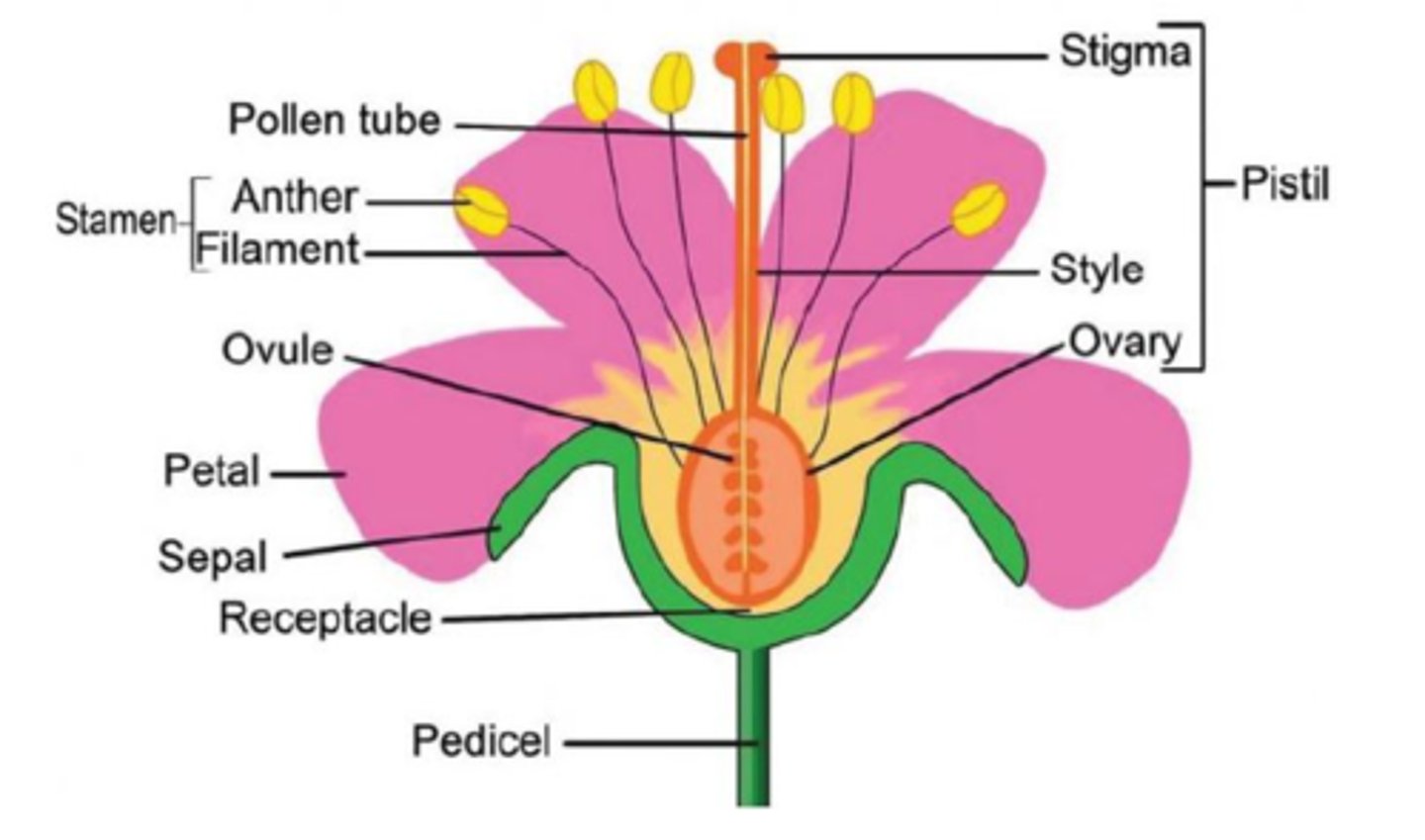
Parts of a flowering plant
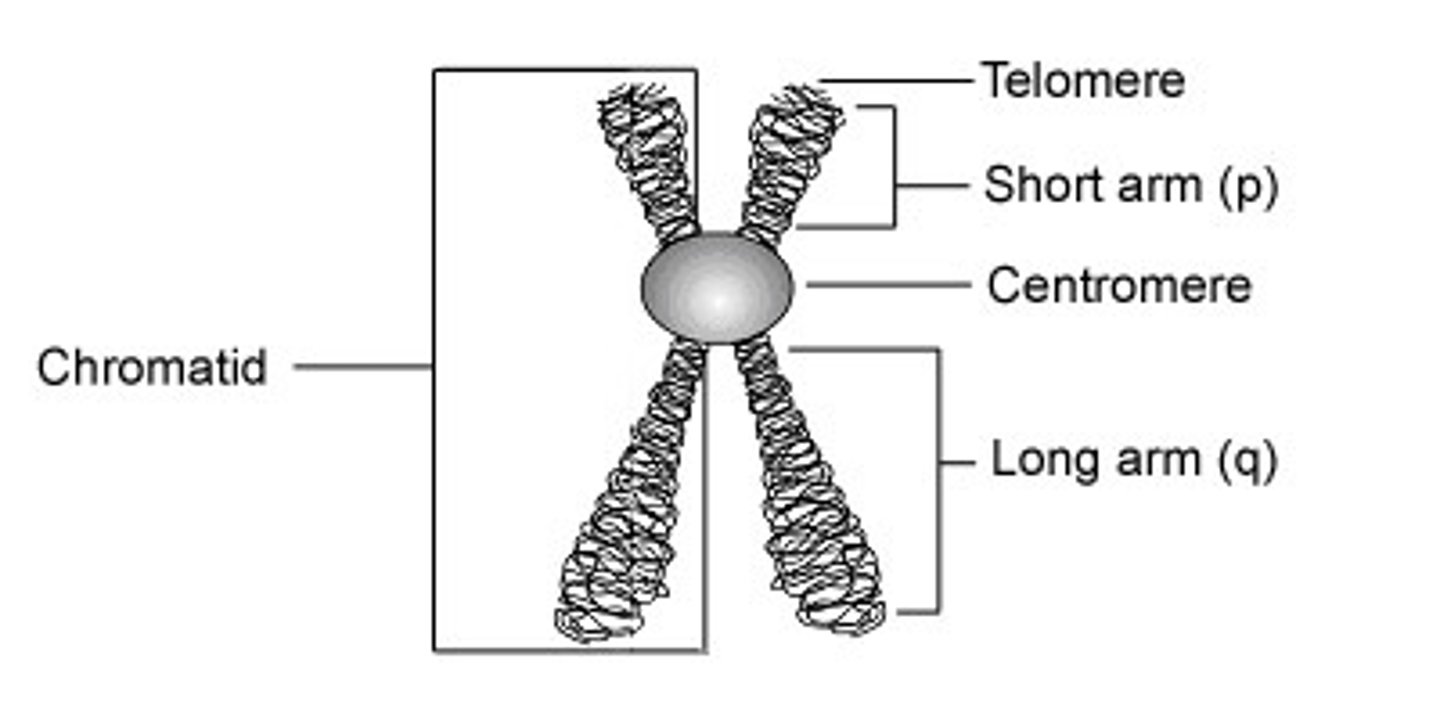
Parts of a chromosome
Parts of a cell in every cell
Cell membrane, DNA, Ribosomes
how is self-pollination different to cross-pollination
produces more genetic diversity in plant populations

