Animals Test 1
 Studied by 0 people
 Call with Kai
 Learn
Learn Practice Test
 Spaced Repetition
 Match
Match Flashcards
 Knowt Play
1/126

Earn XP
Description and Tags
BIOL2030 Test 1 Material
Name | Mastery | Learn | Test | Matching | Spaced | Call with Kai |
|---|
No study sessions yet.
127 Terms
Who is Carolus Linneaus?
developed our current scheme of classification that is based on morphology, has a hierarchal taxnomoic framework, and uses binomial nomenclature
What is phylogeny?
history of development of species or other group
What are characters?
organismal features used to construct a phylogeny (or evolutionary tree)
what is homology
character similarity resulting from common ancestry
what is fusiform
a body shape common to many aquatic animals characterized by being tapered at both the head and the tail
what is homoplasy
non-homologous character similarity, misrepresents common ancestry
what are cladistics
evolution of information for tree building and classification
what is a cladogram
phylogenetic diagram based on cladistic analysis
what is a clade
group of organisms that includes most recent common ancestor and descendents of that ancestor
what is polarity (in terms of phylogeny)
ancestral/descendant relationships among different states of character (e.g. presence or absence of vertebral column)
what is outgroup comparison
examines polarity of a character state
what is comparative morphology
shapes and sizes of organismal structures including developmental origins, taken from living and fossil record; e.g. skull bones, limb bones, scales, feathers
what is comparative biochemistry
gene and protein sequencing of living and some fossil material; e.g. mtDNA, rRNA
what is comparative cytology
numbers, shapes, and sizes of chromosomes and associated material, from living matter only
What are the five levels of organization within animal and animal-like groups
A. protoplasmic level of organization
B. cellular level of organization
C. cell-tissue level of organization
D. tissue-organ level of organization
E. organ-system level of organization
describe protoplasmic level of organization
all life functions within a single cell, differentiated organelles perform specific functions
describe cellular level of organization
aggregation of cells exhibiting functional differentiation,, division of labour between cells (e.g. reproduction, nutrition)
describe cell-tissue level of organization
aggregation of cells into tissues, definite patterns/layers; e.g. cnidaria
describe tissue-organ level of organization
aggregation of tissues into organs, organs made up of more than one kind of tissues, parenchyma and stroma; e.g. platyhelminthes
describe organ-system level of organization
organs work together as a system to perform a function, systems associated with basic body functions
what are the 11 organ systems observed within animals
digestive, circulatory, respiratory, immune, skeletal, endocrine, excretory, nervous, integumentary, reproductive, muscular
which organs work together to constitute the digestive system
gastrointestinal (GI) tract: oral cavity, pharynx, oesophagus, stomach, intestine; accessory digestive organs: salivary glands, liver, gallbladder, pancreas
what is tissue
an organization of like cells; the fundamental structure of which animal organs are composed
what are the four types of tissue
epithelial, connective, muscular, nervous
what is epithelial tissue
sheets of cells that cover an external or internal surface
what is simple squamous epithelia, draw it
flattened cells with broad and flat shape, one cell layer; facilitates movement of gases and other molecules (easier to traverse simple flattened cells)
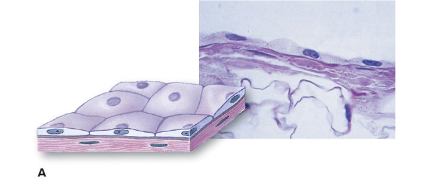
what is simple cuboidal epithelia, draw it
short, box-like cells (one layer of square cells); active secretory or absorptive functions/transport usually through ATP consumption
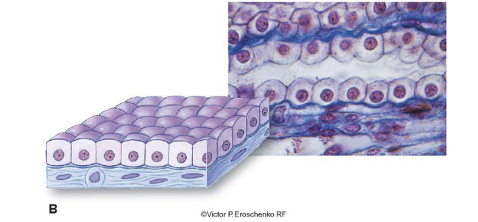
what is simple columnar epithelia, draw it
tall elongated cells (rectangles); often associated with highly absorptive surfaces (e.g. intestinal tract)
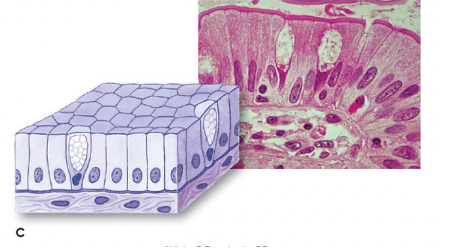
what is stratified squamous epithelia, draw it
layered cells to withstand mild mechanical abrasion; basal cells push upward, constantly reproducing through mitosis, pushing existing cells towards the surface and flattening them; built to slough off dead cells and withstand abrasion
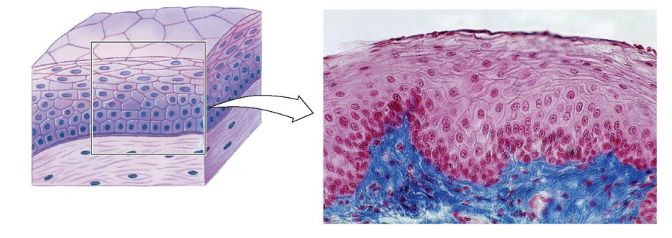
what is transitional epithelia, draw it
stratified but specialized to accommodate stretching (urinary tract, bladder); depending on when you take a cross-section sample it will look different

what is connective tissue
diverse group of tissues specialized to bind and support other tissues
what is muscular tissue
specialized for voluntary and involuntary movement of various organs
what is nervous tissue
specialized for reception and conduction of stimuli and impulses
what are the two types of body fluids (noncellular components)
intracellular: within cells, cytoplasm
extracellular: outside cells (two types: blood plasma - fluid portion of blood outside cells; interstitial fluid - occupies space surrounding cells)
what is interstitial fluid
essentially blood plasma, blood plasma leaks between cells and becomes interstitial fluid, it is recollected and put back into cells
what are extracellular structural elements
supportive material: loose connective ‘tissue’, cartilage, bone, cuticle
what are the different types of body symmetry
asymmetry, spherical symmetry, radial symmetry, bilateral symmetry
what is asymmetry
no body axis and no plane of symmetry (e.g. unicellular eukaryotes (amoeba) and poriferans (sponges)
what is spherical symmetry
any plane passing through center divides the body equally; found only in unicellular eukaryotes (radiolarans)
what is radial symmetry
divided equally by more than two planes passing through the longitudinal axis (head to tail); body has general form of a cylinder (E.g. polyps, some sponges); some forms are modified like starfish which is pentaradial from a top down view
what is bilateral symmetry
body parts oriented around a single anterior to posterior axis; division along the sagittal plane results in two equal halves; associated with cephalization; animal usually moves head first so it confronts environment first; majority of animals (starting with flatworms)
what is the coelem
fluid filled cavity between outer body wall and gut that enables internal organs to grow larger and become more sophisticated (because the fluid cushions internal organs, preventing injury); act as a hydrostatic skeleton, providing support for soft-bodied animals
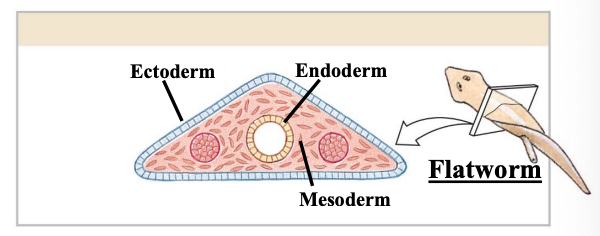
what are the three germ layer types and what do they make
ectoderm: skin
endoderm: gut
mesoderm: most organs
what is acoelomate, draw it
no true coelem (i.e. no body cavity); region between gut and ectoderm occupied by parenchyma/mesoderm; e.g. flatworm
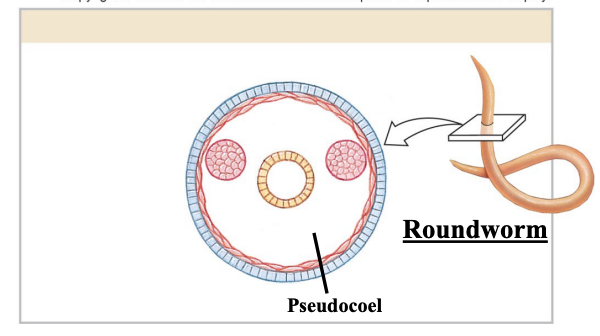
what is a pseudocoelomate, draw it
possess a pseudocoel, no cellular membrane derived from the mesoderm; e.g. roundworm
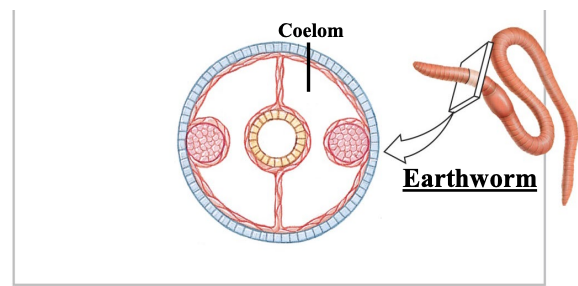
what is coelomate, draw it
true coelem lined with peritoneum (Arises from the mesoderm and forms a lining which surrounds organs/gut/structures that have grown in the coelem); e.g. earthworm
describe unicellular eukaryotes’ complexity
apparently simple but actually as complex as any other animal; i.e. a single cell capable of feeding/digesting, locomotion, ‘behaving’, and reproducing; possess organelles not generally found in metazoan cells
how are eukaryotic cells important
ecologically and economically: primary producers, role in decomposition, human/animal health
how do unicellular eukaryotes fit into classification
paraphyletic group: most recent common ancestor is also the ancestor of plants, animals, and fungi (hence the group does NOT include all the descendants of the common ancestor)
what are the three ways unicellular eukaryotes can move?
ciliary motion, flagellar motion, amoeboid motion
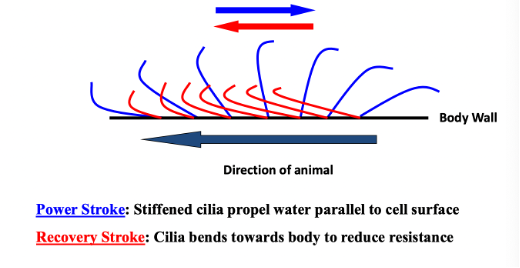
describe ciliary motion, draw it
Cilia: hair-like outgrowths from surface of cell; ciliary beating: a circular motion with 2 components, the power stroke (stiffened cilia propel water) and the recovery stroke (cilia bend towards body to reduce resistance); movement of organism is achieved by synchronized beating of cilia (metachronal beating); cilia beat obliquely/at an angle so the organism moves in a spiral
describe flagellar motion
Flagella: whip-like outgrowths from surface of cell; a flagellum propels water parallel to the main axis of the flagellum, bending in opposite directions along the flagellum to produce a wave action along the flagellum
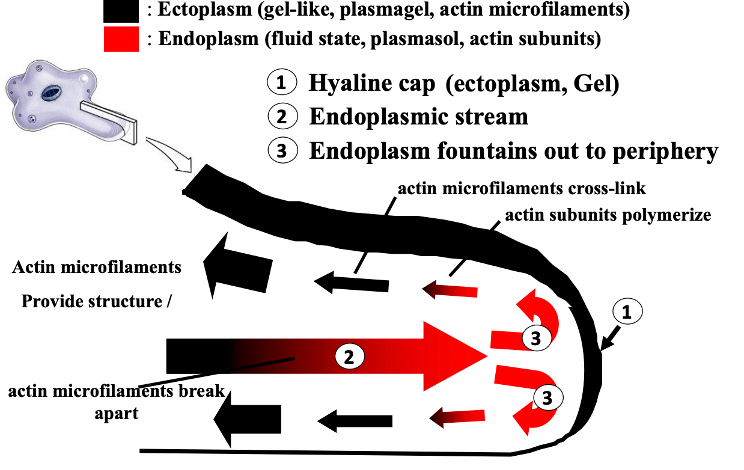
describe amoeboid motion, draw it
Pseudopodia: a free-form projection of the cell; classic amoeboid locomotion uses cytoplasmic streaming and large blunt pseudopodia (lobopodia); ectoplasm is rich in actin microfilaments (F-actin) while endoplasm contains free actin subunits (G-actin); Amoeboid movement occurs by cyclic conversion of actin between G-actin and F-actin. At the leading edge, G-actin polymerizes into F-actin, forming a gel-like ectoplasm that pushes the membrane forward to form pseudopodia.
Endoplasm then streams forward into this extension, while actin filaments at the rear depolymerize, allowing the cell body to move forward.
what type of locomotion is fastest in unicellular eukaryotes
ciliary motion
what are the two kinds of flagellum; draw them
Tractellum – a flagellum that draws water toward and over the cell body; In sessile flagellates: Moves water across cell surface (i.e. prevents stagnation), Brings food particles towards the organism
Pulsellum – a flagellum that propels the cell in a cell body first direction; In free-living flagellates: Moves organism through water like a tadpole

what are filopodia
much slimmer than lobopodian, contain only ectoplasm and lack a hyaline cap
what are reticulopodia
elaborate, extremely thin filaments that branch and coalesce repeatedly in highly complex patterns
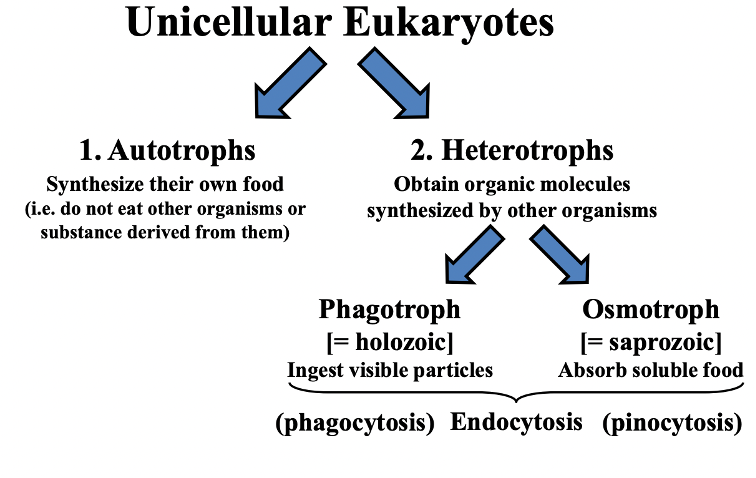
draw a diagram that displays the different types of nutrition among unicellular eukaryotes
Autotrophs or Heterotrophs
Heterotrophs can be either Phagotrophs or Osmotrophs
What is an autotroph
synthesize their own food (i.e. do not eat other organisms nor substances derived from them)
What are heterotrophs
obtain organic molecules synthesized by other organisms
what are osmotrophs
absorb soluble food through pinocytosis; also known as saprozoic
what are phagotrophs
ingest visible particles through phagocytosis (lobopodia extend around particle); also known as holozoic
explain phagocytosis
cell membrane binds to food particle and encloses around it to form a food vacuole
describe the interesting feeding mechanism of didinium
free-living ciliophoran that uses a non-ciliated cytopharynx to engulf prey
describe the interesting feeding mechanism of stentor (vorticella)
free-living ciliophoran that transforms into a horn-like structure; utilizes cilia to generate feeding current towards horn
describe the interesting feeding mechanism of suctorian
utilizes hollow tentacles with an opening on the tip to snag other protozoans and suck their cytoplasm
what are the types of excretion among unicellular eukaryotes
exocytosis, passive diffusion, cytoproct
what is exocytosis
elimination of undigested material within digestive vacuole occurs via fusion with cell surface (i.e. endocytosis in reverse)
what is passive diffusion
metabolic wastes readily diffuse across cell membrane; e.g. end products of nitrogen metabolism, like ammonia
what is a cytoproct
permanent excretory pore; waste accumulates in a vacuole adjacent to the cytoproct and is periodically discharged
what is osmoregulation
process of maintenance of salt and water balance across membranes within the body’s fluids
how does osmoregulation work in unicellular eukaryotes
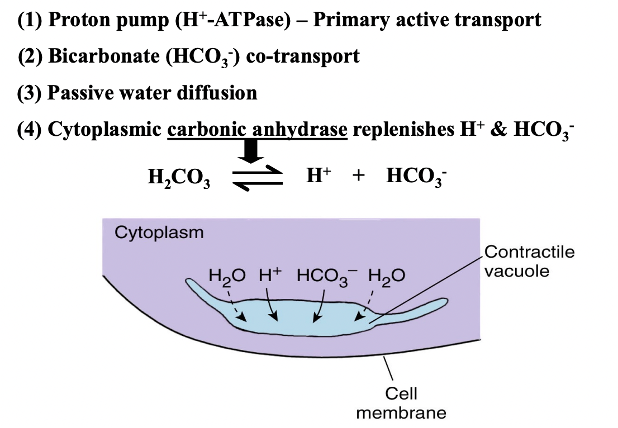
freshwater is hypotonic relative to cytoplasm, so water is constantly diffusing into the cell; contractile vacuole prevents the cell from absorbing too much water and possibly lysing through excessive pressure; water does not get pumped directly into the vacuole, instead, H+ ions are pumped by ATPase (HCO3- also is moved in) → an osmotic gradient forms → water follows passively → carbonic anhydrase (an enzyme) replenishes the ions in the cytoplasm which reverse the gradient
why are contractile vacuoles uncommon in marine/parasitic unicellular eukaryotes, but common in freshwater
freshwater is more diluted than the internal environment of the eukaryotes, diffusive ion loss and water uptake by osmosis would result in dilution of the cytoplasm and eventual death
what are sponges
sessile multicellular animals with no organs but possess functionally distinct cell types
explain the arrangement of sponge body
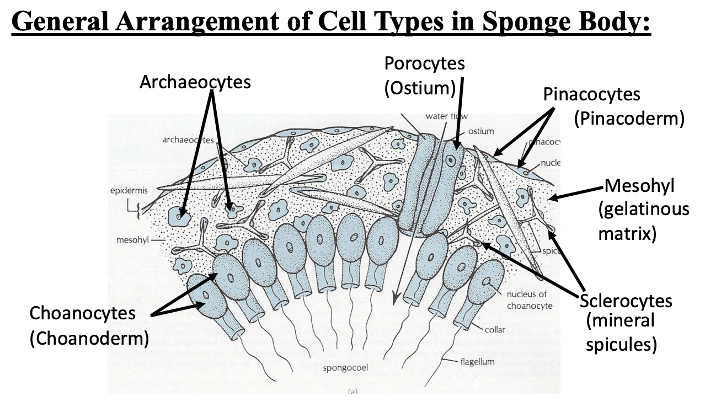
cells lining interior surfaces and exterior surfaces, gelatin-like extracellular substance called mesohyl between layers
what are the different cell types of sponges
choanocytes, archeocytes, secretory cells, pinococytes, porocytes
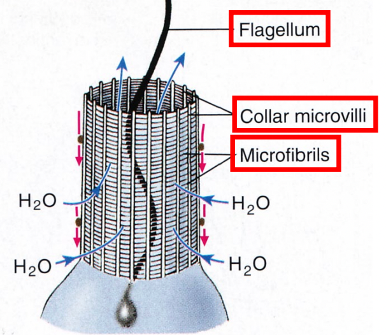
what are choanocytes, sketch it
ovoid cells that line canal systems and chambers; exposed end is a collar shape that acts as a filtering device; the flagellar motion pulls water through the ‘filter’
what are archeocytes
amoeboid cells that receive and digest food particles from choanocytes; totipotent: give rise to all other cell types in the sponge
what are secretory cells
produce spicules through secretions
three subtypes:
sclerocytes - mineral spicules
spongocytes - spongin spicules
collenocytes - collagen spicules
what are pinacocytes
form protective lining (pinacoderm) that faces the external environment; also line some internal canals where choanocytes are not present
what are porocytes
form channels in pinacoderm through which water flows to the inside of the sponge (ostia)
draw a diagram of the general arrangement of cell types in porifera bodies
see image
what are the types of canal systems present among porifera
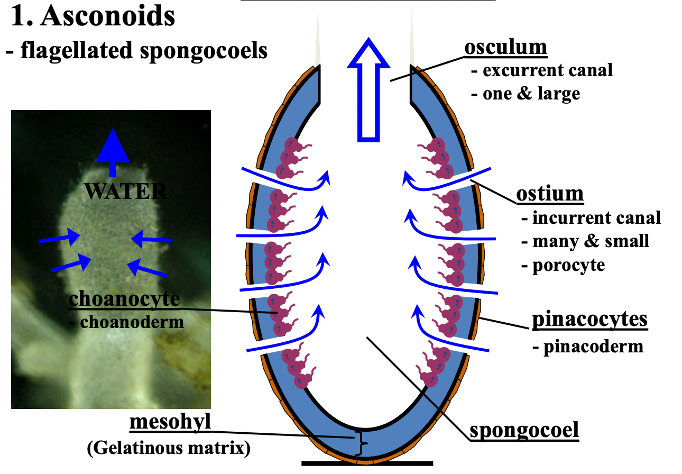
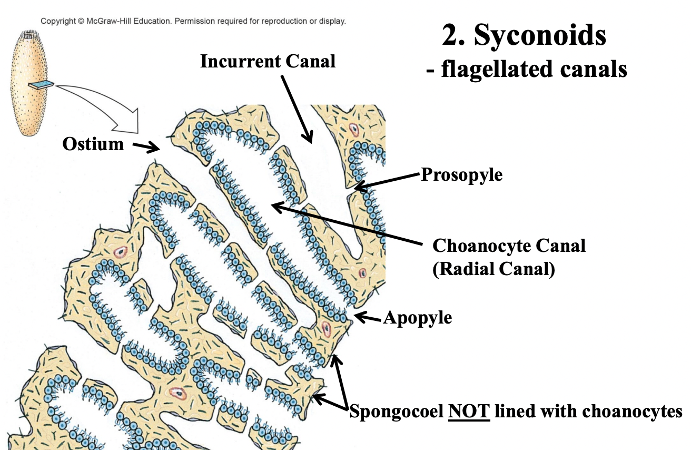
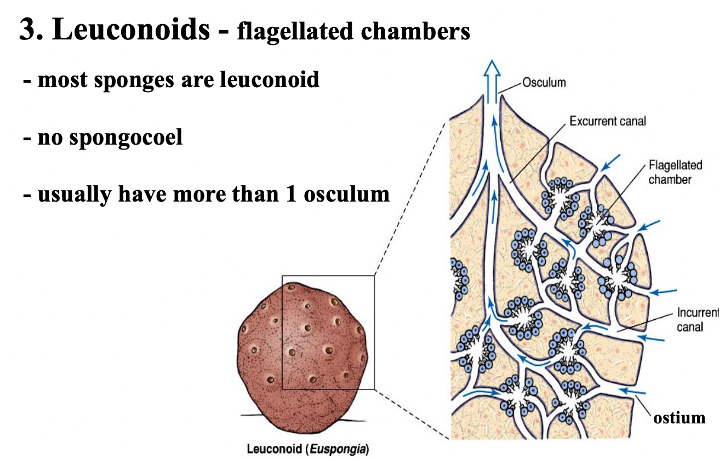
asconoids, syconoids, leuconoids
describe asconoids, draw it
flagellated spongocoels
describe syconoids, draw it
flagellated canals
describe leuconoids, draw it
flagellated chambers
how do porifera reproduce
both asexually and sexually
what are gemmules
form of asexual reproduction + survival structure since sponges are sessile and can’t escape poor environmental conditions; totipotent archaeocytes cluster together, phagocytose other sponge cells to store nutrients, form a capsule of spongin and microscleres, and the archaeocytes with nutrients are sealed and protected during harsh conditions; they will open when conditions improve
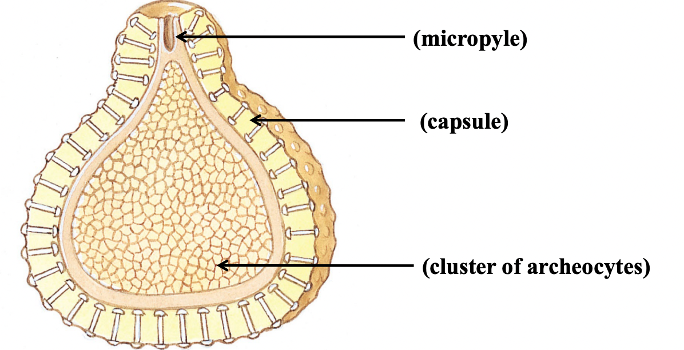
how do sponges reproduce asexually, draw a picture
fragmentation or budding

what are viviparous sponges
monoecious (one individual makes both sperm and eggs) sponges that form sperm from choanocytes (located in special flagellated chambers and released into the water via the osculum) and eggs from archaeocytes (remain inside the spong and are distributed throughout mesohyl); sperm enters through oscula and fertilizes eggs, zygote develops and forms a parenchymula larva that is released into the water
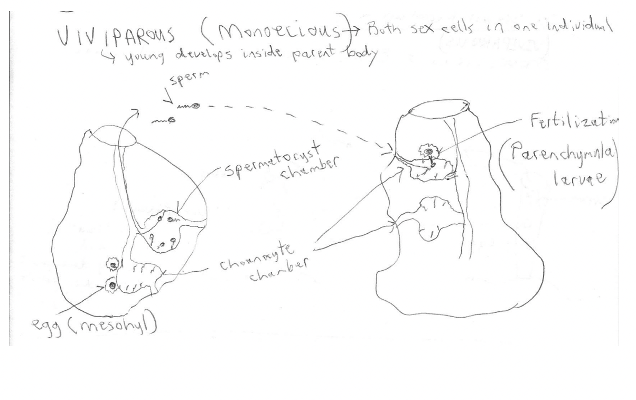
what are oviparous sponges
dioecious (one sponge makes eggs another makes sperm) sponges that release egg and sperm to the environment, usually in mass spawning events; fertilization occurs externally and embryonic development occurs in the water; eggs are surrounded by nurse cells which captures sperm and sinks to substrate
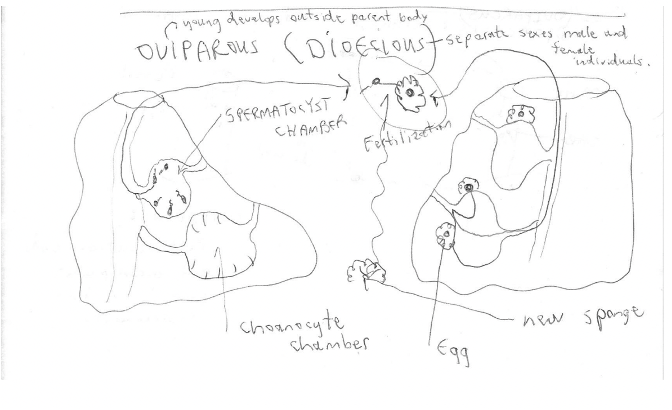
what are parenchymula
flagellated larvae of sponges
how do sponges reproduce sexually
Sponges reproduce sexually in two different ways:
Viviparous (internal fertilization + larval release)
Oviparous (external fertilization)
give a general overview of traits of cnidaria
polymorphic (2 body forms: polyp and medusae), 2 germ layers (ectoderm, endoderm), radial symmetry, gastrovascular cavity with single opening surrounded by tentacles, cnidocytes (contain cnidae)
draw a diagram of both a polyp and medusa morph
see image
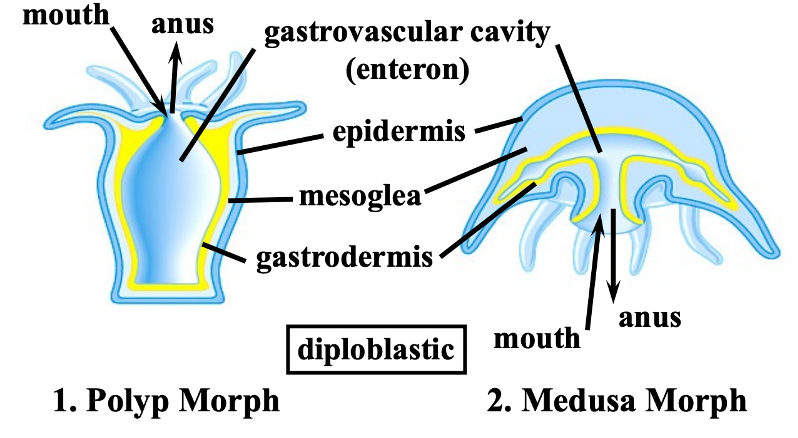
what does diploblastic mean and what phylum has this trait
having a body derived from only two germ layers (endoderm and ectoderm, no mesoderm); cnidaria
which classes of cnidarians have a polyp body form and which do not, what about medusae
all have a polyp body form though it is reduced in scyphozoa and cubozoa; medusae present in hydrozoa, scyphozoa, cubozoa, absent from anthozoa and staurozoa
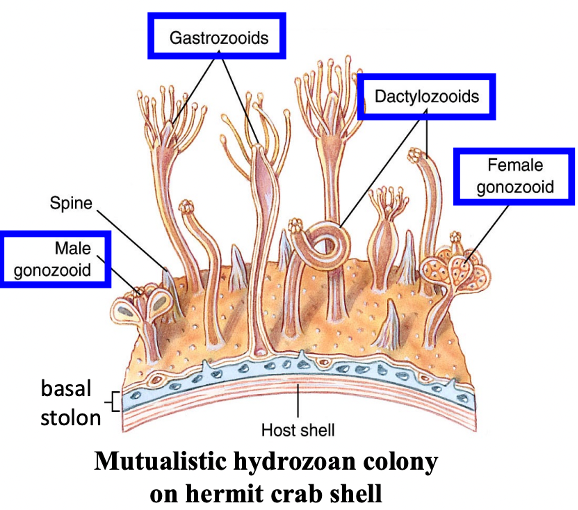
describe the different types of polyps in a sessile polymorphic colonial cnidarian and give an example
§ Gastrozooid polyps
· Feeding polyps with mouth and tentacles for prey capture
§ Dactylzooid polyps
· Naked polyps without mouth
· Functions for defense of colony
§ Gonozooid polyps
· Reproductive naked polyps without mouth
Produce male or female gametes/medusae – could be producing eggs and sperm but in most cases are producing female and male medusae respectively that can swim around freely and reproduce when they come together, forming a new colony
¨ Asexual reproduction basically – the polyps are genetically the same – budding occurring at the basal stolon
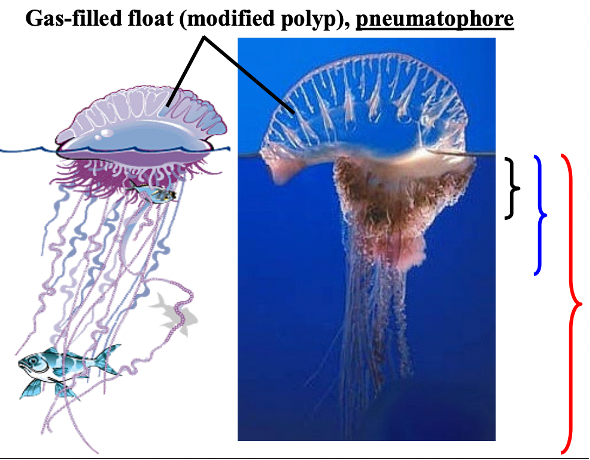
describe the morph types in free living polymorphic colonial forms of cnidaria and give an example of such a species
Gonozooids: Male and female; One colony will be either male or female, not both – they release gametes into the water for fertilization
Gastrozooids: With tentacle; Terminal mouth for feeding
Dactylzooids: With highly retractable tentacle
e.g. portugeuse man of war
gas-filled float is a single polyp called a pneumatophore
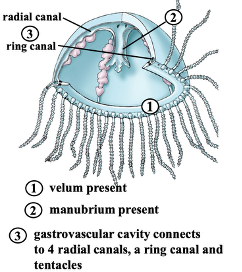
describe the traits of hydrozoan cnidaria and draw a diagram of their body form
¨ Velum = shelf-like area at the bottom of the bell
¨ Manubrium = bell clapper (uvula)
¨ Ring canal runs along all of the base of the circumference
¨ Nutrients in from mouth to gastrovascular cavity then flow down radial canal to ring canal and through tentacles
 Note
Note  Flashcards (90)