pediatric neuro: movement disorders
 Studied by 0 people
 Call Kai
 Learn
Learn Practice Test
 Spaced Repetition
 Match
Match Flashcards
 Knowt Play
1/63

There's no tags or description
Looks like no tags are added yet.
Name | Mastery | Learn | Test | Matching | Spaced |
|---|
No study sessions yet.
64 Terms
Movement disorders are impaired ability to control body movement, not _____
weakness
6 types of movement disorders?
Chorea
Ballismus
Dystonia
Myoclonus
Tics
Tremor
CBDMTT
Things to ask when seeing a movement disorder patient
How long has it been present?
What does the movement look like?
Is it rhythmic, jerky, ‘dancelike’? Show me.
Can it be suppressed?
What medications is the patient taking?
Family history of similar movements?
Case: Parents bring their 3-year-old daughter for evaluation of ADHD. Beginning about two months ago she has been unable to keep still, and they show you this phone video. Her naturopath recommended a regimen of 12 herbs and supplements, but she spits them out. She has stopped talking over the last 10 days or so.
dx?

Chorea
_______ – rapid movement of face/limbs incorporated into voluntary movement to hide it.
Chorea
Constant restlessness with movements flowing from side to side and limb to limb is characteristic of __________.
Chorea
High-amplitude, violent flinging of a limb is called __________.
Ballismus
An extreme form of chorea involving violent flinging movements is __________.
Ballismus
Sustained muscle contractions that may be focal, segmental, hemi, or generalized describes __________.
Dystonia
Involuntary rapid muscle jerks that are usually nonrhythmic define __________.
Myoclonus
Rapid muscle jerks that may be spontaneous, on action, or reflex occur in __________.
Myoclonus
Stereotyped movements or utterances that are shock-like, purposeless, and suppressible briefly indicate __________.
Tics
Dyskinetic movements that come and go are called __________.
Paroxysmal dyskinesias
Brief, irregular movements that are not repetitive or rhythmic, but flow from one muscle to the next
Chorea
Migratory chorea of the limbs and face occurring after a streptococcal infection describes __________.
Sydenham chorea
A movement disorder caused by antibodies to Streptococcus attacking the basal ganglia is __________.
Sydenham chorea
Sydenham Chorea can cause emotional _______.
lability
What is the treatment for Sydenham Chorea?
Treatment with penicillin for latent Strep infection to prevent heart valve damage
Chorea possible causes:
Drugs, Metabolic conditions, Systemic autoimmune disorders, Neurodegenerative diseases
Testing for chorea
Neuroimaging, glucose, electrolytes, thyroid studies, CBC(complete blood count), copper studies, genetic studies
Treatment for chorea:
Treat underlying cause, if found
Medication helps little
______: Muscle contractions result in twisting, repetitive movements and abnormal posture
Dystonia
Time span for dystonia
The movements and postures may be constant or occur in episodes
Dystonia possible causes:
Drugs
Metabolic conditions
Systematic autoimmune disorders
Neurodegenerative diseases
Testing for dystonia
Neuroimaging, glucose, electrolytes, thyroid studies, CBC, copper studies, genetic studies
Treatment for dystonia:
Treat underlying cause, if found
Medication helps little
Cerebral palsy is a group of __________ disorders caused by brain damage early in life.
motor
The brain damage in cerebral palsy occurs before, during, or just after __________.
birth
Cerebral palsy affects muscle __________ and __________.
control, coordination
CP can affect muscle _________, __________, and _________.
muscle tone, posture, and balance
People with CP may also have visual, hearing, speech, epilepsy, and __________ impairment.
intellectual
Cerebral palsy is a __________ condition. (time span)
life-long
Cerebral palsy can include involuntary movements such as __________ and _________.
dystonia and chorea
The dystonia and chorea in CP often appear as __________, twisting movements.
writhing
These involuntary movements in cerebral palsy usually involve __________ sides of the body.
both
Patients with cerebral palsy may also have __________, which means muscle tightness.
spasticity
Myoclonus can occur by itself, but most often it is part of another __________ system disorder.
nervous
Myoclonus may present as generalized, focal, or __________ jerks.
multifocal
Myoclonus disorder symptoms:
Generalized, focal, or multifocal jerks
Continuous or intermittent
Light, sound, touch or movement may be triggers
Myoclonus usually caused by _________.
an underlying disorder (neurological or systemic)
Myoclonus usually caused by an underlying disorder (neurological or systemic), like _____________.
• Head or spinal cord injury
• Stroke or brain infection
• Kidney or liver failure
• Inherited metabolic diseases
The presence of slight __________ helps differentiate anoxic myoclonus from true brain death.
twitches
Physiologic myoclonus occurs in neurologically __________ children
normal
The most common form of physiologic myoclonus is __________ jerking.
sleep
Physiologic myoclonus requires __________ treatment.
no
Anoxic myoclonus typically occurs after a __________.
heart attack
Anoxic myoclonus is seen in patients who are almost at the level of __________.
brain death
The presence of slight __________ helps differentiate anoxic myoclonus from true brain death.
twitches
Anoxic myoclonus indicates severe __________ injury.
anoxic (or brain)
Idiopathic myoclonus involves clinically significant __________ that can occur at any time.
jerking
Idiopathic myoclonus can cause social and/or __________ disability.
physical
The condition progresses __________ or not at all.
slowly
Idiopathic myoclonus may be hereditary with an __________ __________ inheritance pattern or __________.
autosomal dominant or sporadic
The drug of choice for treating idiopathic myoclonus, if needed, is __________.
clonazepam
Epileptic myoclonus shows simultaneous __________ activity on EEG
epileptiform
A classic example of epileptic myoclonus is __________ Myoclonic Epilepsy.
Juvenile
Juvenile Myoclonic Epilepsy includes myoclonic jerks along with generalized - or absence seizures.
tonic-clonic
Epileptic myoclonus typically begins in early __________.
adolescence
Opsoclonus–myoclonus syndrome is associated with __________, a cancer that forms in neuroblasts.
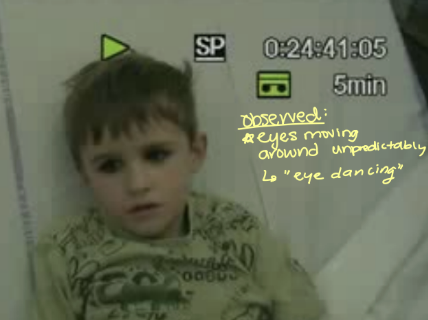
neuroblastoma
Neuroblastoma most commonly begins in the __________ gland.
adrenal
In opsoclonus–myoclonus syndrome, antibodies made against the tumor __________ and attack cerebellar neurons.
overreach
These tumor antibodies attack the __________, leading to abnormal movements.
cerebellar neurons
Case
Term infant girl had routine delivery and was admitted to Newborn Nursery. At 3 hoursof life, during diaper change she stiffened, turned blue, and was not breathing -resolved within 15 seconds. Three more similar events occurred over the next day.
Her neurologic exam was remarkable for tremor, hypertonia (stiffness) when stimulated, and she convulsed every time her nose was touched.
Family history revealed that four infants had died of SIDS in dad’s relatives
dx?
Diagnosis: Congenital Hyperekplexia (Startle Disease)
This case is classic for hyperekplexia, a rare genetic disorder of exaggerated startle with life-threatening stiffness in newborns.
 Note
Note  Flashcards (31)