Interference (8.3)
 Studied by 0 people
 Call with Kai
 Learn
Learn Practice Test
 Spaced Repetition
 Match
Match Flashcards
 Knowt Play
1/4

There's no tags or description
Looks like no tags are added yet.
Name | Mastery | Learn | Test | Matching | Spaced | Call with Kai |
|---|
No study sessions yet.
5 Terms
What are interference, coherence and monochromatic light?
Interference - when two waves superpose, the resultant displacement is the sum of individual displacements of overlapping waves, forming alternating maxima and minima.
Coherence - waves with a constant phase difference and the same frequency and wavelength
Monochromatic light - light of a single frequency
How can two source interference be demonstrated in experiments?
With water waves
With sound waves - when constructive interference occurs (compression + compression or rarefaction + rarefaction) the sound is louder, and the sound is quieter when destructive interference occurs
With microwaves - using a microwave detector, the constructive interference where the detector picks up maximum amplitude and vice versa
Light waves - the bright fringes are where constructive interference occurs, the highest intensity is in the middle, the dark fringes are where destructive interference occurs and they have no intensity
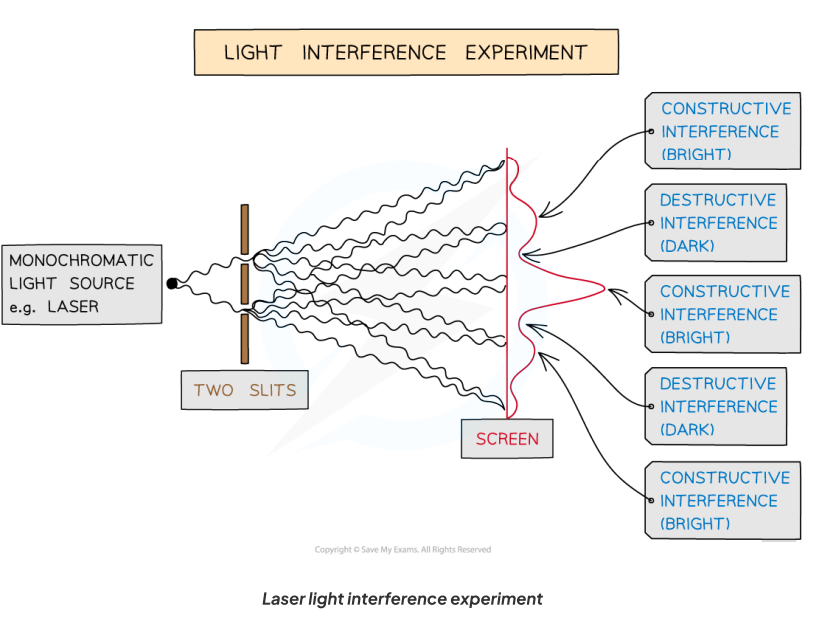
What are the conditions for two-source interference to be observed?
The waves must be coherent and monochromatic
In the double slit experiment how are bright and dark fringes formed?
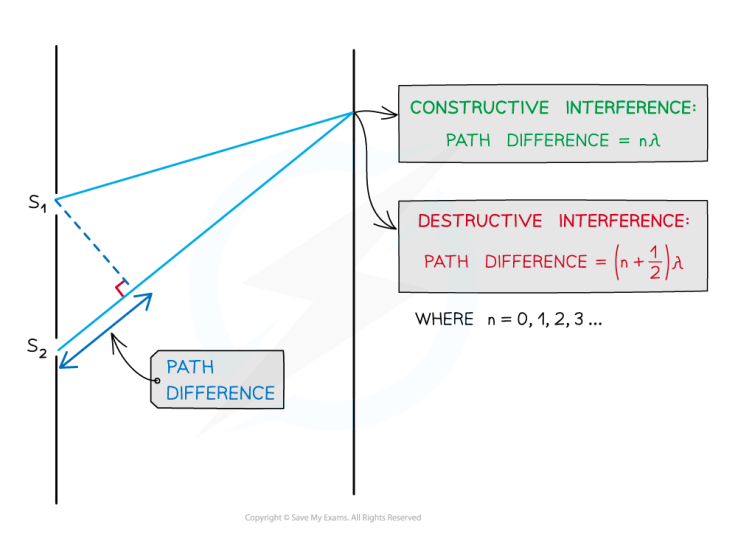
A ray from each of the two slits meet at the screen and superpose:
When a bright fringe is formed, the path difference between them is nλ and the phase difference is 0 so the waves constructively interfere
When a dark fringe is formed, the path difference between them is (n+0.5)λ and the phase difference is π so the waves destructively interfere
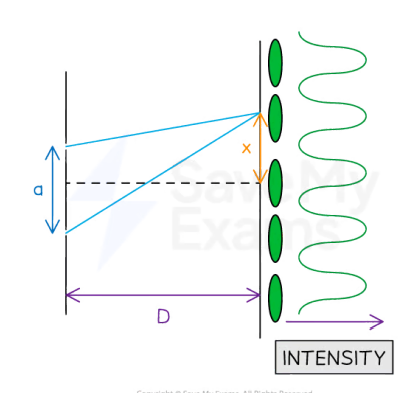
What is the relationship between the distance between the centres of adjacent dark/bright fringes, the distance from the slits to the screen, the slit separation and the wavelength in a double slit experiment?
x=λD/a
Where x is the distance between the centres of adjacent dark/bright fringes
Where λ is the wavelength
Where D is the distance between the slits and the screen (larger the better)
Where a is the slit separation
All are in m
 Note
Note  Flashcards (124)