Halogenoalkanes
 Call Kai
 Learn
Learn Practice Test
 Spaced Repetition
 Match
Match Flashcards
 Knowt Play
1/14

There's no tags or description
Looks like no tags are added yet.
Name | Mastery | Learn | Test | Matching | Spaced | Call with Kai | Chat |
|---|
No analytics yet
Send a link to your students to track their progress
15 Terms
What is a nucleophile?
A chemical which always has a lone pair of electrons that it donates to an electron deficient atom
How do nucleophiles react with haloalkanes?
Nucleophile attacks the positive carbon atom. The carbon has a small positive charge because of the electronegativity difference between the carbon and the halogen
Conditions for nucleophilic substitution with hydroxide ions.(OH-)
Reagent: KOH
Conditions In aq solution,warm
Conditions for nucleophilic substitution with cyanide ions (CN-)
Reagent : KCN
Conditions aq and warm
heat under reflux
Conditions for nucleophilic substitution with ammonia (NH3)
Reagent: NH3 disoolved in ethanol
Condition: Heating under pressure (in a sealed tube )
Excess NH3
Why should excess ammonia be used?
Because in the first stage, the product amine still has a lone pair of electrons on the nitrogen atom.
This can act as a nucleophile which will keep reacting with haloalkane.
Excess ammonia makes it more likely that the haloalkane will react with ammonia rather than the product amine.
What does the halogenoalkane become in elimination
Alkene
What reagents are used in elimination?
Sodium hydroxide or potassium hydroxide
Conditions for elimination
Haloalkane is dissolved in ethanol (alcohol)only and is heated
What is happening in an elimination reaction?
A hydrogen atom and halogen atom is being removed.
Mechanism for elimination
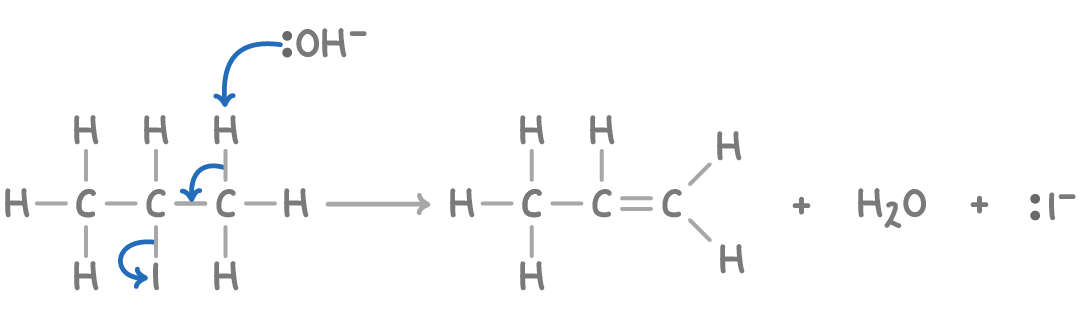
what effects the alkene formed in elimination
elimination can happen starting from any hydrogen atom as long as it is not connected to the same carbon atom the halogen is attached to. So position of double bond can change
mechanism for substitution with ammonia for bromoethane

What reactions do halogenoalkanes undergo
Nucleophilic substitution or elimination
What do the rate of substiuoon reactions depnd on
strength of c-halogen bond
Iodoalakens are the fastest to substitute and fluoroalkenes are the slowest
The strength of the c-f bond is very high so its very unreactive