AP Bio Unit 7 Evolution
 Studied by 6 people
 Call Kai
 Learn
Learn Practice Test
 Spaced Repetition
 Match
Match Flashcards
 Knowt Play
1/81

Earn XP
Name | Mastery | Learn | Test | Matching | Spaced | Call with Kai |
|---|
No analytics yet
Send a link to your students to track their progress
82 Terms
Darwin and Wallace's theory of evolution by natural selection was revolutionary because it _____.
dismissed the idea that species are constant and emphasized the importance of variation and change in populations
was the first time a biologist had proposed that species changed through time
proved that individuals acclimated to their environment over time
was the first theory to refute the ideas of special creation
dismissed the idea that species are constant and emphasized the importance of variation and change in populations
During a study session about evolution, one of your fellow students remarks, "The giraffe stretched its neck while reaching for higher leaves; its offspring inherited longer necks as a result." Which statement is most likely to be helpful in correcting this student's misconception?
Disuse of an organ may lead to its eventual disappearance.
Characteristics acquired during an organism's life are generally not passed on through genes.
Spontaneous mutations can result in the appearance of new traits.
Only favorable adaptations have survival value.
Characteristics acquired during an organism's life are generally not passed on through genes.
The following question refer to the figure below, which shows an outcrop of sedimentary rock whose strata are labeled A-D.
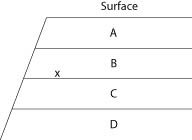
If x indicates the fossils of two closely related species, neither of which is extinct, then their remains may be found in how many of these strata?
three strata
two strata
one stratum
four strata
two strata
Parasitic species tend to have simple morphologies. Which of the following statements best explains this observation?
Parasites do not live long enough to inherit acquired characteristics.
Parasites are lower organisms, and this is why they have simple morphologies.
Simple morphologies convey some advantage in most parasites.
Parasites have not yet had time to progress, because they are young evolutionarily.
Simple morphologies convey some advantage in most parasites.
A population of organisms will not evolve if _____.
the population lives in a habitat without competing species present
all individual variation is due only to environmental factors
the environment is changing at a relatively slow rate
the population size is large
all individual variation is due only to environmental factors
Which of the following represents an idea that Darwin learned from the writings of Thomas Malthus?
Technological innovation in agricultural practices will permit exponential growth of the human population into the foreseeable future.
Earth changed over the years through a series of catastrophic upheavals.
Populations tend to increase at a faster rate than their food supply normally allows.
The environment is responsible for natural selection
Populations tend to increase at a faster rate than their food supply normally allows.
A biologist studied a population of squirrels for fifteen years. During that time, the population was never fewer than thirty squirrels and never more than forty-five. Her data showed that over half of the squirrels born did not survive to reproduce, because of both competition for food and predation. In a single generation, 90% of the squirrels that were born lived to reproduce, and the population increased to eighty. Which inference(s) about this most recent surge in the population size might be true?
The amount of available food may have increased.
The number of predators that prey upon squirrels may have decreased.
The amount of available food may have increased and/or the predators that prey upon squirrels may have decreased.
The parental generation of squirrels developed better eyesight due to improved diet; the subsequent squirrel generation inherited better eyesight.
The amount of available food may have increased and/or the predators that prey upon squirrels may have decreased.
Which of the following must exist in a population before natural selection can act upon that population?
the population has predators
genetic variation among individuals
variation among individuals caused by environmental factors
sexual reproduction
genetic variation among individuals
The role that humans play in artificial selection is to _____.
determine who lives and who dies
create genetic diversity
perform artificial insemination
choose which organisms reproduce
choose which organisms reproduce
In a hypothetical environment, fishes called pike-cichlids are visual predators of large, adult algae-eating fish (in other words, they locate their prey by sight). The population of algae-eaters experiences predatory pressure from pike-cichlids. Which of the following is least likely to occur in the algae-eater population in future generations?
selection for larger female algae-eaters, bearing broods composed of more, and larger, young
selection for nocturnal algae-eaters (active only at night)
selection for drab coloration of the algae-eaters
selection for algae-eaters that become sexually mature at smaller overall body sizes
selection for larger female algae-eaters, bearing broods composed of more, and larger, young
Which of the following evidence most strongly supports the common origin of all life on Earth? All organisms _____.
use essentially the same genetic code
reproduce
require energy
show heritable variation
use essentially the same genetic code
What must be true of any organ described as vestigial?
It must be analogous to some feature in an ancestor.
It must be homologous to some feature in an ancestor.
It must be both homologous and analogous to some feature in an ancestor.
It need be neither homologous nor analogous to some feature in an ancestor.
It must be homologous to some feature in an ancestor.
The following question refer to the evolutionary tree in the figure below.
The horizontal axis of the cladogram depicted below is a timeline that extends from 100,000 years ago to the present; the vertical axis represents nothing in particular. The labeled branch points on the tree (V-Z) represent various common ancestors. Let's say that only since 50,000 years ago has there been enough variation between the lineages depicted here to separate them into distinct species, and only the tips of the lineages on this tree represent distinct species.
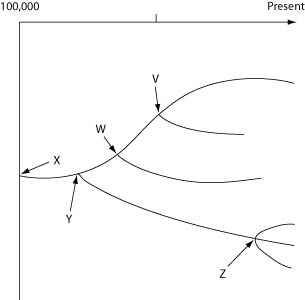
How many distinct species, both living and extinct, are depicted in this tree?
five
six
nine
eleven
eleven
Which of the following is the best modern definition of evolution?
change in the number of genes in a population over time
survival of the fittest
descent with modification
inheritance of acquired characters
descent with modification
Which statement about the beak size of finches on the island of Daphne Major during prolonged drought is true?
The frequency of the strong-beak alleles increased in each bird as the drought persisted.
Each bird evolved a deeper, stronger beak as the drought persisted.
Each bird's survival was strongly influenced by the depth and strength of its beak as the drought persisted.
Each bird that survived the drought produced only offspring with deeper, stronger beaks than seen in the previous generation.
Each bird's survival was strongly influenced by the depth and strength of its beak as the drought persisted.
Which statement about variation is true?
All genetic variation produces phenotypic variation.
All new alleles are the result of nucleotide variability.
All nucleotide variability results in neutral variation.
All phenotypic variation is the result of genotypic variation.
All new alleles are the result of nucleotide variability.
The following experiment is used for the corresponding question.
A researcher discovered a species of moth that lays its eggs on oak trees. Eggs are laid at two distinct times of the year: early in spring when the oak trees are flowering and in midsummer when flowering is past. Caterpillars from eggs that hatch in spring feed on oak flowers and look like oak flowers. But caterpillars that hatch in summer feed on oak leaves and look like oak twigs.
How does the same population of moths produce such different-looking caterpillars on the same trees? To answer this question, the biologist caught many female moths from the same population and collected their eggs. He put at least one egg from each female into eight identical cups. The eggs hatched, and at least two larvae from each female were maintained in one of the four temperature and light conditions listed below.
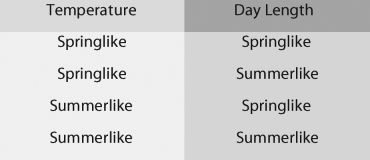
In each of the four environments, one of the caterpillars was fed oak flowers, the other oak leaves. Thus, there were a total of eight treatment groups (4 environments × 2 diets).
Refer to the accompanying figure. Which one of the following is NOT a plausible hypothesis to explain the differences in caterpillar appearance observed in this population?
Differences in diet trigger the development of different types of caterpillars.
The cooler temperatures of spring trigger the development of flowerlike caterpillars.
Differences in air pressure, due to differences in elevation, trigger the development of different types of caterpillars.
The longer day lengths of summer trigger the development of twig-like caterpillars.
Differences in air pressure, due to differences in elevation, trigger the development of different types of caterpillars.
The following experiment is used for the corresponding question.
A researcher discovered a species of moth that lays its eggs on oak trees. Eggs are laid at two distinct times of the year: early in spring when the oak trees are flowering and in midsummer when flowering is past. Caterpillars from eggs that hatch in spring feed on oak flowers and look like oak flowers. But caterpillars that hatch in summer feed on oak leaves and look like oak twigs.
How does the same population of moths produce such different-looking caterpillars on the same trees? To answer this question, the biologist caught many female moths from the same population and collected their eggs. He put at least one egg from each female into eight identical cups. The eggs hatched, and at least two larvae from each female were maintained in one of the four temperature and light conditions listed below.
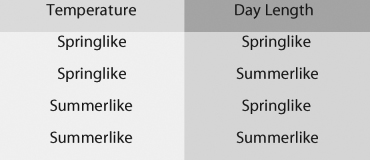
In each of the four environments, one of the caterpillars was fed oak flowers, the other oak leaves. Thus, there were a total of eight treatment groups (4 environments × 2 diets).
Refer to the accompanying figure. In every case, caterpillars that feed on oak flowers look like oak flowers. In every case, caterpillars that were raised on oak leaves looked like twigs. These results support which of the following hypotheses?
Differences in diet trigger the development of different types of caterpillars.
The cooler temperatures of spring trigger the development of flowerlike caterpillars.
Differences in air pressure, due to differences in elevation, trigger the development of different types of caterpillars.
The longer day lengths of summer trigger the development of twig-like caterpillars.
Differences in diet trigger the development of different types of caterpillars.
Use the following information to answer the question(s) below.
Researchers studying a small milkweed population note that some plants produce a toxin and other plants do not. They identify the gene responsible for toxin production. The dominant allele (T) codes for an enzyme that makes the toxin, and the recessive allele (t) codes for a nonfunctional enzyme that cannot produce the toxin. Heterozygotes produce an intermediate amount of toxin. The genotypes of all individuals in the population are determined (see chart) and used to determine the actual allele frequencies in the population.

Refer to the figure above. Is this population in Hardy-Weinberg equilibrium?
Yes
No; there are more homozygotes than expected
No; there are more heterozygotes than expected
More information is needed to answer this question
No; there are more homozygotes than expected
Whenever diploid populations are in Hardy-Weinberg equilibrium at a particular locus, _____.
natural selection, gene flow, and genetic drift are acting equally to change an allele's frequency
individuals within the population are evolving
two alleles are present in equal proportions
the allele's frequency should not change from one generation to the next
the allele's frequency should not change from one generation to the next
In the formula for determining a populations genotype frequencies, the "pq" in the term 2pq is necessary because _____.
the population is diploid
the population is doubling in number
heterozygotes can come about in two ways
heterozygotes have two alleles
heterozygotes have two alleles
In a Hardy-Weinberg population with two alleles, A and a, that are in equilibrium, the frequency of the allele a is 0.3. What is the frequency of individuals that are homozygous for this allele?
0.09
0.9
0.49
9.0
0.09
In a Hardy-Weinberg population with two alleles, A and a, that are in equilibrium, the frequency of allele a is 0.2. What is the frequency of individuals that are heterozygous for this allele?
0.020
0.32
0.16
0.04
0.32
You sample a population of butterflies and find that 56% are heterozygous at a particular locus. What should be the frequency of the recessive allele in this population?
0.70
0.08
0.09
Allele frequency cannot be determined from this information
Allele frequency cannot be determined from this information
The following question(s) are based on information in Hopi E. Hoekstra, Kristen E. Drumm, and Michael W. Nachman, "Ecological Genetics of Adaptive Color Polymorphism in Pocket Mice: Geographic Variation in Selected and Neutral Genes," Evolution 58(6), 2004: 132941.
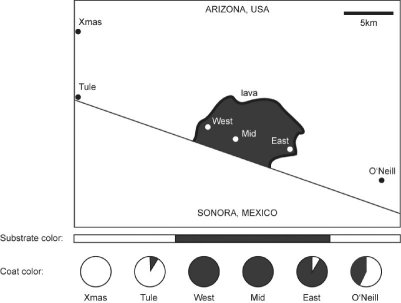
Refer to the figure above. In their investigation of natural selection on Mc1r alleles (the gene that determines coat color) in Arizona pocket mice, Hoekstra et al. determined the frequency of the D and d alleles in each population. They also determined the frequency of alleles for two neutral mitochondrial DNA genes (genes that do not affect and are not linked to coat color). Why did the researchers include the mitochondrial DNA genes as part of their experimental design?
Allele change for the neutral mitochondrial genes serves as an experimental group and gives information on coat-color differences among these populations.
Allele change for the neutral mitochondrial genes serves as an experimental group and gives information on any general background genetic difference among these populations.
Allele change for the neutral mitochondrial genes serves as a control and determines coat-color differences among these populations.
Allele change for the neutral mitochondrial genes serves as a control and gives information on any general background genetic difference among these populations.
Allele change for the neutral mitochondrial genes serves as a control and gives information on any general background genetic difference among these populations.
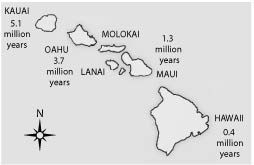
Soon after the island of Hawaii rose above the sea surface (somewhat less than one million years ago), the evolution of life on this new island should have been most strongly influenced by _____.
sexual selection
genetic bottleneck
founder effect
habitat differentiation
founder effect
Over time, the movement of people on Earth has steadily increased. This has altered the course of human evolution by increasing _____.
gene flow
genetic drift
nonrandom making
geographic isolation
gene flow
You are maintaining a small population of fruit flies in the laboratory by transferring the flies to a new culture bottle after each generation. After several generations, you notice that the viability of the flies has decreased greatly. Recognizing that small population size is likely to be linked to decreased viability, the best way to reverse this trend is to _____.
cross your flies with flies from another lab
transfer only the largest flies
change the temperature at which you rear the flies
reduce the number of flies that you transfer at each generation
cross your flies with flies from another lab
Which of the following is a fitness trade-off (compromise)?
In some hornbill species, the male helps seal the female in a tree with her nest until the young are ready to fledge.
The strong, thick beak of a woodpecker helps it find insects in trees.
Turtle shells provide protection but are heavy and burdensome when moving.
Hummingbirds are the best pollinators of certain flowers, but bees are the best pollinators for orchids.
Turtle shells provide protection but are heavy and burdensome when moving.
Martin Wikelski and L. Michael Romero (Body size, performance and fitness in Galápagos marine iguanas, Integrative and Comparative Biology 43 [2003]:376-86) measured the snout-to-vent (anus) length of Galápagos marine iguanas and observed the percent survival of different-sized animals, all of the same age. The graph shows the log snout-vent length (SVL, a measure of overall body size) plotted against the percent survival of these different size classes for males and females.
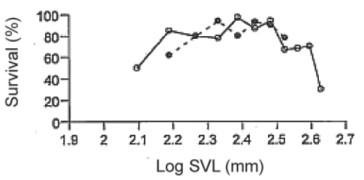
Currently the only predators of Galápagos marine iguanas are Galápagos hawks. Iguana body size is not correlated with risk of hawk predation, although small iguanas can sprint faster than large iguanas. If predators (for example, cats) that preferably catch and eat slower iguanas are introduced to the island, iguana body size is likely to _____ in the absence of other factors; the iguanas would then be under _____ selection.
increase; directional
decrease; directional
decrease; disruptive
increase; disruptive
decrease; directional
The restriction enzymes of bacteria protect the bacteria from successful attack by bacteriophages, whose genomes can be degraded by the restriction enzymes. The bacterial genomes are not vulnerable to these restriction enzymes because bacterial DNA is methylated. This situation selects for bacteriophages whose genomes are also methylated. As new strains of resistant bacteriophages become more prevalent, this in turn selects for bacteria whose genomes are not methylated and whose restriction enzymes instead degrade methylated DNA. The outcome of the conflict between bacteria and bacteriophage at any point in time results from _____.
frequency-dependent selection
neutral variation
heterozygote advantage
evolutionary imbalance
frequency-dependent selection
Arrange the following in order from most general to most specific.
1 natural selection
2. microevolution
3. intrasexual selection
4. evolution
5. sexual selection
1, 4, 2, 5, 3
4, 2, 1, 3, 5
4, 2, 1, 5, 3
4, 1, 2, 3, 5
4, 2, 1, 5, 3
A proficient engineer can easily design skeletal structures that are more functional than those currently found in the forelimbs of such diverse mammals as horses, whales, and bats. The actual forelimbs of these mammals do not seem to be optimally arranged because _____.
though we may not consider the fit between the current skeletal arrangements and their functions excellent, we should not doubt that natural selection ultimately produces the best design
natural selection is generally limited to modifying structures that were present in previous generations and in previous species
in many cases, phenotype is determined by genotype and the environment
natural selection has not had sufficient time to create the optimal design in each case, but will do so given enough time
natural selection is generally limited to modifying structures that were present in previous generations and in previous species
In a very large population, a quantitative trait has the following distribution pattern.
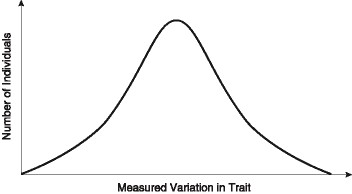
If there is no gene flow, the curve shifts to the left or to the right, and the population size consequently increases over successive generations, which of the following is most likely occurring?
genetic drift
directional selection
disruptive selection
immigration or emigration
directional selection
Macroevolution is _____.
the same as microevolution, but includes the origin of new species
defined as a change in allele or gene frequency over the course of many generations
evolution above the species level
defined as the evolution of microscopic organisms into organisms that can be seen with the naked eye
evolution above the species level
Which of the various species concepts distinguishes two species based on the degree of genetic exchange between their gene pools?
morphological
biological
ecological
phylogenetic
biological
Dog breeders maintain the purity of breeds by keeping dogs of different breeds apart when they are fertile. This kind of isolation is most similar to which of the following reproductive isolating mechanisms?
temporal isolation
habitat isolation
gametic isolation
behavioral isolation
habitat isolation
The production of sterile mules by interbreeding between female horses (mares) and male donkeys (jacks) is an example of _____.
mechanical isolation
hybrid breakdown
reduced hybrid viability
reduced hybrid fertility
reduced hybrid fertility
Two researchers experimentally formed tetraploid frogs by fertilizing diploid eggs from Rana porosa brevipoda with diploid sperm from Rana nigromaculata. When they mated these tetraploid frogs with each other, most of the offspring that survived to maturity were tetraploid, with chromosome sets of both diploid parent species. Based on these results, if this type of tetraploid formed in the wild, what would be the result? (Y. Kondo and A. Kashiwagi. 2004. Experimentally induced autotetraploidy and allotetraploidy in two Japanese pond frogs. Journal of Herpetology 38(3):381-92.)
The two parent species would interbreed and fuse into one species.
The tetraploids would be selected against.
The tetraploids would be reproductively isolated from both parent species.
The two parent species would recognize each other as mates.
The tetraploids would be reproductively isolated from both parent species.
In a hypothetical situation, a certain species of flea feeds only on pronghorn antelopes. In the western United States, pronghorns and cattle often associate with one another in the same open rangeland. Some of these fleas develop a strong preference for cattle blood and mate only with other fleas that prefer cattle blood. The host mammal can be considered as the fleas' habitat. If this situation persists, and new species evolve, this would be an example of _____.
sympatric speciation and habitat isolation
sympatric speciation and temporal isolation
allopatric speciation and habitat isolation
allopatric speciation and gametic isolation
sympatric speciation and habitat isolation
Use the following description to answer the question(s) below.
On the Bahamian island of Andros, mosquitofish populations live in various, now-isolated, freshwater ponds that were once united. Currently, some predator-rich ponds have mosquitofish that can swim in short, fast bursts; other predator-poor ponds have mosquitofish that can swim continuously for a long time. When placed together in the same body of water, the two kinds of female mosquitofish exhibit exclusive breeding preferences.
Which two of the following have operated to increase divergence between mosquitofish populations on Andros?
1. improved gene flow
2. bottleneck effect
3. sexual selection
4. founder effect
5. natural selection
1 and 3
3 and 5
2 and 3
2 and 4
3 and 5
Use the following description to answer the question(s) below.
In the ocean, on either side of the Isthmus of Panama, are thirty species of snapping shrimp; some are shallow-water species, others are adapted to deep water. There are fifteen species on the Pacific side and fifteen different species on the Atlantic side. The Isthmus of Panama started rising about ten million years ago. The oceans were completely separated by the isthmus about three million years ago.
In the following figure, the isthmus separates the Pacific Ocean on the left (side A) from the Atlantic Ocean on the right (side B). The seawater on either side of the isthmus is separated into five depth habitats (1-5), with 1 being the shallowest.
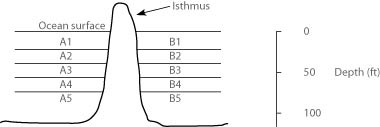
In which habitat should one find snapping shrimp most closely related to shrimp that live in habitat A4?
B4
A5
A3
either A3 or A5
B4
Use the following description to answer the question(s) below.
In the ocean, on either side of the Isthmus of Panama, are thirty species of snapping shrimp; some are shallow-water species, others are adapted to deep water. There are fifteen species on the Pacific side and fifteen different species on the Atlantic side. The Isthmus of Panama started rising about ten million years ago. The oceans were completely separated by the isthmus about three million years ago.
In the following figure, the isthmus separates the Pacific Ocean on the left (side A) from the Atlantic Ocean on the right (side B). The seawater on either side of the isthmus is separated into five depth habitats (1-5), with 1 being the shallowest.
Which habitats should harbor snapping shrimp species with the greatest degree of genetic divergence from each other?
A1 and B5
A1 and A5
A5 and B5
Both A1/A5 and B1/B5 should have the greatest, but equal amounts of, genetic divergence
A5 and B5
Use the following description to answer the question(s) below.
In the ocean, on either side of the Isthmus of Panama, are thirty species of snapping shrimp; some are shallow-water species, others are adapted to deep water. There are fifteen species on the Pacific side and fifteen different species on the Atlantic side. The Isthmus of Panama started rising about ten million years ago. The oceans were completely separated by the isthmus about three million years ago.
In the following figure, the isthmus separates the Pacific Ocean on the left (side A) from the Atlantic Ocean on the right (side B). The seawater on either side of the isthmus is separated into five depth habitats (1-5), with 1 being the shallowest.
Which factor is most important for explaining why there are equal numbers of snapping shrimp species on either side of the isthmus?
the number of actual depth habitats between the surface and the sea floor
the relative shortness of time they have been separated
the elevation of the isthmus above sea level
the depth of the ocean
the relative shortness of time they have been separated
Speciation _____.
must begin with the geographic isolation of a small, frontier population
can involve changes to a single gene
occurs at such a slow pace that no one has ever observed the emergence of new species
occurs only by the accumulation of small genetic changes over vast expanses of time
can involve changes to a single gene
Three populations of crickets look very similar, but the males have courtship songs that sound different. What function would this difference in song likely serve if the populations came in contact?
a behavioral reproductive isolating mechanism
a temporal reproductive isolating mechanism
a postzygotic isolating mechanism
a gametic reproductive isolating mechanism
a behavioral reproductive isolating mechanism
How were conditions on the early Earth of more than three billion years ago different from those on today's Earth? Unlike Earth today, early Earth _____.
experienced little high energy radiation from the sun
had an oxidizing atmosphere
had an atmosphere rich in gases released from volcanic eruptions
had an atmosphere with significant quantities of ozone
had an atmosphere rich in gases released from volcanic eruptions
The questions below refer to the following description and figure.
The figure below represents a cross section of the sea floor through a mid-ocean rift valley, with alternating patches of black and white indicating sea floor with reversed magnetic polarities. At the arrow labeled "I" (the rift valley), the igneous rock of the sea floor is so young that it can be accurately dated using carbon-14 dating. At the arrow labeled "III," however, the igneous rock is about one million years old, and potassium-40 dating is typically used to date such rocks. Note: The horizontal arrows indicate the direction of sea-floor spreading, away from the rift valley.
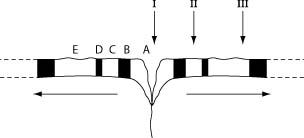
Which section of sea-floor crust should have the thickest layer of overlying sediment, assuming a continuous rate of sediment deposition?
A
B
D
E
E
Which of the following organisms would be most likely to fossilize?
a common worm
a common squirrel
a rare squirrel
a rare worm
a common squirrel
Which of the following would be LEAST likely in the fossil record?
marsh-dwelling species
marine-dwelling species
desert-dwelling species
burrowing species
desert-dwelling species
What is true of the fossil record of mammalian origins?
It includes transitional forms with progressively specialized teeth.
It shows that mammals and birds evolved from the same kind of dinosaur.
It indicates that mammals and dinosaurs did not overlap in geologic time.
It includes a series that shows the gradual change of scales into fur.
It includes transitional forms with progressively specialized teeth.
A sediment core is removed from the floor of an inland sea. The sea has been in existence, off and on, throughout the entire time that terrestrial life has existed. Researchers wish to locate and study the terrestrial organisms fossilized in this core. The core is illustrated as a vertical column, with the top of the column representing the most recent strata and the bottom representing the time when land was first colonized by life.
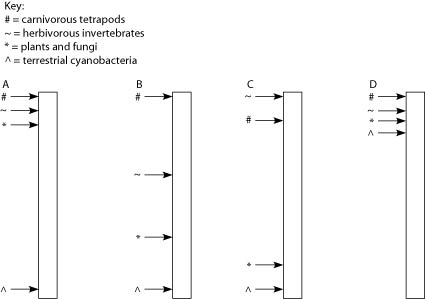
To assign absolute dates to fossils in this sediment core, it would be most helpful if _____.
we knew the order in which the fossils occurred
the sediments had not been affected by underwater currents during their deposition
fossils throughout the column were equally spaced apart
volcanic ash layers were regularly interspersed between the sedimentary strata
volcanic ash layers were regularly interspersed between the sedimentary strata
What is thought to be the correct sequence of these events, from earliest to most recent, in the evolution of life on Earth?
1. origin of mitochondria
2. origin of multicellular eukaryotes
3. origin of chloroplasts
4. origin of cyanobacteria
5. origin of fungal-plant symbioses
4, 3, 1, 5, 2
4, 1, 3, 2, 5
4, 1, 2, 3, 5
4, 3, 2, 1, 5
4, 1, 3, 2, 5
An early consequence of the release of oxygen gas by plant and bacterial photosynthesis was to _____.
make it easier to maintain reduced molecules
change the atmosphere from oxidizing to reducing
cause iron in ocean water and terrestrial rocks to rust (oxidize)
prevent the formation of an ozone layer
cause iron in ocean water and terrestrial rocks to rust (oxidize)
Which of the following characteristics are expected in the first animals to have colonized land?
1. were probably herbivores (ate photosynthesizers)
2. had four appendages
3. had the ability to resist dehydration
4. had lobe-finned fishes as ancestors
5. were invertebrates
1, 2, 3, and 4
1, 3, and 5
3 and 5
3 only
1, 3, and 5
Which factor most likely caused animals and plants in India to differ greatly from species in nearby southeast Asia?
The climates of the two regions are similar.
Life in India was wiped out by ancient volcanic eruptions.
India is in the process of separating from the rest of Asia.
India was a separate continent until forty-five million years ago.
India was a separate continent until forty-five million years ago.
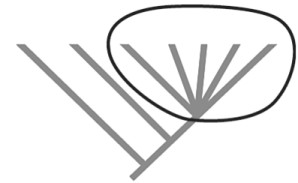
What does the circled part of the phylogenetic tree above indicate?
an adaptive radiation and rapid speciation
a mass extinction event
an adaptive radiation
rapid speciation
an adaptive radiation and rapid speciation
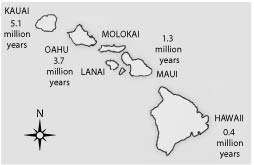
According to the theory of sea-floor spreading, oceanic islands, such as the Hawaiian Islands depicted in the figure above, form as oceanic crustal plates move over a stationary "hot spot" in the mantle. Currently, the big island of Hawaii is thought to be over a hot spot, which is why it is the only one of the seven large islands that has active volcanoes. What should be true of the island of Hawaii?
1. Scientists in search of ongoing speciation events are more likely to find them here than on the other six large islands.
2. Its species should be more closely related to those of nearer islands than to those of farther islands.
3. It should have a rich fossil record of terrestrial organisms.
4. It should have species that are not found anywhere else on Earth.
5. On average, it should have fewer species per unit surface area than the other six islands.
1, 2, and 5
1, 2, and 3
1, 2, 4, and 5
1, 2, 3, and 4
1, 2, 4, and 5
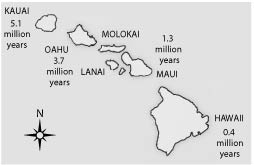
Upon being formed, oceanic islands, such as the Hawaiian Islands, should feature what characteristic, leading to which phenomenon?
mass extinctions, leading to bottleneck effect
adaptive radiation, leading to founder effect
major evolutionary innovations, leading to rafting to nearby continents
a variety of empty ecological niches, leading to adaptive radiation
a variety of empty ecological niches, leading to adaptive radiation
The duplication of homeotic (Hox) genes has been significant in the evolution of animals because it _____.
permitted the evolution of novel forms
allowed animals to survive on significantly fewer calories
reduced morphological diversity into simpler forms of life
caused the extinction of major groups
permitted the evolution of novel forms
The following question are based on the observation that several dozen different proteins comprise the prokaryotic flagellum and its attachment to the prokaryotic cell, producing a highly complex structure.
Certain proteins of the complex motor that drives bacterial flagella are modified versions of proteins that had previously belonged to plasma membrane pumps. This evidence supports the claim that _____.
bacteria that possess flagella must have lost the ability to pump certain chemicals across their plasma membranes
natural selection can produce new structures by coupling together parts of other structures
natural selection produces organs that will be needed in future environments
the motors of bacterial flagella must have originated in other organisms
natural selection can produce new structures by coupling together parts of other structures
The questions below refer to the following phylogenetic trees.
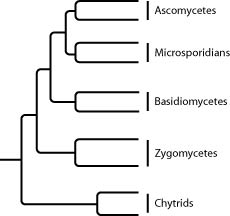
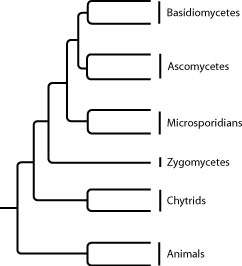
I. II.
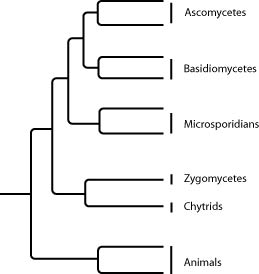
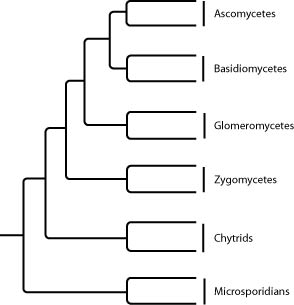
III. IV.
Which tree depicts the closest relationship between zygomycetes and chytrids?
III.
The legless condition that is observed in several groups of extant reptiles is the result of _____.
their common ancestor having been legless
a shared adaptation to an arboreal (living in trees) lifestyle
individual lizards adapting to a fossorial (living in burrows) lifestyle during their lifetimes
several instances of the legless condition arising independently of each other
several instances of the legless condition arising independently of each other
The various taxonomic levels (for example, phyla, genera, classes) of the hierarchical classification system differ from each other on the basis of _____.
how widely the organisms assigned to each are distributed throughout the environment
morphological characters that are applicable to all organisms
their inclusiveness
the relative genome sizes of the organisms assigned to each
their inclusiveness
The best classification system is that which most closely _____.
unites organisms that possess similar morphologies
reflects the basic separation of prokaryotes from eukaryotes
reflects evolutionary history
conforms to traditional, Linnaean taxonomic practices
reflects evolutionary history
Based on this tree, which statement is NOT correct?
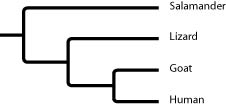
Lizards are more closely related to salamanders than to humans.
The salamander lineage is a basal taxon.
Salamanders are as closely related to goats as to humans.
Salamanders are a sister group to the group containing lizards, goats, and humans.
Lizards are more closely related to salamanders than to humans.
Which of the following pairs are the best examples of homologous structures?
owl wing and hornet wing
bones in the bat wing and bones in the human forelimb
bat wing and bird wing
eyelessness in the Australian mole and eyelessness in the North American mole
bones in the bat wing and bones in the human forelimb
The importance of computers and of computer software to modern cladistics is most closely linked to advances in _____.
light microscopy
molecular genetics
radiometric dating
fossil discovery techniques
molecular genetics
The common ancestors of birds and mammals were very early (stem) reptiles, which almost certainly possessed three-chambered hearts (two atria, one ventricle). Birds and mammals, however, are alike in having four-chambered hearts (two atria, two ventricles). The four-chambered hearts of birds and mammals are best described as _____.
structural homologies
vestiges
homoplasies
the result of shared ancestry
homoplasies
Which of the following would be useful in creating a phylogenetic tree of a taxon?
I) morphological data from fossil species
II) genetic sequences from living species
III) behavioral data from living species
I
II
III
I, II, and III
I, II, and III
Your professor wants you to construct a phylogenetic tree of orchids. She gives you tissue from seven orchid species and one lily. What is the most likely reason she gave you the lily?
to see if the lily is a cryptic orchid species
to serve as an outgroup
to demonstrate likely homoplasies
to see if the lily and the orchids show all the same shared derived characters (synapomorphies)
to serve as an outgroup
Which of the following statements best describes the rationale for applying the principle of parsimony in constructing phylogenetic trees?
The outgroup roots the tree, allowing the principle of parsimony to be applied.
The molecular clock validates the principle of parsimony.
Similarity due to common ancestry should be more common than similarity due to convergent evolution.
Parsimony allows the researcher to "root" the tree.
Similarity due to common ancestry should be more common than similarity due to convergent evolution.
Phylogenetic trees constructed from evidence from molecular systematics are based on similarities in _____.
the pattern of embryological development
biochemical pathways
mutations to homologous genes
morphology
mutations to homologous genes
In a comparison of birds and mammals, having four limbs is _____.
a character useful for distinguishing birds from mammals
an example of analogy rather than homology
a shared ancestral character
a shared derived character
a shared ancestral character
To apply parsimony to constructing a phylogenetic tree, _____.
choose the tree that represents the fewest evolutionary changes, either in DNA sequences or morphology
choose the tree in which the branch points are based on as many shared derived characters as possible
choose the tree that assumes all evolutionary changes are equally probable
choose the tree with the fewest branch points
choose the tree that represents the fewest evolutionary changes, either in DNA sequences or morphology
The lakes of northern Minnesota are home to many similar species of damselflies of the genus Enallagma. These species have apparently undergone speciation from ancestral stock since the last glacial retreat about ten thousand years ago. Sequencing which of the following would probably be most useful in sorting out evolutionary relationships among these closely related species?
ribosomal RNA
conserved regions of nuclear DNA
mitochondrial DNA
amino acids in proteins
mitochondrial DNA
Which statement represents the best explanation for the observation that the nuclear DNA of wolves and domestic dogs has a very high degree of sequence homology? Dogs and wolves _____.
share a very recent common ancestor
have very similar morphologies
belong to the same order
are both members of the order Carnivora
share a very recent common ancestor
The reason that paralogous genes can diverge from each other within the same gene pool, whereas orthologous genes diverge only after gene pools are isolated from each other, is that _____.
having multiple copies of genes is essential for the occurrence of sympatric speciation in the wild
polyploidy is a necessary precondition for the occurrence of sympatric speciation in the wild
paralogous genes can occur only in diploid species; thus, they are absent from most prokaryotes
having an extra copy of a gene permits modifications to the copy without loss of the original gene product
having an extra copy of a gene permits modifications to the copy without loss of the original gene product
The most important feature that permits a gene to act as a molecular clock is _____.
a reliable average rate of mutation
a recent origin by a gene-duplication event
being acted upon by natural selection
a large number of base pairs
a reliable average rate of mutation
The questions below refer to the following table, which compares the % sequence homology of four different parts (two introns and two exons) of a gene that is found in five different eukaryotic species. Each part is numbered to indicate its distance from the promoter (for example, Intron I is the one closest to the promoter). The data reported for species A were obtained by comparing DNA from one member of species A to another member of species A.
% Sequence Homology
Species | Intron I | Exon I | Intron VI | Exon V |
A | 100% | 100% | 100% | 100% |
B | 98% | 99% | 82% | 96% |
C | 98% | 99% | 89% | 96% |
D | 99% | 99% | 92% | 97% |
E | 98% | 99% | 80% | 94% |
Which of these four gene parts should allow the construction of the most accurate phylogenetic tree, assuming that this is the only part of the gene that has acted as a reliable molecular clock?
Exon V
Intron I
Exon I
Intron VI
Intron VI
Which eukaryotic kingdom includes members that are the result of endosymbioses that included an ancient aerobic bacterium and an ancient cyanobacterium?
Protista
Fungi
Animalia
Plantae
Plantae
The following question refer to this phylogenetic tree, depicting the origins of life and of the three domains. Horizontal lines indicate instances of gene or genome transfer.
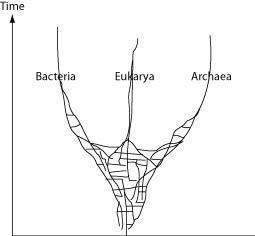
A possible phylogenetic tree for the three domains of life.
Which portion of the figure above may ultimately be better depicted as a "ring"?
the eukaryotic lineage
the trunk of the tree
the archaean lineage
the bacterial lineage
the trunk of the tree
 Note
Note  Flashcards (24)