HE 7 : Price discrimination -Karteikarten | Quizlet
 Studied by 0 people
 Call Kai
 Learn
Learn Practice Test
 Spaced Repetition
 Match
Match Flashcards
 Knowt Play
1/24

There's no tags or description
Looks like no tags are added yet.
Name | Mastery | Learn | Test | Matching | Spaced | Call with Kai |
|---|
No analytics yet
Send a link to your students to track their progress
25 Terms
Differenrec ein pricing between monopoly (imperfect competition) and perfect competition ?
In perfect competition, firms are price takers
In imperfect competition firms can
How is the demand for monopolistic firms ? Consequence ?
- Downward slopping because their demand is the market demand
- Tradeoff between charging high prices and selling large quantities
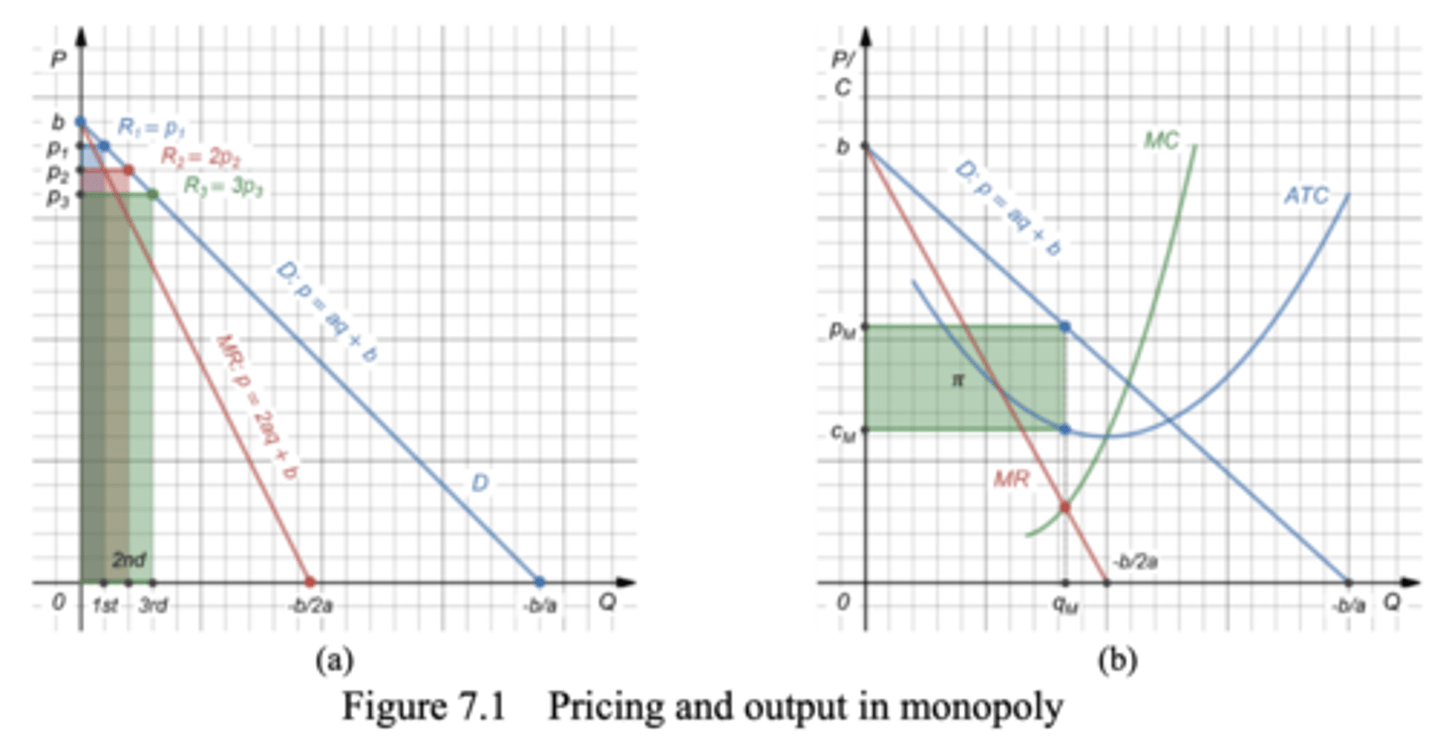
Link price, supply and marginal cost monopoly ?
Since price is set by the firm, there is no supply curve
Quantity supplied depends on the demand and marginal costs (can supply any quantity as long as consumer willingness to pay is above marginal costs)
Two steps of monopoly pricing ?
- First determine output at which MR = MC (profit maximisation)
- Price is determined by the demand curve (has to set qM so that MR = MC)
What are qM and pM ?
qM is the optimal output at which the firm sets it's price pM so that MR = MC (profit is maximised)
What is standard monopoly pricing ? Difference with discrimination ?
Only one price charged for the good produced or sold by the firm in the market (monopoly pricing also called uniform pricing)
> multiple prices are charged for the good
Why is the price uniform ?
• In market demand where there are many consumers and each consumer buys one unit of the good, the same price is charged uniformly to all consumers;
• In individual demand where there is only one consumer who buys a certain quantity of the good, the same price is charged uniformly to all units.
What is price discrimination ? Deductions ?
When firm charge more than one price for a good based on something else than the costs
- Multiple prices for the same good
- Multiple prices does not mean price discrimination (if different costs of production for example)
Approaches of price discrimnation ?
• Multiple prices are charged to different consumers (segments)
• Multiple prices are charged for different quantities of purchase
What are the types of price discrimination ?
• Third-degree price discrimination: to price discriminate on consumer segments, meaning that the firm charges different prices for different consumer segments;
• Second-degree price discrimination: to price discriminate on sale blocks, meaning that the firm charges different prices for different blocks of sales; and
• First-degree price discrimination: to price discriminate on individual consumers (market demand) or individual unit (individual demand), meaning that the firm
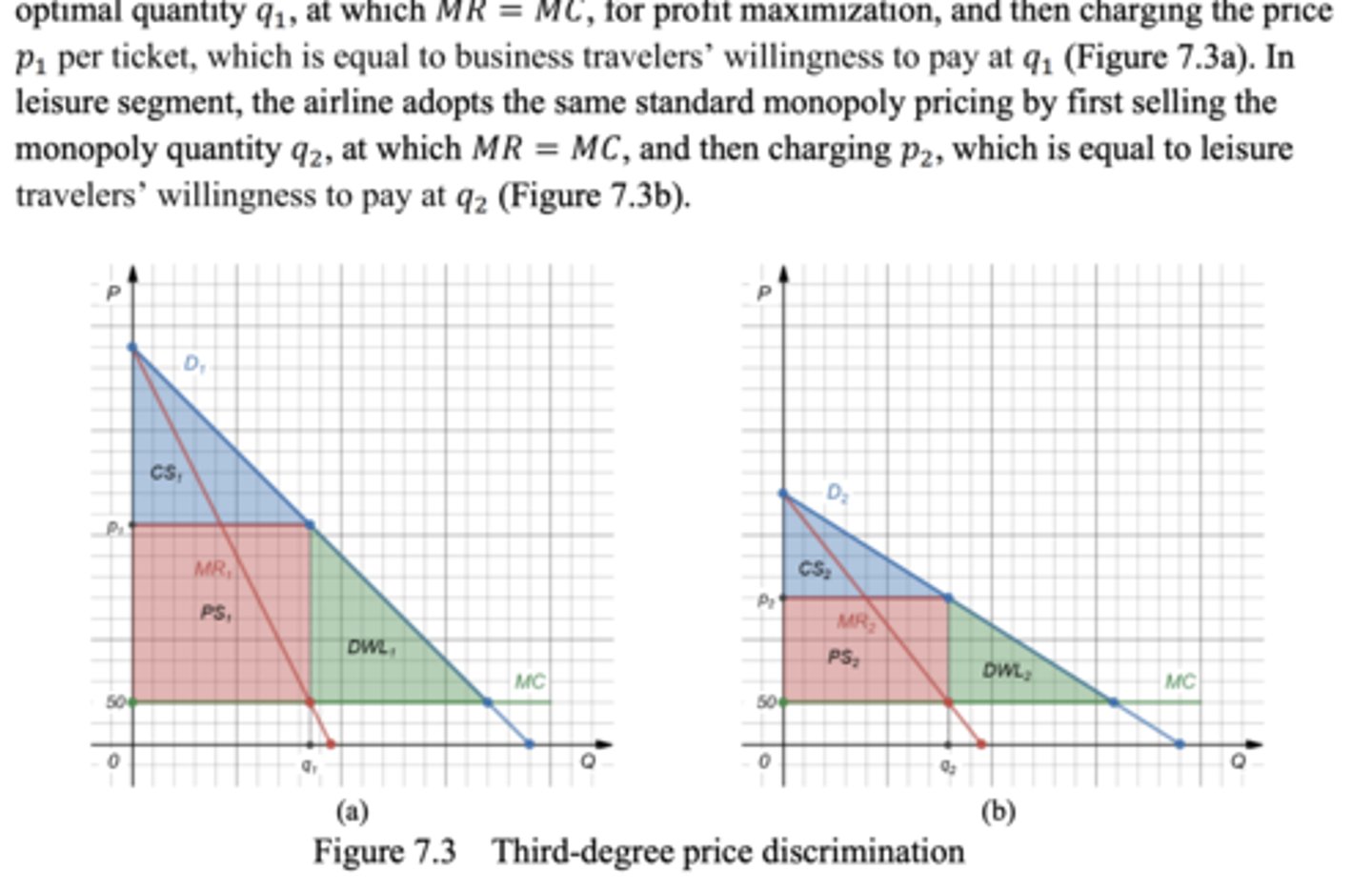
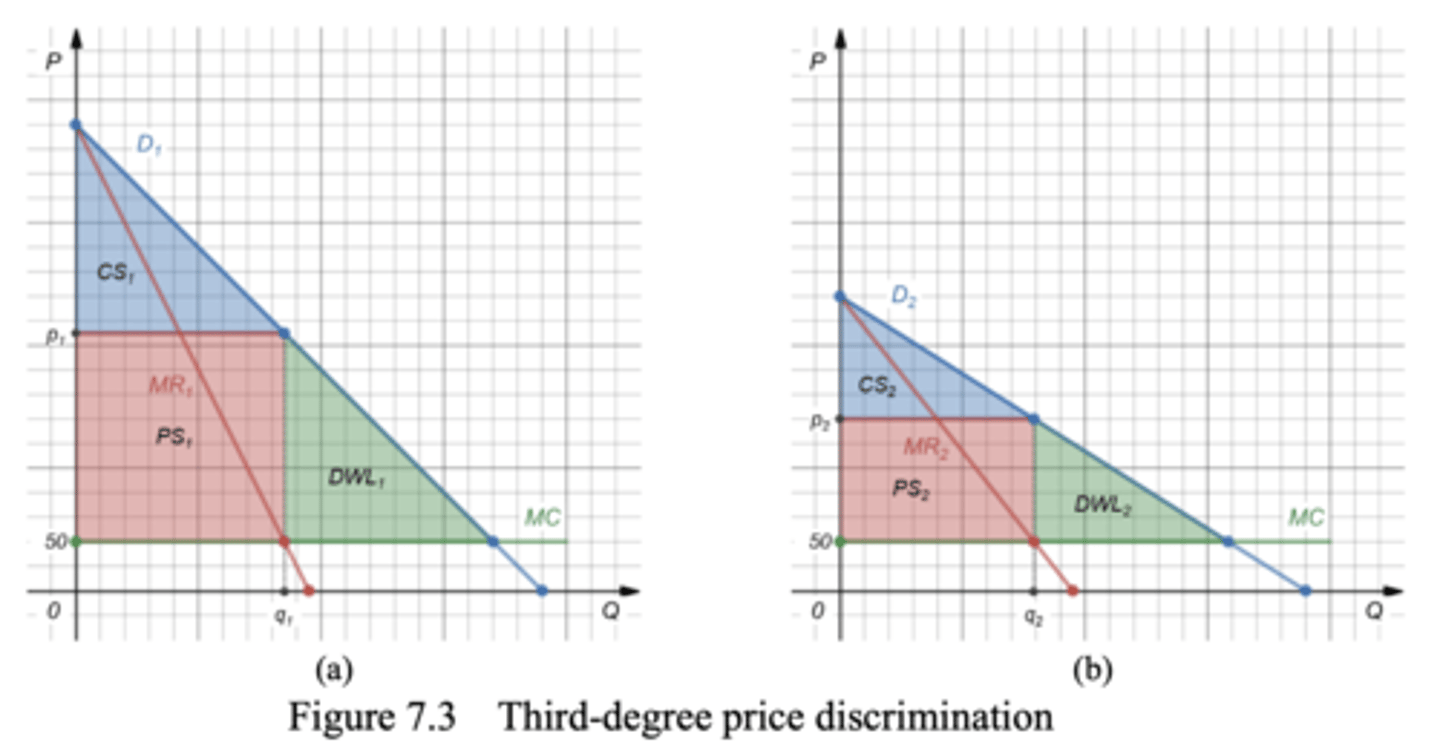
Third degree discrimination ?
Planes seat, economy vs business class
Business is more expensive but this not discrimnation as the costs are higher. But inside the economy class there is discrimination
Business has less price constraints and more rigid schedule (inelastic) in opposition to Leisure
What is the consequence of this price discrimination ?
There is a producer surplus (superior to uniform pricing)
• Producer surplus (PS): 𝑃𝑆 = 𝑃𝑆1 + 𝑃𝑆2
• Consumer surplus (CS): 𝐶𝑆 = 𝐶𝑆1 + 𝐶𝑆2
• Social surplus (SS): 𝑆𝑆 = 𝐶𝑆 + 𝑃𝑆
Second degree price discrimination ? Demand and segment ?
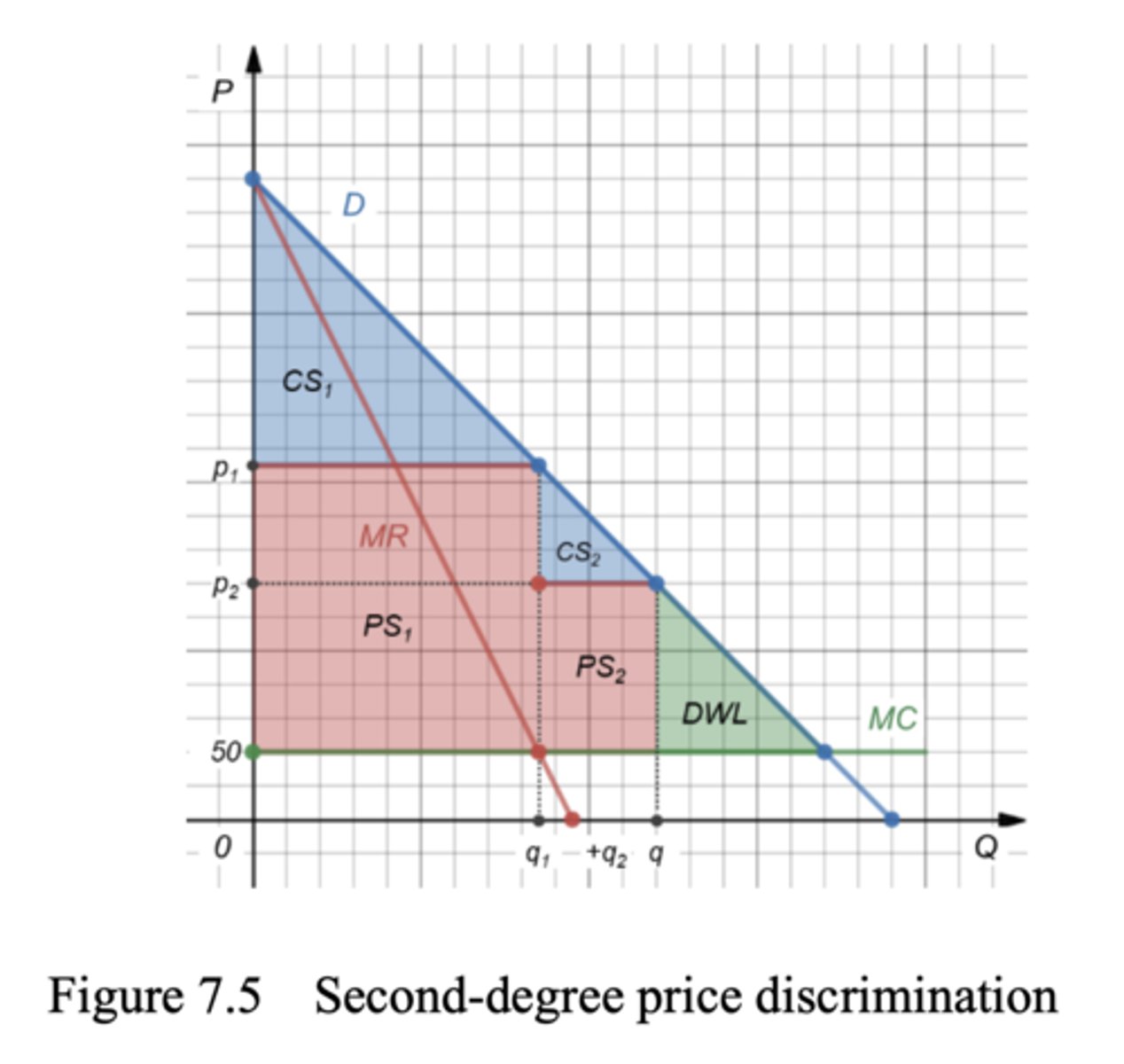
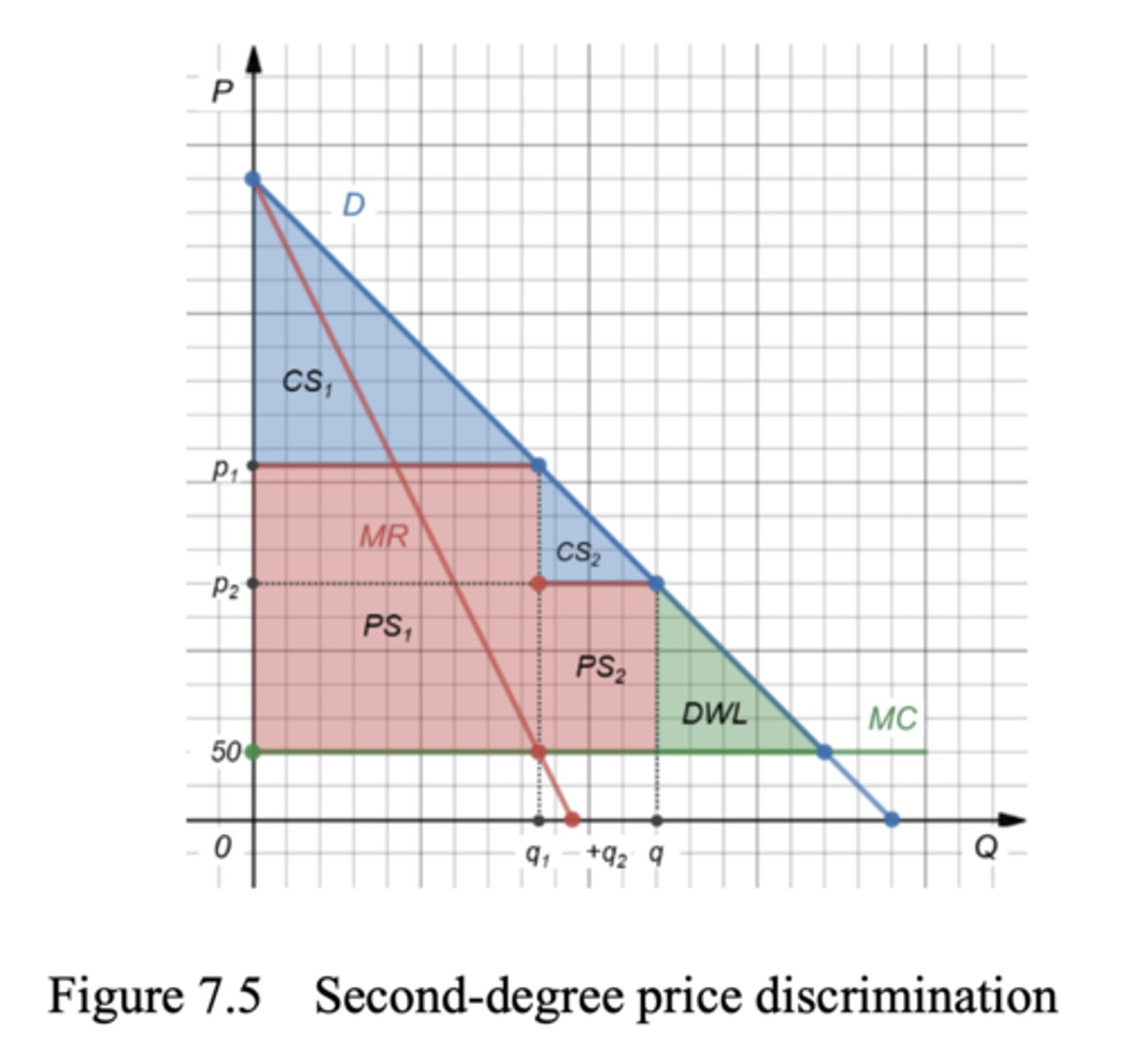
Price discriminate on sale blocks (at least 2 units), and hence multiple prices coexist for different quantities
Only one market segment so one demand curve is analyzed
When does second degree kicks in ?
When an additional quantity q2 is sold, it will be but at a lower price
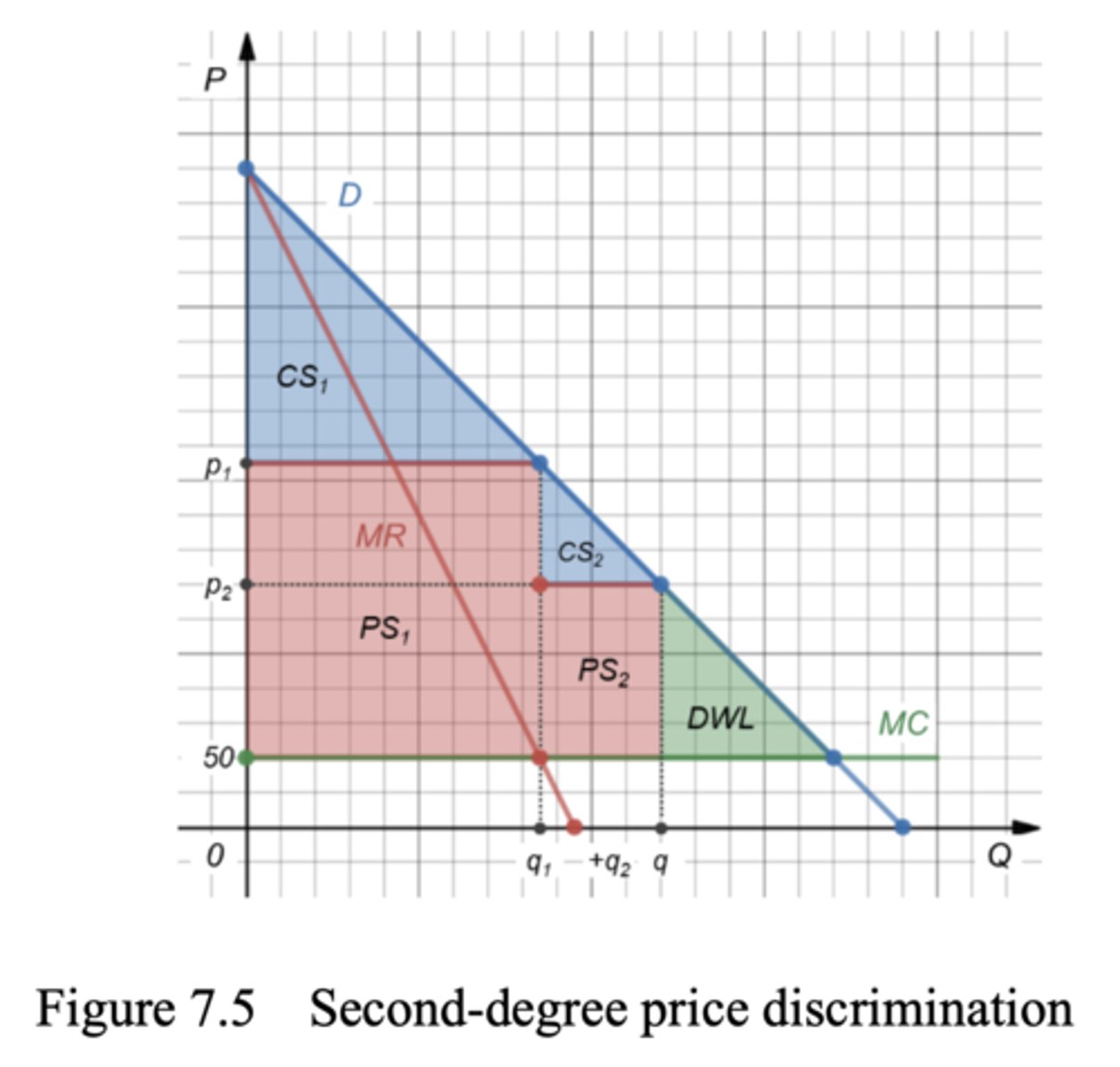
• Charging 𝑝1 for the first sale block with 𝑞1; and only after the first block is sold,
• Charging 𝑝2 for the second sale block with additional 𝑞2.
> law of diminishing marginal utility
What is the law of diminishing marginal utility ?
the benefit gained from consuming one additional unit of a product or service
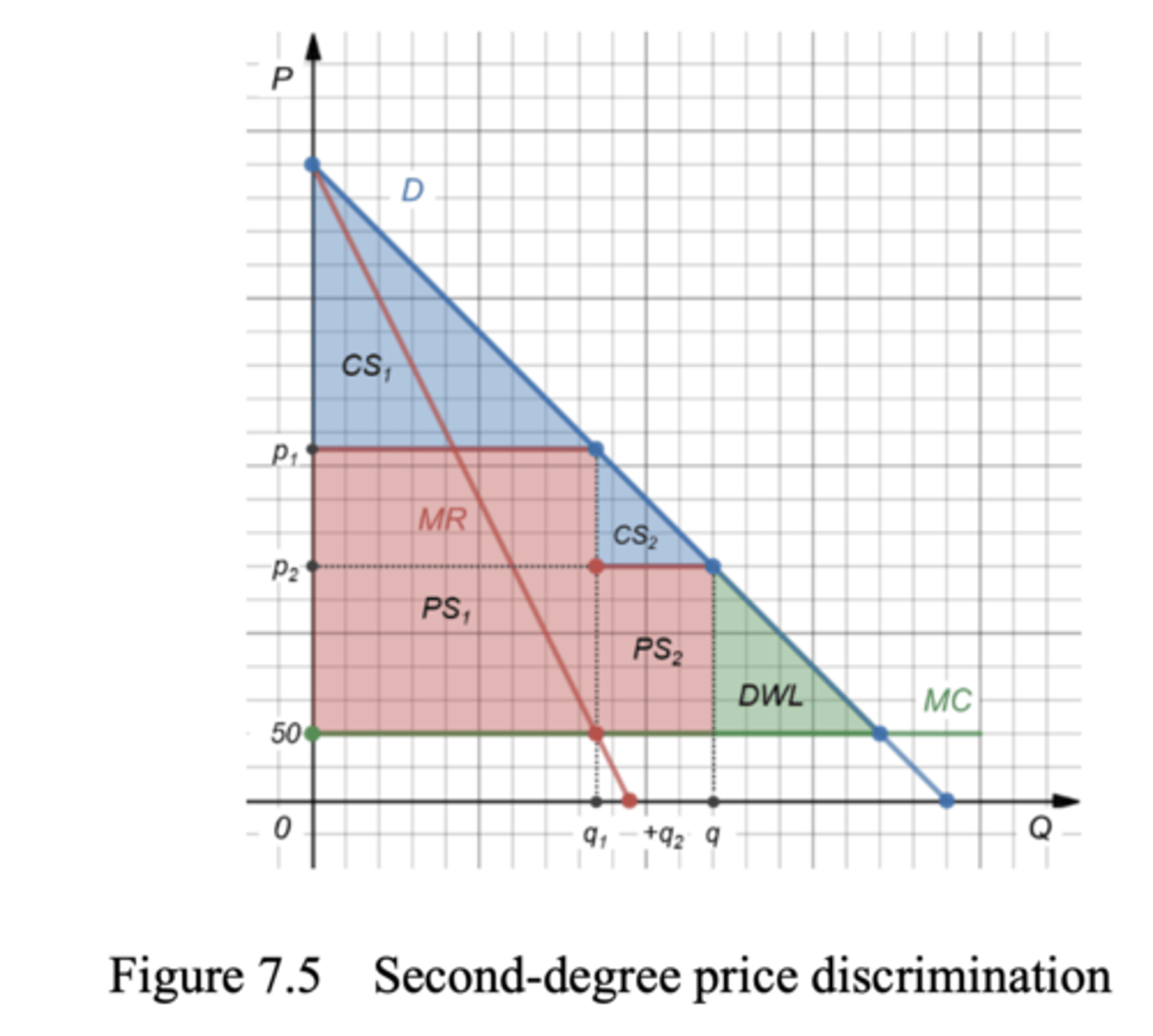
Economic surplus associated with second degree price discrimnation ?
• Producer surplus (PS): 𝑃𝑆 = 𝑃𝑆1 + 𝑃𝑆2
• Consumer surplus (CS): 𝐶𝑆 = 𝐶𝑆1 + 𝐶𝑆2
• Social surplus (SS): 𝑆𝑆 = 𝐶𝑆 + 𝑃𝑆
Both social and producer surplus increases
First degree price discrimination ?
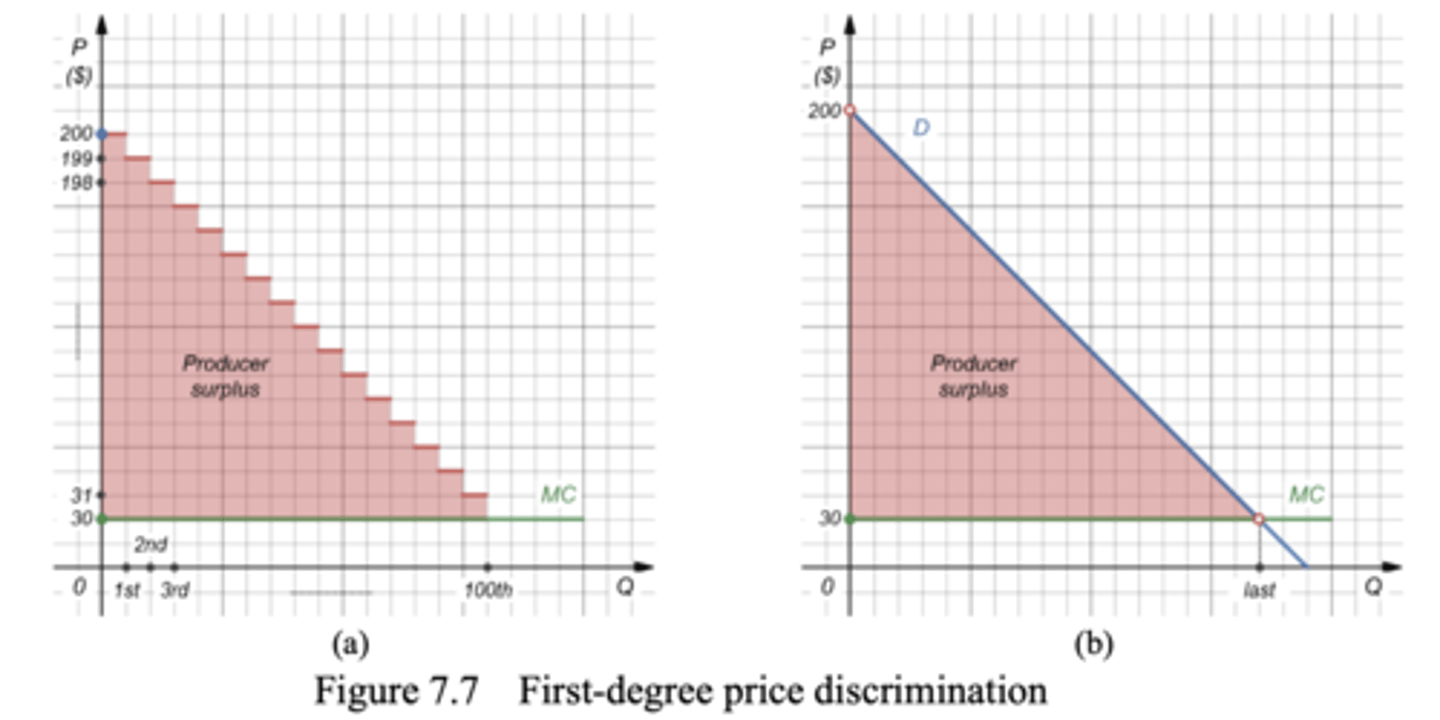
Price discriminate on individual consumers or individual units. Suggests that the firm charges each consumer a distinct price
Why is the biding service of SWISS interesting ? Why is there a range ?
- Reveals the willingness to pay for the upgrade (each person gets a price)
- The lower represents the MC, the higher represents the Highest willingness to pay (otherwise prices would increase)
What surplus changes in first degree ? Characteristics ?
Social surplus increases, and the market becomes more efficient
• Producer surplus is maximized;
• Consumer surplus is minimized (i.e., zero);
• Social surplus is maximized (i.e., deadweight loss is zero)
Is monopoly bad ?
Usually detrimental to market efficiency but can lead to a maximum efficiency if first degree discrimination
Will firms price discriminate ? Are they able to ?
Yes if there is an opportunity
Conditions :
• Supply side: firms have market power, i.e., imperfect competition (e.g., monopoly);
• Demand side: firms know consumers' willingness to pay, i.e., demand.
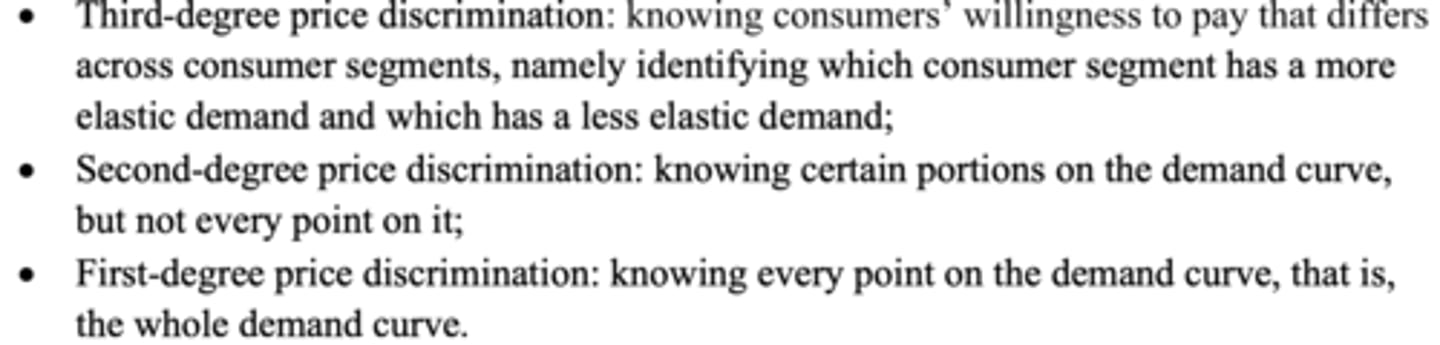
Which price discrimination is easiest ? Hardest ?
The third as it requires least informations
First degree as need the entire demand curve
Second degree is an in between
How to acquire information about demand ?
- Signalling
- Screening
Signalling ? Components ?
Action taken by consumers, even though the action itself is unintentional
• Consumers' personal characteristics: e.g., age, gender, occupation, and so forth
• Consumers' behavioral characteristics: e.g., when to book flights (booking window).
Screening ?
Techniques developed by companies
Coupons for example (users and non users, user are more elastic)
 Note
Note  Flashcards (49)