Chapter 7 - CONSUMERS, PRODUCERS, AND THE EFFICIENCY OF MARKETS
 Call Kai
 Learn
Learn Practice Test
 Spaced Repetition
 Match
Match Flashcards
 Knowt Play
1/46

There's no tags or description
Looks like no tags are added yet.
Name | Mastery | Learn | Test | Matching | Spaced | Call with Kai |
|---|
No analytics yet
Send a link to your students to track their progress
47 Terms
What is consumer surplus?
When the consumer gets to save money, and pay less than they were willing to pay
👉 Example:
You’re willing to pay $10 for a pair of shoes
The store sells them for $6
You saved $4
How does consumer surplus connect to the demand curve?
The demand curve shows how much people are willing to pay
the space above the price but under the demand curve
What is producer surplus?
Money a seller gets when they sell for more than it cost them to make it.
👉 Example:
It costs a company $3 to make a shirt
They sell it for $8
They gain $5 extra → that’s producer surplus
How the producer surplus connects to the supply curve
The supply curve shows how much it costs sellers to make things
The space below the price but above the supply curve
Do markets produce a desirable allocation of resources? Or could the market outcome be improved upon?
In a normal market (no rules messing things up):
Buyers and sellers meet at a fair price
Goods go to people who value them the most
Sellers who can make things cheaply are the ones selling
👉 This creates the most total happiness (consumer + producer surplus)
What is allocation of resources?
how an economy decides to use its limited resources (like time, money, workers, and materials).
The allocation of resources answer three important questions which are
How much of each good is produced?
→ For example: How many cars, clothes, or phones should be made?Which producers make the goods?
→ Which businesses or companies produce them? (Nike vs. Adidas, etc.)Which consumers get the goods?
→ Who buys and uses the products?
What is welfare economics?
the study of how the allocation of resources affects people’s well-being (how happy or satisfied they are).
Welfare economics answer three important questions which are
Are people getting what they want or need?
Are resources being used efficiently (not wasted)?
Is the outcome fair?
A buyers willingness to pay is
the MOST money a person is willing to spend on something
It’s the maximum amount a buyer will pay for a good
It shows how much they value it
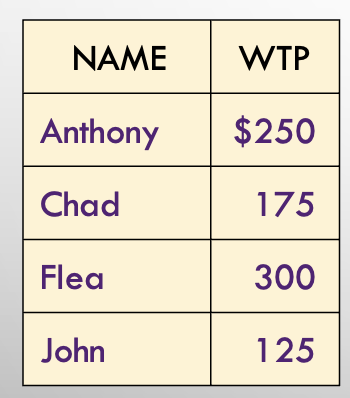
If price of iPod is $200, who will buy an iPod and what is the quantity demanded?
Anthony and Flea will buy an iPod. Chad and John will not.
Quantity Demanded at $200: 2
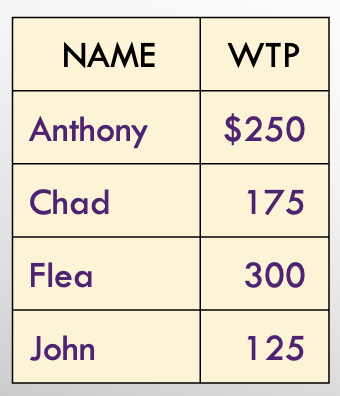
If price of iPod is $175, who will buy an iPod and what is the quantity demanded?
Chad, Anthony, and Flea
Quantity Demanded at $175: 3
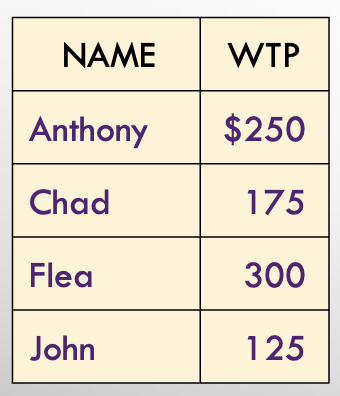
If price of iPod is $125, who will buy an iPod and what is the quantity demanded?
John, Chad, Anthony, Flea
Quantity Demanded at $125: 4
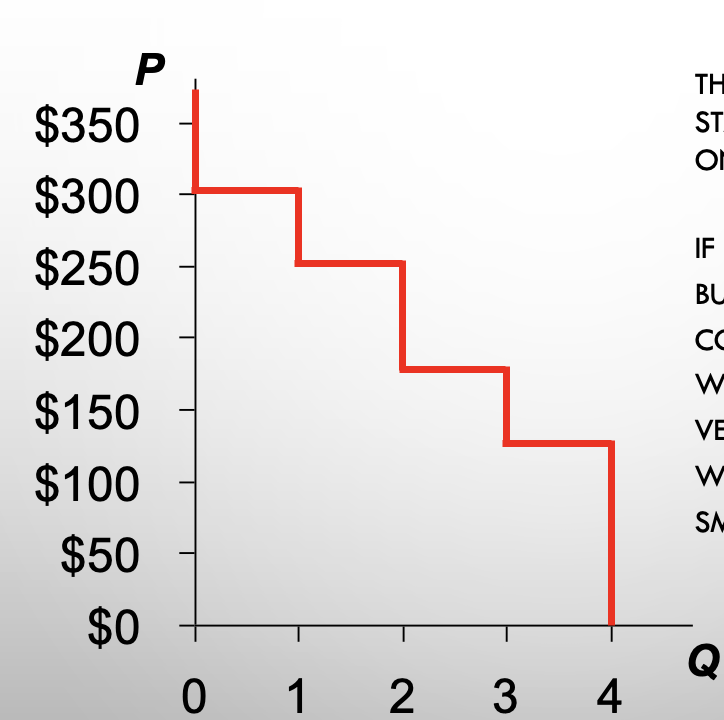
What does this staircase shaped curve represent? What does the steps represent? What does the x and y axis represent?
Willingness to pay and The demand curve
Each step represents each buyer
X axis represents quantity demanded
Y axis represents Price
Consumer Surplus (CS) formula
WTP - P
The amount a buyer is wiling to pay minus the amount the buyer actually pays
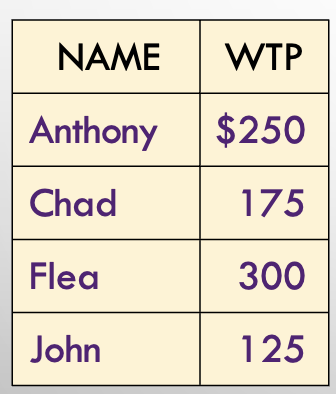
What is Flea’s Consumer Surplus(CS)? If the price is $260
Total CS = $40
Flea’s CS = $300 - $260 =$40.00 $40
What’s the formula for calculating a triangle?
½ x height x base
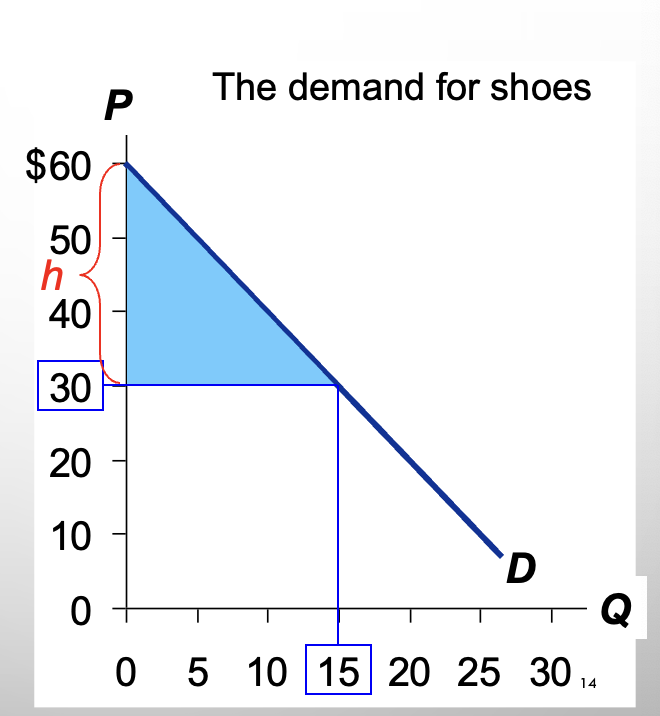
What is the consumer surplus?
½ x 15 x $30 = $225
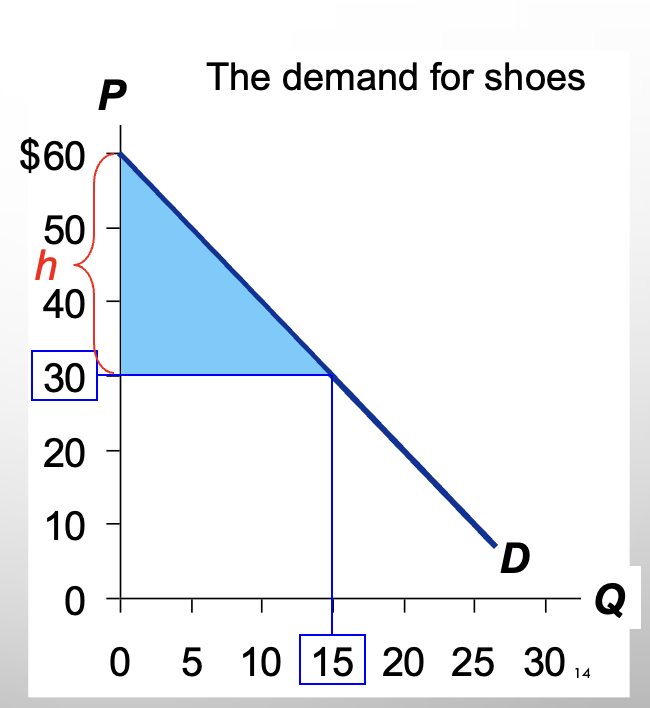
Suppose the price rises to $40. What’s the new Consumer Surplus?
½ x 10 x $20 = $100
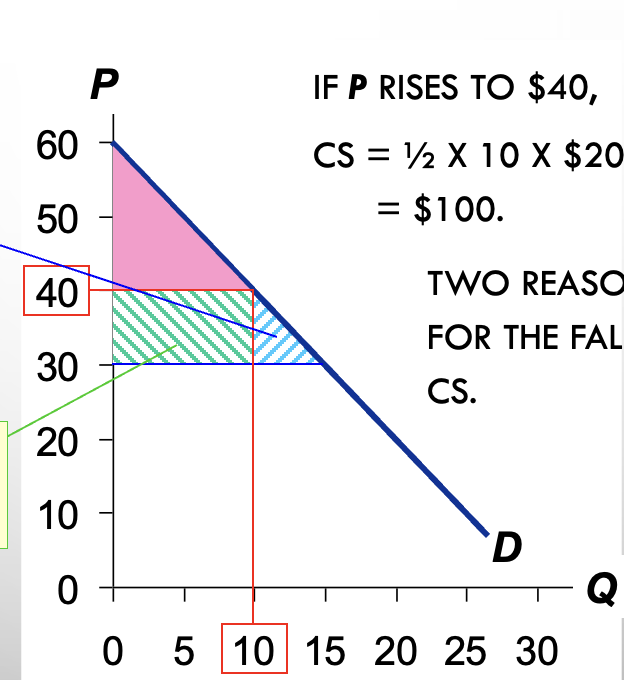
What does the green region represent?
Fall in CS due o remaining buyers paying higher prices (Transfer of surplus from consumers to producers)
👉 This means:
The price went up
Buyers are still buying the product
But they are paying a higher price
So…
👉 Money is not “lost” — it just moves
Consumers lose surplus 😕
Producers gain that same amount 😃
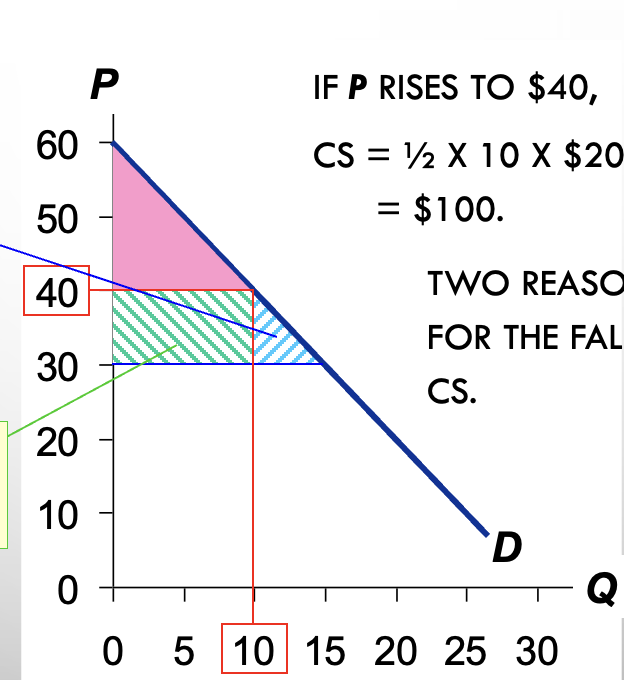
What does the blue region represent?
Deadweight loss
Fall in CS due to buyers leaving the market
👉 When the price goes up:
Some buyers say, “It’s too expensive” ❌
They leave the market (don’t buy anymore at all)
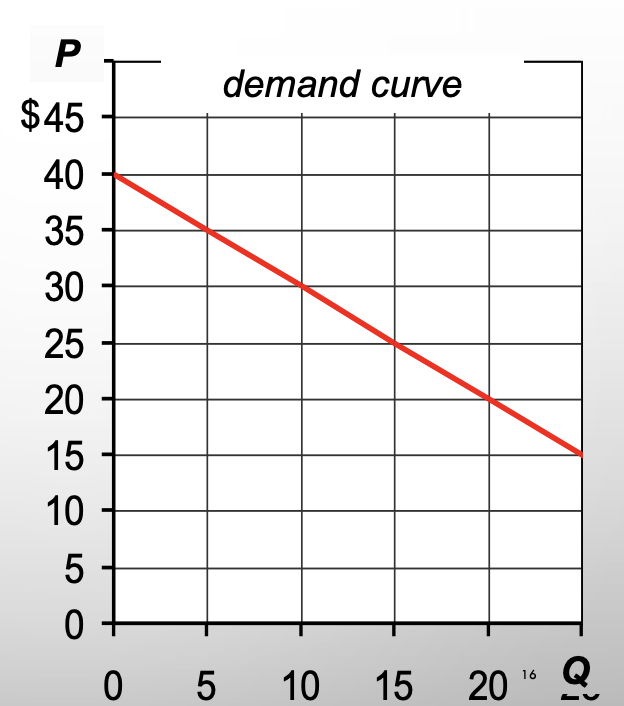
Find marginal buyer’s WTP at Q=10
Buyer’s WTP is $30
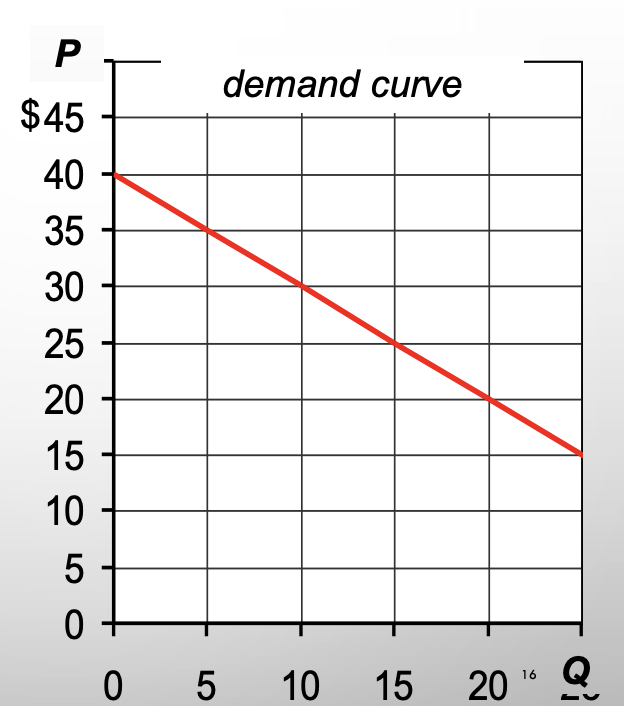
Find CS for P = $30
½ x $10 × 10 = $50
$30 example
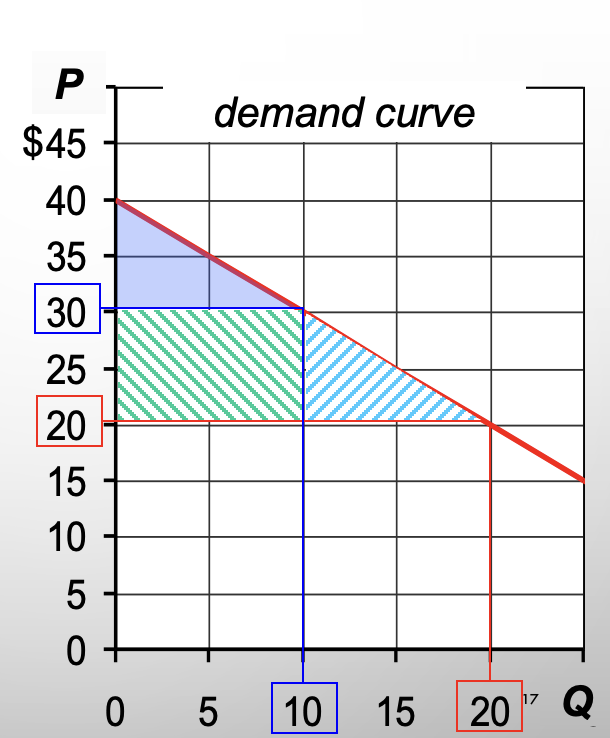
Suppose P falls to $20 from being $3.
How much will CS increase due to buyers entering the market.
½ x 10 x $10 = $50
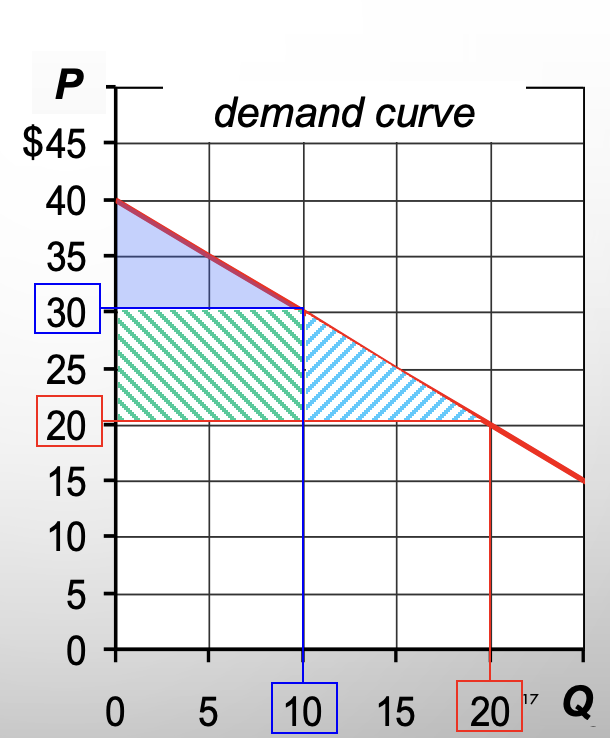
What does the blue region represent if the price falls from $30 to $20?
Buyers entering the market (additional buyers)
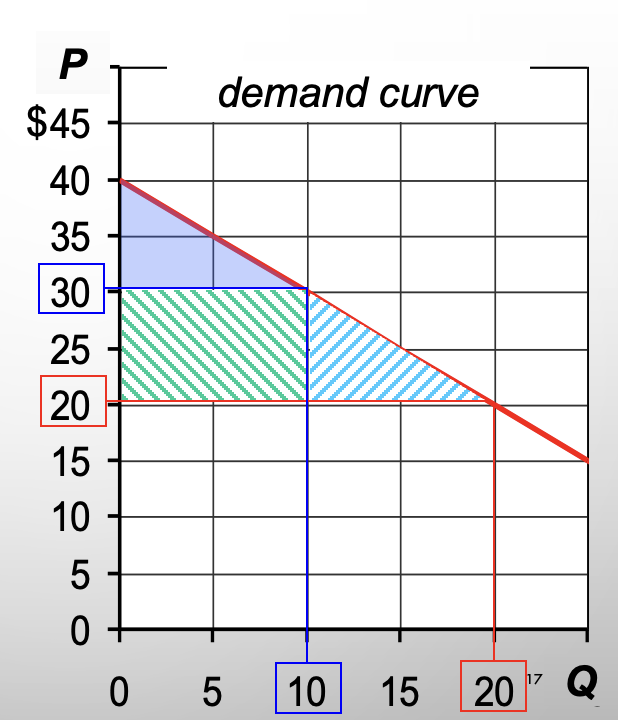
What does the green region represent if the price falls from $30 to $20?
Existing buyers paying lower price (initial buyers)
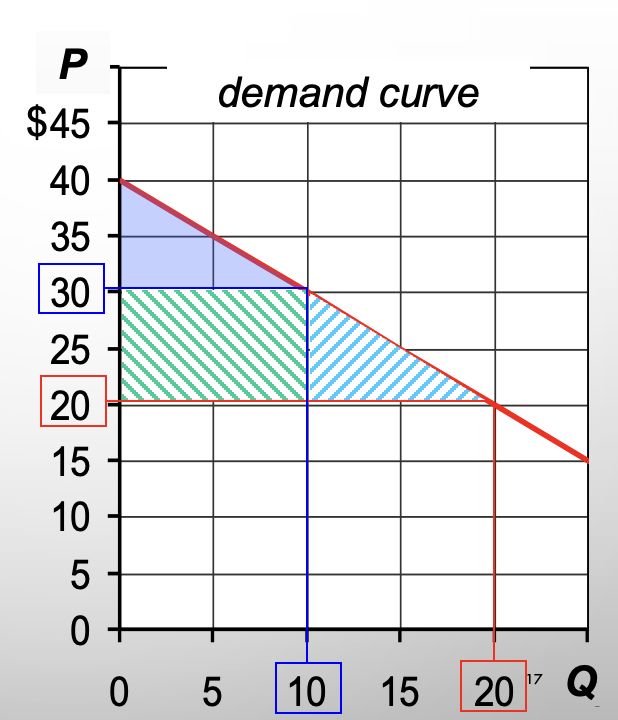
Suppose P falls to $20 from being $3.
How much will CS increase due to existing buyers paying lower price?
10 x $10 = $100
Producer Surplus : Cost meaning
The value of everything a seller must give up to produce a good
Willingness to Sell
Produce and sell the good/service only if the Price > Cost
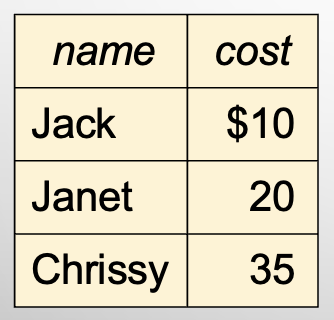
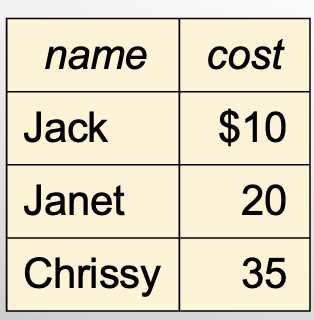
Willingness to sell at $35
3
Jack, Janet, and Chrissy
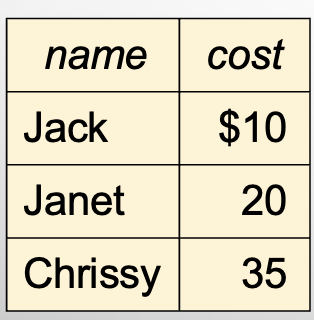
Willingness to sell at $19
1
Jack
Willingness to sell at $34
2
Jack and Janet
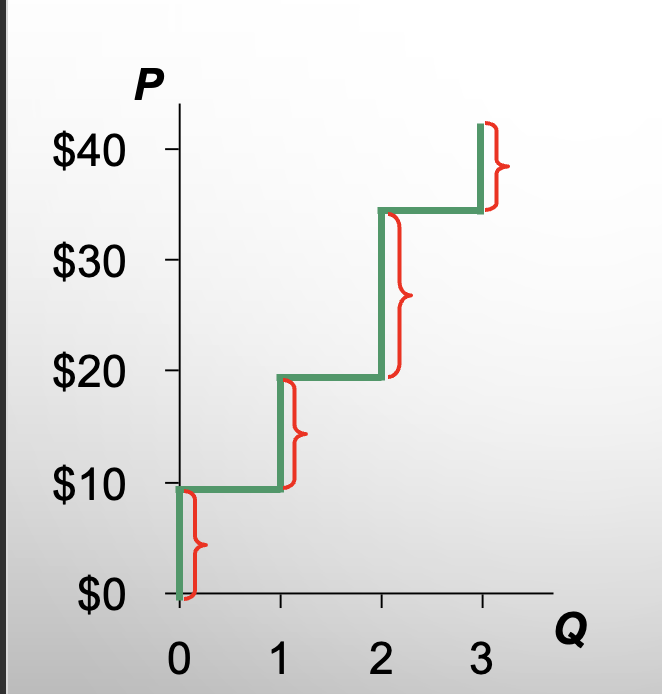
What does this staircase shaped curve represent?
Cost and the supply curve
Producer Surplus formula
PS = P - Cost
The amount a seller is paid or a good minus the sellers cost of creating the product
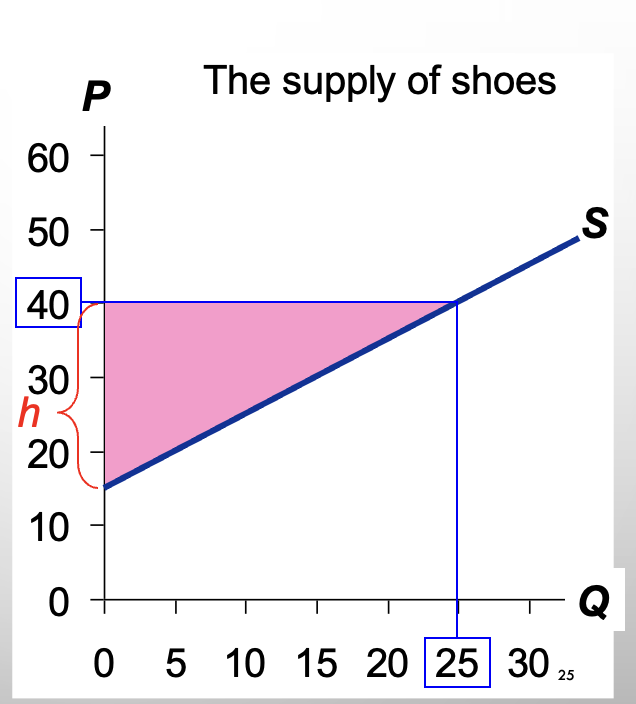
Calculate the producer surplus
½ x 25 x $25 = $312.50
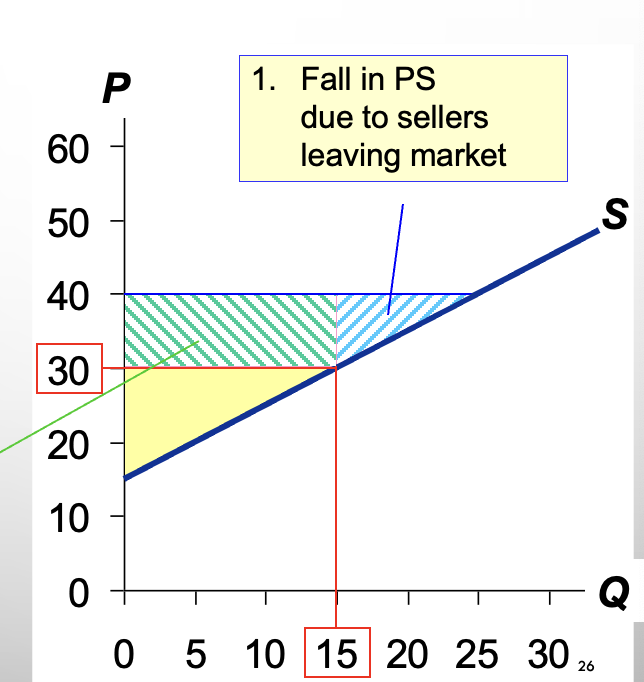
What is the PS if price falls from $40 to $30?
½ x 15 x $15 = $112.50
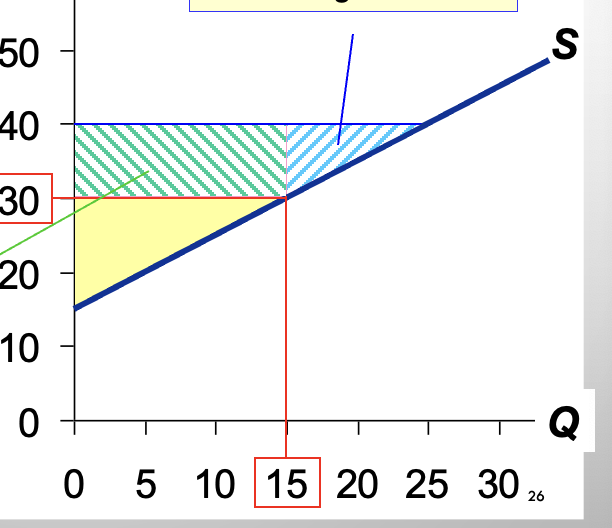
What does the green region represent?
Fall in PS due to remaining sellers getting lower Prive
👉 The price goes down
Sellers are still selling their products ✅
But they are getting paid less money
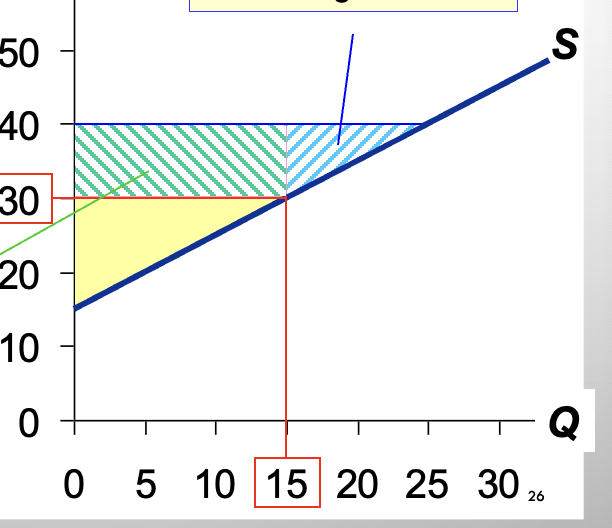
What does the blue region represent?
Fall in PS due to sellers leaving the market
👉 When the price goes down:
Some sellers say, “This isn’t worth it anymore” ❌
Their cost is higher than the price, so they stop selling
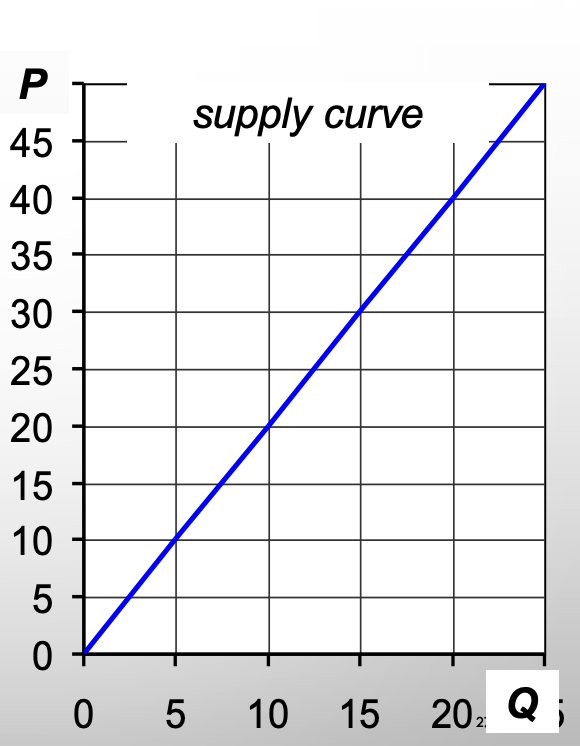
Find marginal seller’s cost at Q = 10
$20
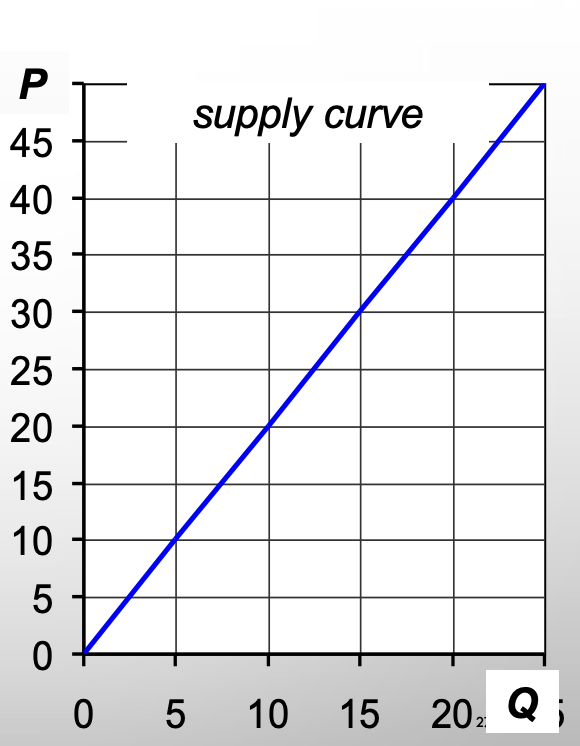
Find Total PS for P = $20
PS= ½ x 10 x $20 = $100
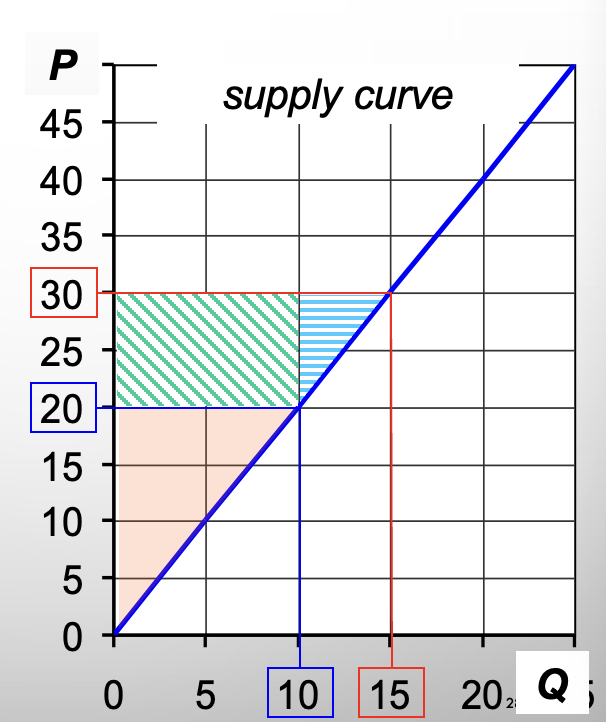
Suppose P rises to $30. Find the increase in PS due to:
Selling 5 additional Units
½ x 5 x $10 = $25
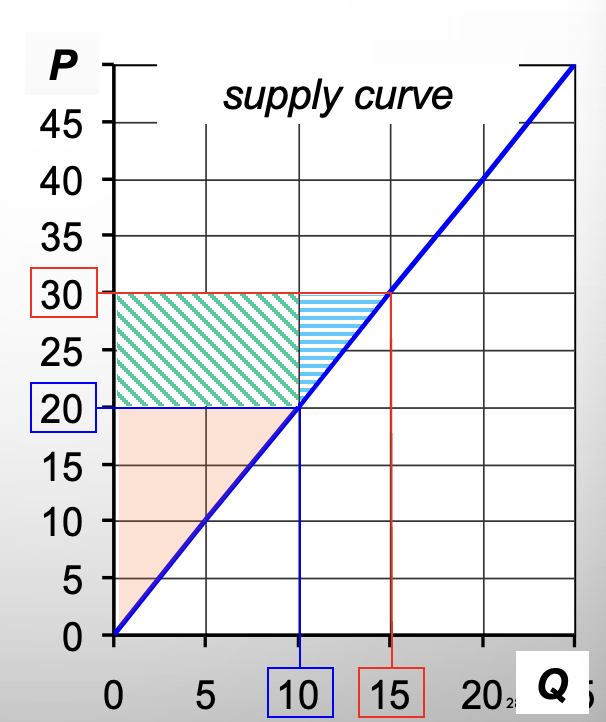
Suppose P rises to $30. Find the increase in PS due to:
Getting a higher price on the initial 10 units
10 x $10 = $100
Total surplus formula
Consumer Surplus + Producer Surplus
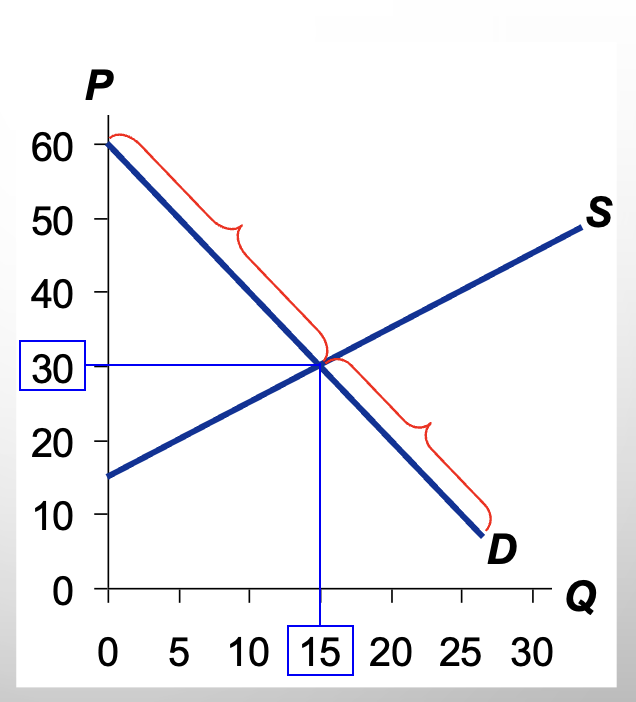
What amount is the WTP for buyers?
WTP is equal to or greater than $30
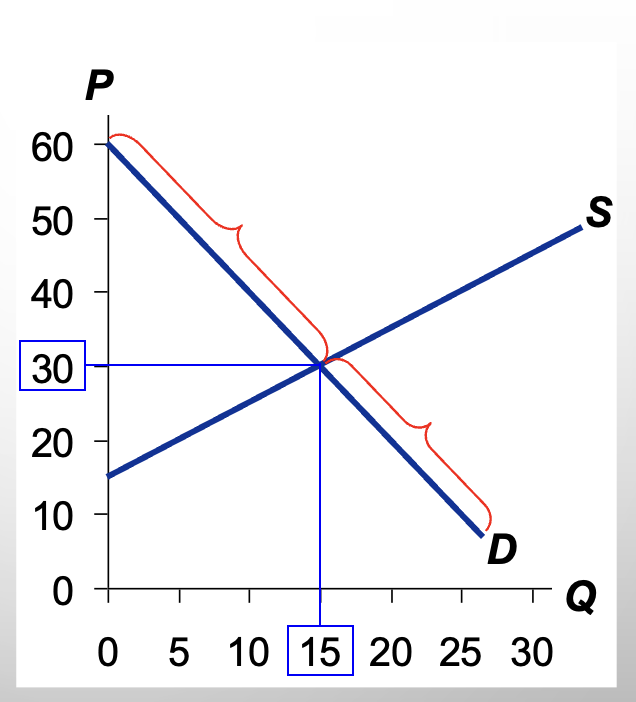
WTP for Buyers who will not consume the good
WTP is Less than $30
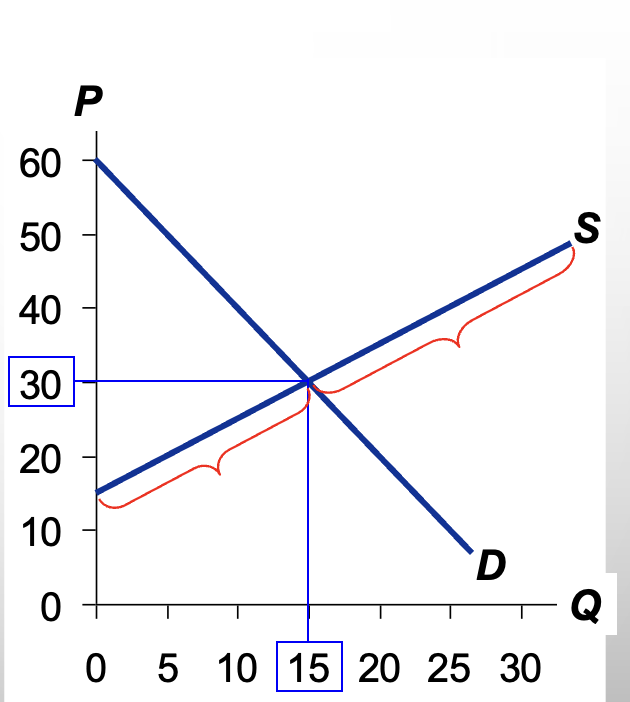
What amount is the willingness to produce a good for sellers?
less than $30 to produce
Sellers with lower costs than the price will remain in the market
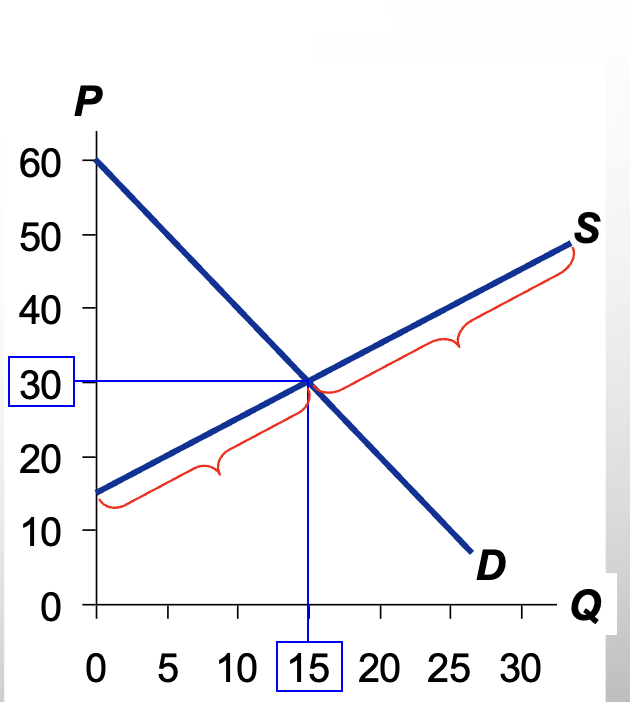
willingness to produce for sellers who will not produce the good
greater than $30 to produce
Sellers with higher costs than the price will exit the market

