CH 5 Derivatives (DONE)
 Studied by 0 people
 Call with Kai
 Learn
Learn Practice Test
 Spaced Repetition
 Match
Match Flashcards
 Knowt Play
1/67

There's no tags or description
Looks like no tags are added yet.
Name | Mastery | Learn | Test | Matching | Spaced | Call with Kai |
|---|
No study sessions yet.
68 Terms
An ________ is a contract that gives the buyer the right, but not the obligation, to buy or sell the underlying asset at a specified price within a specified period of time
option
__________ gives the buyer the right to buy an underlying security (e.g., a stock) at a prespecified price called the exercise or strike price (K)
In return, buyer of call option must pay the writer (or seller) an up-front fee known as a call premium (C)
Call seller is obligated to sell
Call option
_____________ gives the option buyer the right to sell an underlying security (e.g., a stock) at a prespecified price to the writer of the put option
In return, the buyer of the put option must pay the writer (or seller) the put premium (P)
Put seller is obligated to buy
Put option
If you buy a call or a put, you are considered _____________
long the option
If you sell a call or put, you are considered ______________
short the option
If you buy a call, you are considered _______________
long the stock
If you sell a call, you are considered _____________
short the stock
If you buy a put, you are considered _____________
short the stock
If you sell a put, you are considered ______________
long the stock
Option Buyers
Call option buyer wants the stock price to increase
Call option buyer has the right to buy the shares
Put option buyer wants the stock price to decrease
Put option buyer has the right to sell the shares
Option Sellers
Call option seller wants the stock price to decrease
Call option seller has the obligation to sell the shares
Put option seller wants the stock price to increase
Put option seller has the obligation to buy the shares
Option contract characteristics
Option type – either a call or put
Strike price – the predetermined price at which the underlying asset can be exercised at
Calls give the buyer the right to buy at the strike price
Puts give the buyer the right to sell at the strike price
Expiration date – the date at which the option contract expires
At expiration, an option is either exercised or expires worthless
Exercise style – European style or American style
European-style options can only be exercised at expiration
American-style options can be exercised before expiration
Option type
either a call or put`
Strike price
Calls give the buyer the right to buy at the strike price
Puts give the buyer the right to sell at the strike price
the predetermined price at which the underlying asset can be exercised at
Expiration date
At expiration, an option is either exercised or expires worthless
the date at which the option contract expires
Exercise style
European-style options can only be exercised at expiration
American-style options can be exercised before expiration
European style or American style
The relationship between the price of the underlying asset and the strike price is known as _____________. An option’s moneyness can be:
moneyness
In-the-Money (ITM):
A call option is ITM when the underlying asset's price is above the strike price, and a put option is ITM when the underlying asset's price is below the strike price.
Out-of-the-Money (OTM):
A call option is OTM when the underlying asset's price is below the strike price, and a put option is OTM when the underlying asset's price is above the strike price.
At-the-Money (ATM):
An option is ATM when the underlying asset's price is equal to or very close to the strike price.
The time value of an option is the difference between the option’s price and its _________
intrinsic value
An option’s intrinsic value is the difference between the ___________________________
strike price and the underlying asset’s price
Suppose stock ABC is currently trading at $60 and a call option with a strike of $50 is trading at $12.50 with 30 days to expiration
The intrinsic value of the option is $60 – $50 = $10
The time value of the option is $12.50 - $10 = $2.50
The time value of an option is a function of the price volatility of the underlying asset and the time until the option matures
As price volatility in the underlying asset increases, the probability that the stock will go up or down in price increases, the price of an option contract increases.
An options chain is a display of all available option contracts for a _______________________
specific underlying asset.
Information displayed in the options chain:
The underlying asset
The option type
Expiration date
Strike prices
Bid and ask prices
Last price
Volume – the number of contracts traded during the current day
Open interest – total number of outstanding contracts
Greeks – advanced option chains include option Greeks, which are measures of the sensitivity of an option’s price to its underlying parameters (such as the stock’s price or volatility)
Volume
the number of contracts traded during the current day
Open interest
total number of outstanding contracts
Greeks
advanced option chains include option Greeks, which are measures of the sensitivity of an option’s price to its underlying parameters (such as the stock’s price or volatility)
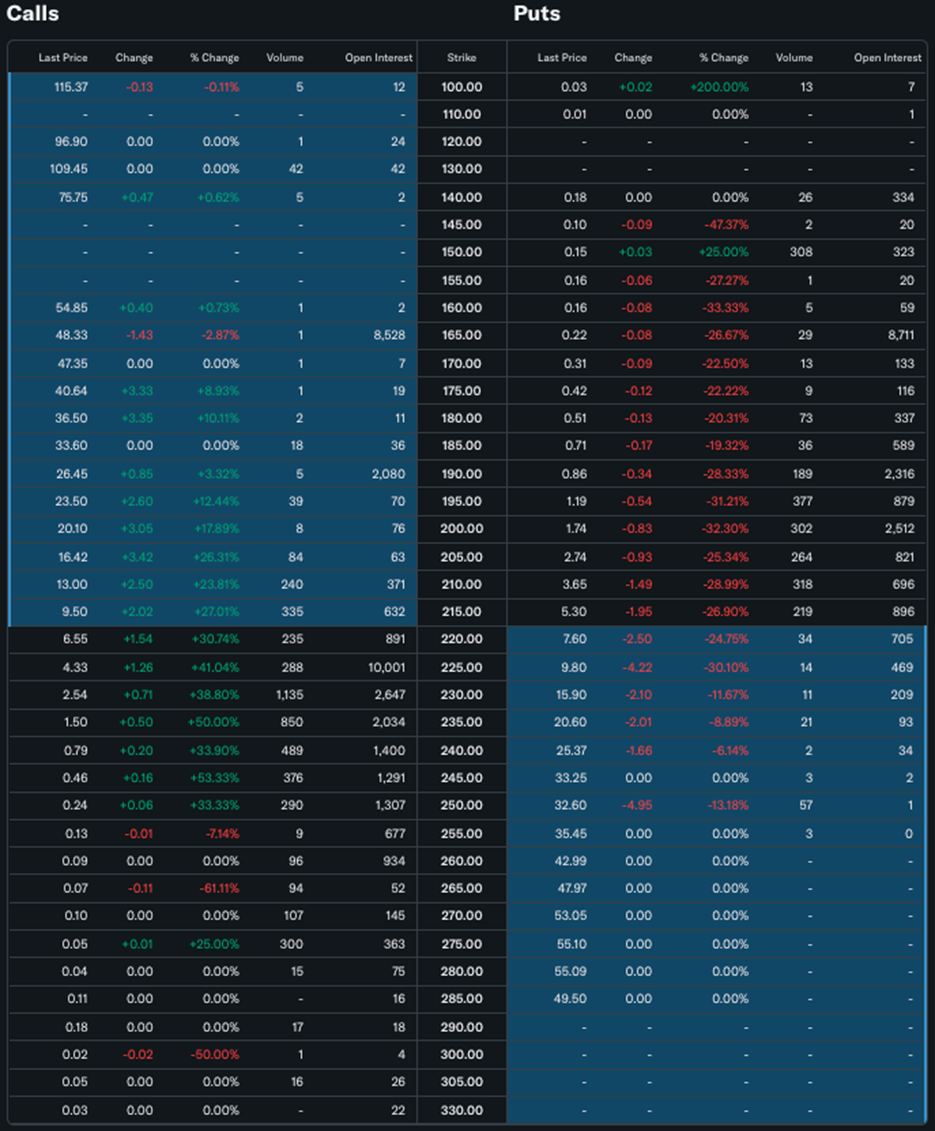
Apple Call and Put Options
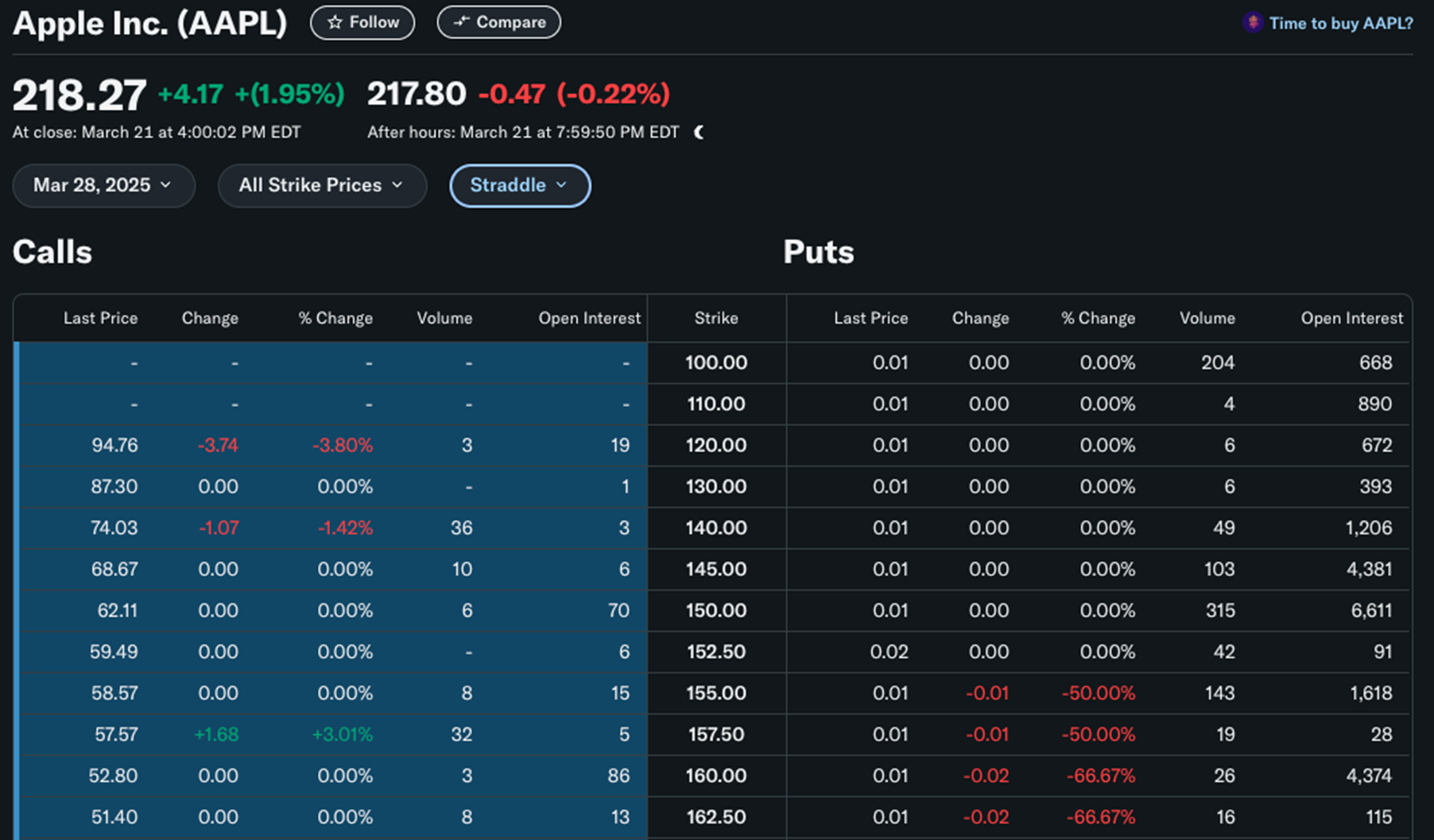
Apple Puts
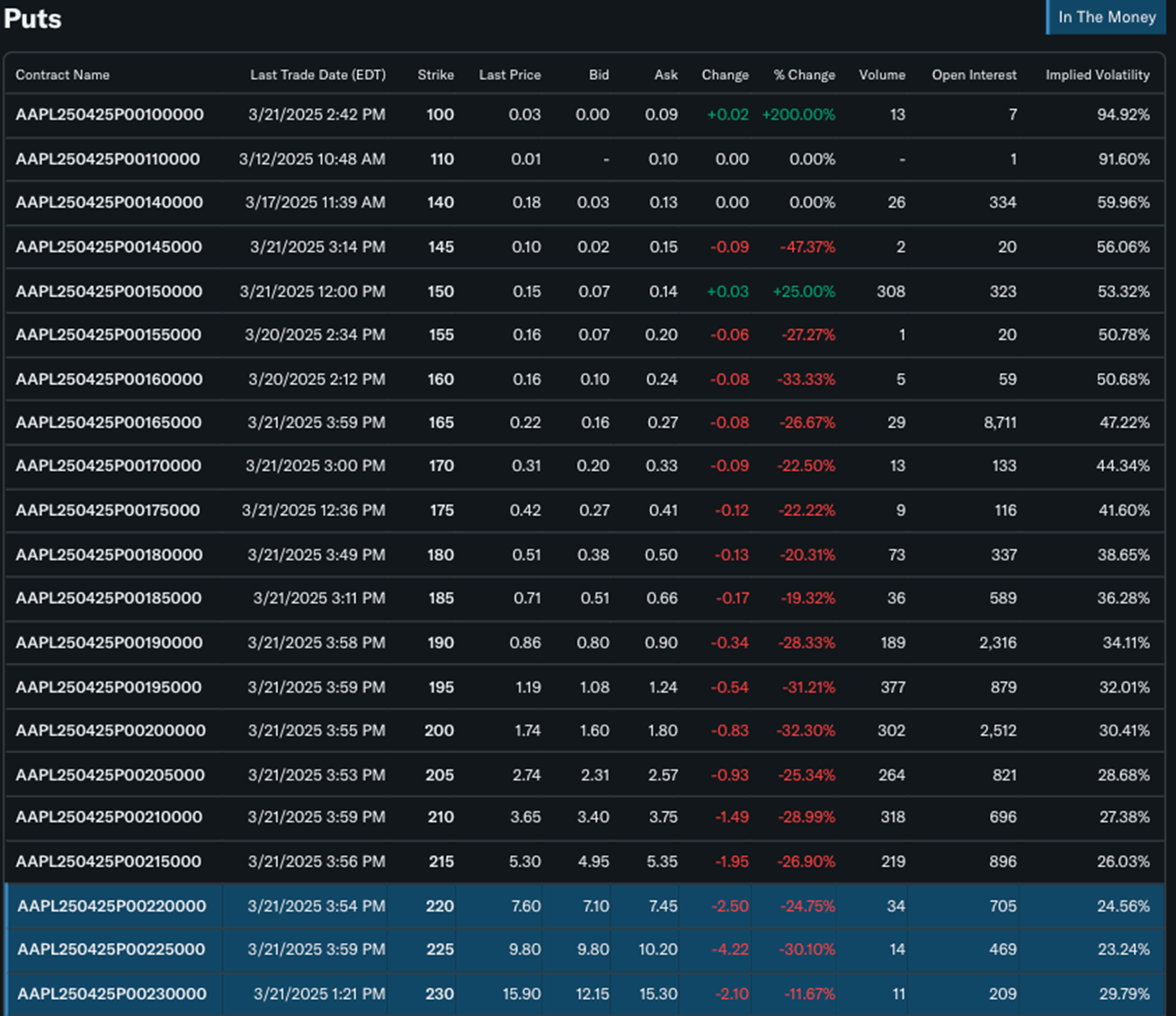
Apple Calls
Entering and exiting an options position
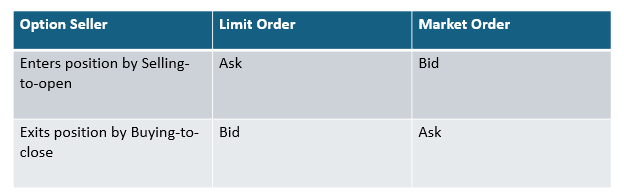
An option buyer enters their position by buying-to-open and exists by selling-to-close
An option seller enters their position by selling-to-open and exits by buying-to-close
Bid/ask spreads are typically wider in options markets compared to equities; therefore, it is important to use limit orders to enter/exit a position to prevent large slippage
An options contract can be executed upon, sold to another buyer, or expire worthless
An option ___________ enters their position by buying-to-open and exists by selling-to-close
buyer
An option __________ enters their position by selling-to-open and exits by buying-to-close
seller
____________ are typically wider in options markets compared to equities; therefore, it is important to use limit orders to enter/exit a position to prevent large slippage
Bid/ask spreads
An options contract can be executed upon, sold to another buyer, or expire __________
worthless
Option Buyer
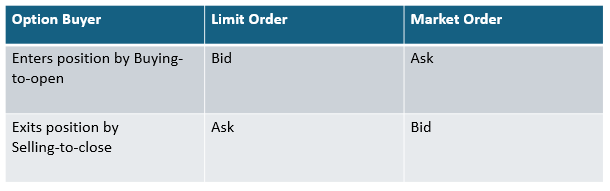
Option Seller


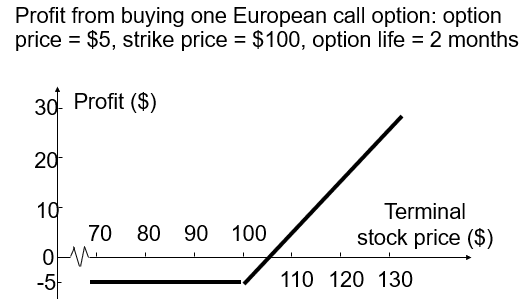
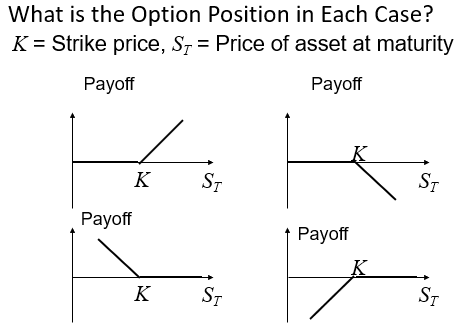
Long Call (Figure 10.1)
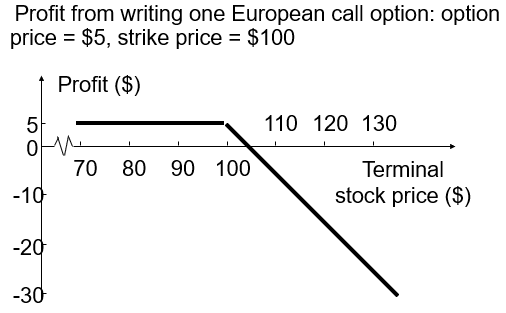
Short Call (Figure 10.3)
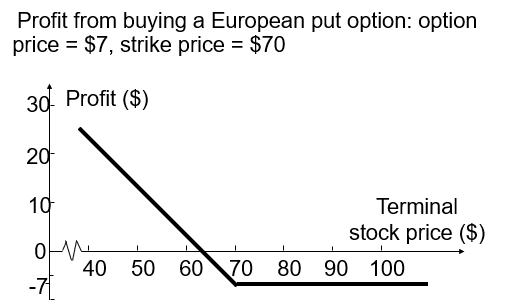
Long Put (Figure 10.2)
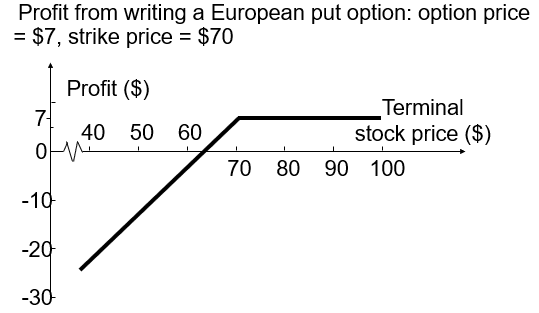
Short Put (Figure 10.4)
Payoffs from Options (Figure 10.5)
What is the Option Position in Each Case?
Inherent leverage of options
Suppose stock XYZ trades at $100 per share and a call option with a strike of $100 that expires one month from now is trading at $2.
You think the price will increase next month. You can do two things:
Buy 100 shares of XYZ at $100 per share, which would cost $10,000
Buy 50 option contracts, which would also cost $10,000
Suppose at expiration XYZ is now trading at $120 and the call option is worth $20
100 shares of XYZ is would net you ($120 – $100) x 100 shares = $2000
50 option contracts would net you ($20 – $2) x 100 shares x 50 contracts = $90,000
Suppose stock XYZ trades at $100 per share and a call option with a strike of $100 that expires one month from now is trading at $2.
You think the price will increase next month. You can do two things:
Buy 100 shares of XYZ at $100 per share, which would cost $10,000
Buy 50 option contracts, which would also cost $10,000
Suppose at expiration XYZ is now trading at $120 and the call option is worth $20
100 shares of XYZ is would net you ($120 – $100) x 100 shares = $2000
50 option contracts would net you ($20 – $2) x 100 shares x 50 contracts = $90,000
Apple stock is trading at $218, and a $200 strike call option with 33 days to expiration is trading at $20.10, what is the intrinsic value of the option and the time value of the option?
Intrinsic value of the call option: $218 - $200 = $18
Time value of the option = $20.10 - $18 = $2.10
Apple stock is trading at $218, and a $200 strike call option with 33 days to expiration is trading at $20.10, what is the intrinsic value of the option and the time value of the option?
A $240 strike put option with the same expiration is trading at $25.37
Intrinsic value of the put option: $240 - $218 = $22
Time value of the option: $25.37 - $22 = 3.27
Apple stock is trading at $218, and a $230 strike call option with 33 days to expiration is trading at $2.54, what is the intrinsic value of the option and the time value of the option?
Intrinsic value of the call option is $0 since the strike > current price (the call option is out-the-money)
Time value of the option is $2.54
Apple stock is trading at $218, and a $230 strike call option with 33 days to expiration is trading at $2.54, what is the intrinsic value of the option and the time value of the option?
A $210 strike put option with the same expiration is trading at $3.65
Intrinsic value of the put option is $0 since the strike < current price (the put option is out-the-money)
Time value of the option is $3.65
Apple stock is trading at $218, and a $225 strike call option with 33 days to expiration is trading at $4.33
If you buy the call, then:
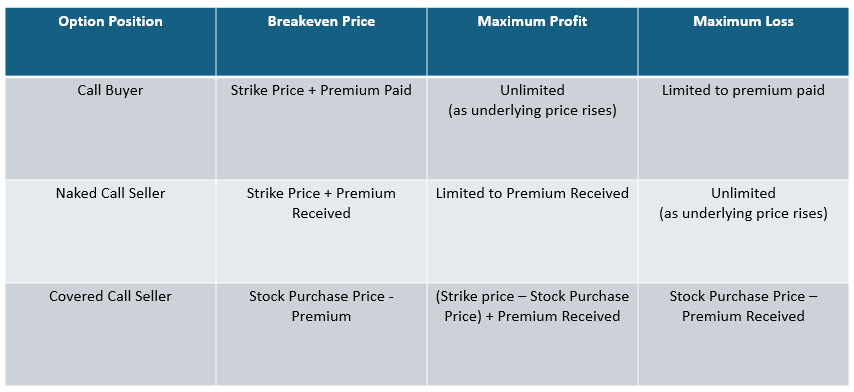
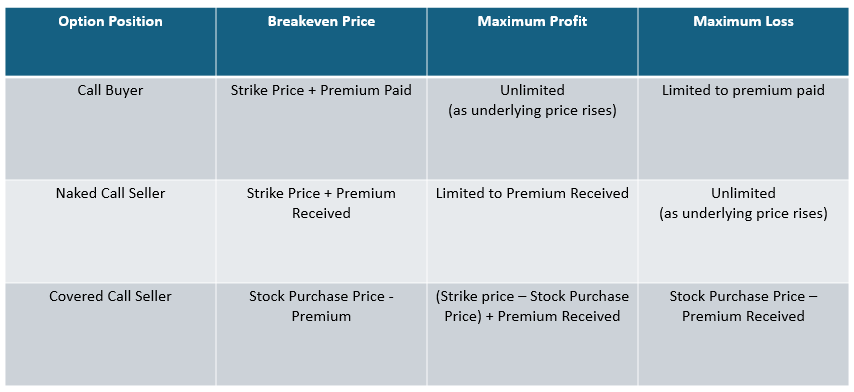
Your breakeven price is Strike + Premium paid = $225 + $4.33 = $229.33 (After Apple stock price passes above $229.33, you start profiting)
Your maximum profit is theoretically unlimited
Your maximum loss is limited to the Premium paid, $4.33 x 100 = $433 per contract
Apple stock is trading at $218, and a $225 strike call option with 33 days to expiration is trading at $4.33
If you sold the call naked, then:
Your breakeven price is Strike + Premium paid = $225 + $4.33 = $229.33
(After Apple stock price passes above $229.33, you start losing money)
Your maximum profit is limited to the Premium received, $4.33 x 100 = $433 per contract
Your maximum loss is theoretically unlimited
Apple stock is trading at $218, and a $225 strike call option with 33 days to expiration is trading at $4.33
Suppose you bought shares at $200, if you sold the covered call, then:
Your breakeven price is Stock purchase price – Premium received = $200 - $4.33 = $195.67 (After Apple stock price falls below $195.67, you start losing money)
Your maximum profit is [(Strike price – Purchase price) + Premium] = [($225 – $200) + $4.33] = $29.33 x100 = $2,933 per contract
Your maximum loss is Purchase price – Premium Received = $200 – $4.33 = $195.67 x100 = $19,567 if the price goes to $0 per share
Apple stock is trading at $218, and a $210 strike put option with the 33 days to expiration is trading at $3.65
If you buy the put, then:
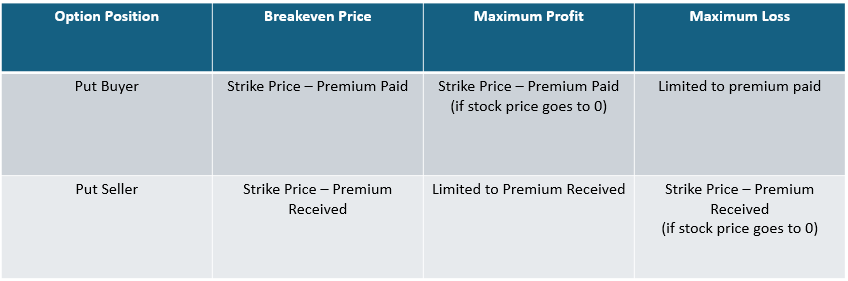
Your breakeven price is Strike – Premium paid = $210 – $3.65 = $206.35
(After Apple stock price falls below $206.35, you start profiting)
Your maximum profit is Strike – Premium paid = $206.35 per contract if the price goes to $0 per share
Your maximum loss is limited to the Premium paid, $3.65 x 100 = $365 per contract
Apple stock is trading at $218, and a $210 strike put option with the 33 days to expiration is trading at $3.65
If you sold the put, then:
Your breakeven price is Strike – Premium Received = $210 – $3.65 = $206.35
(After Apple stock price passes above $206.35, you start losing money)
Your maximum profit is limited to the Premium Received, $3.65 x100 = $365 per contract
Your maximum loss is Strike – Premium Received = $206.35 x100 = $20,635 per contract if the price goes to $0 per share
Suppose you want to write a call option on Apple. The ATM closest expiry call option had a last price of $2.42, a bid of $2.38 and an ask of $2.47
You sell-to-open using a limit order
Assuming the order is immediately executed upon, your entry is at $2.47, so you collect $2.47 x100 = $247 in premium (minus fees)
You sold a call option, meaning you think the price of Apple will decrease.
Suppose the next day Apple has fallen in price, therefore the value of the call option has also decreased.
The call option you sold is now trading at $1.75 with a bid of $1.72 and an ask of $1.78
You buy-to-close using a limit order and you pay $1.72 x100 = $172 to close the position
Your total profit on the trade is $247 - $172 = $75
Suppose you want to buy a call option on Apple. The ATM closest expiry call option had a last price of $2.42, a bid of $2.38 and an ask of $2.47
You buy-to-open using a limit order
Assuming the order is immediately executed upon, your entry is at $2.38, so you pay $2.38 x100 = $238 in premium (plus fees)
You bought a call option, meaning you think the price of Apple will increase.
Suppose the next day Apple has increased in price, therefore the value of the call option has also increased.
The call option you bought is now trading at $3.75 with a bid of $3.72 and an ask of $3.78
You sell-to-close using a limit order and you receive $3.78 x100 = $378 to close the position
Your total profit on the trade is $378 - $238 = $140
Dividends & Stock Splits
Suppose you own N options with a strike price of K :
No adjustments are made to the option terms for cash dividends
When there is an n-for-m stock split,
the strike price is reduced to mK/n
the no. of options is increased to nN/m
Stock dividends are handled similarly to stock splits
Consider a call option to buy 100 shares for $20/share
How should terms be adjusted:
for a 2-for-1 stock split?
for a 5% stock dividend?
Market Makers
Most exchanges use market makers to facilitate options trading
A market maker quotes both bid and ask prices when requested
The market maker does not know whether the individual requesting the quotes wants to buy or sell
Margin
Margin is required when options are sold
When a naked option is written the margin is the greater of:
A total of 100% of the proceeds of the sale plus 20% of the underlying share price less the amount (if any) by which the option is out of the money
A total of 100% of the proceeds of the sale plus 10% of the underlying share price (call) or exercise price (put)
For other trading strategies there are special rules
Warrants
Warrants are options that are issued by a corporation or a financial institution
The number of warrants outstanding is determined by the size of the original issue and changes only when they are exercised or when they expire
The issuer settles up with the holder when a warrant is exercised
When call warrants are issued by a corporation on its own stock, exercise will usually lead to new treasury stock being issued
Employee Stock Options (see also Chapter 16)
Employee stock options are a form of remuneration issued by a company to its executives
They are usually at the money when issued
When options are exercised the company issues more stock and sells it to the option holder for the strike price
Expensed on the income statement
Convertible Bonds
Convertible bonds are regular bonds that can be exchanged for equity at certain times in the future according to a predetermined exchange ratio
Usually a convertible is callable
The call provision is a way in which the issuer can force conversion at a time earlier than the holder might otherwise choose
 Note
Note  Flashcards (49)