SOCI 201 FINAL - UofC
 Studied by 8 people
 Call with Kai
 Learn
Learn Practice Test
 Spaced Repetition
 Match
Match Flashcards
 Knowt Play
1/191

Earn XP
Description and Tags
Name | Mastery | Learn | Test | Matching | Spaced | Call with Kai |
|---|
No study sessions yet.
192 Terms
CHAPTER 8: RELIGION
Richard Dawkins (2)
Well-known Atheist and author of ‘The God Delusion’
Argues that atheists are oppressed in many societies because they are forced to accept or endure ideas they disagree with
What is Religion?
Religion is a system of meaning for interpreting the world, consisting of unified beliefs with a supernatural referent
What is a supernatural referent?
A divine, mystical, or otherworldly being or force that a religion is based on (i.e. God, spirits, ancestors, etc.)
What do religions suggest?
That existence has a predefined meaning and gives purpose
What is the humanist perspective on religion? (2)
The humanist perspective is human-centered and often science-based, rejecting supernatural beliefs
It argues that life has no inherent meaning; we create our own meaning
How is religion studied from a sociological standpoint?
Religion is studied scientifically by developing theories and hypotheses and testing them using rigorous scientific methods
What does Reginald Bibby say about religion in Alberta?
Alberta is not the Bible Belt of Canada and has the second-highest rate of people reporting "no religion" or "no religious affiliation" (after BC)
What does Reginald Bibby argue about religion in Canada? (2)
Canadians and Albertans are trying to figure life out, but few are turning to traditional religions
Argues formal religious institutions do not fully meet spiritual needs
Karl Marx & “Opium” (5)
Religion/God is a human creation
Religion is the “opium of people”
Religions maintains an unequal, exploitive society
Religion delays the inevitable transition to communism
Religion will eventually fade away
What does Marx mean by "religion is the opium of the people"?
Marx argued that religion numbs the suffering of the oppressed (i.e. drugs like opium), preventing them from resisting exploitation
Durkheim & “Holey” (4)
Religion is a social/human construct
Religion contributes to the collective conscience
Religions identifies this as sacred and profane
Religion will continue to impact people and behaviour
What is collective conscience?
The shared beliefs, values, and morals that unite a society and guide behavior, reinforcing social order (religion strengthens this)
Sacred
Things set apart as holy, special, and worthy of worship (i.e. religious symbols, texts)
Profane
Ordinary, everyday objects and activities (i.e. eating, working)
Durkheim: Functions of Religion (6)
Fosters cohesion (unites people through shared beliefs)
Offers support during crisis (comfort)
Addresses ultimate questions (purpose & morality)
Provides social service (charity & welfare activities)
Legitimizes political authority (justifies law & leadership)
Influences social change (inspires movements)
Weber & “Spirit” (4)
Wrote ‘The Protestant Ethic and the Spirit of Capitalism’
We should examine religion in terms of how it affects our behavior
Religion has been instrumental in shaping modern capitalism
Religion creates power for some leaders
The Protestant Ethic and the Spirit of Capitalism
Weber argued that religious beliefs, particularly Protestantism, influenced the rise of modern capitalism
How did religion contribute to capitalism, according to Weber?
Protestant work ethic promoted hard work, discipline, and frugality
These values encouraged economic growth and investment, leading to modern capitalism
What are the four dimensions of personal religiosity argued by Reginald Bibby?
Belief (in God)
Practice (i.e. prayer)
Experience (see/speak directly to God)
Knowledge (understanding religious texts and teachings)
What percentage of Canadians believe in God?
8 out of 10 Canadians believe in God
How many Canadians believe in life after death?
7 out of 10 Canadians believe in life after death
How many Canadians pray at least once a month?
6 out of 10 Canadians pray at least once a month
What does the data (about God, the afterlife, and prayer) suggest about the importance of religion in Canada? (2)
While most Canadians believe in God and life after death, only 1 in 4 consider religion to be "very important" in their lives
This suggests belief is common, but deep religious commitment is declining
What is collective religiosity according to Durkheim?
It refers to how people behave collectively in religion, not just individual beliefs
What are two ways to interpret religions sociologically?
Church-sect typology
Organizational approach
Church-sect typology
Religions can split from existing churches into sects
Organizational Approach (5)
A perspective (by Bibby) that examines religions as structured organizations through:
Sources of members (where members come from)
Goals of the group (aim of religion)
Norms and roles (rules that guide behavior/purpose)
Sanctions (ways to ensure conformity)
Success (how well religion maintains itself)
What is the contradiction in religious trends?
Personal religiosity (belief, prayer, experience) is strong, but collective religiosity (church attendance, institutional influence) seems to be declining
What causes people to become religious? (3)
Reflection
Socialization
Deprivation
Reflection
Personal search for the meaning in life
Socialization
Learning religious beliefs from family, community, or culture
Deprivation
Turning to religion for comfort during hardship (i.e. economic, emotional, or social struggles)
Religion in Canada (3)
High religious tolerance and a separation of church and state
Catholics and Protestants have the most followers, but their numbers are declining
Islamic, Hindu, Sikh, and Buddhist populations are increasing due to immigration
What does Reginald Bibby argue about the fate of religion in Canada?
Religion's survival depends on its ability to meet the needs and interests of Canadians
Are Canadians abandoning religion completely? (2)
No, they are not leaving traditional religions entirely but are instead turning to fragments of them
Bibby’s book called ‘Fragmented Gods’ discusses this
What is meant by "fragments" of traditional religions?
Instead of fully following a religion, people pick and choose certain beliefs and practices that suit them
What does Reginald Bibby say about the role of the "electronic church"?
Canadians are not turning to televised religious services as an alternative to traditional religion
Conclusion: How did Marx, Durkheim, and Weber differ in their views on religion? (3)
Marx: Criticized religion as a tool for maintaining inequality
Durkheim: Saw religion as functional for society, fostering cohesion
Weber: Interested in effects on society and social structures
What is said about the future of religion in Canada?
Canadians appear highly religious, but the future of religion remains unclear
CHAPTER 9: SEX & GENDER
Who is Caster Semenya, and why is she significant?
A South African runner who was publicly scrutinized after "failing" gender testing due to high testosterone levels, highlighting issues of intersex identity and fairness in sports
Sex (2)
Biological traits of men and women
Chromosomes, gonads, hormones, anatomical differences
Gender
Gender is a social, cultural, and psychological construct linked to roles and behaviors traditionally associated with males and females
Sexual Orientation (4)
Heterosexuality
Homosexuality
Bisexuality
Sexual Continuum
What is heterosexuality?
Sexual attraction to individuals of the opposite sex
What is homosexuality?
Sexual attraction to individuals of the same sex
What is bisexuality?
Sexual attraction to both males and females
What is the sexual continuum? (2)
The idea that sexual orientation exists on a spectrum rather than in fixed categories, recognizing fluidity in attraction
Alfred Kinsey
What did Alfred Kinsey’s study find about sex? (3)
85% of men and 50% of women reported having premarital sex
30-45% of men and 26% of women reported engaging in extramarital sex
70% of men reported having sex with prostitutes, while no data was reported for women
What is extramarital sex?
Extramarital sex refers to sexual activity that occurs outside of one's marriage, involving at least one married partner
What did Alfred Kinsey's research on specifically the sexual continuum reveal? (3)
37% of males and 13% of females had homosexual experiences
11.6% of males and 4-7% of females fell in the middle of the sexual spectrum (Rating of 3)
10% of males and 1-3% of females identified as exclusively homosexual
Who was David Reimer?
David Reimer was a Canadian male assigned female after a botched circumcision and raised as a girl following sexual reassignment
What does David Reimer’s case show about gender? (2)
Suggests gender identity is partly biological (nature), not just shaped by upbringing (nurture)'
Despite being raised as a girl after a failed surgery, he identified as male, showing that biology plays a key role in gender
Essentialism
The idea that people and things have 'natural' characteristics that are inherent and unchanging
What is essentialism in sex differences?
Essentialism argues that biological traits (brain structure, genetics, and psychology) determine gender differences
Essentialism: Brain Studies (2)
Left hemisphere: language
Right hemisphere: visual and spatial skills
Essentialism: Sociobiology
Suggests that those who solve problems better pass on their genes, leading to evolutionary gender differences
Essentialism: Freud’s Oedipus & Electra Complexes (2)
Oedipus complex: boys unconsciously desire their mother and sees their father as a rival
Electra complex: girls unconsciously desire their father and sees their mother as a rival
Social Constructionism
Social Constructionism argues that gender roles are shaped by society, history, and culture rather than biology
Social Constructionism: Warfare & Conquest
Historically, warfare created male-dominated leadership and reinforced ideas of masculinity in power
Social Constructionism: Plow Agriculture
Farming with plows required physical strength, leading to men taking dominant roles in society (women took domestic spaces)
Social Constructionism: Separation of Public & Private Spheres
Men took public roles (work, politics), while women were expected to stay in the private sphere (home, caregiving)
What is the first critique to Essentialism? (critique + 3)
Essentialism is criticized for ignoring historical and cultural variability in gender and sexuality
Variation of gender across cultures
Rape rates vary widely across cultures (sexual violence is influenced by societal norms)
Societies change without any corresponding
genetic change
How do gender roles vary across cultures according to Margaret Mead?
Anthropologist Margaret Mead studied the Arapesh in New Guinea, where both men and women were nurturing, showing that gender roles are socially constructed rather than biologically determined
What is the second critique to Essentialism? (critique + 3)
Essentialists ignore that gender differences are rapidly declining and, in some cases, have already disappeared
Studies found no significant difference in verbal abilities between genders
Studies found a slight advantage for females in math ability
Spatial differences were minor, showing that cognitive skills are not strictly tied to gender
What is the third critique to Essentialism? (critique + 2)
Essentialist research is often deeply flawed and lacks scientific evidence
Sociobiologists have not identified specific genes responsible for: male jealousy, female nurturance, unequal division of labor between men and women
Essentialists generalize from the average, ignoring variations within gender groups
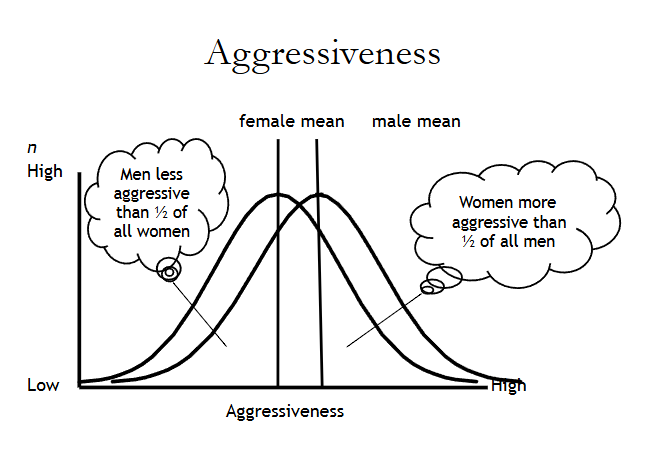
What does the aggressiveness graph show about men and women? (3)
The average level of aggressiveness is higher in men than women, but there is overlap
Some women are more aggressive than half of all men
Some men are less aggressive than half of all women
What is the fourth critique to Essentialism? (critique + 2)
Essentialists exaggerate how unchangeable gender differences are
More egalitarian (promoting equality) societies show smaller gender differences, like a reduced age gap in relationships
Essentialists fail to consider social power structures that shape gender roles
Economic Inequality (5)
Double work day
Sex segregation
Sex typing
Glass-ceiling
Nonstandard work
What is a double work day?
When individuals, often women, work a paid job during the day and then perform unpaid domestic labor at home (i.e. childcare, housework)
What is sex segregation?
The division of jobs based on gender, where men and women are concentrated in different types of work (i.e. nursing vs. construction)
What is sex typing? (2)
The association of certain jobs with a specific gender (i.e. "secretary" as a female job, "mechanic" as a male job)
Sex typing is responsible for inequalities in
economic, social, and political realms
What is the glass ceiling?
An invisible barrier preventing women and minorities from advancing to higher leadership positions, despite qualifications
What is nonstandard work?
Jobs that are temporary, part-time, or contract-based, often with lower pay and fewer benefits than full-time jobs
What is gender stratification?
A system where men generally hold greater power, prestige, and wealth than women in society
Power
The ability to impose one’s will on others
Prestige
A person’s social ranking and respect based on achievements, status, or occupation
Social Inequality: Wealth
Economic resources used to pay for life’s necessities, including money, property, and assets
Why have women become more involved in the labour force since 1961?
Increased demand for service sector workers
Decline in birth rates (fewer children born)
Financial necessity for families
What is the service sector?
The service sector includes jobs that provide services rather than goods, such as healthcare, education, retail, finance, and hospitality
Income: Four Reasons Why Women Earn Less than Men (4)
Differences in education, experience, and seniority
Women are involved in sex-segregated, non-standard work
Discrimination—women are often paid less for the same jobs
Devaluation of work traditionally performed by women
Who was Canada's first and only female Prime Minister, and how long did she serve?
Kim Campbell; she served for 4 months in 1993 after “inheriting” the position from Brian Mulroney (PC party status was lost)
What was the representation of women in Canadian politics in 2013? (3)
Federal: 64 out of 308 politicians were female
Provincial: 156 out of 734 politicians were female
Only 2 out of 4 female Premiers were elected
Socialist Feminism: What are the two sources of women’s oppression? (2)
Capitalism
Patriarchy
What do socialist feminists believe? (4)
Both capitalism and patriarchy must be substantially altered or eliminated
Capitalists benefit from unpaid labor (i.e. raising children without pay)
The state intervenes with social programs, increasing federal debt
Laws should be changed to promote positive social change in society
What do radical feminists believe? (3)
Women are oppressed simply because they are women, not due to capitalism
The state is male-dominated and serves as an enemy, not an ally (patriarchy)
Men are naturally aggressive and seek to dominate women
How does mass media influence beauty norms?
Media reinforces idealized beauty norms that pressure women to meet unrealistic standards
The Body Beautiful: What did Mathews (2000) find about girls and beauty image? (3)
Girls did not see themselves as passive victims of beauty standards
Looking better gives access to social groups and power
Other girls, not boys, were the harshest critics of beauty
What four social groups did Mathews identify in Lethbridge, AB? (4)
The elite (highest status)
The “wannabees” (try to fit in, do not fully belong)
“Life in the middle:” (navigate between the elite and lower-status)
The fringe (marginalized from the mainstream)
CHAPTER 10: CRIME & DEVIANCE
What do Reiman and Leighton (2013) argue about crime?
They argue that crime is best understood as a "carnival mirror," meaning that the way crime is portrayed in the media distorts reality and differs greatly from actual crime patterns
How is the "typical criminal" characterized in society?
As a young, poor, Black, urbanized male
What is the reality of more pervasive and costly crimes? (2)
They are often committed by individuals engaged in fraud, tax evasion, consumer deception, medical malpractice, and property crime
Crime is an illusion in our society
What is crime?
The act of breaking a law
What is deviance?
Non-normative behavior that violates a norm
Can something be a crime but not deviant?
Yes, for example, speeding—many people exceed the speed limit, making it a crime but not necessarily deviant
Can something be deviant but not a crime?
Yes, for example, full-body tattoos may be seen as deviant but are not illegal
What are consensus crimes?
Crimes considered very harmful (mala in se) and carrying the harshest sanctions (e.g., murder, assault)
What are conflict crimes?
Crimes where there is less agreement on their harmfulness (mala prohibita), often varying by culture or society (e.g., drug use, gambling)
 Note
Note  Flashcards (62)