Meiosis
 Call Kai
 Learn
Learn Practice Test
 Spaced Repetition
 Match
Match Flashcards
 Knowt Play
1/59

There's no tags or description
Looks like no tags are added yet.
Name | Mastery | Learn | Test | Matching | Spaced | Call with Kai |
|---|
No analytics yet
Send a link to your students to track their progress
60 Terms
What happens during sexual reproduction?
Reproductive cells called gametes unite to form a new individual in a process called fertilization
What are gametes?
reproductive cells and in animals are called sperm and eggs
What is meiosis?
The nuclear division that leads to a halving of chromosome number. The Gametes must contain half the chromosome number, and at fertilization, the full chromosome number is restored.
What are sex chromosomes?
determine the sex of the individual
females have XX chromosomes, and males have XY chromosomes
What are non-sex chromosomes called?
autosomes
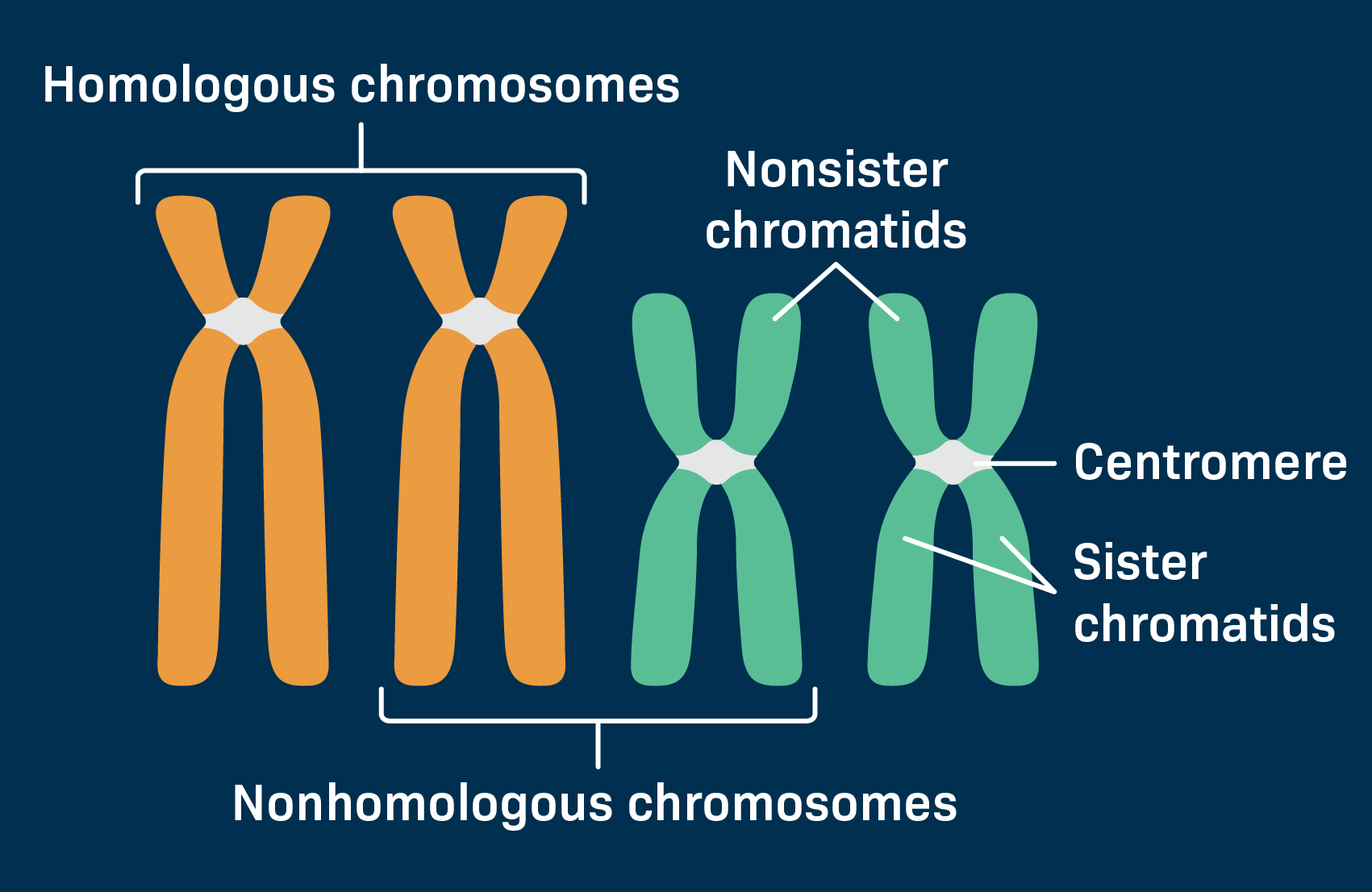
What are homologous chromosomes/homologs?
pairs of matching chromosomes—one inherited from each parent—found in diploid cells that possess the same genes, size, and structure, but often different alleles
What is a gene?
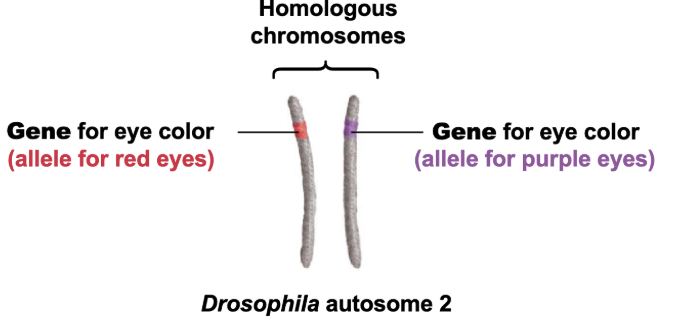
a section of DNA that influences one or more hereditary traits
Different versions of specific genes are called alleles
Homologs may contain different alleles
What is ploidy?
The number of complete sets of chromosomes in a cell or organism (n,2n,3n, etc)
more than three or more versions of each type of chromosome are called polypoid (3n, 4n, etc)
Define Karyotype
identifies the number and types of chromosomes present in a species
humans are diploid (2n) - two homologs of each chromosome and two alleles of each gene, paternal chromosome that came from the father and maternal chromosome that came from the mother
other organisms haploid (n) - only one of each type of chromosome and one alleles of each gene
Define haploid number (n)
indicates the number of distinct types of chromosomes present
sex chromosomes count as a single type
humans have 23
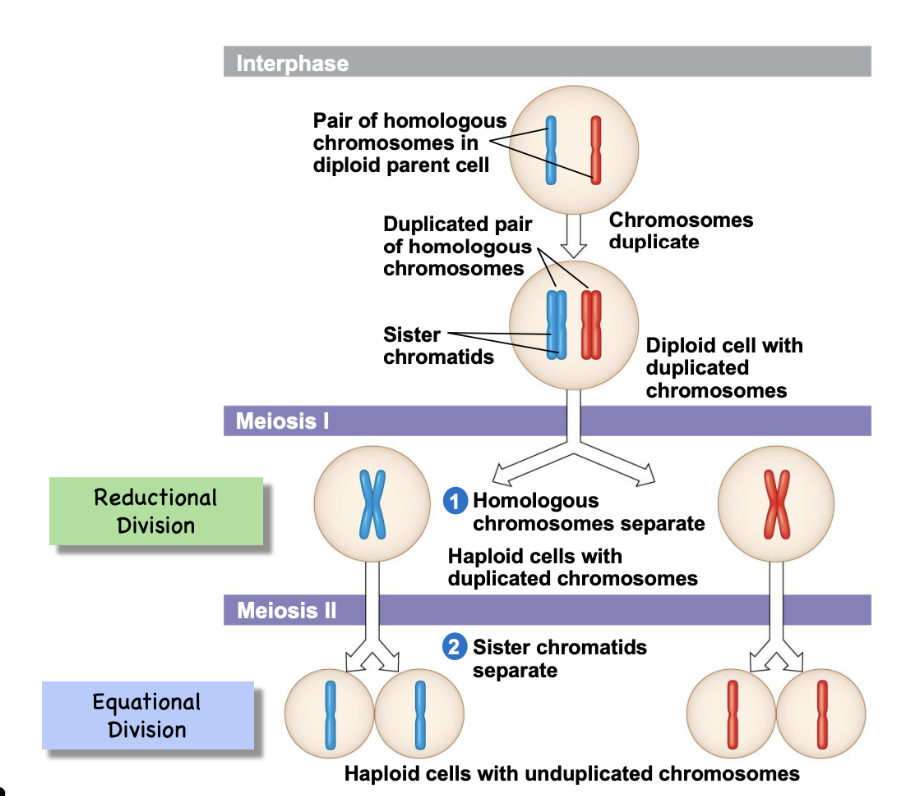
What happens to the chromosomes before meiosis begins?
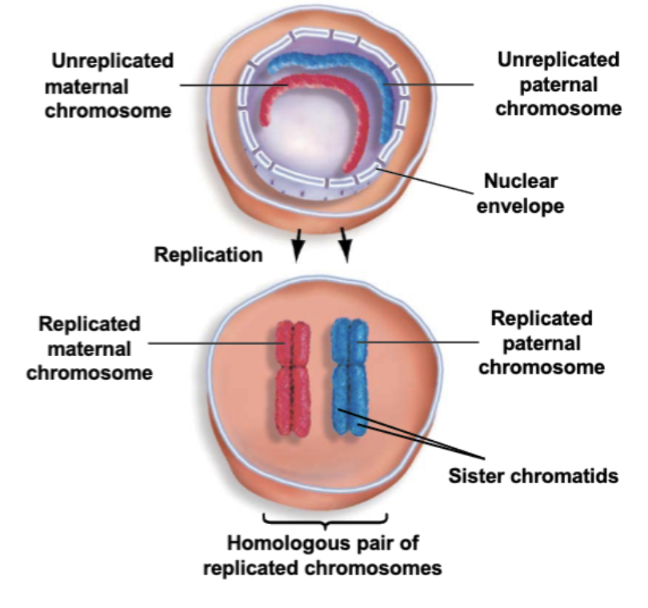
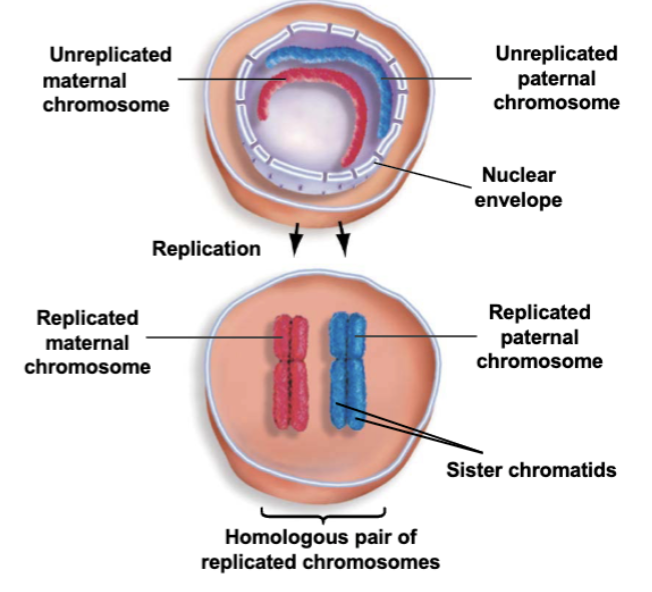
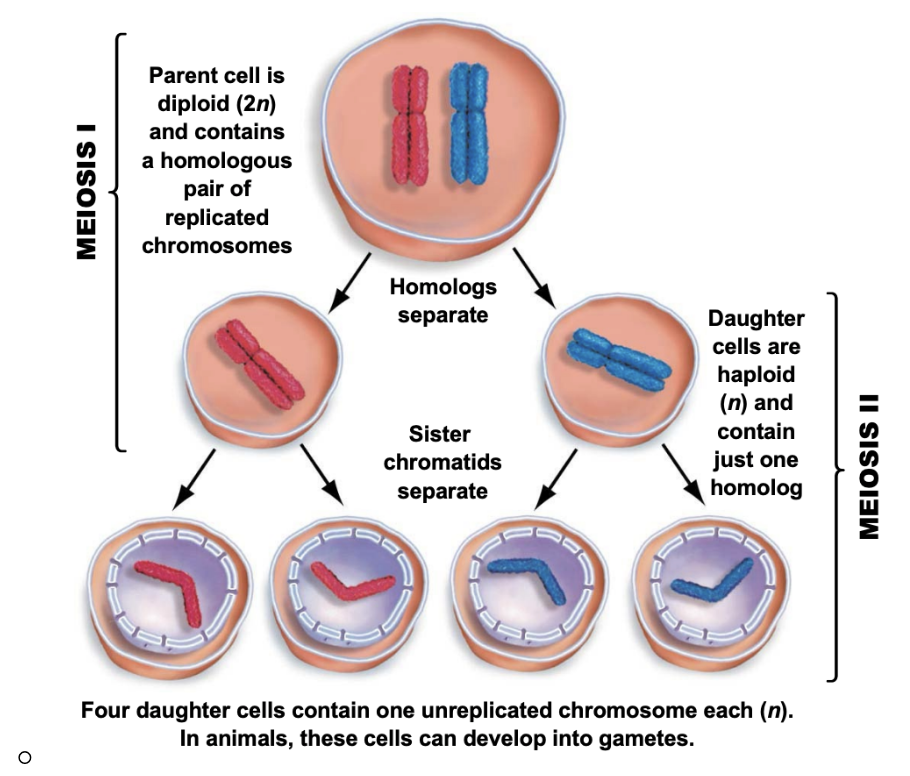
Each chromosome in the diploid (2n) parent cell is replicated. Each chromosome will have two identical sister chromatids.
Define sister chromatids
two identical copies of a single replicated chromosome that are joined together at a region called the centromere
What are the two divisions of meiosis?
Meiosis I: Homologous chromosomes separate
Meiosis II: Sister chromatids separate
How many cells result from meiosis?
Four haploid (n) daughter cells
What happens during fertilization?
two haploid gametes combine to form a diploid zygote
What restores the diploid chromosome number in organisms?
Fertilization
What structure move chromosomes during meiosis?
Microtubules of the spindle apparatus
Where do spindle microtubules attach to chromosomes?
Kinetochores at the centromere
What happens during interphase?
each chromosome in the diploid (2n) parent cell is replicated and each chromosome has two identical sister chromatids
The two attached sister chromatids are still considered a single replicated chromosome
Why is meiosis I called a reductional division?
it reduces chromosome number form diploid (2n) to haploid (n)
What separates during Meiosis I?
homologous chromosomes
What is the result of meiosis I?
two haploid cells with replicated chromosomes
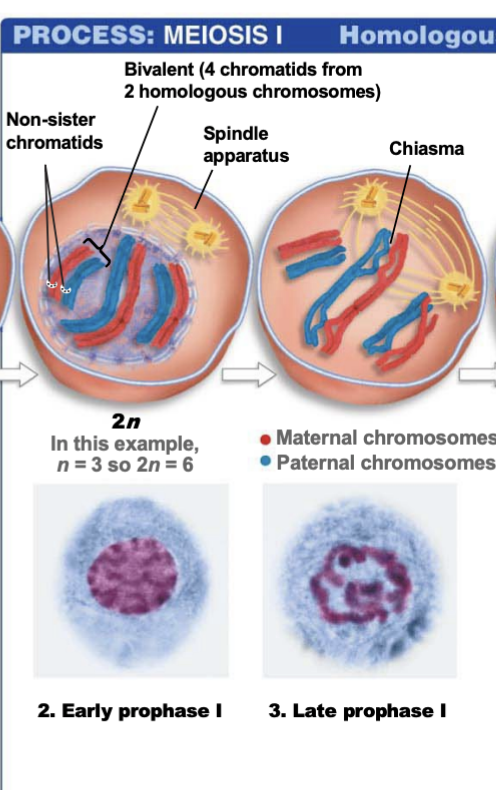
Describe stages of meiosis I: Prophase 1
occupies 90% of meiosis
chromosomes condense
synapsis homologous chromosomes pair gene-by-gene
bivalent a pair of homologous chromosomes
crossing over, non-sister chromatids exchange DNA segments
Each bivalent usually has one or more chiasmata, X-shaped regions where crossing over occurred
Produces chromosomes with a combination of maternal and paternal alleles
What is the genetic result of crossing over?
chromosomes with both maternal and paternal alleles
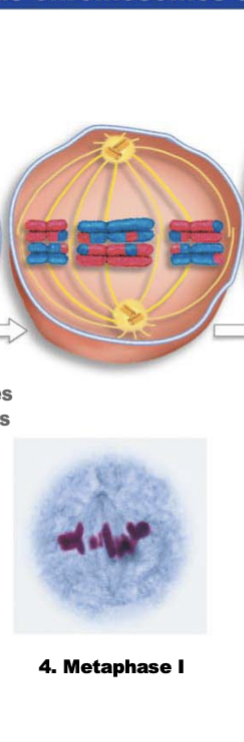
Describe stages of meiosis I: Prophase I, Metaphase I
What happens in metaphase I? How do homologs align in metaphase I?
homologous chromosome pairs line up at the metaphase plate
randomly (independent assortment)
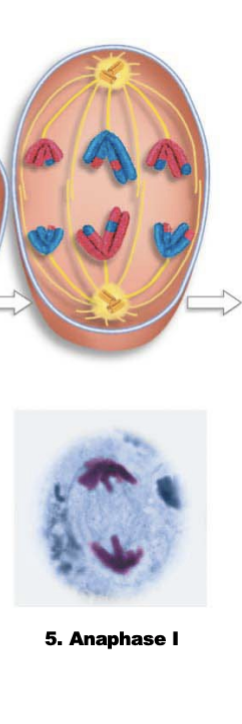
Describe stages of meiosis I: Prophase I, Metaphase I, Anaphase I
homologous chromosomes separates
Describe stages of meiosis I: Prophase I, Metaphase I, Anaphase I, Telophase I?
homologs move to opposite poles
cytokinesis divides the cell
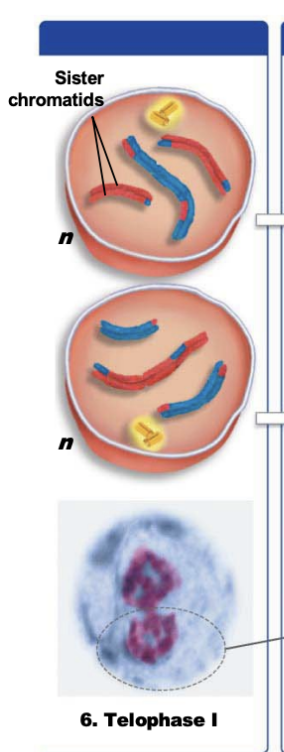
How is meiosis II similar to mitosis?
sister chromatids separate
Does DNA replication occur before meiosis II?
No
What is the result of meiosis II?
Four haploid daughter cells with unreplicated chromosomes
What two mechanisms create genetic variation in meiosis?
crossing over
random assortment of homologous chromosomes
What is the final result of meiosis?
1 diploid cell —> 4 haploid cells
What are the four steps of homolog pairing and crossing over?
prophase I
chromosomes condense; sister chromatids remain joined by cohesins
homologous chromosomes pair by synapsis via the synaptonemal complex
DNA breaks occur and crossing over happens between non-sister chromatids
the synaptonemal complex breaks down, homologs remain attached at chiasmata
Why doesn’t crossing over occur in mitosis?
homologous chromosomes do not pair, so crossing over cannot occur
What is the main difference between mitosis and meiosis
Mitosis: conserves chromosomes number (2n —> 2n), produce identical cells
Meiosis: reduces chromosomes number (2n —> 1n), produces genetically diverse cells
What is the ploidy change in meiosis?
Diploid (2n) —> Haploid (1n)
What three events occur only in Meiosis I?
synapsis and crossing over (prophase I)
homologous pairs align at metaphase plate (metaphase I)
homologous chromosomes separate (anaphase I)
Why does meiosis produce genetically different gametes?
Due to independent assortment and crossing over
What type of reproduction produces genetically identical offspring?
Asexual reproduction (clones)
What type of reproduction produces genetic diversity?
sexual reproduction
How many chromosome combinations are possible from independent assortment?
2^n, where n=haploid number
How many combinations are possible in humans from independent assortment?
2²³ = 8.4 million combinations
What does crossing over produce?
New allele combinations on the same chromosome
What is genetic recombination?
new allele combinations produced by crossing over and independent assortment
Why is crossing over important?
It increases genetic variability beyond independent assortment
What is random fertilization?
any sperm can fuse with any egg
Why is each zygote genetically unique?
Due to independent assortment + crossing over + random fertilization
What is nondisjunction?
failure of homologous chromosomes or sister chromatids to separate properly
What gametes result from nondisjunction?
n+1 (extra chromosome)
n-1 (missing chromosome)
What is trisomy? Monosomy? Aneuploidy?
trisomy - a condition where a zygote has three copies of a chromosome
monosomy - a condition where a zygote lacks one chromosome
aneuploidy - cells with abnormal numbers of chromosomes
What causes down syndrome?
trisomy 21 (extra copy of chromosome 21)
What increases the risk of nondisjunction?
maternal age
Why does maternal age increase nondisjunction risk?
oocytes pause in prophase I for many years, increasing error likelihood
When do primary oocytes begin meiosis?
during female embryonic development
When do primary oocytes pause in meiosis?
prophase I
When is meiosis completed in females?
at ovulation and fertilization
Why is asexual reproduction more efficient?
it can produce twice as many offspring in the same time
What are two hypotheses explaining why sexual production perists?
purifying selection hypothesis
changing environment hypothesis
Which statement correctly describtes non-sister chromatids?
a) they are only formed during meiosis
b) they are held together by centromere
c) they are identical
d) they carry the same gene loci
e) they are always separated during mitosis
d) they carry the same gene loci
Which of the following best represents the four gametes that would be produced if nondisjunction occurred during meiotic division II?
a) two of the gametes will be n+1 wand two will be n-1
b) two of the gametes will be haploid and two will be diploid
c) one of the gametes produced
d) all of the gametes will be diploid
c) one of the gametes produced

