11 Learning Approach
 Studied by 0 people
 Call Kai
 Learn
Learn Practice Test
 Spaced Repetition
 Match
Match Flashcards
 Knowt Play
1/4

There's no tags or description
Looks like no tags are added yet.
Name | Mastery | Learn | Test | Matching | Spaced | Call with Kai |
|---|
No analytics yet
Send a link to your students to track their progress
5 Terms
History
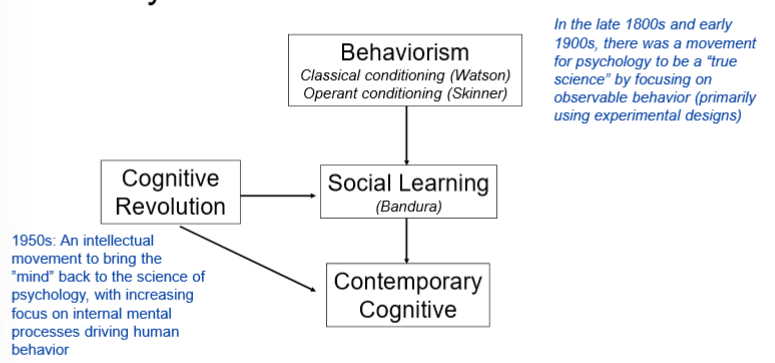
Behaviorism
Philosophical roots in empiricism
Empiricism: the contents of our mind come from the contents of the world
• Implication: at birth, the mind and “personality” is essentially empty
• Tabula Rasa (“Blank Slate”)
environment ellicits response
Philosophical roots in hedonism
• Hedonism: organisms learn in order to maximize pleasure and avoid pain
• aka rewards and punishments
• Implication: People will do whatever they need to do to do experience pleasure and not pain
Basic Assumptions of the Learning approach
The learning approach has multiple levels, each with its own set of assumptions for what personality is and the level of cognition involved
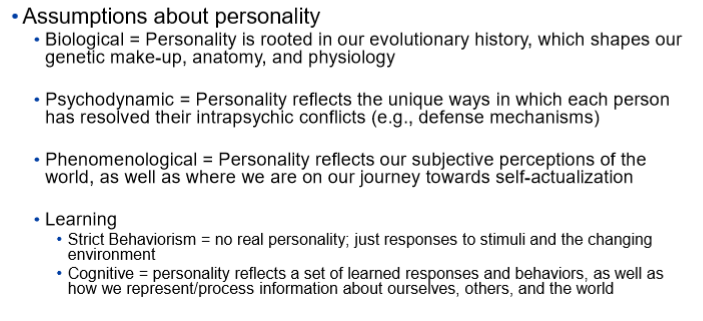
Behaviorism: no real personality traits, or consistency, just learned behavioral responses to the environment, all about observing behavior
Classical Conditioning: paired association
“Personality” are patterns of stimulus-response associations
People differ because they have different paired association histories and are in different situations
Operant conditioning: Reinforcement and punishment
“Personality” is a set of behavioral responses that have been reinforced by rewards and punishments
recall hedonistic roots: if you are rewarded for a behavior, you will do it more/ if you are punished for a behavior, then you will do it less
rewards better than punishment to obtain “correct behavior”
punishment can have neg consequences
Cognitive: personality is real— reflecting a set of learned responses and the ways in which we process info about ourselves, others, and the world
Social Learning: Shift attention to what goes on between stimulus and response
(set of conditioned responses + what we learn from others and our expectations for the future)
expected consequences= ppl are aware of expected consequences (or rewards) and behave in response to anticipated consequences (or rewards)
observation learning= ppl can learn by watching others
Contemporary cognitive= personality is a reflection of how we behave and how we represent/process info abt ourselves, others, and the worlds (learned through schemas)
schemas= scripts, ways we represent/process info (the world is dangerous, you cant depend on others)
clinical applications= Cognitive Behavioral Therapy (retrain brain to think abt world in a diff way and to make these more adaptive ways of thinking automatic)
Video games and aggression
Does playing video games lead kids to be more aggressive?
Classical Conditioning
• Exposure to guns and other cues become associated with violence and the conditioned response is aggression
Operant Conditioning
• Video game player is directly rewarded for being aggressive (e.g., accumulate points)
• Video games are fun to play so pleasurable feelings (reward) become associated with aggression
Social Learning
• Expected consequences: last time video game player was aggressive, they were rewarded; so, should continue to play aggressively to be rewarded
Observational learning:
Player witnesses other players being rewarded for being aggressive (e.g., accumulate points), so player will be aggressive too to reap rewards
Contemporary Cognitive
• Playing video games activates and reinforces a person’s schemas about themselves (“it is important to establish dominance to ensure safety”), others (“no one can be trusted”), and the world (“it is a dangerous place”)
Scientifically
There is no evidence that video games cause kids to become more aggressive
• More likely to be selection effect (e.g., predispositions towards aggression make someone more likely to play violent video games)
• Video games may reinforce preexisting schemas, or mental representations about the world
Theoretical Approach comparison
 Note
Note  Flashcards (345)