(2B) Compartmental Systems to Evaluate Drug Distribution
 Call Kai
 Learn
Learn Practice Test
 Spaced Repetition
 Match
Match Flashcards
 Knowt Play
1/42

There's no tags or description
Looks like no tags are added yet.
Name | Mastery | Learn | Test | Matching | Spaced | Call with Kai |
|---|
No analytics yet
Send a link to your students to track their progress
43 Terms
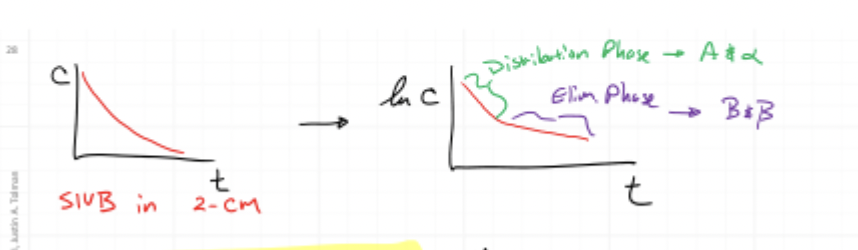
WHAT HAPPENS AFTER IV BOLUS?
tep 1: Concentration vs Time
Looks like normal decline (similar to 1-compartment at first)
Step 2: ln(C) vs Time → IMPORTANT
Now reveals TWO PHASES ✅⭐
This equation used for…
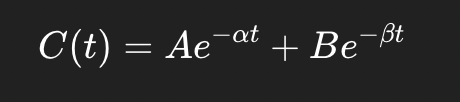
For:
Single IV bolus
2-compartment drug
WHAT MICRO CONSTANTS REPRESENT
These are TRUE rate constants
Govern:
Distribution
Elimination
NOT just math — real physiology
k20 ≈ negligible
why?
Drug eliminated mainly from central (live + kidney)
Major metabolism/excretion happens there
WHAT IF k20 NOT NEGLIGIBLE?
You CANNOT use k10
You USE β instead ✅⭐
β is:
An approximation of elimination
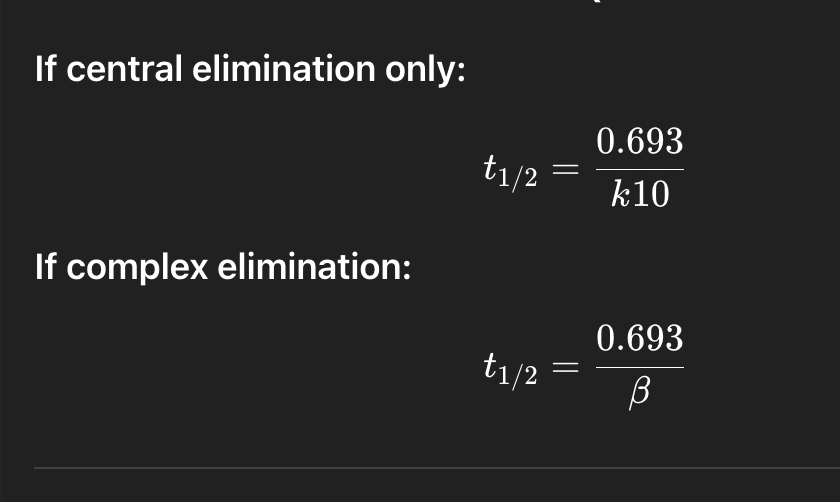
If complex elimination:
If simple (central only):
If complex elimination:
Use β (approximation)
If simple (central only):
Use k10 (true)
What phrases means to use 2-compartment model?
“bi-exponential decline”
“two-phase elimination”
JUST READ:
EXAM FOCUS ON CALCULATIONS
Homework → calculate all micro constants
EXAM → ONLY k10 ✅⭐
Will NOT ask:
k12
k21
Assume k20 is negligible
“What is best elimination rate constant?
k10
k10 vs β
k10:
TRUE elimination constant
Used for:
Half-life
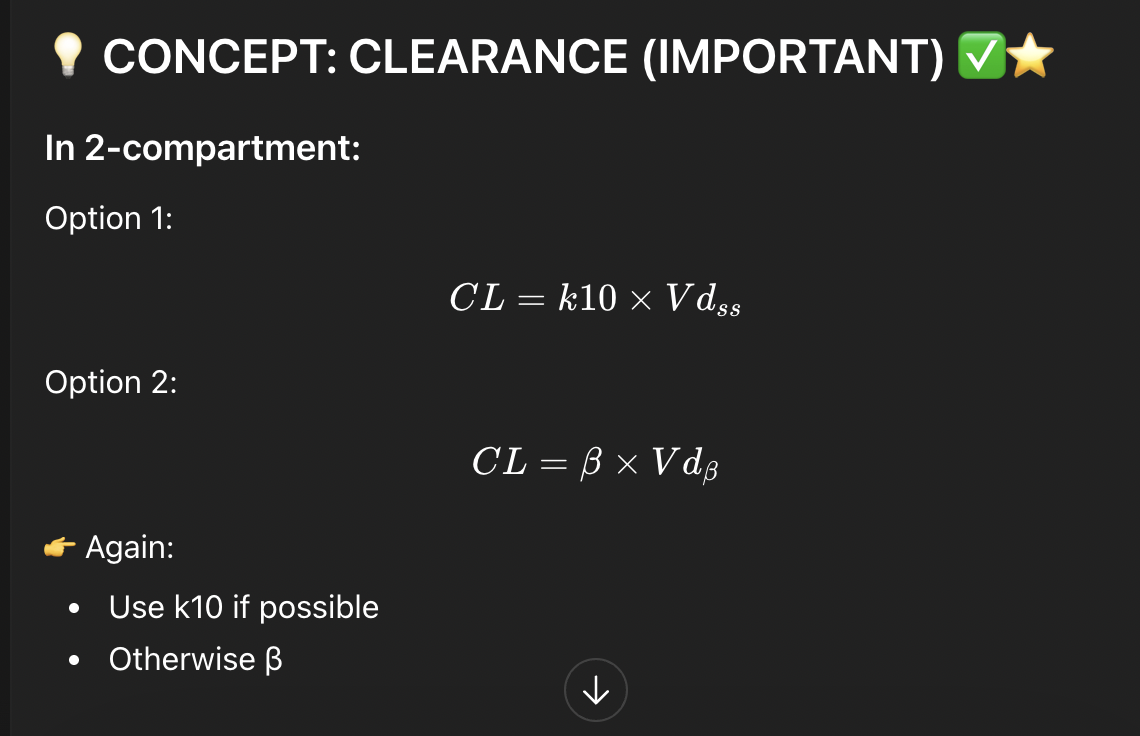
Clearance
β:
Approximation
Used when:
Peripheral elimination exists
👉 RULE:
Use k10 if possible
Otherwise → β
VOLUMES IN 2-COMPARTMENT
1. Central Volume (Vd,c)
Initial distribution space
Governs initial concentration
👉 Similar to:
Dose / C₀
2. Peripheral Volume (Vd,p)
Drug storage space
Affects later concentrations
Steady State Volume
Extrapolated Volume
STEADY STATE VOLUME of Distribution
Represents:
Entire system volume
STEADY STATE VOLUME of Distribution
Occurs when:
Distribution equilibrium reached
DISTRIBUTION STEADY STATE is NOT the same as…
normal steady state
DISTRIBUTION STEADY STATE
Definition:
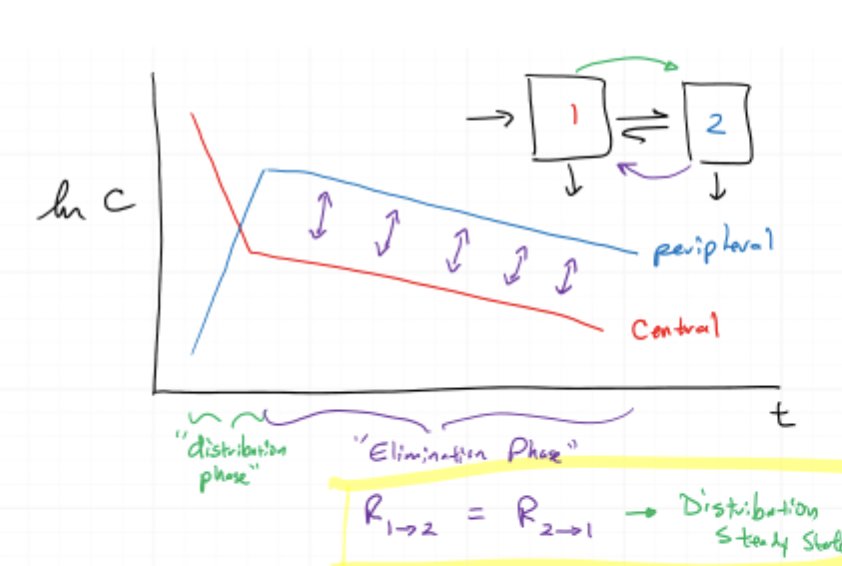
Rate (central → peripheral) = Rate (peripheral → central)
Concentrations NOT equal
👉 Movement rates ARE equal
Extrapolated Volume Of Distribution
Define
The volume of the system at the elimination phase
CONCEPT: DISTRIBUTION PHASE VS ELIMINATION PHASE
a. early
b. later
c. graph
a. Drug moves:
Central → Peripheral
b. Drug moves BOTH ways
Reaches equilibrium
c. Graph:
Two parallel lines in elimination phase
If k12 > k21:
If k21 > k12:
If k12 > k21:
Drug prefers peripheral
Larger peripheral volume
If k21 > k12:
Drug prefers central

DISTRIBUTION HALF-LIFE based on…
α
Time to reach distribution equilibrium:
≈ 5 half-lives
JUST LOOK:
WHY USE STEADY STATE VOLUME?
Drug distributes beyond central
Need full-body representation
JUST LOOK:
EXAM FOCUS ON CALCULATIONS
Homework → calculate all micro constants
EXAM → ONLY k10 ✅⭐
Will NOT ask:
k12
k21
TWO TYPES OF DISTRIBUTION
Fast Distribution
Drug moves into:
Tissue compartment
Fat (adipose)
Organs
2. Slow Distribution
Drug moves into:
Deep tissue compartment
Bone
Ligaments
Connective tissue
Hair
These have low blood flow → drug stays longer
How fast drug goes to tissue compartment
Tissue compartment = like oil/fat
Drug goes there relatively quickly
Deep tissue = very slow entry
Distribution processes can be:
Simultaneous
OR Sequential
HOW TO DIFFERENTIATE between Simultaneous OR Sequential?
Requires:
Statistics
Specialized software
👉 Not determined manually
3-COMPARTMENT MODEL
Central((blood, highly vascularized) + Tissue + Deep tissue
JUST LOOK

RATE CONSTANTS IN 3-COMPARTMENT
6 distribution rate constants
3 elimination rate constants
What drug follows 3-compartment model?
Fentanyl
But:
Many clinicians simplify:
Use 2-compartment instead
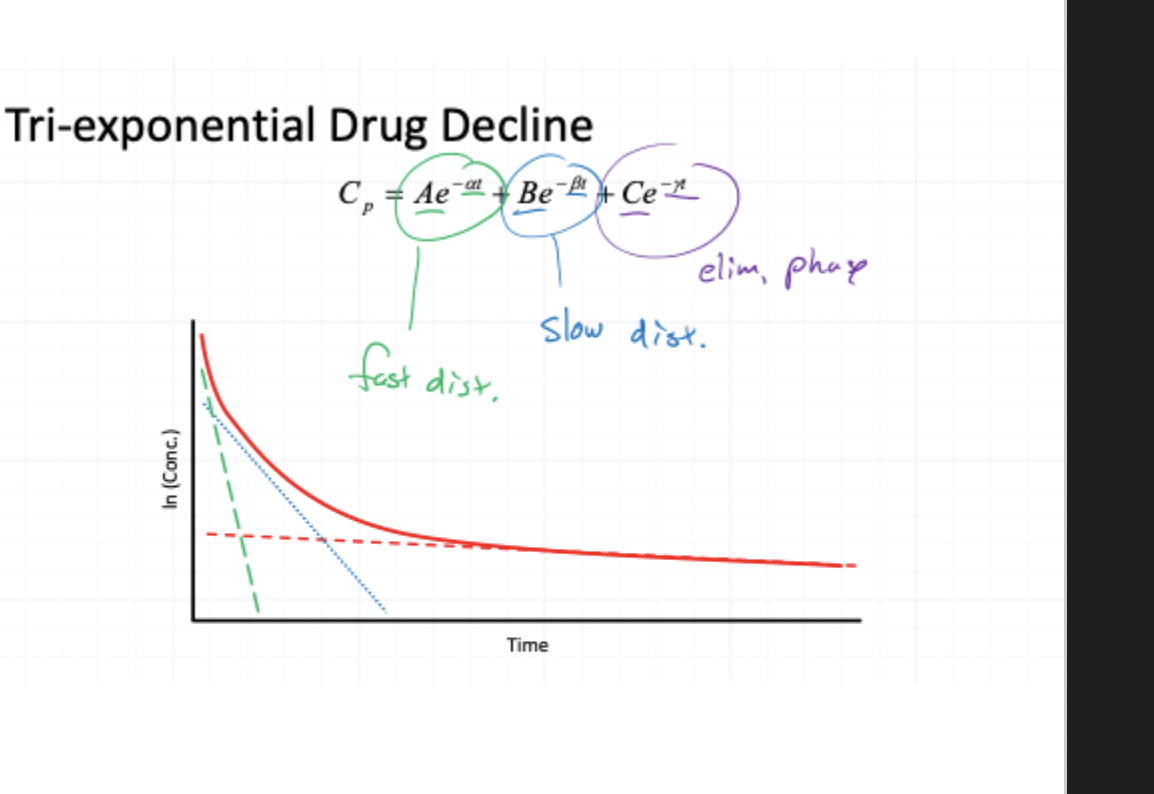
3-compartment is what type of decline?
tri-exponential drug decline
3 compartment model MACRO CONSTANTS?
3-compartment:
A, α → fast distribution
B, β → slow distribution
C, γ → elimination ✅⭐
2-compartment:
A, α → distribution
B, β → elimination
How graph of 3-model compartment
NUMBER OF RATE CONSTANTS for EACH TYPE OF COMPARTMENTS
1-compartment → 1 rate constant
2-compartment → 4 rate constants
3-compartment →
6 distribution
3 elimination
Total = 9
Pattern:
rate constants = (compartments)²
More compartments =
very complex math
Clinicians often:
Simplify models
Assume elimination…
only from central
Ignore:
k20, k30
TERMINAL ELIMINATION HALF-LIFE
Comes from simplified model
Focuses only on:
Elimination phase (later)
Stuff happens early → we ignore it”
NOT from time of dosing
Ignores early distribution
MULTIPLE HALF-LIVES
Regular half-life
Terminal half-life
If professor says:
👉 “terminal elimination half-life”
→ Means: what model
2 or 3 compartment model
INFUSION IN 2-COMPARTMENT
Equation is:
Very complex (“nasty”)
He said:
NOT doing math on this ❌
Even if drug is 2-compartment:
Clinicians often use:
1-compartment approximation
👉 Because:
Focus = steady state

