Unit 6 - Random Variables
 Call Kai
 Learn
Learn Practice Test
 Spaced Repetition
 Match
Match Flashcards
 Knowt Play
1/21

There's no tags or description
Looks like no tags are added yet.
Name | Mastery | Learn | Test | Matching | Spaced | Call with Kai |
|---|
No analytics yet
Send a link to your students to track their progress
22 Terms
probability model
describes the possible outcomes of a chance process and the likelihood that those outcomes will occur
^define sample space (all possible outcomes) and probability for each outcome
random variable
a variable whose value is a numerical outcome of a chance process
*finding probability of event, where possible outcomes are #s (ex: probability for # of heads when flip a coin) (quantitative variable!)
probability distribution
gives a random variable’s possible values and their probabilities
*density curve; histogram, probability vs. random variable X (label x-axis by defining the random variable), analyze w/ SOCS (compare shape, centers, variance) (can say symmetric for shape) (symmetric means the mean is located at the center b/c it’s the balance point of the distribution)
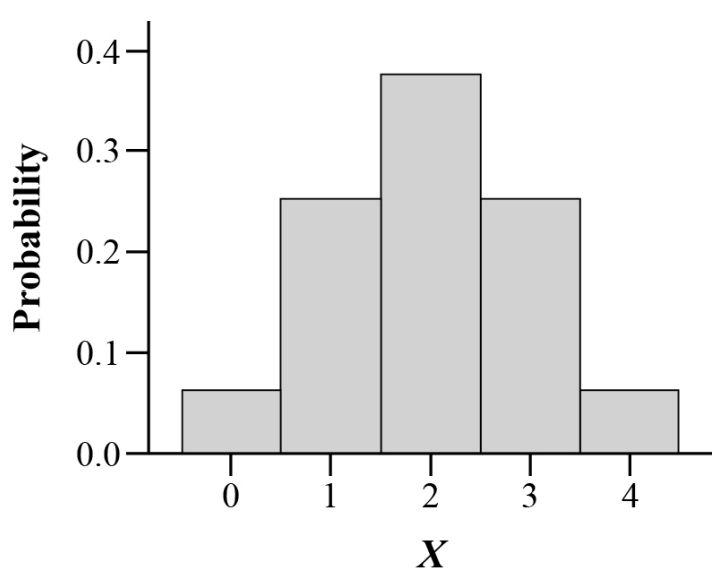
discrete random variable
can list all possible outcomes (value) for a random variable and assign each a probability
*use histogram
Value (numerical outcome): X1, X2, X3
Probability: P1, P2, P3

!!!
interpret P (Probability) → say ‘many many’ and ‘about [P]’
calculator -> use [stat] calc 1-Var Stats → x̄ is mean, σx is SD for discrete random variable
draw normal curve (always draw for normality!) -> draw curve, label N(μ, σ) and axis, draw tick for mean and tick for # in Q, shade appropriate area
if Z = 2X + 3Y → mean: multiply scalars to the means of X and Y then add. SD: multiply scalar to SD first then square. to find σZ, must take sqr root of the sum
μZ is 2*μX + 3*μY
σZ² is (2*σX)² + (3*σY)² IF X & Y ARE INDEPENDENT (can’t find SD if X & Y aren’t independent) (use this squared eqn if multiple random variables to define a random variable!!) (ex: if only Z = 2X + 3, would just do σZ = 2σX (Z defined by only one random variable X) (no +3 b/c spread not affected by adding/subtracting))
expected value of X (a discrete random variable)
the mean/avg (measure of center) of the possible outcomes, with each outcome weighted by its probability
^for each outcome, do value * probability, then sum all of them
μX = E(X) = X1P1 + X2P2 + X3P3 + …
“incr/decr by about [mean], on avg” / “the mean of [variable] is [mean]. This is the avg [measure of variable] of many, many randomly selected [variable]”
SD of X (a discrete random variable)
for each outcome, do value-mean squared times probability, sum for all outcomes, then square root
=√(∑(xi-μX)2 * Pi)
“[event] will typically differ from the mean [mean] by abt [SD] units”
continuous random variable
takes on all values in an interval of #s (no gaps) (find probability of an interval of #s)
^infinitely many possible values, can’t list all ^use density curve
^for every indiv outcome, P is 0
median lifetime
value m such that P(X ≤ m) = 0.5
^find m using [2nd] [vars] invNorm
*1/2 success, 1/2 fail
!!!
discrete
#s
each has probability btwn 0 and 1, sum of all probabilities =1
fixed set of all possible outcomes/values with gaps in between
histogram
continuous
interval of #s
indiv outcomes have a P of 0 since you're finding probability of intervals
infinitely many possible outcomes
density curve
continuous random variable → on calc, use [2nd] [vars]. normalcdf to find probability w/ upper and/or lower bound, invNorm to find value given probability/area under the curve
Transforming random variables
add/subtract ‘a’ to each observation → changes measures of center/location by a; measures of spread and shape don’t change
multiply/divide ‘b’ to each observation → changes measures of center/location by b, changes measures of spread by |b|; shape doesn’t change
Linear transformation, where Y and X are random variables: Y = a + bX
Y and X have the same probability distribution
μY = a + bμX
σY = |b|σX
compare variance → variance is SD squared, so variance of Y is b² times larger than variance of X
If T = X + Y
μT = μX + μY (mean of a sum is always the sum of the means)
σT² = σX² + σY² (X and Y must be independent random variables!!) (variance of the sum is not equal to the sum of the variances, b/c we can't assume that X and Y are independent)
if D = X - Y
μD = μX - μY
σD² = σX² + σY² (X and Y must be independent random variables!!)
measures of center and location (mean, median, quartiles, percentiles) // measures of spread (range, IQR, SD)
independent random variables
when knowing [any event involving X alone] has occurred tells us nothing abt the occurrence of [any event involving Y alone] (and vice versa)
binomial random variable & setting
perform several independent trials of the same chance process and record the # of times that a particular outcome occurs, where X is the count of successes
CONDITIONS (always check!):
Binary (success or failure, 2 diff possibilities)
Independent (trial’s results tell us nothing abt the result of any other trial) (sampling w/o replacement is not independent, exception is if sample is far less than 10% of the population of interest)
Number (fixed # of trials of a chance process)
Success (same probability of success on each trial)
binomial distribution
the probability distribution of X, with n trials and p probability of success on any 1 trial
^possible values of X are whole numbers btwn 0 and n
^binomial distribution shape → more symmetric, approx. normal
*check LCC & 10% condition to approximate binomial distrib w/ normal distrib
^same probability w/ different arrangement (ex: HHFF vs. FFHH)
binomial coefficient
the number of different ways in which k successes can be arranged among n trials
→ [math] prob nCr to find coefficient, left put # of trials and right put # of successes
ex: k=2, n=4: HHFF, HFHF, HFFH, FFHH, FHHF, FHFH (coefficient = 6)
finding mean, SD, and probabilities of binomial variables
μX = np
σX = √(np(1-p))
binompdf (find exactly k successes)
P(X=k)
binomcdf (find up to k successes)
P(X≤k)
P(X<k) = P(X≤k) - P(X=k)
P(X>k) = 1 - P(X≤k)
P(X≥k) = 1 - P(X≤k) + P(X=k) = P(X≥k) = 1 - P(X≤(k-1))
^n aka x-value is # of trials, p is probability for each success // [2nd] [vars] then up arrow to find binompdf and binomcdf
geometric random variable & setting
perform independent trials of a chance process until a success occurs, count the # of trials Y it takes to get the first success (until first success)
^check BINS (but for N, # of trials is not fixed)
probability p for each success must be the same
geometric distribution
probability distribution of geometric random variable Y
*possible values of Y are 1, 2, 3, …
^geometric distribution shape → always right skewed, most common # is 1
finding mean, SD, and probabilities of geometric variables
μY = 1/p
σY = √(1-p) over p
geometpdf (exactly n trials to get first success)
P(Y=n)
P(Y=n) = (1-p)n-1p
geometcdf (takes up to n trials to get first success)
P(Y≤n)
P(Y<n) = P(Y≤n) - P(Y=n)
P(Y>n) = 1 - P(Y≤n)
P(Y≥n) = 1 - P(Y≤n) + P(Y=n) = P(Y≥n) = 1 - P(Y≤ (n-1))
^n aka x-value is # of trials, p is probability of success // [2nd] [vars] then up arrow to find geometrpdf and geometrcdf
!!! when taking an SRS of size n from a population of size N, we can use a binomial distribution to model the count of successes in the sample as long as n ≤ 1/10*N (10% condition)
^can infer and use mean and SD formula
^if large population, then SRS w/o replacement is ok and can bypass ‘independent’ in BINS (^why use 10% for binomial) (10% if sample w/o replacement (establish independence))
incr n trials, looks more like normal curve
‘no more than’ is less than or equal to (≤)
how many [] do you expect... -> expected value, mean, do np (binomial) or 1/p (geometric)
is it legit or not -> if # is suspiciously too high, find probability that X is greater than or equal to that number → P(X≥n) = 1 - P(X≤n) + P(X=n)
Large Counts Condition
use normal approximation for a binomial distribution when n is so large such that np ≥ 10 AND n(1-p) ≥ 10 (the expected # of successes and failures are both at least 10!)
^can infer normality and use normal curve
!!! do normal curve for normality
var means variance, variance = SD2
interpret mean/SD: use context, use ‘many many’
random variable
mean: perform many many of chance process, you would expect [random variable] of about [mean], on average.
SD: perform many many of chance process, the [random variable] would typically vary around the mean [mean] by about [SD].
binomial
mean: when performing many many trials of n [chance process], the expected number of [desired outcome] is about [mean], on average.
SD: when performing many many trials of n [chance process], the # of [desired outcome] varies from the mean [mean] by about [SD].
geometric
mean: if probability of success is [p], when perform independent trials of [chance process] many many times, then expect [mean] trials until get first success
SD: when perform independent trials of [chance process] many many times, the typical first [success] will vary by [SD] units from the mean [mean].