[DEV] CH 16: Socioemotional Development in Middle Adulthood
 Studied by 1 person
 Call with Kai
 Learn
Learn Practice Test
 Spaced Repetition
 Match
Match Flashcards
 Knowt Play
1/55

There's no tags or description
Looks like no tags are added yet.
Name | Mastery | Learn | Test | Matching | Spaced | Call with Kai |
|---|
No study sessions yet.
56 Terms
Eriksonian stage in middle adulthood
7th stage: generativity versus stagnation
Generativity
Adults’ desire to leave legacies of themselves to the next generation
desire for generativity increases in midlife
more strongly related to enduring & happy marriage at 75-80 yo than intimacy
linked with greater wisdom in late adulthood
Adults achieve a kind of immortality
Commit themselves to the continuation and improvement of society as a whole through their connection to the next generation.
Through biological, parental, work, cultural generativity
types of generativity
biological
parental
work
cultural
[types] biological generativity
produce offspring
[types] parental generativity
nurturing and guiding children
[types] work generativity
develop skills that are passed down to others
[types] cultural generativity
adults create, renovate, or conserve some aspect of culture that ultimately survives
Stagnation or self absorption
Develops when individuals sense that they have done nothing for the next generation
feel stagnant: feel like they aren’t progessing in their life
lack a sense of purpose
feel unfulfilled in life
can manifest in being focused on their own needs
balance needed; a person doesn’t have unlimited energy and resources
need to take care of the self to give to the world
Research supporting erikson
Generativity grows from the 30s to 50s
Respect from grandchildren boosts life satisfaction
Intergenerational programs strengthen generativity
Greater midlife generativity leads to more wisdom later
Meaningful work increases generativity
Sharing life lessons reduces loneliness and improves support
Levinson’s Periods of Adult Development
The Seasons of a Man’s Life
Extensive interviews with 40 middle aged men
By the 40s, man has a stable career and now must look forward to the kind of life he will lead as a middle-aged adult
Transition to middle adulthood lasts for 5 yrs
80% found the transition to be tumultuous & psychologically painful
[levinson] Four stages
End of teens
Age 30 trasition
Culminating life structure for early adulthood
Transition to middle adulthood
[levinson] End of teens
20s
Transition from dependence to independence
Marked for the formation of a dream: kind of life youth wants to have especially in career and marriage
Novice phase of adult development
Reasonably free experimentation and testing dream in world
Explore possibilities for adult living
Developing stable life structure
[levinson] Age 30 transition
28 to 33 years old
Face more serious question of determining goals
Focus on family and career development
Phase: becoming one’s own man
[levinson] Culminating life structure for early adulthood
40
reach stable point in career, outgrown attempts at learning to be an adult,, look forward to the kind of life lead as a middle aged adult
[levinson] Transition to middle adulthood
Last about 5 years (40 to 45) and requires to come to grip with four major conflicts
Being young versus being old
Being destructive versus being constructive
Being masculine versus being feminine
Being attached to others versus being separated from them
aim: reduce polarities, accept that each is an integral part of life
[levinson] caveats/critcisms
His original research included only men, though he later claimed the stages also apply to women
Data about middle adulthood is more valid than their data on young adulthood
Participants may distort and forget things about earlier experiences
The study lacked statistical analysis but offered rich qualitative insights through detailed life histories
[midlife] levinson
Levinson: Midlife as crisis -> suspended between past and future
[midlife crisis] George Vaillant’s Grant Study
The forties are a decade of reassessing and recording the truth about the adolescent and adulthood years.
maintains that only a minority of adults experience a midlife crisis
most people, midlife is not a crisis
cognitive skills and career peak
happiness & positive effect have an upward trajectory from early adulthood to late adulthood
midlife crises have been exagerrated
[midlife crises] Stage Theories
The stage theories place too much emphasis on crises in development, especially midlife crises
Individual variation shows some individuals may experience a midlife crisis in some contexts of their lives but no others
For example, turmoil and stress may characterize a person’s life at work even while things are going smoothly at home.
Stress and personal control
Personal control changes when individuals age through their adult years
personal sense of control is challenged by
many demands and responsibilities
physical and cognitive aging
Middle age is a time when a person’s sense of control is frequently challenged by many demands and responsibilities, as well as physical and cognitive aging
[personal control] Young people
Focus primarily on self-pursuits and don’t worry much about responsibilities for others
a sense of invulnerability, unrealistic about their personal control, unaware of the aging process; worry about self-pursuits, don’t have to worry much about responsibilities for others.
[personal control] Middle age
Less attention is given to self-pursuits and more to responsibility for others, including people who are younger and older than they are
Taking on and juggling responsibilities in different areas of their lives
A sense of control peaks in Midlife then declines
Some aspects of personal control increase with age while others decrease
Ex. Finances, work, marriage > sex life, children
[personal control] emotional & physical domain
Better self control in childhood: aged slower, fewer signs of aging (brain), better able to manage later-life health, financial , social demands.
During midlife: improving self-control (across 4 yrs) also helps
People with higher sense of control: better health behavior, higher psychological well-being, lower psychological distress, decreased loneliness, more contact with friends
[stress and gender] women
Women: more vulnerable to social stressors
ex. Higher level of stress for when things go wrong in Romantic & marital relationships, more depressed than men in Divorce & death of a friend
seek psychotherapy, talk to friends about stress, self help book, take prescription medication, engage in comfort eating
tend and befriend
[stress and gender] tend and befriend
Type of behavior women engage in when they experience stress
• Seek social alliances with others
• Bec: oxytocin is released when stressed
[stress and gender] men
Men: attend a support group mtg, have sex, use porn, try to fix the problem themselves, not admit to having problems
fight or flight
[stress and gender] fight or flight
Type of behavior men engage in when they experience stress
Become aggressive, socially withdraw, or drink alcohol
Health status and aging
Childhood self-control predicts slower aging and better brain health in midlife
Those with strong early self-control handle health, financial, and social challenges more effectively
Midlife self-control still matters; increases in self-control lead to better health, well-being, and social connection
Bronfenbrenner’s Bioecological Systems
Importance of the complex settings of our lives, exploring everything from our income and family supports to our sociohistorical circumstances
[bronfenbrenner] Gender contexts
Some say that stage theories of adult development have a masculine bias
The view that midlife is a negative age period for women is stereotypical, as so many perceptions of age periods are
The demands of balancing career and family are usually not experienced as intensely by men as it is by women
Midlife is a diversified and heterogenous period for women and men
Some it is a negative period
For some it is a New prime of life, a time of renewal, shed preoccupations on youthful appearance & body, seeking new challenges, valuing maturity, enjoying change
[bronfenbrenner] Cultural contexts
The concept of middle age is not very clear, or in some cases is absent.
Nonindustrialized societies to describe individuals as young or old but not as middle-aged
Some cultures have no words for “adolescent,” “young adult,” or “middle-aged adult.
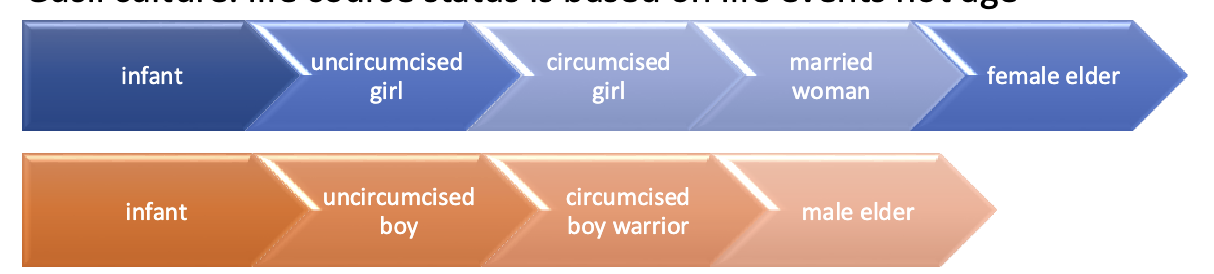
Gusii culture: life course status is based on life events not age
[cultural] Gusii culture in kenya
Females
Infant
Uncircumcised girl
Circumcised girl
Married woman
Female elder
Males
Infant
Uncircumcised boy
Circumcised boy warrior
Male elder
close relationships
Love and marriage at midlife
Companionate love increases during middle adulthood
Security, loyalty, and mutual emotional interest are more important in middle adulthood
Most married individuals are satisfied with their marriages during midlife
Some marriages that were difficult & rocky improved in middle adulthood
Two major forms of love
Romantic love
Affectionate love
Romantic love
Strong in early adulthood
Affectionate love
Increases during middle adulthood
Physical attraction, romance, and passion are more important in new relationships, especially in early adulthood
Security, loyalty, and mutual emotional interest become more important as relationships mature, especially in middle adulthood
Marriage
Having a happy relationship or marriage, having children, and being there for others were the life goals rated as most important across almost the entire adult life span
Prior to middle adulthood it is more important for women, but it becomes more important for men in late adulthood
Effects of happy marriage
Better health
Lower likelihood of work-related health limitations
Marital conflict
Health risk behaviors, vulnerability for physical illness
gray divorce
The rise in divorce among adults 50+
women usually initiate divorce
Many delay divorce for their children, but most report satisfaction with their decision afterward
[divorce] reasons for women
verbal, physical, emotional abuse
alcohol
drug abuse
cheating
[divorce] reasons for men
falling out of love
cheating
differing values or lifestyles
Empty nest syndrome
Decline in marital satisfaction after children leave the home
parents who live vicariously through their children expeirence this
But for most, marital satisfaction does not decline after children have left home but rather increases during the years after child rearing
Refilling of empty nest
Many stay due to financial struggles, delaying independence into their late twenties
Middle-generation parents often give financial, emotional, and practical support to adult children
Both generations benefit emotionally but face privacy and independence issues
B2B/ Back to bedroom/ boomerang kids
Economic uncertainty causes more adult children to return home after college, job loss, or divorce
Complaints when kids come back
Parents complain about noise, disrupted routines, and added responsibilities; children feel restricted and treated like kids
Returning home creates family disequilibrium that needs mutual adaptation
Grandparenting
first time during middle age
Provide childcare – mothers & fathers can work, OFW parents, separation, parent illness
Grandfathers: perceive it as voluntary; Grandmothers: perceive it is their responsibility to maintain ties across generations
The increase in longevity is influencing the nature of grandparenting
Important in lives of grandchildren when family crises like divorce, death, illness, abandonment, poverty occur
Grandmothers have more contact with grandchildren
[grandparenting] 3 prominent meanings of being a grandparent
Biological reward and continuity
Source of emotional self fulfillment (companionship and satisfaction)
Remote role
Intergenerational relationships
Adults in midlife play important roles in the lives of the young and the old, as intergenerational relationships increases during midlife
middle aged adults are happiest when they have harmonius relationships with their parents and grown children
middle aged adults develop more positive perception of parents
Positive perceptions; love, help, shared values
Negative perceptions: isolation, family conflicts, abuse, neglect, stress
[intergen] summary of possible experiences
Launching children
• Experiencing empty nest
• Adjusting to children coming back
• Becoming grandparents (common role in older Filipinos)1
• Giving or receiving financial assistance to/ from children
• Caring for a sick/widowed parent or parents-in-law
• Adapting to being the oldest generation (if both parents pass away)
“Sandwich,” “squeezed,” or “overload” generation
Called these because of the responsibilities they have for their adolescent and young adult children as well as their aging parents
Stress involved in intergenerational relationships
Caring for ill or dying parents; over 40% (mostly daughters) provide such care
Despite this, many give more support to their grown children than to aging parents
Care involved in intergenerational relationships
Arranging medical help, managing finances, or assisting with daily activities
[intergen] Parent-child relationships
Often ambivalent—mixing love, help, and conflict
Values and traits are passed across generations; adult children often view parents more positively with age
netherlands: affection and solidarity than ambivalence
[intergen] Gender differences
Women maintain stronger intergenerational bonds than men
Mothers and daughters have closer relationships during their adult years than mothers-sons, fathers-daughters, or fathers –sons.
Married men are more involved with their wives’ families than with their own
Grandparent-grandchild relationships
Mothers’ intergenerational ties were more influential
Immigration
Increases family stress due to separation, though new support networks eventually form
 Note
Note  Flashcards (39)