#21 ASTR 1000 Smartwork Homework
 Call Kai
 Learn
Learn Practice Test
 Spaced Repetition
 Match
Match Flashcards
 Knowt Play
1/9

There's no tags or description
Looks like no tags are added yet.
Name | Mastery | Learn | Test | Matching | Spaced | Call with Kai |
|---|
No analytics yet
Send a link to your students to track their progress
10 Terms
When the core of a red giant becomes hot enough to fuse helium into carbon (100 million K), the entire core ignites suddenly in a burst of nuclear fusion called the helium flash. The figure here shows the location of the helium flash on the H-R diagram, at the top of the red giant branch (lower red line).
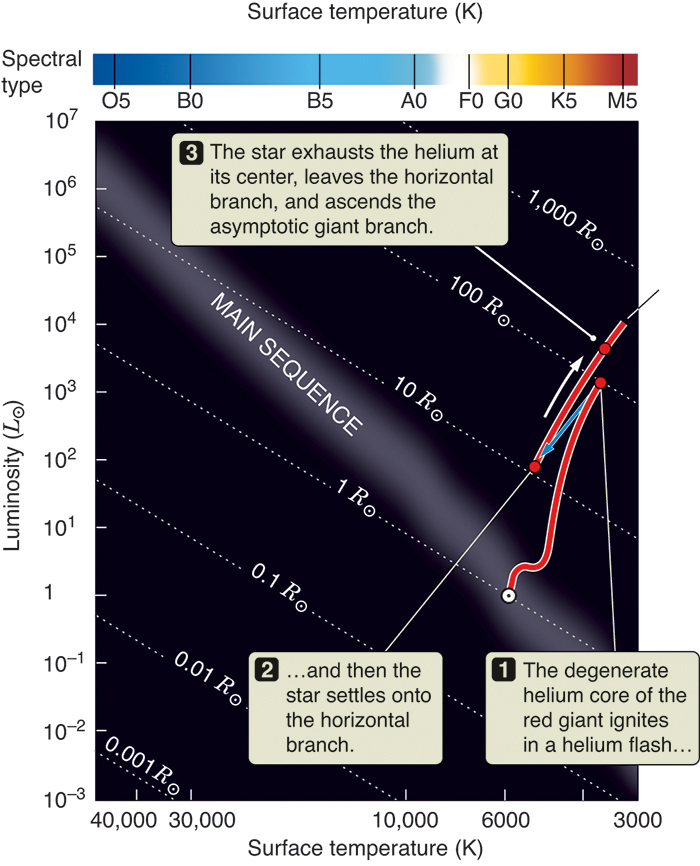
The star suddenly shifts to the horizontal branch (red dot at the bottom of the upper red line via the blue arrow). Eventually it runs out of helium to burn in the core, and instead begins to burn helium in a shell around the carbon ash core, surrounded by another shell burning hydrogen.
As it does this it follows the upper red line (along the white arrow) on the diagram: the asymptotic giant branch.
Based on your observations of the H-R diagram and what you have learned of the balance between gravity and pressure, sort each stage of a star's life below in order of increasing energy produced by the peak of its nuclear reactions.
Main Sequence Star
Horizontal Branch Star
Red Giant Star
Asymptotic Giant Branch Star
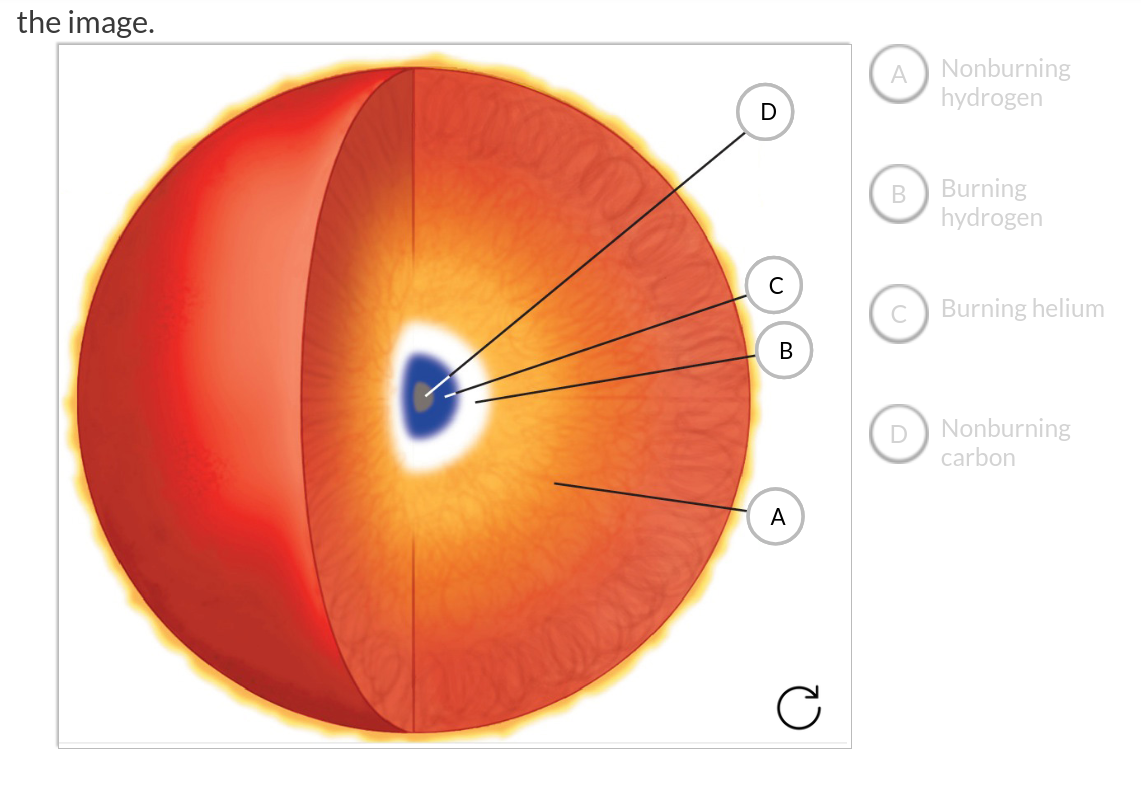
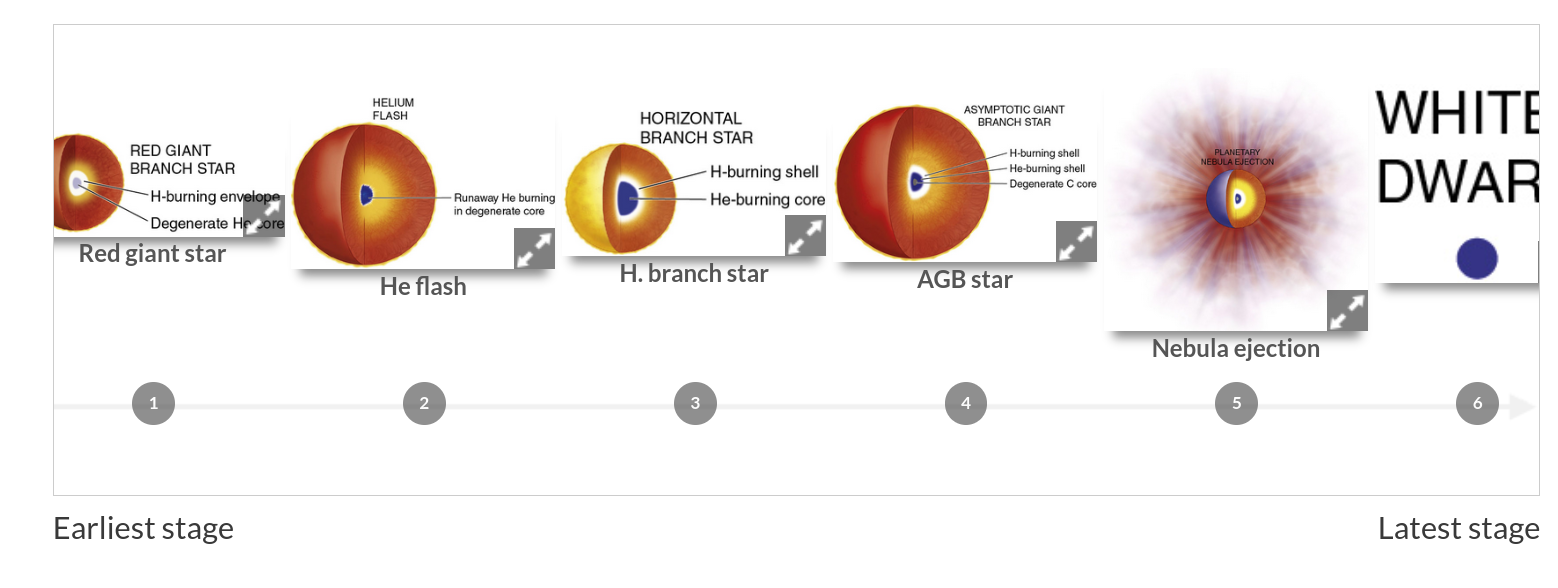
The following image is a cross section of an asymptotic giant branch star. Place each label in the correct position on the image.
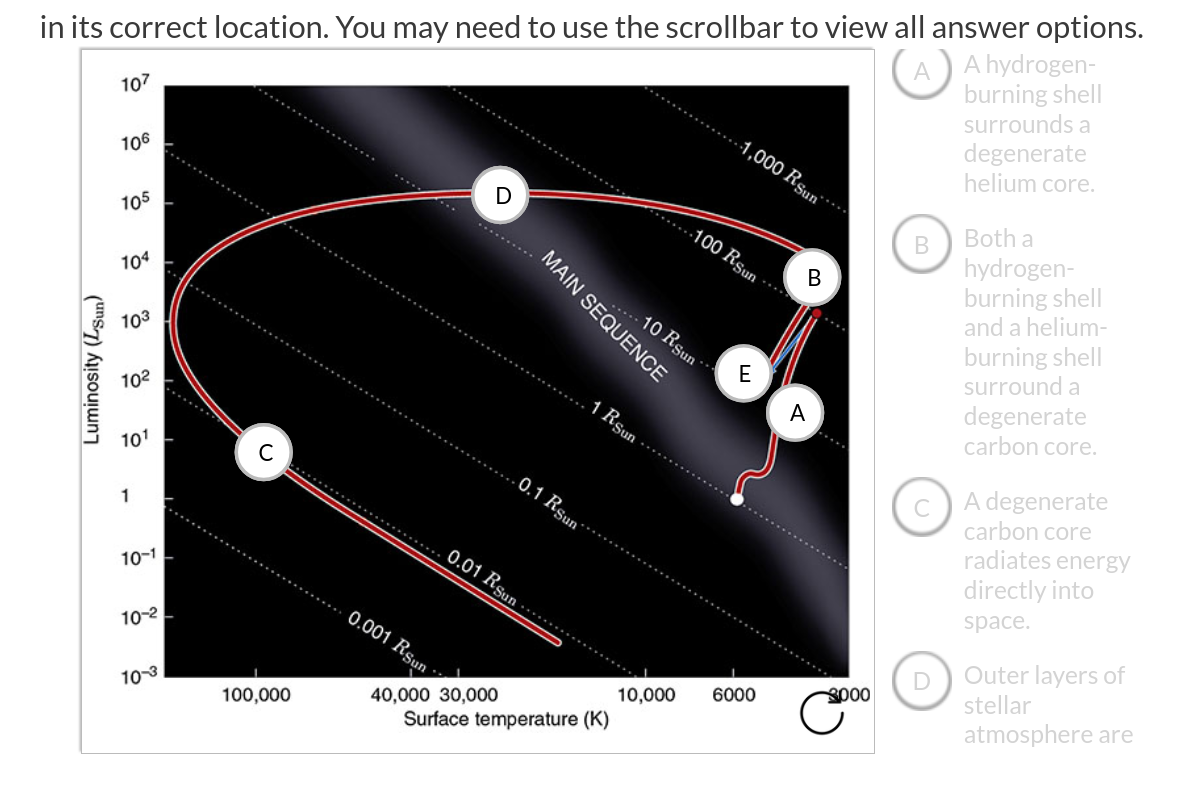
The following figure displays the evolutionary track of a 1-MSun star. Place each description of the evolutionary stage in its correct location. You may need to use the scrollbar to view all answer options.

A) hydrogen-burning shell surrounds a degenerate helium core.
B) Both a hydrogen-burning shell and a helium-burning shell surround a degenerate carbon core.
C) A degenerate carbon core radiates energy directly into space.
D) Outer layers of stellar atmosphere are ejected into space.
E) A hydrogen shell surrounds a helium-burning core.
An AGB star expands to a much larger size (rAGB) than it did during the red giant phase for our Sun. Recall that the force of gravity between two objects is given by this equation, where m1 and m2 are the masses, and r is the distance between them: .
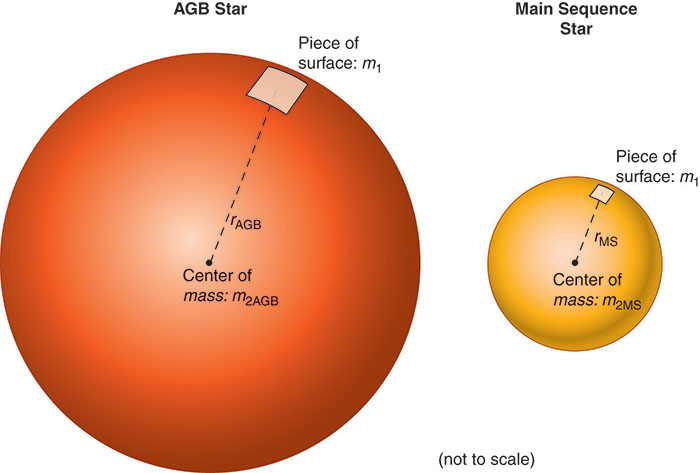
How will the gravitational force on a piece of the surface of the star (m1) by the mass of the rest of the star (m2) (effectively located at a point at the center of the star) compare between the AGB and main-sequence phases of a particular star, assuming its mass stays the same?
The surface will feel a weaker gravitational force during the AGB phase because it is farther from the center of the star.
The following images represent different evolutionary stages of a post-main-sequence star of 1 MSun. Place them in chronological order. You may need to use the arrows to view all of the placement choices.
Here are five stars or star-like objects as we might observe them today. Eleven billion years from now, what will be the most probable state of each object? You may need to use the scroll bar to see all answer options from left to right.
BROWN DWARF
0.065 Msun Protostar Cool
A “COOL” WHITE DWARF
.9 Msun White dwarf Non Binary
A “HOT” WHITE DWARF
1Msun main sequence star; single star not binary
STILL ON MAIN SEQUENCE
Newly Formed 0.09 Msun star
NEUTRON STAR
1.4Msun white dwarf; binary with a red giant companion
All Type Ia supernovae
involve degenerate matter.
always involve a white dwarf.
Place the following steps that lead some low-mass stars in binary systems to become novae or supernovae in the correct order. Note that the first step is given.
Star 1 (the more massive star) begins to evolve off the main sequence.
Star 1 fills its Roche lobe and begins transferring mass to star 2.
Star 2 gains mass, becoming hotter and more luminous.
A white dwarf orbits a more massive main-sequence star.
Star 2 fills its Roche lobe and begins transferring mass to the white dwarf.
The white dwarf becomes either a nova or a supernova.
Suppose Jupiter were not a planet, but instead were a G5 main-sequence star with a mass of 0.8 MSun. How could this affect the Sun as the G5 star came to the end of its life?
The G5 may have transferred all its mass to the Sun, causing the Sun to explode
as a Type I supernova.The Sun would have already become a white dwarf, and as the G5 swelled into a red giant,
material from it would be transferred to an accretion disk around the Sun, making the Sun explode as a nova.
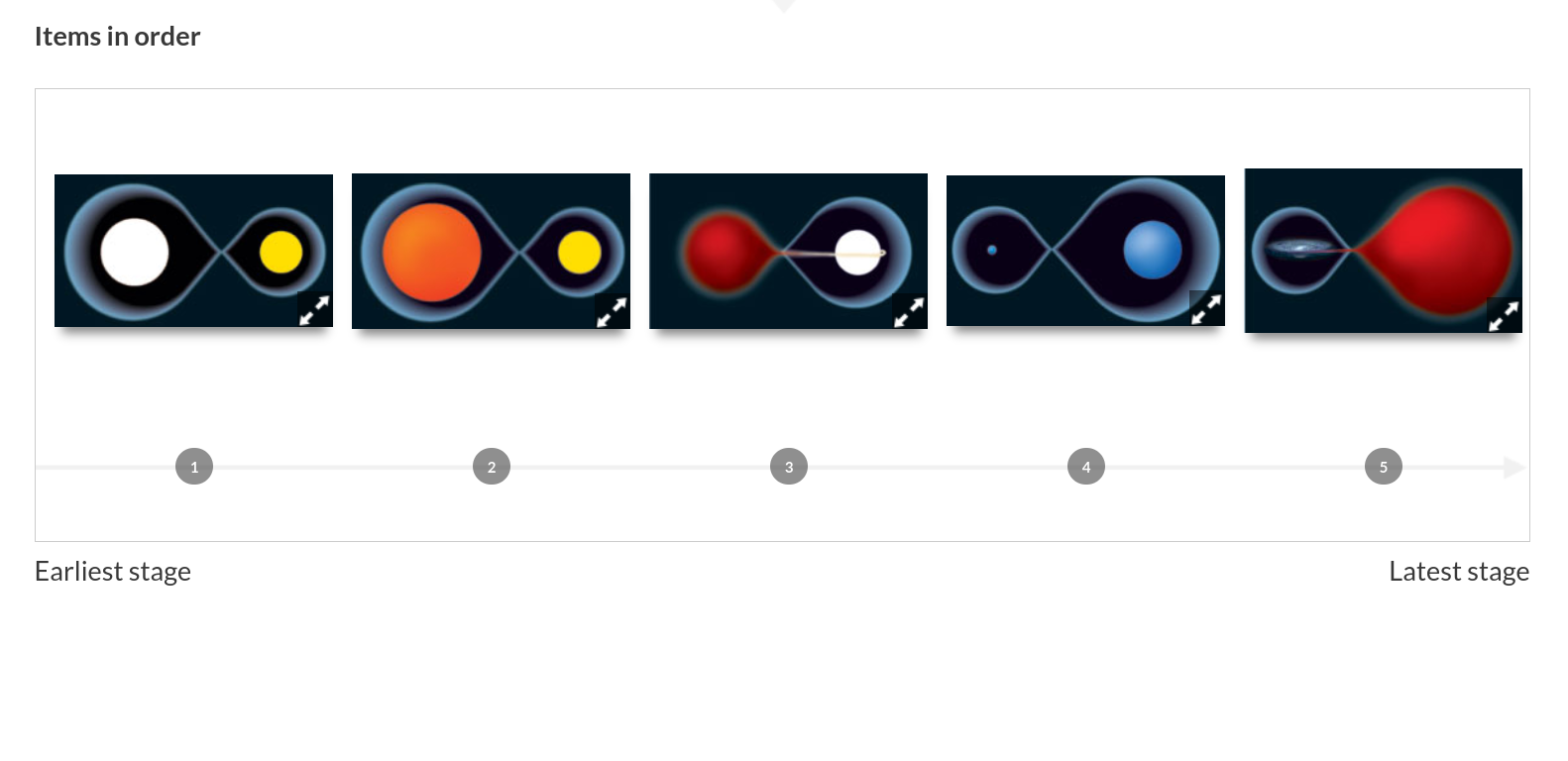
The following images show the evolution of two close binary stars. Rank them from earliest to latest stage in this system.
Explore top notes

