Types of cancers, mutations and viral carcinogenesis
 Call Kai
 Learn
Learn Practice Test
 Spaced Repetition
 Match
Match Flashcards
 Knowt Play
1/25

There's no tags or description
Looks like no tags are added yet.
Name | Mastery | Learn | Test | Matching | Spaced | Call with Kai |
|---|
No analytics yet
Send a link to your students to track their progress
26 Terms
What is cancer?
Abnormal growth of cells in an uncontrolled way that can spread or metastasise into other tissues.
What are the types of tumours?
Benign and malignant.
Describe benign tumours.
Abnormal growths that are no longer under normal regulation.
Describe malignant tumours.
- Poorly differentiated cells growing rapidly in a disorganised manner.
- Can invade surrounding tissues and become metastatic which cause the growth of similar tumours in other organs.
How can cancers be classified and what are the main classes?
Based on cell origin:
- Carcinomas
- Sarcomas
- Lymphomas
- Leukaemias
Describe carcinomas.
- Most common type (85%).
- Arise from cells that cover external and internal body surfaces.
Describe sarcomas.
- Around 12% of cancers are sarcomas.
- Originate from cells found in the supporting tissues of the body e.g., bone, muscle and fat.
- Highly malignant
Describe lymphomas.
- Cancers which originate from lymph nodes and tissues of the body's immune system.
- Can spread to intestine, spinal cord, bone and brain.
Describe leukaemias.
Cancers of immature white blood cells that proliferate in the bone marrow and accumulate in the bloodstream.
What is staging of cancer?
It determines the exact location of the cancer and its degree of metastasis at diagnosis.
What is staging of cancer based on?
- The site of primary tumour.
- The size of tumour.
- How far it has invaded into local tissues and structures.
- Whether it has spread to regional lymph nodes.
- Whether it has metastasized to other regions of the body.
What is cancer grading?
- Graded 1 to 4 to show how advanced the tumour is (1 is the least advanced).
- Based on number of cell abnormalities, the more abnormalities the more advanced the tumour.
What is carcinogenesis?
A multistep process which causes cancer via an accumulation of mutations.
Describe the process of carcinogenesis.
- Tumour progression occurs which causes normal cells to become cancer cells.
- Tumour progression is a series of random mutation and changes in DNA methylation that affects genes controlling proliferation and survival.
How can DNA viruses cause cancer?
The viral genome can persist in a cell as an episome which promotes the expression of proteins that cause proliferation or proteins that inhibit tumour suppressor genes.
How can RNA viruses cause cancer?
Two ways:
1. The RNA virus can contain an extra gene additional to the sequences needed for viral replication that alters host cell growth.
2. The virus can integrate into the Host DNA close to a gene that regulates growth and upregulates its expression.
What are the two viral mechanism of carcinogenesis?
Direct and Indirect
What is the difference between direct and indirect mechanisms of viral carcinogenesis?
The direct mechanism is when the virus causes a tumour from within the cells whilst indirect is when the virus causes a tumour from outside the cell.
Describe the direct mechanism of viral carcinogenesis.
- Viral genomes can form episomes which can promote expression of viral oncogene and therefore cause proliferation.
- Can also integrate into the host and promote expression of genome of viral and cellular oncogene to cause proliferation.
Describe the indirect mechanism of viral carcinogenesis.
- Virus can trigger chronic inflammation which persistently damages local tissue over time.
- This increases the risk of developing a hepatocellular carcinoma.
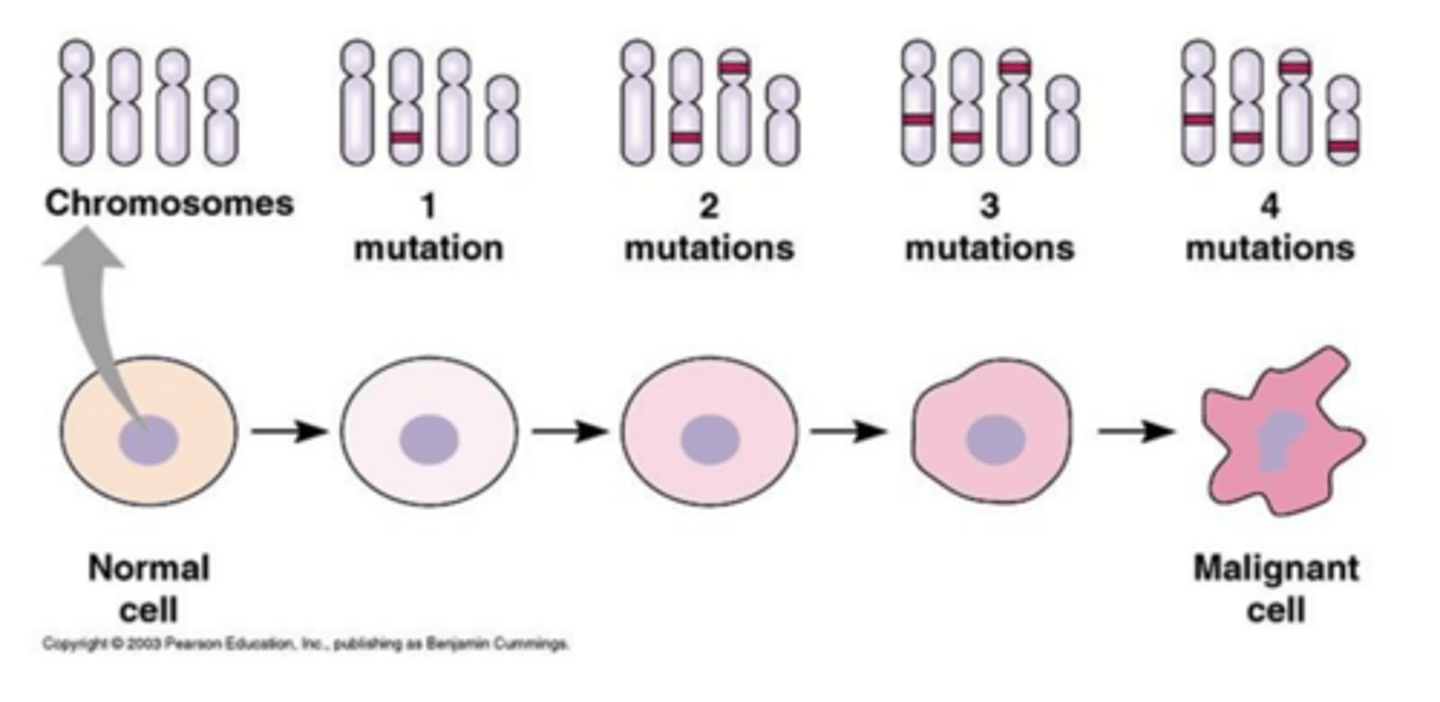
How can mutations change the morphology of the cell
3-20 mutations are required to cause enough change to a cell to cause a cancer cell to develop.
What is neoplasia?
The formation of a new, abnormal growth of tissue
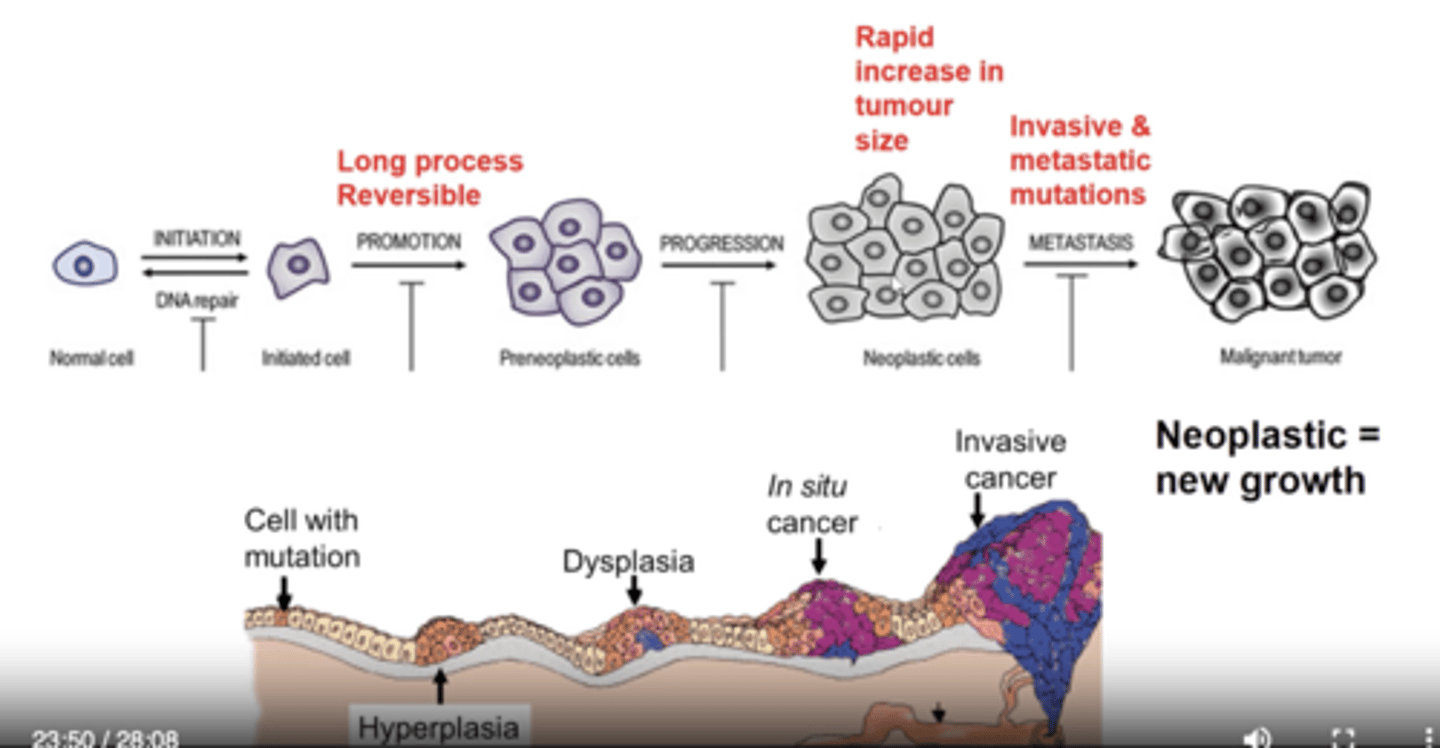
What are the phases of carcinogenesis?
Initiation, promotion, progression and metastasis.
Describe the phases of carcinogenesis.
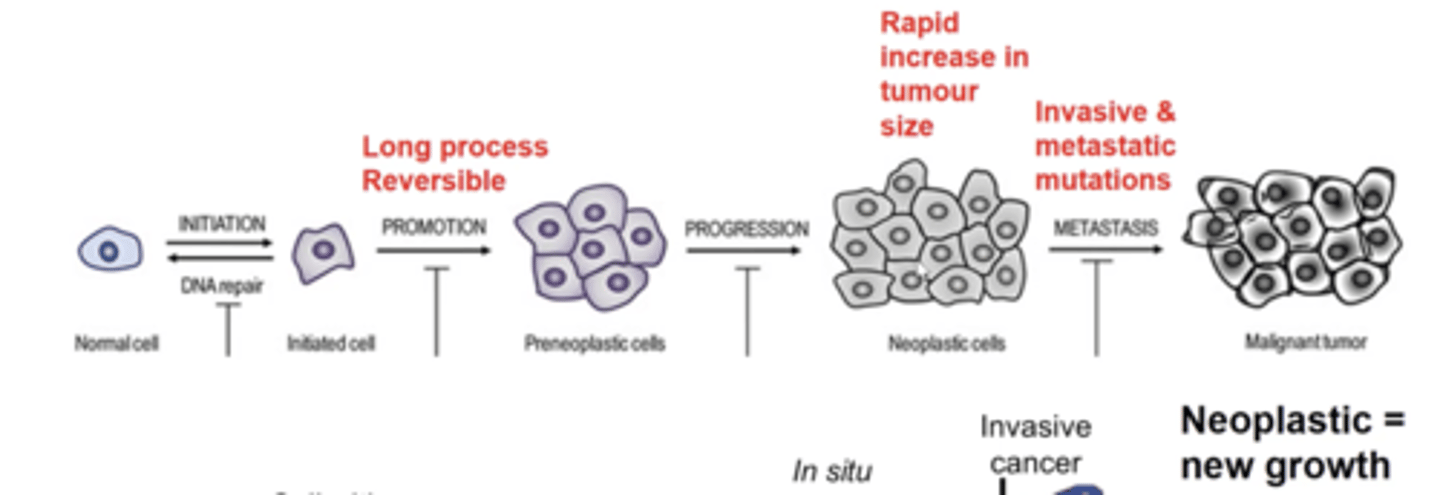
- Initiation occurs where a cell is mutated.
- Promotion then occurs when the initiated cells becomes preneoplastic as it has lots of mutations.
- Progression then occurs when the preneoplastic cell becomes neoplastic cells.
- Metastasis of neoplastic cells can then occur.
What are neoplastic cells?
Cancer cells
What does metastasise mean?
To spread

