TP 8 ECOLOGY BIO FLASHCARDS
 Call Kai
 Learn
Learn Practice Test
 Spaced Repetition
 Match
Match Flashcards
 Knowt Play
1/28

There's no tags or description
Looks like no tags are added yet.
Name | Mastery | Learn | Test | Matching | Spaced | Call with Kai |
|---|
No analytics yet
Send a link to your students to track their progress
29 Terms
Taxis
directed movement toward or away from a stimulus
ex: moths flying towards light and fishing swimming upstream
Kinesis
non directional change in activity level in response to environmental conditions
ex: ants wandering actively when searching for food OR cockroaches scurrying randomly when exposed to light
visual
signals seen by other animals
ex: color change , posture, movement
audible
communicate by the use of sounds
ex: chirps, song,
chemical
the process by which animals send and receive information using chemical signals
ex: like releasing perfume , use urine or feces that have pheromones
tactile
transfer of information through direct physical contact between animals, such as touching, grooming, or rubbing
electrical
biological process where primarily aquatic animals (like weakly electric fish) generate and detect weak electric fields to send signals to others
innate behavior
genetically controlled and w/o prior experience
learned behaviors
develops as a result of experience
behavioral adaptions
evolved traits that enhance an organisms ability to communicate effectively
visual
audio
chemical etc.
endotherms
when organisms generate heat and uses it to regulate body temp (warm blooded)
ex: change in heart rate , fat storage, shivering (muscle contractions)
ectotherms
“cold blooded” when organisms rely on external heat and uses energy so they can’t regulate body temp
ex: rely on behavior to regulate temp ( moving in or out of shade)
net positive energy balance
organism take in more energy than it uses allowing for growth, reproduction, and energy storage in form of fat
because gain of energy
net negative energy balance
use more energy than it consumes leading to weight loss, reduced reproductive success, death
because of loss of energy
autotrophs also known as producers
generate their own energy
heterotrophs also known as consumers
rely on organisms for energy
photoautotrophs
like plants and alge use sunlight to produce food through photosynthesis
chemoautotrophs
certain bacteria harness chemical energy from inorganic substances
decomposers
like fungi bacteria break down dead organisms recycling nutrients back into the ecosystem
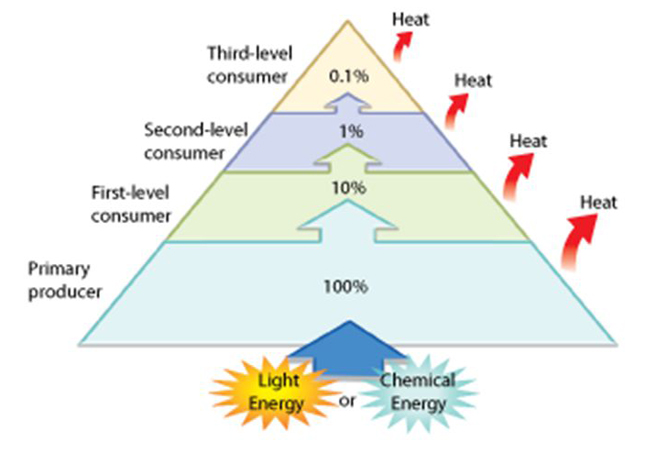
10 % rule in energy transfer
only 10% of energy from one tropic level is passed onto the next the rest is lost as heat and uses for life processes
Bottom up
starts with resources like sunlight water and nutrients when plants have plenty of these they grow well providing more food for herbivores and predators
Top down
when predators keep prey populations in check which affects food chain predators keep plant life abundant by controlling herbivores
keystone species
regulate population of other organisms preventing imbalances that could disrupt the entire food web when remove it can trigger trophic cascade
Trophic cascade
chain reaction of changes that affect multiple levels of the ecosystem for example the loss of a predator may cause prey populations to grown uncontrollably leading to overgrazing and habitat destruction
Density Dependent
factors that affect population size regardless of the population's density, such as natural disasters, climate changes, or human activities.
Density Independent
influences on population size that occur regardless of the population's density. Examples include natural disasters, climate changes, and human activities. These factors can affect populations even if they are small or large.
Exponential growth
A pattern of population growth where the number of individuals increases by a constant proportion over time, typically resulting in a J-shaped curve when graphed.
Logistical Growth
A model of population growth that describes how a population grows quickly at first and then slows as it approaches the carrying capacity of its environment, influenced by resource limitations.
population growth
<span>the increase in the number of individuals in a population over time, typically characterized by phases of exponential or logistical growth, influenced by environmental factors and resource availability.</span>

