Year 12 Legal Studies Criminal Law
 Studied by 2 people
 Call with Kai
 Learn
Learn Practice Test
 Spaced Repetition
 Match
Match Flashcards
 Knowt Play
1/157

There's no tags or description
Looks like no tags are added yet.
Name | Mastery | Learn | Test | Matching | Spaced | Call with Kai |
|---|
No study sessions yet.
158 Terms
What is a summary offence?
A minor criminal offence, sanctions are usually small fines and there is no right to trial by jury.
Where is it outlined? (Legislation)
Outlined in the Summary offences act 1966
Examples (3)
Driving offences, Damage to property, Disorderly conduct
Where are they heard?
Usually heard in the magistrates court
what is a Indictable offence?
More severe criminal offences that are heard by a judge/jury and are more serious offences and the sanctions are more serious and include longer sentences.
Where is it outlined? (Legislation)
In the crimes act (1958)
Examples (3)
Murder, Rape, Kidnapping
Where are they heard?
In the county and supreme court.
What is a indictable offence heard summarily?
Less serious indictable offences that can be heard in the magistrates court. Accused will generally choose to have this happen if possible
Where is it outlined? (Legislation)
Crimes that can be heard summarily are listed in the criminal procedures act (1966)
Examples (3)
Theft, Burglary, Property Damage
Under what circumstances can it be used?
- the offence is not punishable by a maximum term exceeding 10 years of imprisonment.
-court determines its appropriate
-Accused agrees
Committal proceeding
hearing in the magistrates court that determines whether there is sufficient evidence against an accused person
what is the burden of proof?
the responsibility of proving facts of a case. in a criminal case the prosecution has the burden of proof, can be reversed if accused raises defence of self defence
what is the Standard of proof?
the level of evidence needed to prove someones guilt, in criminal law this is beyond reasonable doubt, meaning the judge or jury must have no reasonable doubt when determining the verdict.
What is the presumption of innocence?
the right for all accused persons to be presumed innocent until its proven that they are guilty.
examples of features and principles that uphold the presumption of innocence? (3)
-the right to silence
-The right to appeal a case
-the right to apply for bail
What is the right to be tried without unreasonable delay?
The right for an accused person to have their case heard in a timely manner.
what legislation is it protected by?
VCHRR 2006 (victorian charter or human rights and responsibilities)
Factors considered of a unreasonable delay?
-Length of the delay
-Complexity of the case
-Number of offences committed
Strengths
An accused does not have to experience prolonged stress and anxiety, witnesses are more likely to remember key facts
Weaknesses
memory of witnesses may fade the longer a trial is delayed
what is The right to silence
The right for an accused to choose to not speak in preventing self incrimination and upholds the presumption of innocence
when can it be used?
Being confronted by law enforcement at the time of an arrest, when being accused of committing an offence
Strengths of right to silence
A common law right that allows a person to remain silent when questioned or asked to supply information by a person in authority
limitations of right to silence
The right to silence can cause an accused to be uncooperative with police, possibly resulting in barriers to justice for the victim/s.
what is the right to trial by jury?
a common law right that allows a person to remain silent when questioned or asked to supply information by a person in authority.
Where is it outlined?
Section 80 of the constitution
Strengths of right to trial by jury
Promotes fairness by accurately representing the wider community and being entirely impartial.
Proceedings will use less legal jargon when presenting evidence so all can understand. Promotes access.
limitations of right to trial by jury
A jury is very costly and time consuming.
A jury is not always impartial due to pre existing biases.
What is the right to give evidence through alternative arrangements?
The entitlement for victims or witnesses of certain crimes in Victoria to give evidence in court in a non-standard way that aims to be less traumatic for the victim.
What are some examples where this may be needed?
During cases of sexual violence.
Family violence offences.
Summary offences with obscene language.
Summary offences with sexual exposure.
How can this be supported in court?
Giving evidence through a video call.
A privacy screen to block the accused from view.
Allowing another person to join them on the stand for emotional support.
strengths
- reduces victim trauma associated with giving evidence in court.
- Allows witnesses who may be intimidated by the court to provide evidence. Reduces the chance of a trial being cancelled.
- ensures victims do not present unreliable evidence as a result of feeling intimidated in front of the accused.
Limitatations
- Not all witnesses meet the eligibilitycriteria to give evidence using alternative arrangements.
- Some witnesses may still wish to avoid giving evidence.
What is the right to be informed about the proceedings
An entitlement whereby victims can be provided with information about the case they are involved in.
What are some examples on how this right is achieved?
- The victim has the right to be informed of charges the accused has been charged with.
- Key details of the case, bail, date and time and whether an appeal has been lodged.
- Outcomes of the trial or appeal, guilty/not guilty and the sanction imposed.
strengths
- Ensures police and prosecutors keep victims informed and minimise further suffering, promoting fairness.
- Provided with information about proceedings, regardless of the offence involved, and regardless of their personal characteristics, promoting equality.
Limitations
- information about proceedings may be confusing to victims.
- A victim who feels their right to be informed about the proceedings has been infringed, cannot take civil action.
- Information will not be provided to victims where the disclosure might jeopardise the proceeding.
What is the right to be informed of a likely release date of an offender?
A right provided to victims of violent crimes whereby they can apply to be registered on the Victims Register and will be informed about the likely release date of an offender who has been imprisoned.
Strengths
- Ensures victims do not face uncertainty about the release date, promoting fairness.
- Enables a victim to apply for or extend an intervention order to prevent the offender from contacting them.
Limitations
- Only victims of serious offences can apply to be on the Victims Register for information about the offender. Limited in achieving equality.
- Victims cannot take civil action if they feel their right has been breached.
What is fairness in a criminal trial?
The principle that all people can participate in the justice system and its processes should be impartial and open.
Procedures and principles that uphold this (Presumption of innocence)
Presumption of innocence guarantees that a person accused of a crime does not have to prove their innocence, but rather, the prosecution has to prove the accused is guilty beyond reasonable doubt.
Procedures and principles that uphold this (Burden of proof lies with the prosecution)
The onus is on the prosecution to prove the facts and claims against the accused. It is not the responsibility of the accused to prove their own innocence, as this would be unfair.
Procedures and principles that uphold this (Standard of proof in criminal cases)
The standard of proof is high in criminal cases as the prosecution must prove the accused is guilty beyond reasonable doubt. Prevents any false sentencing.
Procedures and principles that uphold this (Other)
- The right to seek legal representation.
- Accused has the opportunity to present their case.
- Resolution of cases with minimal delay.
- Prejudicial and irrelevant evidence is not presented in court.
- Any Victim can make a victim impact statement.
What is equality in a criminal trial?
The principle that all people engaging with the justice system and its processes should be treated in the same way. If the same treatment creates disparity then appropriate measures should be implemented.
Procedures and principles that uphold this (Right for all accused people to be treated the same)
Each accused person must be treated the same before the law, regardless of personal characteristics such as age, gender, wealth, language background, ethnicity, or religion.
Procedures and principles that uphold this (Availability of interpreters)
Each court in the Victorian court hierarchy can arrange an interpreter in particular circumstances. This reduces the likelihood of an accused being disadvantaged before the law due to not understanding court processes and procedures.
what is access in a criminal trial?
The principle that all people should be able to engage with the justice system and its processes on an informed basis with few barriers.
Procedures and principles that uphold this (The availability of free legal info for all)
VLA and CLCs provide free legal information for all, enabling all people to engage with the justice system on an informed basis.
Procedures and principles that uphold this (Resolution of cases with minimal delay)
minimal delays reduces stress and anxiety for victims and their family, witnesses, and accused persons awaiting trial. As delays may impact reliability of evidence.
Procedures and principles that uphold this (Other)
-Availability of legal aid
-hearings open to public
-The right to a trial by jury for all serious criminal offences
What is Vic legal aid?
Victorian Legal Aid (VLA) is an organization in Victoria, Australia, that provides free legal information, advice, and representation to people who cannot afford a lawyer.
Roles of Vic legal aid?
-provide accessible legal aid to services such as providing individuals with information and advice
-Free or low cost legal aid services
Assistive capacity (Income duty test and its requirements)
in order to qualify for duty lawyer assistance, An accused must satisfy the requirements by
-demonstrating their income is limited
-prove welfare payment
Assistive capacity (Mean test and its requirments)
the means test involves the grant of legal assistance, VLA considers the accused income, expenses and whether they meet the requirements.
Roles of VLA for accused
-provide free legal info
-provide free legal advice
-provide duty lawyer services
Roles of VLA for victim
-provide legal information
-provide a victims legal service
-provide duty lawyers
how VLA promotes fairness
Strength- Duty lawyers, advice and assistance ensures a fair hearing for disadvantaged individuals.
limitation- VLA has a limited budget, only able to provide for a small number of accused persons
how VLA promotes Equality
strength- provides info on its website to all accused and victims regardless of personal characteristics
limitation- Eligibility requirements to access rep are strict
how VLA promotes Access
strength- Free info is accessible to all accused and victims
limitations-Means and income tests can prevent many from accessing VLA advice and legal rep.
what are CLC's?
Not for profit, community organisations that provide free legal info, advice, education and carework services
What are the two types of CLC's?
- Generalist CLCs, assist individuals in a particular geographical area for a broad range of legal matters
- Specialist CLCs, Specific areas of law, may focus on a particular group. e.g young people
Role of CLC for accused
-provide legal information
-provide legal advice and assistance
-Legal rep (in some circumstances)
Role of CLC for victim
-provide duty lawyers
-provide legal rep
-provide legal info
How CLC's promote fairness
Strength- free legal support enables individuals to participate and present their cases, promoting fairness
limitation- CLC cannot provide legal assistance to all victims meaning some may not be able to participate in the justice system
How CLC's promote equality
strength- can provide an interpreter service to ensure those who may not speak english can participate
limitation- Lack of funding may inhibit new cases and without rep people can suffer
How CLC's promote access
strength- Provides free advice and info, enhancing access to the legal system for everyone
limitation- There are not as many CLC's in rural areas of Victoria, limiting access
What are plea negotations? who initiates it and when can it be done?
Discussions between prosecution and accused aimed to encourage the accused to plead guilty to avoid trial. can be initiated by prosecution or accused at any stage before or during the trial.
What can the accused achieve from a plea deal?
-withdrawal of some charges
-reduction in the severity of the charge
Purposes of a plea negotiation (2 explained)
achieve an early outcome- enable matters to be resolved without a trial
avoid stress and trauma with trial- for victims, their families and witnesses.
When are plea deals appropriate?
-accused is willing to plead guilty
-either/both parties would like to avoid costs and time
-accused is representing themselves
when are plea deals not appropriate?
-Accused is not prepared to plead guilty
-case is serious to the point a lesser charge would not be in the public intrest (may 'get off lightly')
-Victim or family apposes this agreement
How plea negotiations promote fairness
Strength- accused may plead guilty to a charge that reflects the severity of the crime
limitation-accused may plead guilty to a charge that does not reflect severity of the crime
How plea negotiations promote Equality
strength- Personal characteristics such as gender or outcome, not relevant during plea negotiations
limitation- only possible if the prosecution agrees to it therefore it is not always equal for accused.
How plea negotiations promote access
strength- minimises delays and frees up time for resources that make the system more accessible
limitation- access to plea negotiations can be limited as prosecution must also agree.
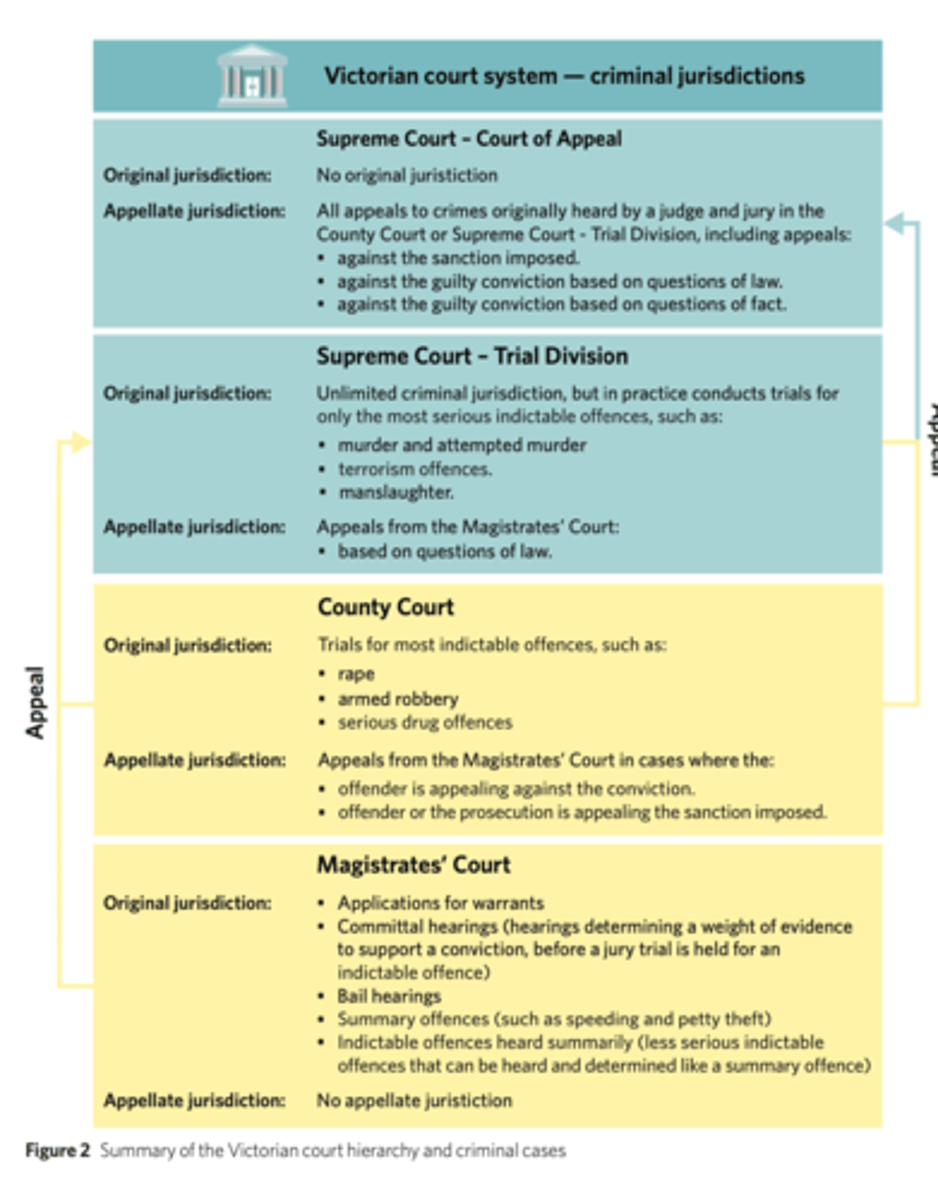
What is a court hierarchy? what is original and appellate jurisdiction?
The arrangement of courts in order of superiority. Original jurisdiction is the legal power of a court or other authority to hear a case for the first time. When Appellate jurisdiction is the legal power of a court to review a decision of a lower court or tribunal on appeal.
Reasons for Hierarchy (Specialisation)
the process of a court developing expertise in a area as a result of hearing similar cases, leads to cases being heard more efficiently
Reasons for Appeals (Appeals)
accused may appeal the final decision and have it reviewed by a higher court which promotes fairness, would not be possible if there was no hierarchy
grounds for appeals (sanction)
sanction being imposed does not reflect severity of the crime
grounds for appeals (question of law)
the legal principles or legislation may have been incorrectly applies or interpreted.
grounds for appeals (conviction)
party may appeal the jury or judicial officers verdict
Image of court system with jurisdiction
How the hierarchy promotes fairness
strength- specialisation enables knowledgable judges to give just outcomes as they are experts
limitation- some may not be able to appeals if they can not afford the costs associated
How the hierarchy promotes equality
strength- all parties have the right to appeals regardless of characteristics
limitation-costs with appeals means they are not always equally accessible.
How the hierarchy promotes Access
strengths- appeals promote access to the justice system if a party feels as though they were wronged
limitations- cost for appeals may make it hard to access the justice system
what is the judge or magistrate in a trial?
the 'umpire of the court' must treat each party without bias
role of the judge (Manage the trial hearing)
-ensures procedures are followed
-limiting number of witnesses or topics on which they can be questioned
-limiting examination time
role of the judge (Apply the rules of evidence and procedures)
-only admissible evidence is presented
-gives directions on how evidence is presented
-provides clarity on rules of evidence
how Judges and magistrates promote fairness
strength-ensures trial and proceedings are conducted fairly without bias and following the rules
limitations-they are appointed by the government and therefore may be more sympathetic to a particular ideology
how Judges and magistrates promote equality
strength- ensure rules of evidence apply equally to both parties
limitation- still subject to personal bias and may subconsciously discriminate
how Judges and magistrates promote access
strength-Judges can explain points of law to jury members allowing them to access the system better
limitation- party who has self rep may not provide as much evidence and inhibit their access to a fair outcome.
What is a jury?
randomly selected group from electoral role, represent a cross section of the community, only used when accused pleads guilty to indictable offence.
Roles of the jury
-determine the verdict
-remain objective
-listen to evidence, judge directions
what can jurors NOT do?
-conduct personal research
-discuss trial with anyone not in the jury
-have relations with either party
Who is excluded from the jury?
-those who have committed a indictable offence
-Lawyers
-police officers
how a jury promotes fairness
Strength-The jury is only able to make a verdict based on the evidence presented in court to promote a fair outcome
limitation-Juries are only used in a very small number of cases and therefore only promote fairness rarely.
how a jury promotes equality
strength-all accused people have access to trial by jury
limitations-jury trials are not available for summary offences
 Note
Note  Flashcards (39)