Economic Transition
 Studied by 0 people
 Call Kai
 Learn
Learn Practice Test
 Spaced Repetition
 Match
Match Flashcards
 Knowt Play
1/22

Earn XP
Description and Tags
Name | Mastery | Learn | Test | Matching | Spaced | Call with Kai |
|---|
No analytics yet
Send a link to your students to track their progress
23 Terms
Development
Development means positive change that makes things better. It usually means that people’s standard of living and quality of life has improved.
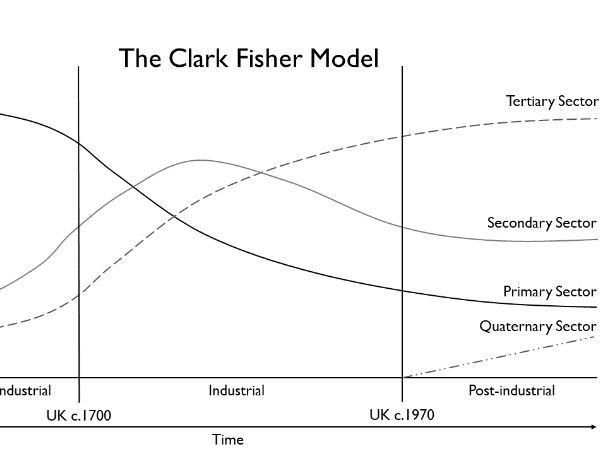
Clark Fisher Model Critiques
Eurocentric
Not the same for everyone
Some countries faster, some with different levels of employment, can go backwards and forwards
Describes, doesn’t explain
Changes to work in HICs
Shorter working week
More interconnectivity
Longer annual holidays
Development of the internet
Flexibility (hours, location etc)
Outsourcing
Companies do this to save money. Work is sent out of the company and can be sent abroad - e.g. BT having a call centre in India
Teleworking
Due to advances in ICT, there is a greater opportunity to work from home
Public Sector (working)
People working in the public sector are employed by national, regional or local government (e.g. nurses, doctors, teachers, social workers etc)
Private Sector (working)
People working in the private sector are either self-employed or work for a larger company or organisation, not owned by the government (e.g. manufacturing, shops, design, engineering, building, farming, forestry etc)
What can Infant Mortality Rates of a country suggest?
Infant mortality rates (IMR) is indicative of a country’s health services, sanitation and standard of living, as they all contribute to the IMR of a country.
IMR is regarded as one of the most sensitive indicators of socio-economic progress because it is an important measure of health equity, both between and within countries. The highest rates are concentrated in Africa and Southern Asia. IMR generally compares well with other indicators of development.
“Canaries down the mine”
Why are IMR hard to estimate?
IMR are hard to establish accurate figures because many early deaths go unreported or are wrongly classified, so the statistics are an estimation.
Neonatal mortality has been decreasing worldwide, however progress is slow and unequal in different countries
Education
Education is key to socio-economic development within a country. It is one of the key components of the HDI, examining: adult literacy, school enrolment and mean years in school.
Women literacy rates are increasing (decreasing fertility rates, leading to economic boosts and health benefits) within many countries. Female education is one of the World Bank’s largest aims and the UN sees education as vital in its efforts of achieving sustainable development.
Nutrition
Nourishment is an important indicator because it can affect peoples ability to work, get educated and fight disease.
However, this is not used as much because calorie intake is increasing in HICs, leading to obesity (USA, UK).
Gross Domestic Product (GDP)
GDP is the total value of goods and services produced by a country in a year.
Gross National Income (GNI)
GNI comprises the total value of goods and services produced within a country, together with its income received from other countries (notably interest and dividends), less similar payments made to other countries.
GNI at Purchasing Power Parity
GNI at PPP involves converting the GNI of a country into US $ on the basis of how the value of the currency compares with that of other countries.
Problems and Limitations of Development Indicators
Countrywide statistics disguise intra-country variations (China is a lot richer in the west)
In many countries, data is inaccurate or incomplete. Some countries refuse to release certain pieces of information or data
Most development indicators (except HDI) only focus on one aspect of development
Most indicators use averages, neglecting or highlighting sectors of the population that are always marginalised
Indicators are always out of date - once information has been collected, analysed, presented and published, a lot of things could have changed (for better or worse)
Development indicators can be manipulated, used or ignored to suit peoples needs
Human Development Index
HDI was devised by the UN in 1990, containing 3 variables:
Life expectancy
Educational attainment
GDP per capita (PPP$)
GDP critiques
Not a measure of human wellbeing
Does not reflect the value of productive activities performed within the home
Fails to account for the loss of environmental assets
Does not engage sufficiently with issues of inequality and deprivation
Gini Coefficient
It is typically used as a measure of income inequality, but it can be used to measure the inequality of any distribution – such as the distribution of wealth, or even life expectancy.
It measures inequality on a scale from 0 to 1.
Lorenz Curve
The Lorenz curve is a graphical representation of income inequality or wealth inequality developed.
Spread Effect
The filtering of wealth from central, prosperous areas, to peripheral, needier areas.
Back wash
A ‘growing point’ established by the location of a factory, or any other expansional move, will attract other businesses, skilled labour, and capital. However, it will also have backwash effects that keep down, or even impoverish, out-regions.
Core areas
Core areas are described as the engines of economic growth and are characterized by modern, technologically advanced production methods as well as highly skilled and high-wage labour.
Periphery areas
Areas using low-technology production methods accompanied by low skill and low-wage labour.
 Note
Note  Flashcards (117)