Ch.6 Chemical signals
 Call Kai
 Learn
Learn Practice Test
 Spaced Repetition
 Match
Match Flashcards
 Knowt Play
1/69

There's no tags or description
Looks like no tags are added yet.
Name | Mastery | Learn | Test | Matching | Spaced | Call with Kai |
|---|
No analytics yet
Send a link to your students to track their progress
70 Terms
Propagation
Molecule itself must be detected, and can move by
current, diffusion, or direct contact. This refers to the movement and spread of molecules through a medium
Propagation impacts
Directionality, speed, temporal pattern, and spectrum
Hormones
a regulatory substance produced in an organism and transported in tissue fluids such as blood or sap to stimulate specific cells or tissues into action
Semiochemicals
chemical signals emitted by organisms (plants, animals, insects) that induce behavioral or physiological responses in others, acting as crucial communication tools
Pheromones
chemical signals released by animals and insects to trigger social, reproductive, or behavioral responses in members of the same species. They work as specialized, often wind-borne, chemical messengers that communicate danger, territory, or mating availability, frequently detected via a specialized organ.
Volatility
The ability of pheromone molecules to easily evaporate or sublimate into the air from a liquid or solid source, enabling them to travel through the atmosphere and act at a distance from the producer.
How does oxygen effect volatility
Oxygen acts as a primary degradative agent on airborne pheromones, reducing their volatility and effectiveness by breaking down compounds containing double bonds and aldehyde groups. Oxygen can create dipole interactions (diminish volatility)
Specificity
the ability of chemical signals, transmitted through the air, to elicit precise behavioral or physiological responses exclusively in members of the same species. It ensures that the signal is understood only by the intended recipients, often involving a unique chemical compound or a specific ratio of a mixture (blend) of volatile compounds that only conspecifics can detect and act upon
Too small and _____ is insufficient
specificity
Too big and _____ is insufficient
volatility
_______ is important for airborne odorants.
Volatility
Waterborne pheromones
a chemical substance released by an aquatic organism into the surrounding water that triggers a specific behavioral or physiological response in other members of the same species
______ is not applicable for waterborne chemicals.
Volatility
waterborne chemicals will float if
they are mostly made of carbons and hydrogens
____ pheromones are water soluble
Waterborne
Waterborne chemicals need to be _____ for ____ and _____
water soluble; dispersal and detection
____ pheromones are characterized by their high solubility and polar chemical nature
Waterborne
Solubility is dictated by ____
polarity
Longer carbon chains make molecule less ___, decreasing _____
polar ; solubility
Contact Pheromones
chemical substances secreted by organisms, such as sweat or oil, placed and left in environment, that cause behavioral or physiological responses in others of the same species upon physical contact or close proximity
______ pheromones are typically hydrophobic
Contact
Cuticular Hydrocarbon blends
vital contact pheromones and recognition cues for mate selection, kin recognition, and social regulation in many insects
Cuticular Hydrocarbon blends are
Species specific; Non-volatile, so contact receptors on antenna or feet must be used; Colony insects groom each other, creating a colony specific blend
an exposed gland allowing the pheromone to evaporate is a method of
dissemination by direct release into air/water
the spraying of a pheromone is a method of
dissemination by direct release into air/water
self-generated currents
(fluid movement) in aquatic species, such as crabs, act as convective transport mechanisms, fanning chemical pheromones toward potential mates. These active, voluntary currents help convey sexual signals over distance, often carrying volatile fatty acids or lipids released via urine or skin, which are then detected by the recipient's sensory antennas.
self generated currents are a method of
dissemination by direct release into air/water
Using hair dispersal to increase surface area for vaporization is a method of
dissemination by deposition onto the senders body
Grooming is a method of
dissemination by deposition onto the senders body
Harderian glands
Glands found in many animals that function as pheromones to signal reproductive state, stress, and identity. These secretions are disseminated onto the fur through specialized grooming behavior, acting as a key mechanism for social and sexual communication.
Uropygial gland
Glands found at the base of bird tails used to disseminate lipid-based pheromones and preen oil by rubbing being rubbed against by their beak or head.
Passive dissemination
dissemination of pheromones involves the slow, continuous release of chemical signals into the environment without active propulsion or energy expenditure by the producer. Common in insects and some mammals, this method relies on evaporation from specialized glands, bodily fluids (urine, sweat), or synthetic dispensers, influencing behavior like mating or alarm responses.
Passive dissemination is a method of
dissemination through deposition onto solid substrates
Conjugated steroids
steroid hormones (testosterone, estrogen, corticoids) that have been bound to another molecule by liver for excretion purposes
Diffusion
spreads pheromones over short distances through random movement; Molecules move from areas of high concentration to low concentration. It is inherently slow and generally effective only for short-range communication
Current flow
responsible for long-range transport, often creating turbulent, patchy plumes that allow insects and animals to track signals to their source; Transport is driven by wind, water, or active fanning. This mechanism moves pheromones rapidly and is responsible for creating filamentous, intermittent "patches" of odor, rather than a smooth gradient
What two mechanisms does the dissemination of pheromones rely on
Diffusion and current flow which determine the speed, range, and structure of the signal
Diffusion becomes ____ relevant as current increases
less
Reynolds number (Re)
tells you whether diffusion or current flow will be more relevant
Small Re means ______ is more relevant
diffusion
Large Re means ______ is more relevant
current
Re =
(Flow velocity * dispersal distance)/ fluid viscosity
Diffusion coefficient (D) is affected by
Size of molecule, How molecule interacts with medium, How molecules in medium interact with each other
Active Space
area around source in which a receiver may detect stimulus
Active space depends on
Q - how much pheromone is released(moles)
K - how sensitive receiver is to pheromone (moles/mm3)
Active space increases as long as there is
a gradient of increasing concentration >K
when molecules will disperse faster than they arrive at the active space boundary, active space ____
begins to shrink
equation for Max active space
rmax = (3Q/4πK)1/3
equation for time to reach max active space
tmax = r2/D
Costs that come with diffusion
Current flow takes over at distance regardless, Body size limits Q(how much pheromone is released), Diffusion can be slow, especially in water
Transmission by current flow is ___ than diffusion
Faster
Transmission by current flow goes farther than diffusion because
molecules are not spreading in all directions... concentrations in plume remains higher
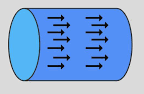
Laminar flow
All parts of medium move in same direction with same velocity
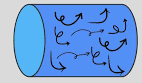
Turbulent flow
Flow hindered in one location relative to another...generating torque on the fluid and generating vortices in very unpredictable and complex patterns
How does air temperature affect Chemical signal propagation
Can affect volatility of compounds, Organisms evolve compounds that work best at temperatures they live in
How does UV radiation affect Chemical signal propagation
Ionizing energy denatures compound
How does moisture and humidity affect Chemical signal propagation
Water molecules compete with pheromones for substrate binding sites, Volatile molecules evaporate more quickly when moisture or humidity are higher
Detecting airborne or waterborne chemical
Likely from distant sources...so sparse density, Need to sample a lot of air or water quickly
n vertebrates, most air goes to lungs/gills...but a portion of air directed to chamber containing _____ _____
olfactory epithelium
Terrestrial vertebrates can increase portion of air
moving over olfactory epithelium by _____ or ______
sniffing harder or scrunching nose
Arthropods have ____ covering antennae for olfactory sensing
sensilla
Contact receptors
important for detecting nonvolatile and insoluble compounds, used to detect cuticular chemicals in insects
Kinesis
“Random” walk in which the speed, or rate of turning changes in response to stimulus...but turns are random with respect to the stimulus source
Taxis
Organism detects orientation of active space relative to itself, and turns appropriately (toward or away the stimulus)
Tropotaxis
Taxis that involves 2 receptors sampling simultaneously usually on different parts of the body
Klinotaxis
Taxis that involves sequential sampling by a single receptor moved through the active space
polarized odor trails
chemical scent paths that convey directional information, allowing insects, animals, or dogs to determine which way to follow the trail
Anemotaxis
coupling orientation of current flow with detection of chemical to discern direction
rheotaxis
coupling orientation of current flow with detection of chemical to discern direction in water
Casting
a technique used by animals to locate a scent source by moving in a crosswind, zigzag pattern when the odor plume is lost

