Memory
 Call Kai
 Learn
Learn Practice Test
 Spaced Repetition
 Match
Match Flashcards
 Knowt Play
1/23

There's no tags or description
Looks like no tags are added yet.
Name | Mastery | Learn | Test | Matching | Spaced | Call with Kai |
|---|
No analytics yet
Send a link to your students to track their progress
24 Terms
Chart(draw it)
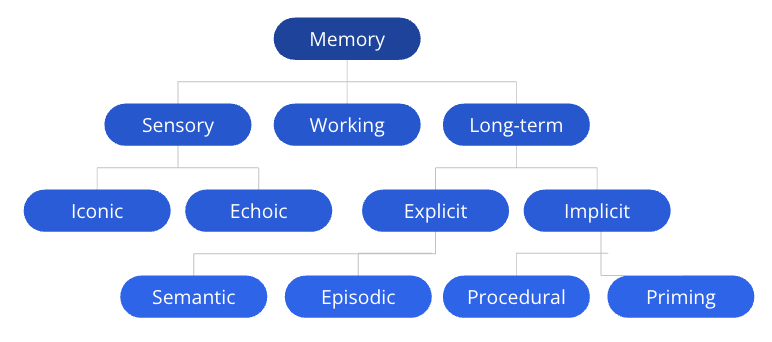
Sensory memory
a type of storage that holds sensory information for a few seconds or less
Iconic memory
a fast-decaying store of visual information
Echoic memory
a fast-decaying store of auditory information
Working memory
holds non-sensory information for more than a few seconds but less than a minute
Rehearsal
keeping information in short-term memory by mentally repeating it
Chunking
combining small pieces of information into larger clusters or chunks that are more easily held in short-term memory
Long-term memory
a type of storage that holds information for hours, days, weeks, or years
Explicit memory
when people consciously or intentionally retrieve past experiences
Implicit memory
the influence of past experiences on later behavior and performance, even without an effort to remember them or an awareness of the recollection. (unconscious)
Semantic memory
a network of associated facts and concepts that make up our general knowledge of the world
Episodic memory
the collection of past personal experiences that occurred at a particular time and place
Consequences of distributed representation (Episodic)
Encoding Specificity
Context dependence
Encoding Specificity
Retrieval cues overlapping with those available during encoding makes memory better
Context dependence
Memory works better in context at encoding is identical to the state at retrieval
Procedural memory
the gradual acquisition of skills as a result of practice
Priming
an enhanced ability to think of a stimulus, such as a word or object, as a result of a recent exposure to the stimulus
Long Term Memory additional stufff
Encoding
Retrieval
Consolidation/Storage
Encoding
set of mental operations that convert information from stimuli into a form that can be stored in brain’s storage system
Retrival
reinstantiation/ reactivating the distributed representation created at encoding
Retrieval cue
Retrival cue
“seed” for such reinstantiation / activates the memory
Consolidation/Storage
information is processed and organized in a form suitable for LT storage
Neural bases of Memory
Hippocampus - “convergence zone”
Damage to Hippocampus leads to significant impairment in creating new episodic memories
Patient “H.M”
Anterograde amnesia
inability to transfer new information from the short-term store into the long-term store

